
(7% discount is applied at checkout)
Cart is empty
Your go-to destination for cutting-edge server products
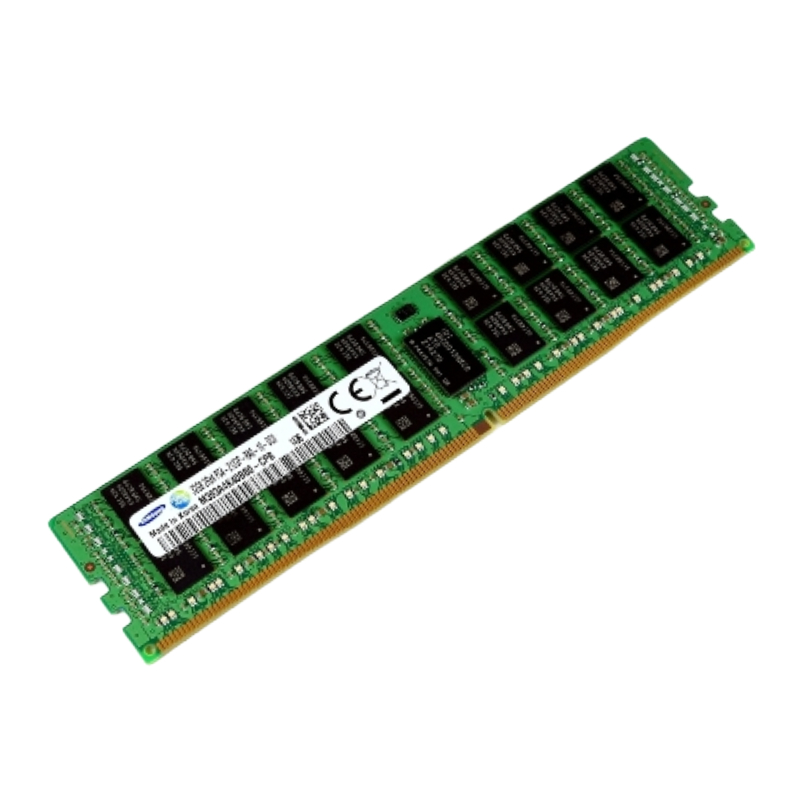
Samsung M393A8G40CB4-CWECO 64GB RDIMM PC4-25600 Memory Module. New Sealed in Box (NIB) with 3 Years Warranty
In the realm of enterprise computing and data center operations, system memory is a critical component that dictates performance, stability, and capacity for handling intensive workloads. The Samsung M393A8G40CB4-CWECO represents a high-capacity, high-reliancy memory module engineered specifically for server environments. This 64GB DDR4 module is built to meet the rigorous demands of servers running databases, virtualization, high-performance computing (HPC), cloud infrastructure, and large-scale transactional systems.
The Samsung M393A8G40CB4-CWECO represents a pinnacle of reliability and performance in the realm of enterprise server memory. Engineered for data centers, high-performance computing (HPC), and critical business servers, this 64GB DDR4 module is built upon Samsung's proven semiconductor technology. Its design focuses on delivering unwavering data integrity, robust stability under continuous load, and seamless integration into server ecosystems demanding the highest levels of uptime. This module is not merely a component; it is a foundational pillar for systems handling massive datasets, virtualization, cloud infrastructure, and enterprise databases.
At its heart, the M393A8G40CB4-CWECO is defined by a set of rigorous technical parameters that dictate its compatibility and performance envelope. These specifications ensure it meets the exacting demands of modern server platforms.
This module features a substantial 64GB (Gigabyte) capacity as a single monolithic unit (1x64GB). Utilizing a 2Rx4 (Dual Rank, x4 organization) design, it optimally balances signal loading and memory rank interleaving on the memory channel. This configuration enhances performance efficiency compared to single-rank modules, especially in memory-intensive applications, by allowing more simultaneous access to data across the ranks.
The module features a CAS Latency (CL) timing of 22 clocks at its rated 3200 MT/s speed. This timing, part of a broader set of timings (often listed as 22-22-22 or similar), represents the number of clock cycles between the memory controller issuing a read command and the first piece of data being available. While higher speeds generally increase latency in clock cycles, the dramatically shorter clock cycle period at 3200 MT/s means absolute latency in nanoseconds (ns) often remains competitive or improves compared to slower-speed modules, resulting in a balance of high throughput and responsive access.
The Samsung M393A8G40CB4-CWECO incorporates ECC, a critical data integrity feature. ECC enables the module to detect and correct the most common types of memory data corruption on-the-fly. It adds extra bits (8 bits for every 64 bits of data) to form a check code. When data is read, the memory controller recalculates the code and compares it to the stored code. Single-bit errors (the most common type) are automatically corrected without any system interruption. Multi-bit errors, which are far rarer, are detected and reported to the system, allowing for a controlled shutdown or alert. This dramatically reduces the risk of silent data corruption and system crashes.
The "2R" denotes two independent sets of memory chips (ranks) that share the same data path but can be accessed separately, improving concurrency. The "x4" refers to the physical organization of the DRAM chips, indicating they have a 4-bit wide data interface. This x4 organization is crucial for supporting advanced error correction and is a standard for server-grade Registered DIMMs (RDIMMs).
The module operates at a speedy DDR4-3200 data rate, translating to a peak transfer rate of 3200 Megatransfers per second (MT/s). With a 64-bit wide interface (plus ECC bits), this yields a theoretical bandwidth of approximately 25.6 GB/s per module. The timing latency is specified at CL22 (CAS Latency 22), a standard latency for DDR4-3200 server memory, optimized for stability and throughput over ultra-tight timings. It operates at the standard DDR4 voltage of 1.2V, ensuring energy efficiency.
The JEDEC designation "PC4-25600" provides a clear indicator of the module's bandwidth. "PC4" signifies a DDR4 module. The number "25600" refers to the total data transfer rate in Megabytes per second (MB/s). Calculating as 3200 MT/s * 8 Bytes/transfer = 25,600 MB/s, confirming its high-performance pedigree.
Operating at a standard DDR4 voltage of 1.2 volts, this module is significantly more power-efficient than previous-generation DDR3 memory (typically 1.5V). The 1.2V operation reduces the power consumption and heat generation of the memory subsystem, which is a critical factor in densely packed server racks where thermal management are major concerns. Samsung's advanced semiconductor manufacturing processes contribute to this low-power profile without sacrificing performance or reliability.
Server environments cannot tolerate silent data corruption. The M393A8G40CB4-CWECO incorporates multiple layers of data integrity protection, making it far superior to consumer-grade unbuffered memory.
This is an ECC module. It includes extra memory bits (typically 8 bits for every 64 bits of data) to store an encrypted error-correcting code. As data is written, a code is calculated and stored. Upon readback, the code is recalculated and compared. The ECC logic can automatically detect and correct single-bit errors (Single Error Correction, or SEC) and detect multi-bit errors (Double Error Detection, or DED). This prevents soft errors from cosmic rays or electrical noise from causing system crashes or data corruption.
Unlike Unbuffered DIMMs (UDIMMs) used in desktops, RDIMMs offer greater capacity and stability for servers. Load-Reduced DIMMs (LRDIMMs) take this further by buffering the data lines as well, enabling even higher capacities but with slightly increased latency. The M393A8G40CB4-CWECO RDIMM offers an ideal balance of capacity, performance, and cost for mainstream enterprise deployments.
Physical design ensures seamless integration into target server systems, guaranteeing proper fit, cooling, and electrical contact.
The module conforms to the standard DDR4 288-pin DIMM layout. The pin count and key notch position are specifically designed for server motherboards. The "RDIMM" specification ensures the pinout and signaling are compatible with server platforms that require registered memory. It is crucial to verify motherboard and CPU compatibility, as server platforms (Intel Xeon Scalable, AMD EPYC) explicitly specify support for DDR4-3200 RDIMMs.
The Samsung M393A8G40CB4-CWECO is deployed in scenarios where capacity, reliability, and data integrity are non-negotiable.
In virtualization hosts (VMware vSphere, Microsoft Hyper-V, KVM), large memory capacity per module allows for higher virtual machine density. The ECC protection safeguards the state of multiple VMs running on a single physical host, preventing costly downtime due to memory errors.
Database management systems heavily cache data in RAM for performance. The 64GB capacity allows for massive caching, drastically reducing disk I/O latency. ECC is critical here, as a single-bit error in a database cache or transaction log could lead to severe data corruption and business logic failures.
Applications in scientific computing, financial modeling, and big data analytics (like SAP HANA, in-memory analytics platforms) process terabytes of data. Systems are often scaled out with dozens or hundreds of these modules. The combination of 3200 Mbps speed and large per-module capacity provides the necessary bandwidth and memory footprint to tackle complex computational workloads efficiently.


 Contact Us
 Information
 Catalog
 Solid State Drives (SSD)
 Network Switches
 Hard Disk Drives
 HBA & Controllers
 PC & Servers
 PC & Server Memory
 CPU & Processors
 Network Routers
 Power Supplies
 Tape Drives & Libraries
 Network Devices
 Computer & Network Cables