
(7% discount is applied at checkout)
Cart is empty
Your go-to destination for cutting-edge server products
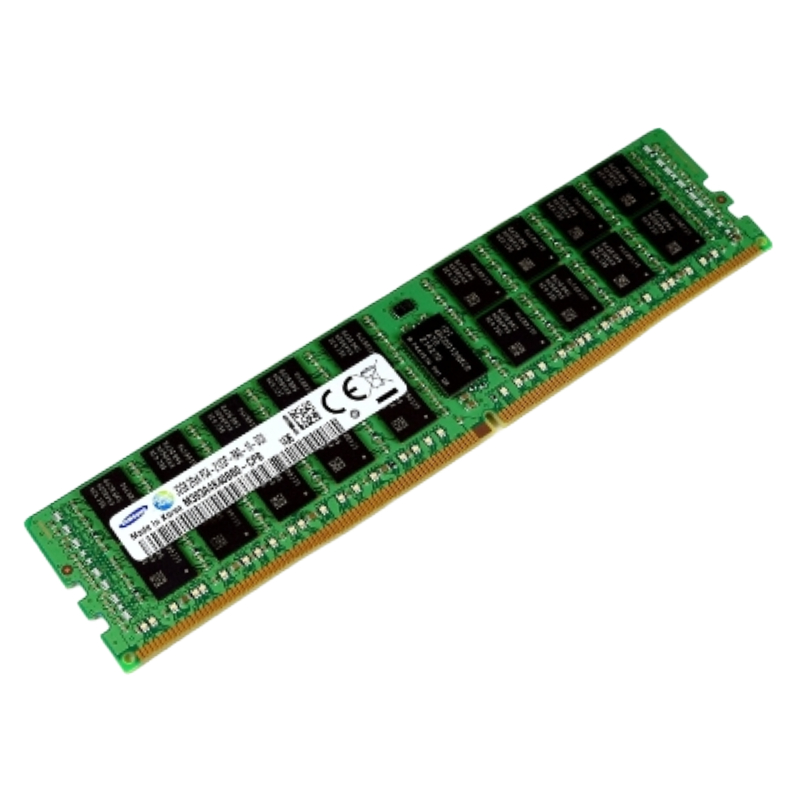
Samsung M393A8G40CB4-CWEGY 64GB RDIMM PC4-25600 Memory Module. New Sealed in Box (NIB) with 3 Years Warranty
This high-performance memory module, identified by the part number M393A8G40CB4-CWEGY, is a 64GB DDR4 SDRAM designed specifically for servers. It is engineered to deliver fast and reliable memory performance, ideal for demanding tasks in data centers and other professional environments that require substantial memory capacity and error-checking mechanisms.
In the realm of enterprise computing and data center operations, memory is a critical component that directly impacts system stability, performance, and capacity for handling massive workloads. The Samsung M393A8G40CB4-CWEGY represents a pinnacle of server-grade memory technology. This specific module is a 64GB DDR4 Registered ECC RDIMM, engineered for high-performance servers, workstations, and storage systems requiring exceptional reliability and large memory pools. Its specifications—PC4-25600, 3200 Mbps, 2Rx4 configuration, and 1.2V operation—define a module built for modern data-intensive applications, virtualization environments, and mission-critical database management.
Understanding the part number and its associated specifications is key to identifying the correct module for your server's needs. Each segment of the alphanumeric code provides essential information about the memory's capabilities and physical design.
The part number is not a random string but a detailed blueprint. In Samsung's nomenclature, 'M' stands for Memory Module. '393' indicates it is an ECC Registered RDIMM. 'A' denotes a 1.2V operating voltage. '8G40' refers to the density and organization—8 Gigabit (Gb) components arranged for a 40-bit (32 data + 8 ECC) bus per rank. 'C' specifies the revision. 'B4' indicates the substrate and material type. The suffix 'CWEGY' provides further detail on speed, latency, and product family, pointing to its 3200 Mbps speed and specific internal timing configuration.
This is a single 64-gigabyte module. The "1x64GB" denotes a single module offering 64GB of total memory capacity. This high density per module is crucial for servers with a limited number of memory slots, allowing for maximum total system memory without immediate need for complete slot population. It enables efficient memory expansion and scalability in multi-socket server platforms.
This module utilizes Double Data Rate 4 Synchronous Dynamic Random-Access Memory (DDR4 SDRAM) technology. DDR4 succeeded DDR3, offering significant improvements in performance, power efficiency, and capacity. Key architectural advances include higher data transfer rates, increased bank groups for improved efficiency, and a lower operating voltage, which collectively contribute to better overall system performance and reduced energy consumption in the data center.
The performance of a memory module is defined by its data rate, latency timings, and the resulting bandwidth. These factors determine how quickly the processor can access and manipulate data stored in memory, directly affecting application response times and throughput.
The module operates at a data rate of 3200 Megatransfers per second (MT/s), often referred to as 3200 Mbps. This means it can complete 3.2 billion data transfers per second on its data pins. The classification "PC4-25600" is derived from this speed: the peak transfer rate in megabytes per second (MB/s). Calculating 3200 MT/s * 8 bytes (64-bit data bus) = 25,600 MB/s. Therefore, PC4-25600 denotes a DDR4 module with a theoretical peak bandwidth of 25.6 GB/s per module.
The CAS Latency (CL) is a critical timing parameter, measured in clock cycles. A CL22 rating means there is a delay of 22 clock cycles between when the memory controller requests a piece of data and when that data is available on the module's output pins. While higher-speed modules often have higher CAS latencies in terms of cycles, the actual time in nanoseconds can be lower due to the faster clock speed. The CL22 timing at 3200 MT/s is a standard and optimized timing for server-grade ECC memory, balancing high bandwidth with stable, reliable operation.
This memory module operates at a standard DDR4 voltage of 1.2 volts, a reduction from DDR3's 1.5V. This lower voltage is a fundamental improvement in DDR4 technology, leading to significantly reduced power consumption and heat generation. For data centers with thousands of servers, this power efficiency translates directly into lower operating costs (OPEX) and a reduced thermal load on cooling systems, contributing to overall infrastructure sustainability.
Server memory differs fundamentally from consumer desktop memory. It incorporates specialized technologies to ensure data integrity, maintain system stability over continuous operation, and support large-scale memory configurations.
ECC is a non-negotiable feature for critical server applications. It enables the memory module to detect and correct single-bit data errors on-the-fly and detect multi-bit errors. This is achieved by using extra memory bits (the "ECC bits") to store an encrypted code. When data is read, the code is recalculated and compared; any mismatch triggers correction. This hardware-level error correction prevents silent data corruption, system crashes, and computational errors that could compromise database integrity, financial transactions, or scientific calculations.
This module is a Registered Dual In-line Memory Module (RDIMM). It features a register (or buffer) on the module, placed between the memory controller and the DRAM chips. This register buffers the command, address, and clock signals, reducing the electrical load on the memory controller. This allows a system to support a greater number of memory modules (higher total capacity) and more memory ranks per channel with greater stability and signal integrity, which is essential for multi-socket servers populated with high-density modules.
The module uses a 288-pin edge connector layout, which is the standard for DDR4 memory. The pin count and keying are physically different from DDR3's 240-pin design, preventing accidental insertion into an incompatible motherboard. The RDIMM form factor is specifically keyed and designed for server motherboards that support registered/buffered memory. It is essential to verify your server's specifications to ensure compatibility with RDIMMs, as they are not interchangeable with Unbuffered (UDIMM) or Load Reduced (LRDIMM) modules.
The "2Rx4" designation describes the internal architecture of the memory module, which affects how the memory controller accesses the DRAM chips and the overall loading on the memory channel.
A "rank" is a set of DRAM chips that work together to fulfill a 64-bit (or 72-bit with ECC) data word. A dual-rank (2R) module has two independent sets of chips on the same physical PCB. The memory controller can access one rank at a time, but it can switch between ranks with minimal delay. Dual-rank modules generally offer better performance in many server workloads compared to single-rank modules at the same speed, due to more efficient interleaving of memory accesses. They also represent a common configuration for achieving high capacity per module.
The "x4" refers to the data width of the individual DRAM chips on the module. Each chip outputs 4 bits of data at a time. To form a 64-bit data word (plus 8 ECC bits), the module requires multiple chips working in parallel. A x4 organization is standard for ECC memory because it naturally provides the extra bits needed for error correction (using 18 chips for 64/72 bits: 72 bits / 4 bits per chip = 18 chips). This organization also offers advantages in reliability and sparing capabilities compared to x8-based modules.
The Samsung M393A8G40CB4-CWEGY is designed for environments where scale, reliability, and performance are paramount. Its high density and server-grade features make it unsuitable for consumer desktops but ideal for specific enterprise and professional scenarios.
This is the primary application. The module is intended for use in rackmount and blade servers from major OEMs like Dell EMC, HPE, Lenovo, Cisco, and Supermicro, as well as in white-box server builds. It is ideal for populating servers tasked with running virtualized environments (VMware vSphere, Microsoft Hyper-V, KVM), large-scale SQL/NoSQL databases (Oracle, Microsoft SQL Server, MongoDB), ERP and CRM platforms (SAP, Salesforce), and big data analytics frameworks (Hadoop, Spark).
Certain professional workstations and HPC clusters that utilize server-grade motherboards and processors (Intel Xeon Scalable, AMD EPYC) require registered ECC memory. Applications in scientific simulation, computational engineering, financial modeling, and media rendering demand both the large capacity provided by 64GB modules and the absolute data integrity ensured by ECC to prevent costly errors in long-running calculations.
Technologies like SAP HANA, Oracle Database In-Memory, and other real-time analytics platforms rely on storing massive datasets entirely in RAM to achieve unprecedented query speeds. For these systems, the total amount of reliable, high-bandwidth memory is the limiting factor for dataset size. Populating servers with multiple 64GB RDIMMs like the Samsung M393A8G40CB4-CWEGY is a standard practice to build terabyte-scale in-memory computing nodes.
While specifications define capability, compatibility determines successful deployment. Several critical factors must be verified before integrating this memory module into a server system.
DDR4 memory is supported across multiple generations of server platforms, from Intel's Xeon E5 v4 and Xeon Scalable (Skylake, Cascade Lake, Cooper Lake) to AMD's EPYC Naples, Rome, and Milan processors. However, support for specific speeds like 3200 MT/s is often tied to the latest processor generations (e.g., 2nd/3rd Gen Intel Xeon Scalable or 2nd/3rd Gen AMD EPYC). The motherboard's BIOS and memory controller within the CPU must explicitly support the module's speed, density, and registered ECC type.


 Contact Us
 Information
 Catalog
 Solid State Drives (SSD)
 Network Switches
 Hard Disk Drives
 HBA & Controllers
 PC & Servers
 PC & Server Memory
 CPU & Processors
 Network Routers
 Power Supplies
 Tape Drives & Libraries
 Network Devices
 Computer & Network Cables