
(7% discount is applied at checkout)
Cart is empty
Your go-to destination for cutting-edge server products
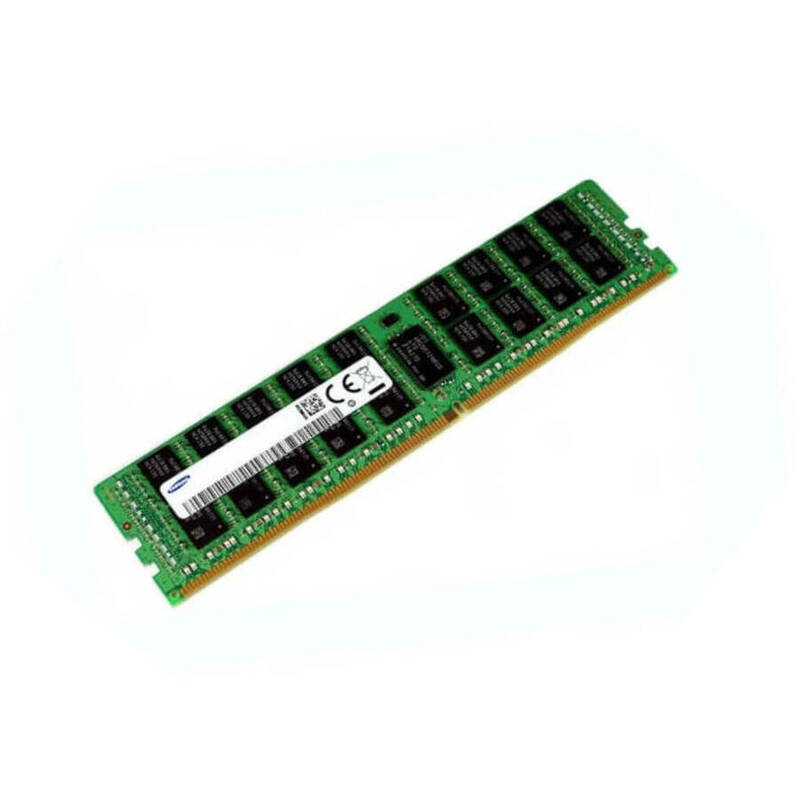
Samsung M393A8G40MB2-CVFBY 64GB RAM PC4-23400 SDRAM DDR4 2933MHZ Cl21 Ecc Registered. New (System) Pull with 1 year replacement warranty
| SKU/MPN | Warranty | Price | Condition | You save |
|---|---|---|---|---|
| M393A8G40MB2-CVFBY | 1 Year Warranty | $950.00 | New (System) Pull | You save: $332.50 (26%) |
| M393A8G40MB2-CVFBY | 1 Year Warranty | $1,099.00 | New Sealed in Box (NIB) | You save: $384.65 (26%) |
The Samsung M393A8G40MB2-CVFBY represents a pinnacle of DDR4 technology engineered for enterprise-grade servers. This specific module is a 64GB (1x64GB) dual-rank registered ECC RDIMM, operating at a swift 2933 megabits per second (Mbps). Designed for mission-critical applications, it balances immense capacity with robust error correction and signal integrity, making it a cornerstone for servers handling virtualization, large databases, high-performance computing (HPC), and cloud infrastructure.
The Samsung M393A8G40MB2-CVFBY represents a pinnacle of DDR4 server memory engineering, designed for data centers, enterprise servers, and high-performance computing environments that demand exceptional reliability, massive capacity, and sustained data integrity. This specific module is a 64GB Registered ECC RDIMM, operating at a speed of 2933 Mbps. It is a critical component for system builders and IT administrators looking to upgrade or deploy robust server infrastructure capable of handling virtualization, large-scale databases, in-memory computing, and other intensive workloads.
At its heart, the M393A8G40MB2-CVFBY is a sophisticated piece of silicon-based technology. Its part number encodes key attributes, but a detailed breakdown reveals the components of its performance profile.
This module offers a substantial 64GB of memory in a single stick. This high-density design is achieved through advanced semiconductor manufacturing processes. The "(1x64GB)" notation confirms it is a single module. The "2Rx4" designation is crucial: it means the module is internally organized as a Dual Rank (2R) module with a x4 data width. Dual-rank modules allow for better bus utilization and can offer a performance advantage over single-rank modules in many server applications by effectively interleaving accesses between the two ranks. The x4 bit width (meaning four data bits per memory chip access) is essential for supporting advanced error correction.
Understanding the part number can aid in verification and sourcing. While Samsung's coding is complex, key segments can be interpreted: "M" typically denotes a module, "393" often indicates a registered ECC RDIMM, "A8G40" refers to the 64GB capacity and specific die revision, "MB2" is the design/feature set, and "CVFBY" is a crucial suffix indicating the speed grade (2933), latency (CL21), and other electrical parameters. Matching this full part number, especially the suffix, is essential for ensuring compatibility and performance matching within a server.
The dual-rank, x4 architecture of this Samsung module is not arbitrary. In a x4 configuration, each memory chip manages 4 bits of the 64-bit data bus. With Error Correction Code (ECC), the bus is extended to 72 bits. Therefore, a x4-based module requires 18 chips (72 bits / 4 bits per chip) to populate the full data bus. This configuration is ideal for Registered ECC memory, as it provides the optimal granularity for the sophisticated error checking and correcting algorithms. The dual-rank design means there are two independent sets of these 18 chips (or equivalent packages) on the module, which the memory controller can address separately, improving overall memory efficiency.
The module operates at a data rate of 2933 Megatransfers per second (MT/s), often marketed as 2933 Mbps. In the older PC naming convention, this correlates to PC4-23400. The "23400" refers to the theoretical peak bandwidth in megabytes per second (MB/s) for the module. Calculated as (2933 MT/s * 8 bytes per transfer) ≈ 23,466 MB/s, rounded to 23400. This high-speed interface ensures rapid data movement between the CPU and memory, reducing latency in memory-bound applications and improving overall system responsiveness under load.
Speed is only one part of the performance equation; timings are equally critical. This module operates at a CAS Latency (CL) of 21 cycles at its rated speed of 2933 MT/s. While this number is higher than typical consumer DDR4, it is a standard and optimized latency for server-grade memory at this frequency. Server workloads often prioritize stability, bandwidth, and error correction over ultra-tight latencies. The balance of high data rate (2933 MT/s) and a CL21 timing provides an optimal blend of throughput and responsiveness for enterprise applications.
What truly distinguishes the M393A8G40MB2-CVFBY from consumer memory are its enterprise-oriented features: Error Correcting Code (ECC) and a Registered (Buffered) design.
ECC is a non-negotiable feature for mission-critical servers. It continuously monitors data for bit-level errors. The module can automatically detect and correct single-bit errors on the fly, without any interruption to system operation. It can also detect (though not correct) multi-bit errors, signaling the system to prevent corrupted data from being processed. This drastically reduces the risk of silent data corruption, system crashes, and application faults caused by memory soft errors, which can be induced by cosmic rays, electrical interference, or other factors. For databases, financial transactions, and scientific computations, ECC is essential for ensuring absolute data fidelity.
The ECC functionality on this Samsung module works by storing extra bits alongside every 64-bit word. The "x4" organization of the DRAM chips is specifically chosen to support this. The module stores 72 bits for every 64-bit word, with the extra 8 bits used to calculate and store a checksum. When data is read, the checksum is recalculated and compared to the stored value. A mismatch triggers the correction logic. This process is handled transparently by the server's memory controller and the module's onboard circuitry.
The "Registered" in its description, denoted by the "R" in RDIMM, is another cornerstone of server reliability. A Registered DIMM includes a memory register (or buffer) on the module itself, positioned between the memory controller and the DRAM chips. This register buffers the command, address, and clock signals, reducing the electrical load on the controller. This allows a server motherboard to support a much larger number of high-density memory modules (like this 64GB stick) without signal degradation. While it adds a minimal one-clock-cycle of latency, the benefit is vastly improved system stability, higher supported memory capacities, and the ability to populate all memory slots reliably—a key requirement for multi-socket servers and large memory configurations.
It is vital to contrast this RDIMM with Unbuffered (UDIMM) and Load Reduced (LRDIMM) modules. UDIMMs, common in desktops, have no buffer; they place a direct electrical load on the controller, limiting the number of high-capacity modules that can be installed. LRDIMMs use a buffer for the *data* lines as well as the address/command lines, further reducing load and enabling even greater capacities (e.g., 128GB+ per module) but at a higher cost and potentially slightly higher latency. The M393A8G40MB2-CVFBY RDIMM sits in the optimal sweet spot for mainstream enterprise servers, offering high capacity (64GB), excellent stability, and broad compatibility.
The module adheres to strict JEDEC standards for form factor and operation, ensuring interoperability with qualified server platforms.
The module uses the standard 288-pin layout defined for DDR4 SDRAM. The "RDImm" pinout is physically and electrically keyed differently than a UDIMM, preventing accidental insertion into an incompatible motherboard slot. It is designed to fit into DDR4 memory slots found on server motherboards from major OEMs like Dell (PowerEdge), HPE (ProLiant), Lenovo (ThinkSystem), and Supermicro, as well as custom server builds. Always verification of the system's Qualified Vendor List (QVL) or memory compatibility tool is mandatory before purchase, as compatibility depends on the specific server model and CPU generation.
Operating at a nominal voltage of 1.2V, this DDR4 module offers significantly improved power efficiency compared to the 1.5V or 1.35V standards of DDR3. Lower voltage reduces overall power consumption and heat generation in the memory subsystem, a critical factor in dense data center deployments where power and cooling costs are major operational considerations. The module supports advanced power management features like self-refresh modes to further conserve energy during periods of low activity.
The combination of high density, ECC, and registered design makes this memory module suited for specific demanding computing environments.
In virtualization hosts (e.g., VMware vSphere, Microsoft Hyper-V, KVM), physical memory is the primary resource limiting the number of virtual machines (VMs) that can run concurrently. A single server equipped with multiple 64GB RDIMMs can host dozens to hundreds of VMs, improving consolidation ratios and maximizing hardware utilization. ECC ensures the hypervisor and guest VM data remain intact, while the high bandwidth supports the aggregated workload of all running VMs.
Platforms like SAP HANA, Oracle Database In-Memory, and Microsoft SQL Server Hekaton rely on storing massive datasets in RAM for instantaneous query processing. The 64GB capacity per module allows for the construction of terabyte-scale in-memory pools. The 2933 MT/s speed accelerates data access, and ECC is absolutely critical to prevent corruption of live business or analytical data residing in memory.
Clusters used for computational fluid dynamics, genetic sequencing, financial modeling, and climate research require not only vast amounts of memory but also unwavering reliability. A single uncorrected memory error in a week-long simulation could invalidate the entire result. The ECC protection in this Samsung module safeguards the integrity of these complex calculations, while its high density allows researchers to tackle larger problems within a single node's memory space.
Traditional relational database management systems (RDBMS) like MySQL, PostgreSQL, and enterprise-grade solutions from Oracle and IBM benefit tremendously from large, fast, and reliable memory. The memory acts as a cache (buffer pool) for frequently accessed data and indexes, dramatically reducing disk I/O latency. ECC protects against database corruption, and the registered design ensures stability in servers with full memory configurations, which is typical for database appliances.


 Contact Us
 Information
 Catalog
 Solid State Drives (SSD)
 Network Switches
 Hard Disk Drives
 HBA & Controllers
 PC & Servers
 PC & Server Memory
 CPU & Processors
 Network Routers
 Power Supplies
 Tape Drives & Libraries
 Network Devices
 Computer & Network Cables