
(7% discount is applied at checkout)
Cart is empty
Your go-to destination for cutting-edge server products
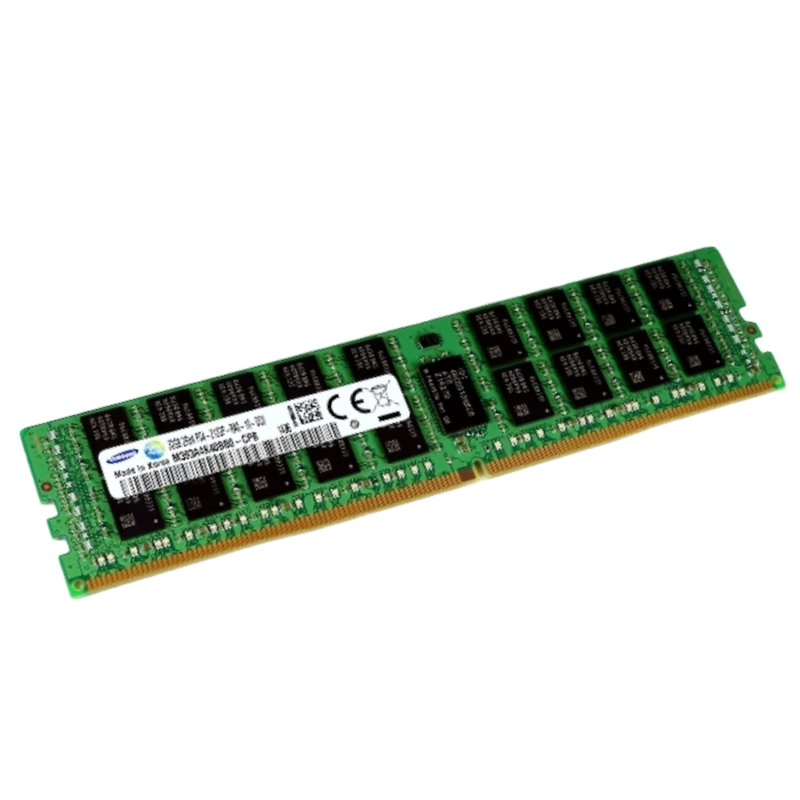
Samsung M393AAG40M32-CAEBYSM 128GB PC4-25600 DDR4-3200Mbps 4RX4 ECC Memory Module. New Sealed in Box (NIB) with 3 Years Warranty
The Samsung M393AAG40M32-CAEBYSM memory module is a high-performance solution for demanding computing environments. Designed to offer robust reliability and efficiency, this 128GB DDR4 SDRAM module is ideal for servers and workstations requiring superior data integrity and speed.
Server-grade DDR4 memory represents a critical tier of computing hardware, engineered explicitly for the relentless demands of 24/7 operation, data integrity, and system stability. Unlike standard consumer modules, server memory incorporates advanced technologies like Error-Correcting Code (ECC) and specialized signaling to prevent data corruption and system crashes. The Samsung M393AAG40M32-CAEBYSM module is a quintessential example of this class, designed to power enterprise servers, high-performance computing clusters, robust workstations, and sophisticated storage arrays.
The alphanumeric string "M393AAG40M32-CAEBYSM" is a detailed technical blueprint. Breaking it down: 'M' denotes a memory module, '393' indicates it's an ECC Registered RDIMM, 'A' signifies 1.2V operation, 'AG' represents the specific DRAM component density and organization, '40' is the module data rate (here, 3200 Mbps), 'M' stands for module type (RDIMM), and '32' relates to the number of DRAM components. The suffix 'CAEBYSM' details the revision, rank, and other manufacturing specifics. This precise naming allows IT professionals to unequivocally identify the module's capabilities and compatibility.
This section elaborates on the core technical attributes that define the module's performance and application scope.
The module offers a substantial 128GB capacity in a single 288-pin package. This high-density design is crucial for modern servers, enabling maximum memory capacity within limited physical slot constraints. A system with, for instance, 16 memory slots can achieve a staggering 2 terabytes of RAM using modules like this, facilitating massive in-memory databases, virtualization with numerous guests, and intensive scientific simulations.
The "Quad Rank" designation is a key performance and compatibility factor. A rank is an independently addressable set of DRAM chips. A quad-rank module has four such sets, accessed one at a time by the memory controller. This architecture allows for high capacity on a single module but has specific loading effects on the memory channel. It is essential to consult your server's memory configuration guide, as platforms often have rules on mixing ranks across slots to maintain signal integrity.
Single-rank (SR) modules offer the best potential for high-frequency operation and are easiest on the memory controller. Dual-rank (DR) provides a balance of capacity and performance. Quad-rank (QR), like this Samsung module, prioritizes maximum capacity per module and can offer slightly better performance in some access patterns due to rank interleaving, but may limit the maximum speed or number of populated slots on some server platforms.
Performance is governed by the interplay of frequency, latency, and power.
The module operates at a data rate of 3200 million transfers per second (MT/s), marketed as 3200 Mbps. This is also expressed as PC4-25600, where "PC4" denotes DDR4 and "25600" refers to the theoretical peak bandwidth in megabytes per second (MB/s) for the module (3200 MT/s * 8 bytes = 25,600 MB/s). This high bandwidth is vital for CPU-intensive applications, reducing bottlenecks in data flow between the processor and memory.
The CAS Latency (CL22) is the number of clock cycles between the memory controller issuing a read command and the moment data is available. While CL22 is a standard latency for high-capacity DDR4-3200 server modules, the true measure is absolute latency in nanoseconds. At 3200 MHz (clock cycle of 0.625 ns), CL22 translates to approximately 13.75 nanoseconds. Server memory often optimizes for stability and capacity over ultra-tight timings, ensuring reliability across vast quantities of RAM.
Operating at the standard DDR4 voltage of 1.2V, this module balances performance with energy efficiency. Reducing power consumption in data centers is a critical operational cost and cooling consideration. The 1.2V standard represents a significant efficiency gain over previous-generation DDR3 memory.
These features are the defining differentiators between consumer and server memory, directly targeting data integrity and system scalability.
ECC is a non-negotiable feature for mission-critical systems. It detects and corrects the most common types of internal data corruption. Single-bit errors (where one bit flips state) are corrected on-the-fly, while multi-bit errors are detected and reported to the system, allowing for preventative shutdown. This prevents silent data corruption that could lead to corrupted calculations, databases, or file systems without any warning.
Extra DRAM chips are added to the module to store cryptographic codes for the data stored in each word. When data is read, the codes are recalculated and compared. A mismatch triggers the correction circuit. This overhead is why ECC modules typically have 9 memory chips per rank instead of 8 (for x4 data chips), which is visible on the physical module.
The "Registered" in RDIMM (Registered Dual In-Line Memory Module) is key to supporting large memory capacities. A register, or buffer, sits on the module for address and command signals (but not data). This buffer reduces the electrical load on the server's memory controller, allowing it to drive more memory modules reliably. This stability is essential when populating all channels on a multi-CPU system with high-capacity modules.
Unbuffered DIMMs (UDIMMs) have no buffer, offering lower latency but severely limiting capacity per channel. Load-Reduced DIMMs (LRDIMMs) use a buffer for the data lines as well, enabling the very highest capacities but with slightly higher latency and cost. RDIMMs, like this Samsung module, offer the optimal balance of capacity, performance, and cost for the vast majority of enterprise servers.
The module uses a 288-pin edge connector, which is physically and electrically incompatible with DDR3's 240-pin design. The notch key is in a different position to prevent accidental insertion into the wrong socket type. The pin layout supports higher data rates, improved signal integrity, and the lower operating voltage of the DDR4 standard.
The "x4" refers to the internal organization of the individual DRAM chips, meaning each chip has a 4-bit wide data interface. Using x4 chips with ECC is a standard and efficient configuration for server memory. This organization, combined with Stacked Die technology often used in high-density modules, allows Samsung to build reliable 128GB capacities on a single RDIMM.
This module is not for consumer desktop PCs. It requires a server or high-end workstation motherboard with a CPU and chipset that explicitly support DDR4-3200 ECC Registered memory.
The Samsung M393AAG40M32-CAEBYSM is designed for compatibility with modern enterprise server platforms from vendors like Dell (PowerEdge), HPE (ProLiant, Apollo), Lenovo (ThinkSystem), Cisco (UCS), and supermicro, as well as AMD EPYC and Intel Xeon Scalable processors. Critical: Always verify compatibility in the system's official memory compatibility list or vendor-specific part number guide before purchase, as firmware and BIOS can affect support.
High-density modules are the backbone of virtualization hosts. More RAM allows for a higher virtual machine density, improving consolidation ratios and operational efficiency in private clouds and data centers.
These applications store entire datasets in RAM for near-instantaneous query response. A system's total memory capacity is its primary determinant for database size, making 128GB modules invaluable.
Scientific computing, rendering, and machine learning training workloads often process enormous datasets. Large memory capacity prevents disk swapping, keeping computational pipelines running at peak CPU and GPU utilization.


 Contact Us
 Information
 Catalog
 Solid State Drives (SSD)
 Network Switches
 Hard Disk Drives
 HBA & Controllers
 PC & Servers
 PC & Server Memory
 CPU & Processors
 Network Routers
 Power Supplies
 Tape Drives & Libraries
 Network Devices
 Computer & Network Cables