
(7% discount is applied at checkout)
Cart is empty
Your go-to destination for cutting-edge server products
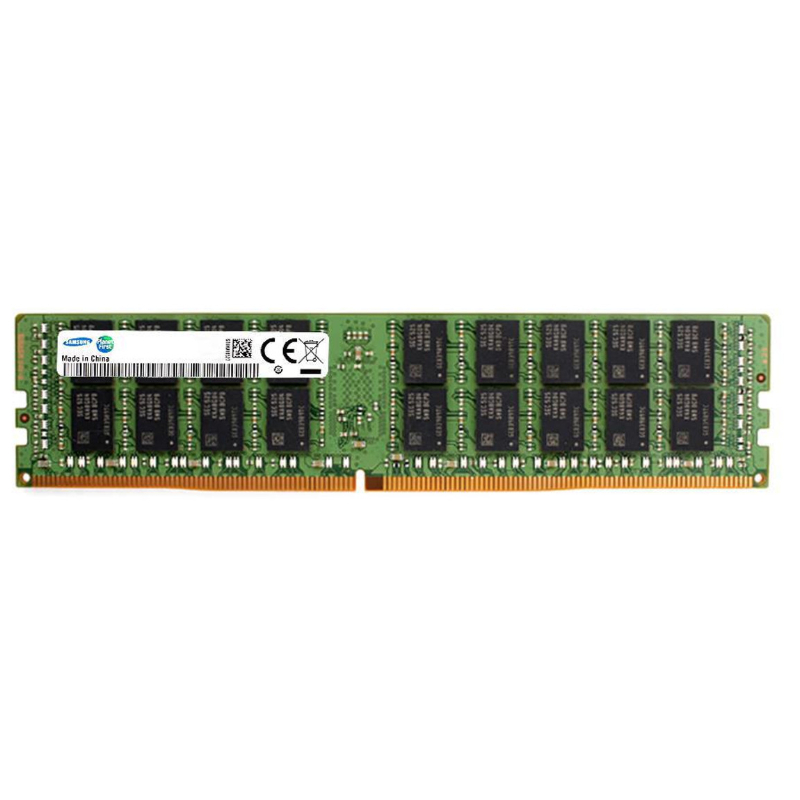
Samsung M393AAG40M3B-CYFBQ 128GB 2933MBPS Pc4-23400 Cl24 Ecc Registered Quad Rank X4 1.2v Ddr4 Sdram 288-pin Rdimm Memory. New Sealed in Box (NIB) with 3 Years Warranty
The Samsung M393AAG40M3B-CYFBQ represents a pinnacle of reliability and performance in the domain of enterprise server memory. This 128GB DDR4 RDImm module is engineered specifically for data centers, cloud servers, and high-performance computing (HPC) environments where system stability, data integrity, and consistent throughput are non-negotiable.
In the realm of enterprise computing and data center operations, system stability, data integrity, and consistent performance are non-negotiable. This is where server-grade memory modules, like the Samsung M393AAG40M3B-CYFBQ, play a pivotal role. Unlike standard desktop memory, these modules are engineered for 24/7 operation under heavy loads, featuring advanced technologies that ensure every bit of data is processed and stored with utmost accuracy.
The alphanumeric model string for this Samsung module is a detailed blueprint of its capabilities. Breaking it down provides immediate insight into its key parameters and intended use case within server and workstation environments.
This module offers a substantial 128 gigabytes of memory in a single stick. The "1x128GB" designation indicates it is a single-module kit, allowing for high-density memory configurations. In multi-socket servers with numerous DIMM slots, using modules of this capacity enables total system memory pools reaching into the terabytes, essential for memory-intensive applications like virtualization, large in-memory databases (e.g., SAP HANA), and big data analytics.
The high density of this 128GB module allows system administrators to maximize memory capacity while minimizing the number of occupied slots. This can be crucial for maintaining optimal memory channel performance and leaving room for future upgrades.
The module operates at a data rate of 2933 Megatransfers per second (MT/s), commonly referred to as 2933Mbps. This translates to a peak theoretical bandwidth of 23,400 MB/s per module, which is denoted by the PC4-23400 classification (PC4 for DDR4, 23400 for ~23400 MB/s bandwidth). This high-speed data transfer is critical for reducing latency in CPU-to-memory communication, accelerating application response times, and improving overall server throughput.
The CAS Latency (CL) is a critical timing parameter that measures the delay between the memory controller requesting data and the data being available. A CL24 rating at 2933Mbps represents a balance between high speed and controlled latency. In server environments, consistent and predictable performance often takes precedence over ultra-tight timings, making this a robust specification for enterprise workloads.
The true differentiators of server memory lie in its error-handling and electrical load management features, which are paramount for system integrity.
ECC is an absolute necessity for mission-critical systems. It can detect and correct the most common types of internal data corruption (single-bit errors) on-the-fly, preventing software crashes, data corruption, and system instability that can be caused by cosmic rays, electrical interference, or minor chip flaws. The Samsung M393AAG40M3B-CYFBQ includes this vital technology, ensuring data accuracy and system reliability.
ECC works by adding extra memory bits to each word of data. These bits store an encrypted code. When data is read back, the code is recalculated and compared. A mismatch triggers an automatic correction of the single-bit error, logging the event for system administrators. This silent, background protection is a cornerstone of data center uptime.
This module is a Registered Dual In-Line Memory Module (RDIMM). It incorporates a register, or buffer, on the module itself that sits between the memory controller and the DRAM chips. This buffer handles electrical load, relieving the memory controller and enabling more stable operation with higher densities and more modules per channel. RDIMMs are the standard for most mainstream server platforms due to their superior scalability and reliability compared to unbuffered (UDIMM) memory.
The "Quad Rank X4" description refers to the internal organization of the memory chips. A "rank" is a set of DRAM chips that work together to service a 64-bit data block (or 72-bit with ECC). A quad-rank module has four such sets, allowing for high capacity. The "X4" indicates the individual DRAM chips have a 4-bit data interface. This organization, combined with the register, optimizes signal integrity and capacity in multi-DIMM configurations.
The module adheres to strict industry-standard form factors and operating parameters to ensure broad compatibility and safe operation within server systems.
The module utilizes the standard 288-pin layout defined for DDR4 RDIMMs. The pin count and notch position are specifically designed to prevent insertion into incompatible sockets (e.g., desktop UDIMM slots or older DDR3 sockets). It is essential to verify motherboard and server compatibility lists to ensure proper physical and operational support.
DDR4 technology operates at a reduced standard voltage of 1.2V compared to DDR3's 1.5V. This lower voltage contributes to significant power savings at scale for data centers by lowering electricity consumption and heat output, which in turn reduces cooling requirements.
The Samsung M393AAG40M3B-CYFBQ is designed for specific server platforms that demand high-capacity, reliable, and error-correcting memory.
This memory module is engineered for compatibility with enterprise servers from major OEMs like Dell (PowerEdge), HPE (Proliant), Lenovo (ThinkSystem), and Cisco (UCS), as well as white-box server motherboards based on Intel Xeon Scalable (e.g., Purley, Cascade Lake, Cooper Lake platforms) or compatible AMD EPYC processors. Always consult the system or motherboard manufacturer's Qualified Vendor List (QVL) for validated compatibility.
This high-density, high-performance RDIMM is suited for demanding server applications where capacity, reliability, and throughput are key. Primary use cases include enterprise virtualization hosts (VMware vSphere, Microsoft Hyper-V), high-performance computing (HPC) clusters, cloud infrastructure servers, SQL/NoSQL database servers, and enterprise resource planning (ERP) systems. Its specifications make it a workhorse for consolidating workloads and handling large, in-memory datasets.
In virtualization, physical memory is a critical resource partitioned among multiple virtual machines. The high capacity and reliability of 128GB ECC RDIMMs allow for greater VM density per host, improving hardware utilization and efficiency in private and public cloud environments.
Applications like SAP HANA, Oracle Database In-Memory, and Apache Spark thrive on massive, fast RAM. The 128GB capacity per module allows these platforms to store entire working datasets in system memory, accelerating query times and data processing by orders of magnitude compared to disk-based systems.


 Contact Us
 Information
 Catalog
 Solid State Drives (SSD)
 Network Switches
 Hard Disk Drives
 HBA & Controllers
 PC & Servers
 PC & Server Memory
 CPU & Processors
 Network Routers
 Power Supplies
 Tape Drives & Libraries
 Network Devices
 Computer & Network Cables