
(7% discount is applied at checkout)
Cart is empty
Your go-to destination for cutting-edge server products
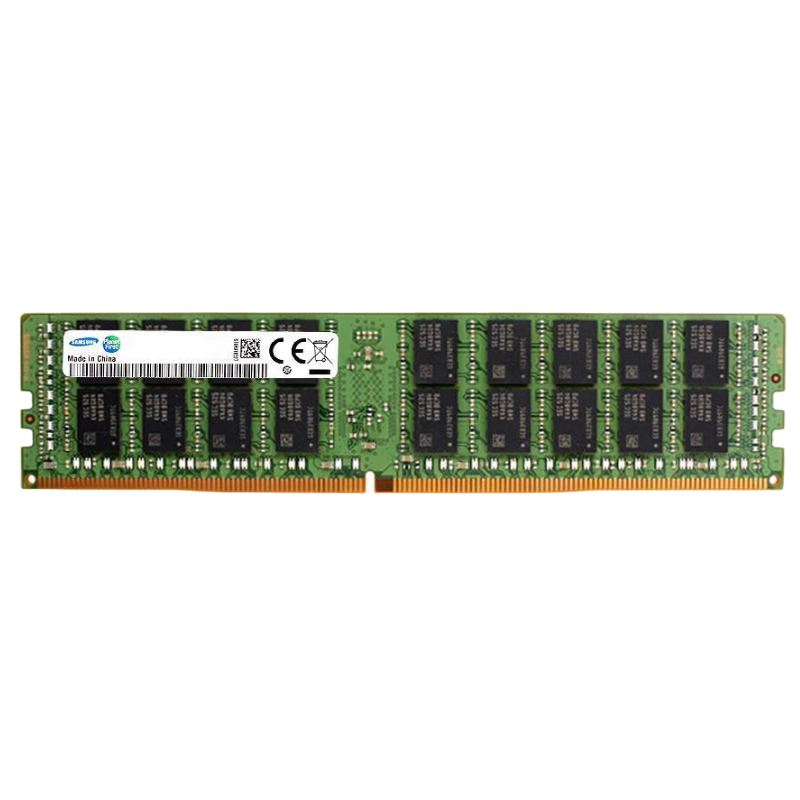
Samsung M393AAG40M3B-CYFBY 128GB PC4-23400 DDR4-2933MHz ECC CL21 288-Pin DIMM 1.2V Quad Rank Memory Module. New Sealed in Box (NIB) with 3 Years Warranty
The Samsung M393AAG40M3B-CYFBY represents a pinnacle of reliability and performance in the realm of enterprise server memory. This specific 128GB DDR4 RDImm module is engineered for mission-critical server environments where data integrity, large-scale data handling, and unwavering stability are non-negotiable.
The Samsung M393AAG40M3B-CYFBY is a high-performance 128GB DDR4 memory module engineered for reliability and stability in mission-critical server environments. Built to meet the stringent demands of data centers, cloud infrastructure, and enterprise servers, this module integrates advanced technologies to ensure data integrity and optimal performance under continuous operational loads.
This module is a single 128GB capacity stick, configured as a 1x128GB solution. It operates at a data transfer rate of 2933 megabits per second (Mbps), which is classified under the PC4-23400 designation. This speed refers to the module's theoretical peak bandwidth of 23,400 MB/s. It operates at a standard DDR4 voltage of 1.2 volts, balancing performance with power efficiency, a critical factor in dense server deployments where thermal design power (TDP) and cooling are paramount.
Samsung's part numbering system provides detailed information about the module. 'M393' indicates a registered RDIMM for server use. 'A' signifies that it is a 288-pin module. 'AG' represents 128GB density and the specific chip configuration. '40' denotes a data width of x4. 'M3B' provides information on the revision and die generation. The suffix 'CYFBY' indicates attributes like the 2933 Mbps speed, the CL24 timing, and the quad-rank design.
The PC4-23400 label is a standardized industry classification. "PC4" denotes a DDR4 module. The "23400" number represents the maximum theoretical bandwidth in megabytes per second (MB/s). This is calculated by taking the data rate (2933 million transfers per second), multiplying by the bus width (64 bits = 8 bytes), and accounting for dual-channel operation inherent to the technology. This high bandwidth is essential for accelerating data-intensive applications, virtualization, and large-scale databases.
This module incorporates three key technologies that define its server-grade pedigree: Error-Correcting Code (ECC), Registered (Buffered) design, and Quad Rank architecture. Together, these features differentiate it from standard consumer-grade memory and are non-negotiable for enterprise stability.
ECC is a fundamental requirement for server memory. It detects and corrects the most common types of internal data corruption. Single-bit errors are corrected on-the-fly without any interruption to system operation, while multi-bit errors are detected and reported to the system to prevent corrupted data from propagating. This dramatically reduces system crashes, silent data corruption, and downtime, ensuring the reliability of financial transactions, scientific computations, and stored data.
The module includes extra memory bits (typically 8 bits for every 64 bits of data) that store an encrypted code. Whenever data is written to memory, a code is calculated and stored alongside it. When the data is read, the code is recalculated and compared to the stored code. Any mismatch triggers a correction algorithm for single-bit errors. This hardware-level protection is transparent to the operating system and applications but is vital for maintaining 24/7/365 uptime.
The module is a Registered Dual In-Line Memory Module (RDIMM). It features a register, or buffer, placed between the memory controller and the DRAM chips. This register buffers the command, address, and clock signals, reducing the electrical load on the memory controller. This allows servers to support significantly higher quantities of memory modules per channel (often 2-3x more than unbuffered modules) and larger total memory capacities without signal degradation, which is crucial for multi-socket servers and large-scale memory configurations.
Unlike Unbuffered DIMMs (UDIMMs) used in desktops, RDIMMs provide greater stability for dense configurations. Compared to Load-Reduced DIMMs (LRDIMMs), which use an additional buffer for data signals to further increase capacity, RDIMMs offer an excellent balance of high capacity, performance, and lower latency. The M393AAG40M3B-CYFBY, as an RDIMM, is the workhorse of modern enterprise servers, enabling robust and scalable memory solutions.
This module is configured as a Quad Rank (QR) x4 module. "Rank" refers to an independent set of DRAM chips that are accessed simultaneously by the memory controller. A quad-rank module has four such sets of chips on a single stick. This architecture allows the 128GB capacity to be achieved efficiently. It enables better interleaving, which can improve performance for certain workloads by allowing the memory controller to access different ranks in a pipelined fashion, masking latency.
It is crucial to consult your server's documentation regarding rank population rules. Memory controllers have limits on the total number of ranks they can drive per channel. Using quad-rank modules like this one may limit the total number of modules you can install per channel compared to using single- or dual-rank modules. Proper planning is required to maximize total system capacity while adhering to the manufacturer's guidelines for optimal speed and stability.
The performance of DDR4 memory is defined by its data rate, timings, and resultant latency. The Samsung M393AAG40M3B-CYFBY is optimized for server workloads where consistent throughput and reliability are prioritized over ultra-tight latencies.
With a speed of 2933 Mbps (or 2933 MT/s), this module operates at a mainstream-high speed for enterprise DDR4. This data rate ensures ample bandwidth for CPU cores to access data in memory, reducing bottlenecks in multi-core processors. In platforms supporting multiple memory channels (e.g., six or eight channels per CPU), the aggregate bandwidth scales massively, feeding high-core-count CPUs in servers and workstations.
The module's primary timing is CL24, which stands for CAS Latency 24. This is the number of clock cycles between the memory controller issuing a read command and the first piece of data being available. While higher than typical consumer module latencies, CL24 at 2933 MHz represents an optimized balance for server-grade ECC registered memory. The absolute latency in nanoseconds is a more important metric, calculated as (CL / Speed in MHz) * 2000. For this module, it is approximately (24 / 2933) * 2000 = 16.36 nanoseconds.
Alongside CL, other critical timings include tRCD (RAS to CAS Delay), tRP (RAS Precharge Time), and tRAS (Row Active Time). These are typically specified in the module's SPD (Serial Presence Detect) chip. While Samsung may bin these for stability, they are generally aligned with JEDEC standards for 2933 Mbps CL24 modules. These timings collectively manage the access to different rows and banks within the DRAM chips, influencing overall real-world performance.
The physical construction of the module is tailored for server environments, ensuring compatibility, durability, and effective thermal management.
The module uses the standard 288-pin DDR4 RDIMM form factor. It features a single notch in the connector, positioned differently from DDR3 modules to prevent accidental insertion into an incompatible slot. The pins are gold-plated for reliable connectivity and corrosion resistance. The length (133.35mm) and height (with included heat spreader) adhere to standard specifications to ensure fitment in server blade chassis and rackmount servers.
This module is designed for servers and workstations that support DDR4 ECC Registered memory. Compatibility is specific. It requires a motherboard and CPU (typically Intel Xeon Scalable, AMD EPYC, or certain Intel Core X-series/W-series) with a memory controller that supports 2933 Mbps, 1.2V, quad-rank RDIMMs. It is imperative to verify support via the system or motherboard manufacturer's Qualified Vendor List (QVL) before purchase, as BIOS and firmware play a key role in compatibility.
The high capacity, reliability features, and performance profile of this module make it ideal for specific demanding computing environments.
In virtualized environments and private/public cloud infrastructure, high memory density is key to achieving high consolidation ratios. A single server equipped with multiple 128GB modules can host dozens of virtual machines, containers, or applications. ECC protection ensures the stability of these consolidated workloads, preventing a single memory error from affecting multiple tenants or services.
Platforms like SAP HANA, Oracle Database In-Memory, and Apache Spark thrive on massive, fast memory pools. The 128GB capacity per module allows for the creation of terabyte-scale in-memory datasets, dramatically accelerating transaction processing, real-time analytics, and machine learning training by keeping entire working sets in RAM, avoiding slower disk access.
HPC clusters used for computational fluid dynamics, genomic sequencing, and financial modeling require vast amounts of reliable memory. The bandwidth of 2933 Mbps modules, when aggregated across multiple channels and nodes, provides the necessary data throughput for parallel computations. ECC is often mandatory in these settings to ensure the scientific integrity of long-running simulations.


 Contact Us
 Information
 Catalog
 Solid State Drives (SSD)
 Network Switches
 Hard Disk Drives
 HBA & Controllers
 PC & Servers
 PC & Server Memory
 CPU & Processors
 Network Routers
 Power Supplies
 Tape Drives & Libraries
 Network Devices
 Computer & Network Cables