
(7% discount is applied at checkout)
Cart is empty
Your go-to destination for cutting-edge server products
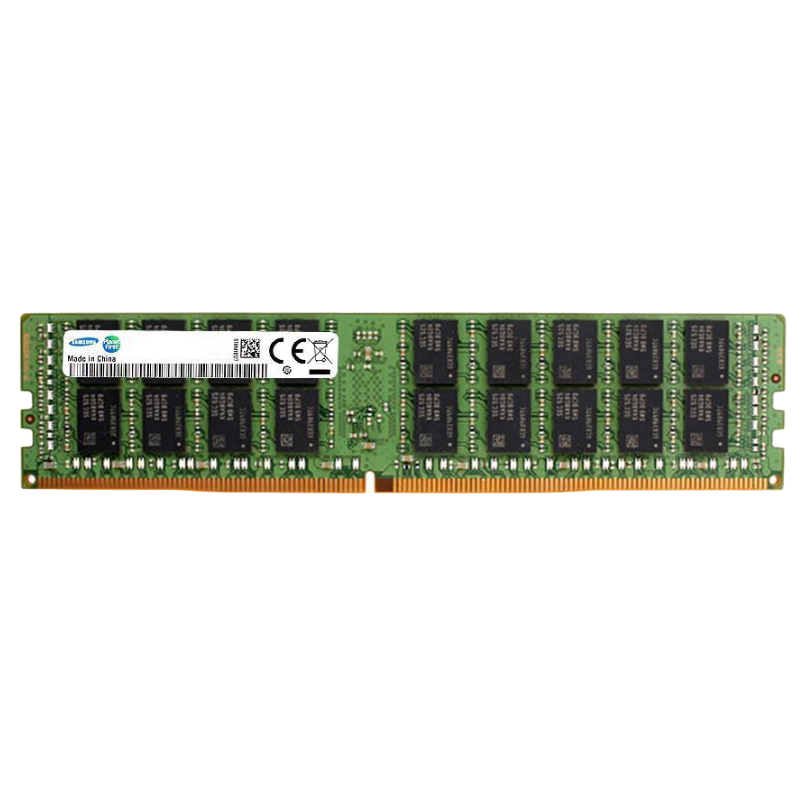
Samsung M393AAG40M3B-CYFCO 128GB PC4-23400 DDR4-2933MHz ECC CL21 288-Pin DIMM 1.2V Quad Rank Memory Module. New Sealed in Box (NIB) with 3 Years Warranty
The Samsung M393AAG40M3B-CYFCO is a high-performance 128GB DDR4 memory module, designed to meet the demands of professionals requiring fast and reliable memory for demanding applications. With cutting-edge technology, this module ensures data integrity and high speeds for optimal computing power.
At the core of enterprise-grade computing, the Samsung M393AAG40M3B-CYFCO is a high-performance 128GB DDR4 RDIMM engineered for demanding server environments. This module represents a significant leap in memory density and reliability, providing system builders and data center managers with a robust solution for memory-intensive applications. With its specific combination of capacity, speed, and error-correcting features, this memory module is a critical component for servers tasked with virtualization, large databases, high-performance computing (HPC), and enterprise resource planning (ERP) systems.
Understanding the part number is key to identifying the module's capabilities. The Samsung M393AAG40M3B-CYFCO designation breaks down into a comprehensive specification sheet. The 'M393' prefix indicates a registered DIMM (RDIMM) format. The 'A' signifies a 1.2V operating voltage. 'AG40' points to the module's organization and density—a 128GB capacity. 'M3B' relates to the component and revision. The crucial suffix 'CYFCO' details the performance profile: 'C' for the speed grade (2933 Mbps), 'Y' for the CAS Latency (CL24), and 'FCO' for the specific fine-tuning of timings and the quad-rank design. This precise nomenclature ensures compatibility and sets clear expectations for performance within supported server platforms.
This module offers a substantial 128GB capacity as a single module (1x128GB), enabling servers to achieve high total memory capacities with fewer DIMM slots. This is particularly valuable in 1U and 2U rack servers where slot count can be limited. The module is built as a Quad Rank (QR) x4 configuration. "Quad Rank" means the module presents four independent sets of memory banks to the memory controller. The "x4" refers to the data width of the individual DRAM chips (4 bits). This organization is optimal for maximizing capacity and performance within the electrical constraints of a dual inline memory module (DIMM), allowing for efficient population of memory channels and improved overall system bandwidth compared to single or dual-rank modules in many server workloads.
Utilizing 128GB modules allows data centers to scale memory resources dramatically without proportionally increasing power consumption, cooling requirements, and physical rack space. For instance, populating a two-socket server with 1TB of RAM requires only eight of these modules, leaving additional slots free for future expansion or optimizing channel configuration.
Performance in server memory is a balance of raw speed, latency, and sustained bandwidth. The Samsung M393AAG40M3B-CYFCO is engineered to deliver a robust profile across all these metrics, ensuring that it can keep pace with the latest multi-core CPUs and prevent memory bottlenecks in data-heavy processing tasks.
The module operates at a data rate of 2933 million transfers per second (MT/s), often expressed as 2933 Mbps. This is also classified under the PC4-23400 designation. The PC4 number indicates the module's theoretical peak bandwidth in megabytes per second (MB/s). To calculate this: 2933 MT/s * 8 bytes (64-bit data bus) = approximately 23,464 MB/s, rounded to 23,400 MB/s, hence PC4-23400. This high bandwidth is crucial for applications that stream large datasets, such as in-memory databases like SAP HANA, scientific simulations, and real-time analytics platforms, where the speed of data movement directly impacts computation time and user responsiveness.
Latency, the delay before a data transfer begins, is equally important. This module operates at a CAS Latency of 24 clocks (CL24). CAS Latency (Column Address Strobe) is the number of clock cycles between the memory controller requesting data and the first piece of data being available from the module. While higher-speed memory often comes with slightly higher CAS latencies in cycles, the actual time in nanoseconds is a more critical metric. For this module at 2933 MT/s (clock frequency ~1466.5 MHz), the CL24 timing translates to a very competitive absolute latency. This balance ensures that the module delivers both high throughput and responsive data access.
The 2933 MT/s speed ensures compatibility with modern server platforms based on Intel Xeon Scalable (Cascade Lake, Ice Lake) and compatible AMD EPYC processors. Running memory at this optimized speed allows the CPU's integrated memory controller to function at its designed efficiency, reducing wait states and improving instructions per clock (IPC). For virtualized environments, this translates to higher VM density and smoother performance during peak loads. In database servers, it accelerates query processing and transaction completion times.
Beyond capacity and speed, the defining characteristics of true server memory are its mechanisms for ensuring data integrity and signal stability. The Samsung M393AAG40M3B-CYFCO incorporates two critical technologies: Error-Correcting Code (ECC) and a Registered (Buffered) design.
This is an ECC memory module. ECC is a non-negotiable feature for enterprise servers, as it detects and corrects the most common types of internal data corruption. Single-bit errors (the most frequent) are corrected on-the-fly without any system interruption, while multi-bit errors are detected and reported to the system, allowing for preventive maintenance. This capability is vital for preventing silent data corruption that could lead to computational errors, database corruption, or application crashes, thereby ensuring the integrity of financial records, scientific data, and customer information.
The module is a Registered DIMM (RDIMM). It features a register (or buffer) on the module itself, located between the memory controller and the DRAM chips. This register buffers the command and address signals, reducing the electrical load on the controller. This allows servers to support a greater number of memory modules per channel and to use higher-density modules (like this 128GB QR stick) without overloading the controller. The result is enhanced signal integrity, greater system stability, and support for larger total memory capacities compared to unbuffered (UDIMM) memory. This makes RDIMMs the standard for multi-socket, mission-critical servers.
It is important to distinguish this ECC RDIMM from consumer-grade UDIMMs and Load-Reduced DIMMs (LRDIMMs). UDIMMs lack both the register and often ECC, limiting their use to low-end servers and workstations. LRDIMMs use a more advanced buffer to reduce load on both data and address lines, enabling the very highest capacities but often at a slight latency or cost premium. The ECC RDIMM sits as the optimal balance of performance, capacity, reliability, and cost for the vast majority of enterprise server applications.
The physical design of the module adheres to strict industry standards to ensure seamless integration into compatible server systems, while its electrical profile is optimized for efficiency and reliability.
The module uses the standard 288-pin layout defined for DDR4 SDRAM. It is built in the RDIMM form factor, which is mechanically keyed differently than UDIMMs or LRDIMMs to prevent insertion into an incompatible slot. The 288-pin design supports the increased data rates and signaling requirements of DDR4 technology over the previous 240-pin DDR3 standard. The physical dimensions (height, length, and component placement) conform to JEDEC specifications, ensuring it fits properly into server memory slots, often with clearance for adjacent heatsinks or cooling shrouds.
This DDR4 module operates at a nominal 1.2 volts, a significant reduction from the 1.5V or 1.35V common in DDR3 memory. This lower voltage directly translates to reduced power consumption and heat generation per module. For a data center deploying hundreds or thousands of servers, this power efficiency compounds into substantial savings on electricity and cooling infrastructure costs (OPEX). The module's power management features align with JEDEC standards, allowing the system BIOS to manage power states dynamically, further optimizing energy use during periods of low utilization.
The Samsung M393AAG40M3B-CYFCO is not a universal memory module; it is designed for specific enterprise server platforms that demand its combination of features.
This module is designed for compatibility with enterprise server platforms from leading OEMs such as Dell EMC (PowerEdge), HPE (ProLiant, Synergy), Lenovo (ThinkSystem), Cisco (UCS), and Supermicro, among others. It is optimized for servers using Intel Xeon Scalable processors (Cascade Lake SP/AP and Ice Lake SP generations) and compatible platforms that support 2933 MT/s DDR4 RDIMMs. It is also compatible with certain AMD EPYC 7002 and 7003 series platforms, but verification against the specific system's qualified vendor list (QVL) or memory configuration guide is absolutely essential before purchase. Compatibility depends on factors including CPU memory controller, motherboard chipset, and BIOS firmware.
This high-density, high-reliability memory module is purpose-built for critical infrastructure. Primary use cases include: Virtualization Hosts (VMware vSphere, Microsoft Hyper-V, KVM) where large memory pools are needed to host numerous virtual machines; In-Memory Databases (SAP HANA, Oracle Database In-Memory, Microsoft SQL Server) where performance is directly tied to the capacity and speed of RAM; Big Data Analytics (Hadoop, Spark) for processing massive datasets in real-time; High-Performance Computing (HPC) clusters for scientific modeling and simulation; and Enterprise Application Servers running large ERP (SAP, Oracle) or CRM (Salesforce) suites that require high throughput and stability.
When configuring servers with this memory, it is critical to follow the server manufacturer's memory population rules. These rules dictate the optimal slots to populate first (usually starting with the lowest-numbered channel per CPU) to enable multi-channel architecture for maximum bandwidth. Mixing modules of different speeds, capacities, or ranks within a channel or across channels can force all memory to run at the slowest common denominator and may cause instability. For best performance, populate an equal number of identical modules per CPU socket. Always consult the system's technical documentation or configuration tool for validated population sequences.


 Contact Us
 Information
 Catalog
 Solid State Drives (SSD)
 Network Switches
 Hard Disk Drives
 HBA & Controllers
 PC & Servers
 PC & Server Memory
 CPU & Processors
 Network Routers
 Power Supplies
 Tape Drives & Libraries
 Network Devices
 Computer & Network Cables