
(7% discount is applied at checkout)
Cart is empty
Your go-to destination for cutting-edge server products
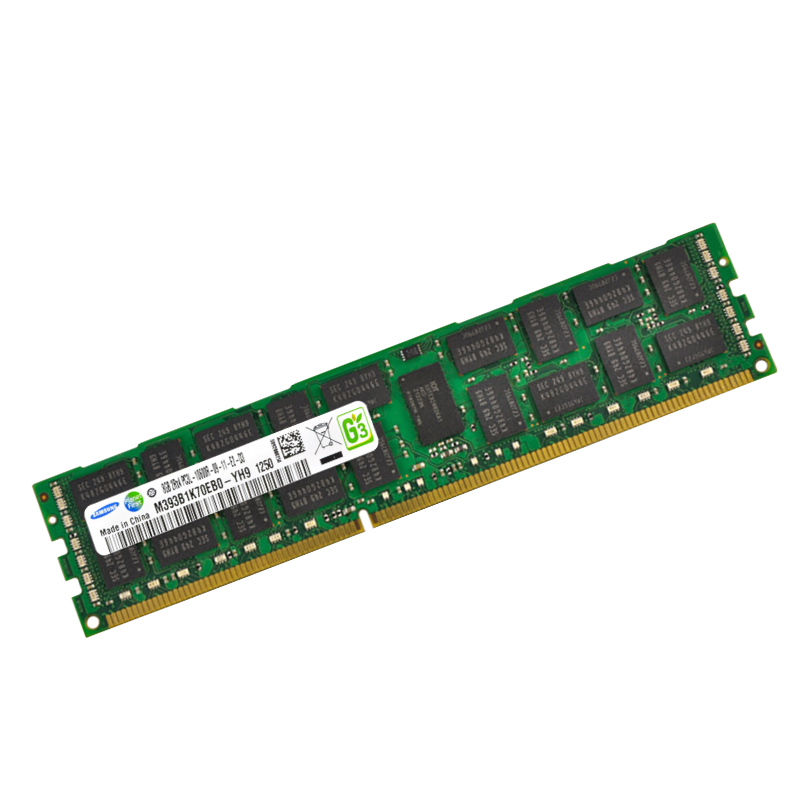
Samsung M393B1K70EB0-YH9 Memory 8GB 1333mhz Pc3-10600 Cl9 Dual Rank Ecc Registered DDR3 SDRAM 240-Pin Dimm. New (System) Pull with 1 year replacement warranty
Discover the Samsung M393B1K70EB0-YH9 memory module, engineered for reliability and speed. This 8GB PC3-10600 DDR3-1333MT/s 2RX4 ECC Registered DIMM is designed to enhance server performance and ensure data integrity.
The Samsung M393B1K70EB0-YH9 8GB DDR3 SDRAM memory module belongs to the enterprise-grade ECC Registered DIMM category, engineered specifically for server and workstation environments where stability, data integrity, and predictable performance are mandatory. This category focuses on memory solutions designed to operate continuously under sustained workloads, supporting mission-critical applications, virtualization platforms, enterprise databases, and legacy server infrastructures that rely on DDR3 technology.
DDR3 Registered DIMM memory modules introduce a register between the DRAM chips and the memory controller, reducing the electrical load on the controller and enabling higher capacity configurations per channel. This architectural design makes RDIMM modules particularly suitable for dual-processor and multi-socket server platforms, where memory scalability and signal integrity are essential for consistent system operation.
ECC Registered memory modules like the Samsung M393B1K70EB0-YH9 are fundamental to maintaining data accuracy in enterprise systems. Error Correcting Code technology actively detects and corrects single-bit memory errors, preventing data corruption that could otherwise lead to system crashes, application errors, or data loss. In server environments that process financial transactions, healthcare records, or large-scale virtualization workloads, this level of protection is not optional but required.
The registered buffer further enhances reliability by stabilizing command and address signals. This allows servers to populate more memory slots without compromising performance or system stability, making DDR3 RDIMM modules a preferred choice for dense memory configurations in rack-mounted and tower servers.
The PC3-10600 designation identifies this memory module as operating at a data transfer rate of 1333MT/s, a widely adopted speed tier during the DDR3 era. This performance level delivers balanced bandwidth and latency characteristics that align well with Intel Xeon and AMD Opteron server platforms designed for DDR3 memory support.
At 1333MT/s, the Samsung M393B1K70EB0-YH9 provides reliable throughput for applications such as virtualization hosts, file servers, email servers, and enterprise resource planning systems. The speed class ensures compatibility with a broad range of legacy server motherboards while maintaining efficient data access patterns for multi-threaded workloads.
The CL9 latency rating indicates a carefully optimized timing configuration that balances responsiveness and stability. In server memory categories, consistent latency behavior is often more critical than achieving the lowest possible latency. CL9 timing ensures predictable access cycles, which is essential for applications that rely on deterministic performance, such as database query processing and transaction handling.
This timing configuration also supports long-term operational stability, minimizing the risk of timing-related errors under heavy memory utilization. For enterprise administrators maintaining legacy DDR3 platforms, CL9 memory modules provide a proven and validated timing profile.
The Samsung M393B1K70EB0-YH9 operates at 1.35 volts, placing it within the DDR3L low-voltage memory category. This design reduces power consumption compared to standard 1.5V DDR3 modules, offering tangible benefits in data center environments where energy efficiency and thermal management are critical considerations.
Lower operating voltage contributes to reduced heat output, enabling improved airflow and cooling efficiency within server chassis. Over time, these characteristics help extend component lifespan and reduce operational costs, particularly in environments with large memory footprints.
In multi-server racks and blade server configurations, cumulative power savings from low-voltage memory modules can be significant. DDR3L RDIMM categories like this Samsung module are often selected for infrastructure refresh projects that aim to optimize existing hardware without a full platform upgrade.
The combination of ECC protection, registered buffering, and low-voltage operation positions this memory category as a dependable solution for enterprises maintaining DDR3-based systems while seeking incremental efficiency improvements.
The dual rank x4 architecture of the Samsung M393B1K70EB0-YH9 reflects an advanced memory organization optimized for server workloads. Dual rank modules present two sets of memory ranks to the memory controller, allowing improved interleaving and better utilization of memory channels.
The x4 DRAM configuration enhances error correction capabilities by distributing data across more memory chips. This design improves fault tolerance and aligns with enterprise reliability standards, making x4-based RDIMM modules a preferred choice in data centers.
Dual rank memory modules can improve effective memory bandwidth by allowing the memory controller to alternate access between ranks. This reduces idle cycles and improves overall throughput, particularly in multi-threaded server workloads.
In virtualized environments where multiple virtual machines compete for memory resources, dual rank DDR3 RDIMM modules help maintain smoother performance and reduce contention-related bottlenecks.
The 240-pin RDIMM form factor is a defining characteristic of DDR3 registered memory modules. This standardized physical layout ensures compatibility with a wide range of server and workstation motherboards designed for DDR3 ECC Registered memory.
The module’s mechanical design supports secure installation in high-density memory slots, maintaining stable electrical connections even in systems that operate continuously under vibration and thermal stress.
The Samsung M393B1K70EB0-YH9 is designed to integrate seamlessly with server platforms that require DDR3 RDIMM modules, including systems based on Intel Xeon E5 and earlier Xeon architectures, as well as compatible AMD server processors.
This category remains highly relevant for organizations maintaining long-term deployments of proven server platforms, where memory upgrades are used to extend system life and improve performance without replacing the entire infrastructure.
The 8GB capacity of the Samsung M393B1K70EB0-YH9 aligns with common server memory configuration strategies, particularly in systems that balance cost efficiency with adequate memory resources. This capacity is well-suited for application servers, directory services, and infrastructure roles that require stable memory performance without excessive capacity.
In clustered environments, multiple 8GB modules can be combined to achieve scalable memory configurations, allowing administrators to tailor memory capacity to specific workload requirements.
DDR3 ECC Registered memory remains a viable choice for virtualization platforms running legacy hypervisors or lightweight virtual machines. The reliability and predictable latency of RDIMM modules support consistent virtual machine performance.
This memory category is also suitable for development and testing environments where stability and data integrity are more important than cutting-edge performance.
Server memory modules must operate reliably across a wide range of temperatures and environmental conditions. The Samsung M393B1K70EB0-YH9 is designed to maintain stable operation under continuous load, with thermal characteristics optimized for dense server chassis.
Low-voltage operation contributes to reduced heat generation, supporting effective cooling strategies and minimizing thermal hotspots within the system.
ECC Registered memory modules rely on compatible memory controllers to deliver their full error correction capabilities. The Samsung M393B1K70EB0-YH9 is designed to work seamlessly with server-class memory controllers that support ECC and registered buffering.
This integration ensures accurate error detection and correction, reinforcing system stability and protecting critical data from corruption.
By reducing the likelihood of memory-related system crashes, ECC RDIMM modules contribute to higher overall system availability. This is particularly valuable in enterprise environments where downtime can result in significant operational and financial impact.
The Samsung DDR3 ECC Registered memory category continues to play an important role in maintaining dependable performance for legacy and transitional server infrastructures.


 Contact Us
 Information
 Catalog
 Solid State Drives (SSD)
 Network Switches
 Hard Disk Drives
 HBA & Controllers
 PC & Servers
 PC & Server Memory
 CPU & Processors
 Network Routers
 Power Supplies
 Tape Drives & Libraries
 Network Devices
 Computer & Network Cables