
(7% discount is applied at checkout)
Cart is empty
Your go-to destination for cutting-edge server products
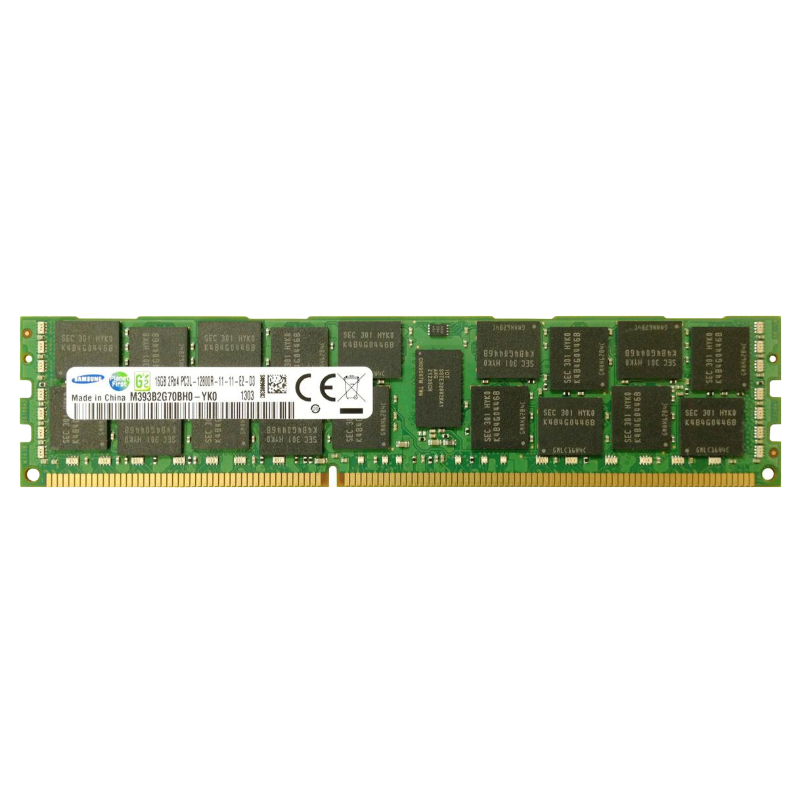
Samsung M393B2G70BH0-YK0 16GB 1600MHz PC3-12800 DDR3 Registered SDRAM RAM. New (System) Pull with 1 Year Replacement Warranty
The Samsung M393B2G70BH0-YK0 DDR3 SDRAM is equipped with a remarkable capacity of 16GB. This capacity makes it an ideal choice for users who require high-performance memory modules to handle demanding tasks and applications.
The Samsung M393B2G70BH0-YK0 16GB 1600MHz PC3-12800 DDR3 Registered SDRAM RAM occupies a critical category of server-grade memory designed for enterprise-class systems, mission-critical workstations, virtualization hosts, and storage controllers. This category emphasizes stability, expandability, and data integrity over consumer-focused overclocking or RGB aesthetics. Modules in this class are engineered with a registered buffer and error-correcting code functionality to ensure reliable operation in multi-socket, multi-DIMM configurations where consistency of performance and protection against single-bit memory errors are essential.
At the core of this category sits the registered (RDIMM) architecture. The Samsung M393B2G70BH0-YK0 leverages a register between the DRAM chips and the memory controller to reduce electrical loading, enabling servers to accept more modules and higher total memory capacity without compromising signal integrity. This architectural choice allows system designers to scale memory density across multiple channels while maintaining predictable timing and stability.Error-correcting code, commonly abbreviated as ECC, is an accompanying pillar of this category. ECC detects and corrects single-bit memory errors in real time and flags multi-bit errors for system-level handling. The integration of ECC with registered buffering makes this product family ideally suited for environments where data corruption is unacceptable, such as database servers, virtualization clusters, enterprise resource planning systems, and scientific computing nodes.
The PC3-12800 classification denotes a theoretical peak transfer rate that aligns with an effective clock speed of 1600MHz. For server workloads, this frequency represents a balance between bandwidth and latency that supports diverse enterprise workloads. The Samsung M393B2G70BH0-YK0’s 1600MHz operation offers improved throughput compared to 1333MHz DDR3 variants, making it more suitable for memory-intensive applications, higher VM densities, and tasks requiring rapid memory access patterns.Performance in this category should be evaluated through sustained throughput and deterministic latency under load rather than peak single-threaded benchmark numbers. In real-world server deployments, the 1600MHz modules frequently deliver better responsiveness across aggregated workloads, particularly when paired with processors and chipsets that are optimized for DDR3-1600 operation.
These modules conform to the 240-pin DIMM form factor standard used across mainstream DDR3 server motherboards. Physical compatibility ensures straightforward replacement and upgrades for existing server fleets, facilitating lifecycle management. The standardized form factor in this category simplifies procurement and reduces the risk of mechanical mismatch during maintenance operations.Compatibility within this category often extends across a range of Intel and AMD server platforms that accept registered ECC DDR3 memory. System administrators should verify motherboard and BIOS support for PC3-12800 RDIMMs when planning upgrades, but Samsung’s modules are widely recognized for broad interoperability across enterprise-class platforms.
One of the primary advantages of DDR3 registered memory is its ability to scale within multi-DIMM channel architectures. The Samsung M393B2G70BH0-YK0 supports denser memory configurations, allowing servers to reach higher total memory capacities without the electrical penalties associated with unbuffered modules. This scalability is particularly valuable for virtualization hosts that require large memory footprints to support numerous virtual machines or containerized workloads.When designing systems that fall into this category, attention to memory channel population, bank interleaving, and matching of module specifications across channels is crucial. Properly balanced configurations help the system maintain peak efficiency and reduce the risk of subtle timing or stability issues under sustained workloads.
Modules in this family are produced under strict quality control processes and undergo extensive validation to meet enterprise reliability expectations. Samsung’s server memory manufacturing includes rigorous screening, extended burn-in testing, thermal cycling, and compatibility verification with a range of server platforms. These validation steps are central to the category, as enterprise customers require components that demonstrate long-term stability and predictable behavior in 24/7 production environments.Reliability extends beyond manufacturing to supply chain consistency and traceability. This category typically supports long-term procurement contracts, controlled firmware revisions, and part number stability so that IT administrators can confidently source replacements that meet the same electrical and thermal profiles as the original modules.
Error-correcting code in this category provides an active safeguard against data corruption inside system memory. For applications like financial transaction processing, patient health record systems, data warehousing, and high-availability clusters, ECC reduces the incidence of silent data corruption and the likelihood of system crashes caused by transient memory faults. As a result, organizations relying on Samsung M393B2G70BH0-YK0 modules experience elevated service continuity and reduced data integrity risk compared to non-ECC memory solutions.Administrators should consider the operational implications of ECC detection mechanisms, including logging policies and system management alerts, because ECC events can be early indicators of failing components or environmental issues such as overheating or marginal power delivery.
Even with enterprise-grade modules, occasional issues can arise. Memory errors reported by system logs, ECC event counters, or POST codes warrant immediate investigation. Common root causes in this category include marginal DIMM seating, incompatible BIOS settings, mismatched voltage or timing parameters, failing motherboard traces, or environmental factors such as elevated ambient temperatures. A methodical approach to troubleshooting, including reseating modules, verifying BIOS compatibility, testing with known-good modules, and monitoring thermal telemetry, helps isolate the problem.For persistent ECC events, replacing the module with an identical Samsung M393B2G70BH0-YK0 or a verified substitute often resolves the issue, but correlating ECC logs with hardware maintenance records and environmental metrics provides the deeper insight necessary to prevent recurrence.
Within the broader DDR3 ecosystem, PC3-12800 RDIMMs represent a higher-performance tier compared to PC3-10600 modules, while remaining part of the mature DDR3 generation. Organizations choosing between DDR3 speed grades should balance compatibility requirements against performance needs. The Samsung M393B2G70BH0-YK0 is positioned as a favorable option for those seeking the incremental bandwidth of 1600MHz memory without moving to newer architecture platforms that would mandate different memory standards entirely.Comparatively, unbuffered ECC modules and non-ECC consumer DDR3 parts are less suitable for enterprise workloads because they lack the buffering and correction mechanisms essential for dense, mission-critical deployments. The registered ECC category continues to provide a secure path for organizations that require reliable expansion of existing server estates.
Procurement for this category should account for part number consistency, warranty coverage, and availability of quality documentation such as JEDEC compliance statements and validated configuration lists. The Samsung M393B2G70BH0-YK0 typically comes with manufacturer-backed warranties and a history of production consistency. Enterprises planning large-scale rollouts should negotiate for sufficient spare inventory and clarify return merchandise authorization procedures to streamline replacement in case of failures.Lifecycle management also requires attention to firmware and BIOS update cycles, which can impact compatibility with PC3-12800 modules. Maintenance windows for firmware updates and planned memory upgrades should be coordinated to minimize application downtime and to leverage vendor support during transitions.
Memory is a critical component of the data integrity chain. Modules in this category help maintain security indirectly by reducing the probability of silent memory corruption that could alter application behavior or compromise data. In some deployments, additional security features at the platform level, such as memory scrubbing and secure boot integration, complement the error detection and correction capabilities of registered ECC memory to produce a robust, defense-in-depth posture against data anomalies.Administrators should integrate memory health checks into their monitoring frameworks, treating ECC event rates and thermal metrics as first-class alerts. Proactive monitoring combined with high-quality components like the Samsung M393B2G70BH0-YK0 improves the predictability and security of data center operations.
Choosing memory from manufacturers with established enterprise support channels and comprehensive warranties reduces operational risk. Samsung’s reputation in DRAM manufacturing supports confidence in both quality and long-term availability. When purchasing modules within this category, verifying warranty terms, RMA processes, and technical support access is essential to ensure quick remediation of any hardware issues that could otherwise affect service delivery.OEMs and system integrators often validate specific part numbers against their hardware stacks. Selecting modules that are commonly validated by server vendors and that appear on vendor compatibility lists simplifies integration and shortens the path to vendor-supported configurations.
The Samsung M393B2G70BH0-YK0 16GB 1600MHz PC3-12800 DDR3 Registered SDRAM RAM offers a compelling value proposition for organizations seeking to extend the life and capability of DDR3-based server platforms. By delivering increased bandwidth over lower-speed DDR3 modules while maintaining ECC and registered buffering features, this category enables improved performance and higher VM densities at a fraction of the cost of platform migrations.Cost considerations in this category should be viewed through the lens of total cost of ownership. The upfront expense of quality modules is counterbalanced by reduced downtime, fewer data corruption incidents, and the ability to scale memory capacity without wholesale hardware replacement. In many enterprise scenarios, targeted memory upgrades represent a fiscally prudent strategy to meet interim performance and capacity needs.
When procuring within this category, prioritize purchasing from authorized distributors or vendors that offer clear lifecycle support and warranty coverage. Validate compatibility with intended server models and request vendor-provided validated configuration references whenever possible. Maintain inventory of spare modules for critical systems and plan staged rollouts that allow for controlled testing before full-scale deployment. During deployment, monitor ECC logs and system telemetry closely for the first maintenance interval to ensure that modules perform as expected under production workloads.By following these guidelines, organizations can leverage the Samsung M393B2G70BH0-YK0 to enhance server performance and reliability while preserving investment in existing infrastructure.
Upgrading to PC3-12800 RDIMMs requires a careful assessment of platform support, BIOS capabilities, and memory slot population rules. While switching to higher-frequency DDR3 memory can yield noticeable benefits for certain workloads, real-world gains depend on the memory controller’s ability to take advantage of the additional bandwidth. Conducting benchmark testing in a controlled environment with representative workloads helps quantify the performance improvements and guides capacity planning.As organizations map out future infrastructure strategies, memory upgrades using products like the Samsung M393B2G70BH0-YK0 can serve as a bridge strategy that defers full platform refreshes while delivering immediate improvements in memory capacity and bandwidth. Properly planned, these upgrades contribute to efficient operations, improved application responsiveness, and a measured approach to capital expenditure.


 Contact Us
 Information
 Catalog
 Solid State Drives (SSD)
 Network Switches
 Hard Disk Drives
 HBA & Controllers
 PC & Servers
 PC & Server Memory
 CPU & Processors
 Network Routers
 Power Supplies
 Tape Drives & Libraries
 Network Devices
 Computer & Network Cables