(7% discount is applied at checkout)
Cart is empty
Your go-to destination for cutting-edge server products
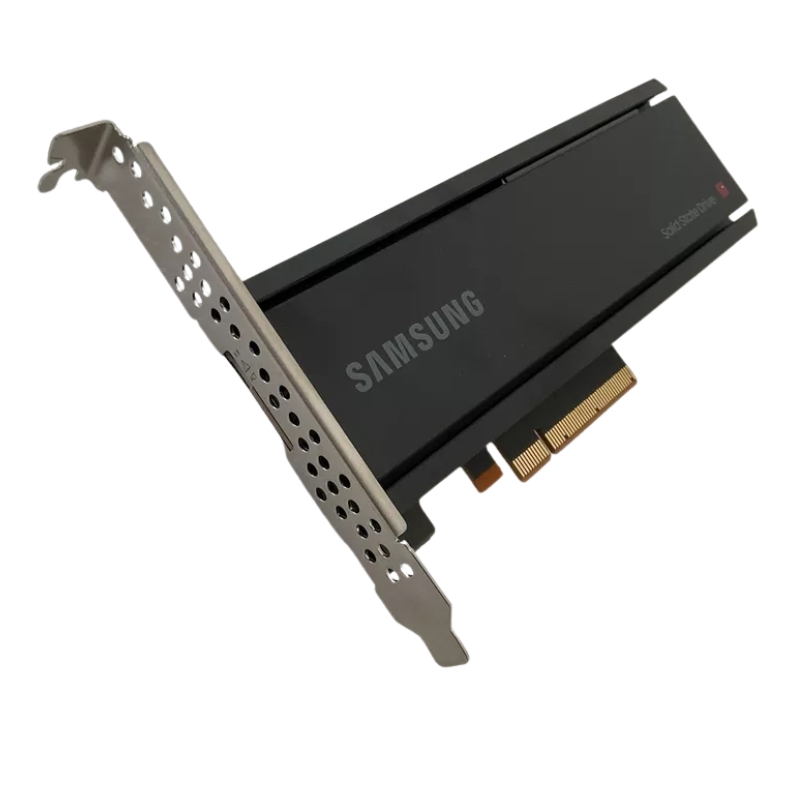


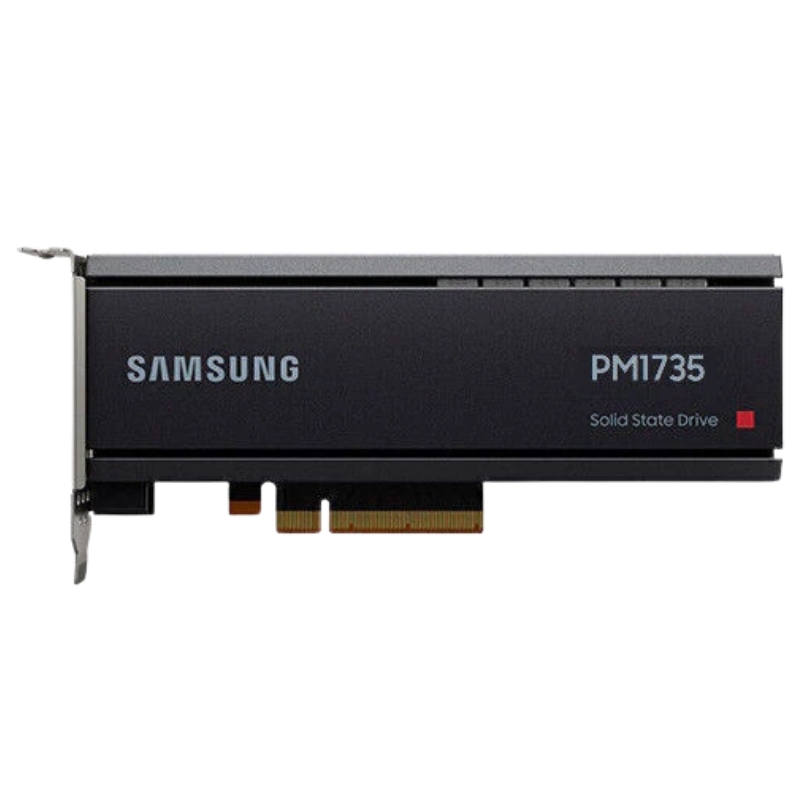
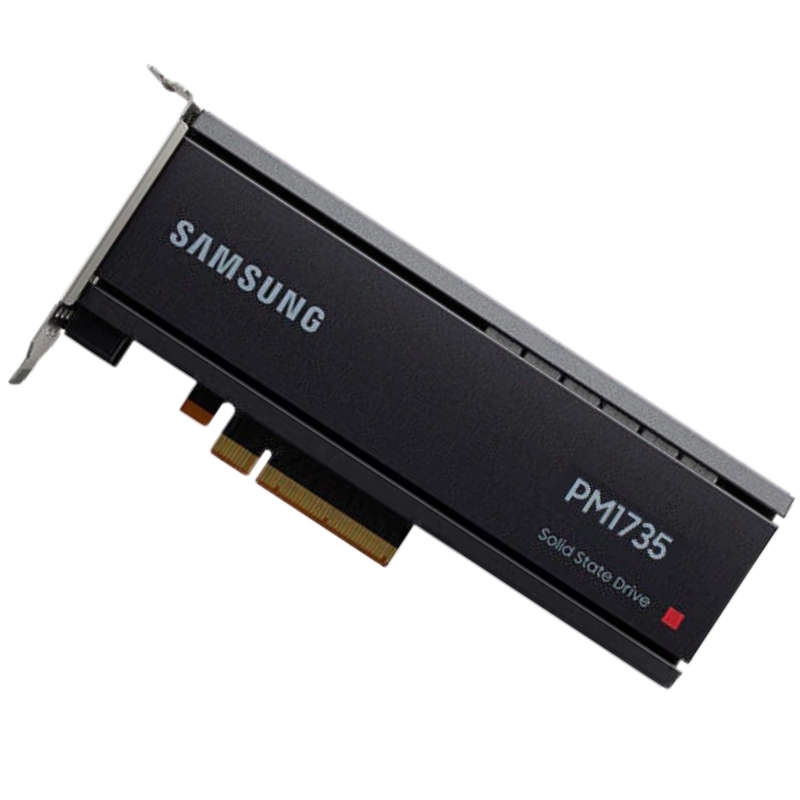
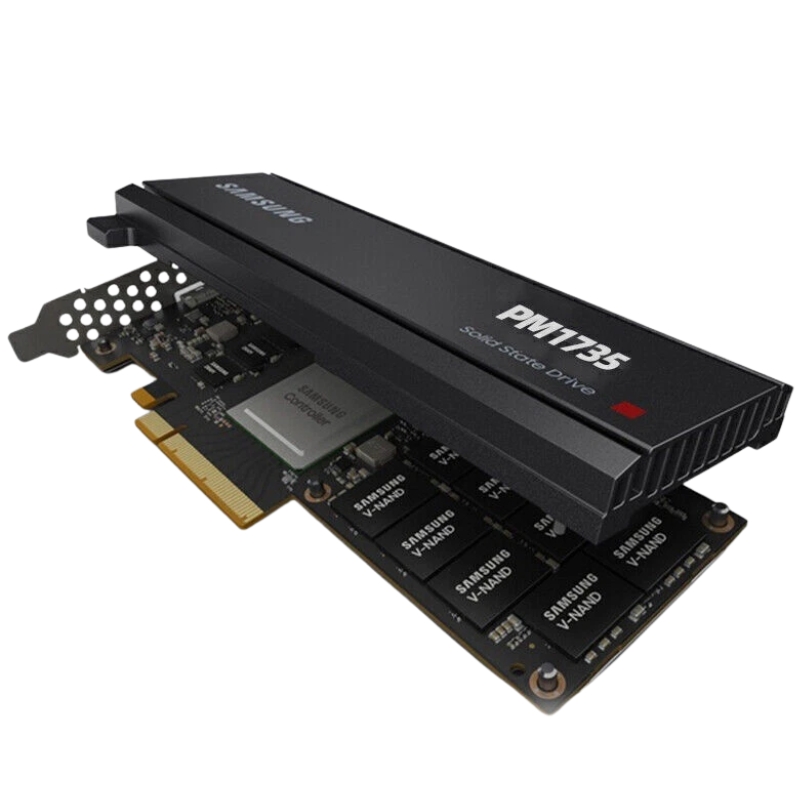
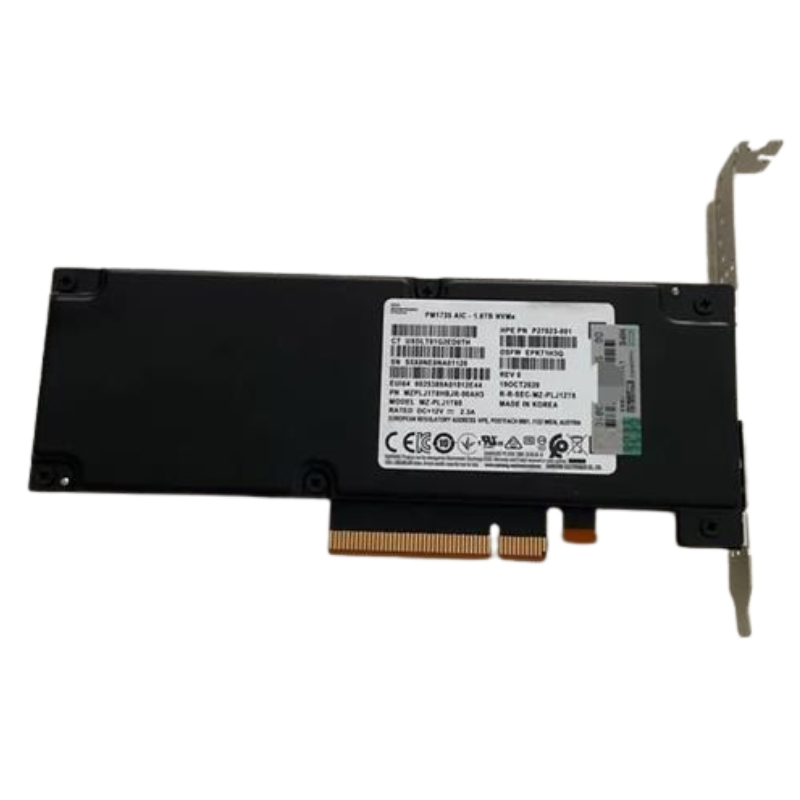
Samsung MZPLJ12THALA PM1735 12.8TB PCI-E 4.0 x8 NVMe HHHL TLC Solid State Drive. Excellent Refurbished with 1-Year Replacement Warranty
The Samsung PM1735 model MZPLJ12THALA is engineered to deliver exceptional throughput and reliability for data-intensive environments. Designed in a Half-Height Half-Length (HHHL) form factor, this solid-state drive leverages PCI-E Gen 4.0 x8 connectivity to maximize bandwidth and minimize latency.
Equipped with PCI-Express 4.0 x8 lanes, this SSD ensures ultra-fast data transfer rates, making it ideal for enterprise-grade applications such as virtualization, AI workloads, and real-time analytics.
The Samsung MZPLJ12THALA PM1735 is a purpose-built enterprise NVMe SSD offered in a Half-Height Half-Length (HHHL) add-in-card form factor and optimized for the heaviest data-center workloads that require both massive usable capacity and sustained throughput. Engineered to take advantage of the PCIe 4.0 x8 physical interface and the NVMe protocol, the 12.8TB PM1735 targets servers, storage arrays, and specialised appliances where ultra-low latency, sustained random I/O performance, and high drive endurance translate directly into application-level responsiveness and predictable service-level behaviour. Key published performance figures include up to 8,000 MB/s sequential read and up to 3,800 MB/s sequential write, with random performance rated to roughly 1.5 million 4KB read IOPS and 250K 4KB write IOPS — numbers that place the PM1735 among the highest-performing HHHL NVMe cards for its generation.
The PM1735 is a native PCIe device that leverages four gains from the Gen4 specification: doubled per-lane bandwidth relative to PCIe Gen3, improved command latency through the NVMe stack, parallelism across multiple NVMe submission and completion queues, and native host/controller orchestration designed for SSD media. The card’s eight-lane physical configuration ensures the controller can drive multiple channels of NAND at full speed without saturating the I/O fabric, making it a natural choice for workloads that combine large sequential transfers — backup restores, large file ingest, media streaming — with extremely bursty random I/O patterns common to virtual machine hosting and database transaction processing. The PM1735’s design is geared to maintain predictable latency under sustained mixed workloads by matching high bandwidth with internal parallelism, efficient flash management, and a firmware stack tuned for data-center consistency and QoS.
For operations that move large contiguous datasets — large-file reads, imaging, analytics checkpointing — sequential throughput is the most important metric. The PM1735’s peak sequential read of up to 8,000 MB/s and sequential write up to 3,800 MB/s are measured with 128 KB transfer sizes, which reflects real-world behaviour when storage systems stream large objects or perform full-device scans. Because the drive uses an x8 PCIe slot and internal parallelism across many NAND channels, sustained sequential performance remains high even as drives approach full occupancy, reducing job completion times for data-intensive tasks and improving overall cluster throughput.
Random small-block performance is what separates consumer-class storage from enterprise-grade media. The PM1735’s published 4KB random read capability of around 1.5M IOPS and random write capability around 250K IOPS enables thousands of virtual machines, containers, or database threads to access storage simultaneously without the long tail latency that degrades user experience or transaction throughput. This level of random I/O capacity is especially important for mixed OLTP/OLAP environments, metadata-heavy file systems, content delivery caching layers, and real-time analytics where responsiveness at small block sizes translates directly into application-level SLA compliance.
Enterprise workloads are rarely purely sequential or purely random; rather, systems face mixed I/O patterns with varying read/write ratios and concurrency. The PM1735’s internal firmware, NAND management techniques and DRAM-backed metadata structures are designed to maintain steady performance across a wide range of access patterns. Techniques such as aggressive garbage collection tuning, wear-leveling strategies that preserve capacity longevity, and background optimization routines allow the drive to sustain near-peak IOPS over longer durations than consumer-focused devices. These engineering choices reduce variance in response time and avoid the throughput cliffs that can occur when drives are highly fragmented or deeply written.
Endurance is central to enterprise procurement decisions. The PM1735 family is qualified for up to 3 drive writes per day (DWPD) over a five-year standard warranty window at its specified capacity points; this endurance rating allows data center operators to estimate total petabytes written (PBW) and design redundancy and refresh cycles accordingly. In practical terms, a 12.8TB device at 3 DWPD over five years maps to a substantial multi-petabyte write budget, which is suitable for write-intensive applications such as database logging, high-velocity telemetry ingestion, and virtualized workstation hosting. Endurance provisioning like this simplifies TCO calculations and reduces the need for conservative over-provisioning at the system level.
Mean Time Between Failures (MTBF) is a conventional reliability metric used to size redundancy and maintenance windows. The PM1735 family is specified with an MTBF in the multi-million-hour range, and Uncorrectable Bit Error Rate (UBER) figures aligned with JEDEC enterprise recommendations, which together provide predictable failure rates suitable for redundant, RAID-like architectures and erasure-coded systems. These reliability numbers allow architects to model risk and set replacement thresholds that match service availability targets and backup policies.
Unexpected power interruptions are among the most damaging events for data integrity. The PM1735 incorporates internal power-loss protection (PLP) circuitry so that data and metadata resident in volatile caches are flushed to NAND in the event of abrupt power loss. This feature ensures that host-issued writes that the drive reports as complete are not left in an indeterminate state, which simplifies firmware and file system recovery logic and reduces the risk of corruption after a sudden outage. The card also includes inrush current protection to avoid damage and ensure safe hot-plug behaviour in rack-scale systems. Collectively these protections make the PM1735 appropriate for hot-swap, high-availability environments where controller-level redundancy and rapid replacement are standard operating procedures.
The Half-Height Half-Length (HHHL) add-in-card format used by the PM1735 offers a favourable trade-off between capacity, thermal headroom, and ease-of-installation compared with blade-style or 2.5-inch U.2/7mm drives. HHHL cards plug directly into standard PCIe slots, avoiding the need for special drive bays or backplanes, and can be retrofitted into many existing server platforms that expose full-length or half-length PCIe slots. For operators seeking to add large, fast storage without redesigning front-access drive cages, HHHL cards provide a straightforward upgrade path and reduce the number of devices required to reach multi-petabyte capacity targets.
Because PM1735 is a native NVMe device, compatibility with mainstream operating systems and server platforms is broad; however, enterprise deployments should coordinate firmware revisions across host firmware, platform BIOS/UEFI and driver stacks to maximize compatibility and stability. Many manufacturers and system integrators maintain validated firmware bundles and HCL entries for enterprise platforms; incorporating those validated configurations into fleet rollouts shortens qualification cycles and reduces the risk of field incidents. OEMs typically publish guidance on slot assignment, lane bifurcation and BIOS settings that yield the best performance and reliability for HHHL cards in multidevice racks.
For virtualization hosts and desktop-as-a-service deployments, the PM1735’s strong random IOPS characteristics allow high VM densities while preserving boot storm resilience and acceptable interactive latency. Large capacity also reduces the number of drives needed for large VM images and snapshots, simplifying management and lowering per-GB overhead for redundancy schemes.
Databases that are I/O-bound — particularly those with small random read/write footprints such as key-value stores and high-frequency transaction databases — will benefit from the low-latency random performance of the PM1735. For analytics systems that stage or checkpoint terabytes of intermediate data, the drive’s sequential throughput reduces ETL windows and shortens time-to-insight for large-scale batch operations.
When media workloads require both capacity and throughput — for example, uncompressed video editing, rendering farms, or high-resolution image stores — a 12.8TB NVMe card that can sustain multi-gigabyte-per-second transfers allows single-node ingest and processing without external NAS dependencies. Additionally, for backup and restore operations that are largely sequential, fewer high-throughput drives can reduce backup windows and simplify backup architecture.
Though many AI training workloads rely on GPU-local NVMe or massive parallel storage fabrics, inference deployments and smaller model-serving tasks often require predictable, low-latency storage close to the processor. The card’s combined performance and capacity make it suitable for inference databases, feature stores, and streaming pipelines where local disk access improves end-to-end latency and reduces network hops.
High-capacity NVMe cards like the 12.8TB PM1735 reduce the number of drives and host slots required to deliver large usable pools, potentially lowering per-GB infrastructure costs when factoring in power, cooling and management overhead. While raw acquisition cost per TB for enterprise NVMe tends to be higher than nearline SAS or SATA SSDs, the total cost of ownership calculation must include performance benefits — shorter job windows, higher VM density, and reduced network traffic — that can translate into fewer servers, less rack space and lower operating costs over the life of the deployment.
Because enterprise storage operates in complex ecosystems, integrating PM1735 cards into production fleets should follow a structured validation approach: baseline firmware and platform compatibility tests, stress and endurance cycles under expected load profiles, and production-like failover drills for controllers and redundancy layers. Observing vendor-recommended firmware versions and validating upgrades on representative hardware reduces the operational risk of unplanned downtime during maintenance windows.


 Contact Us
 Information
 Catalog
 Solid State Drives (SSD)
 Network Switches
 Hard Disk Drives
 HBA & Controllers
 PC & Servers
 PC & Server Memory
 CPU & Processors
 Network Routers
 Power Supplies
 Tape Drives & Libraries
 Network Devices
 Computer & Network Cables