(7% discount is applied at checkout)
Cart is empty
Your go-to destination for cutting-edge server products


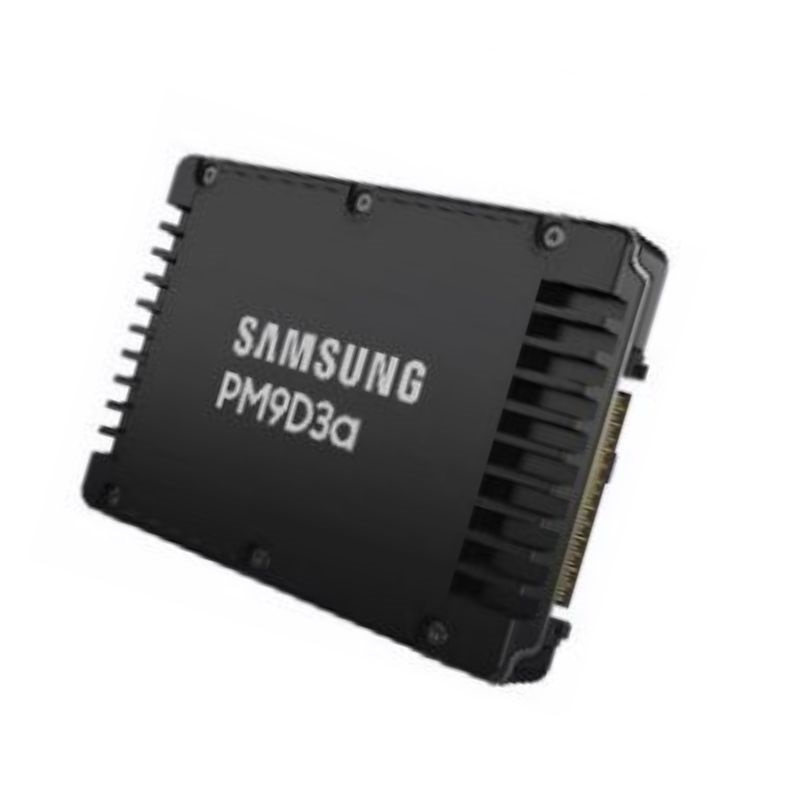
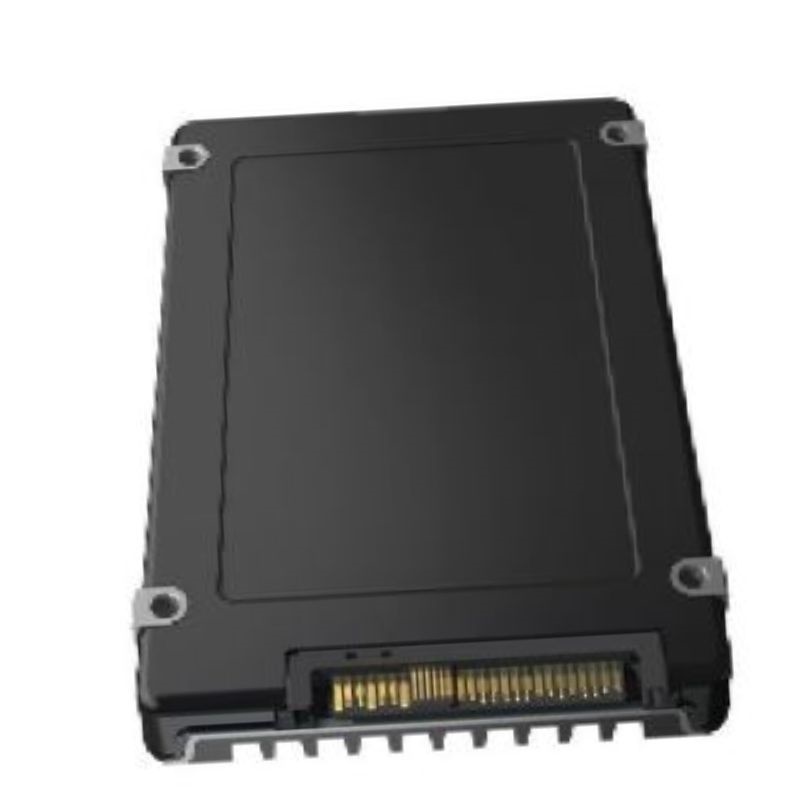
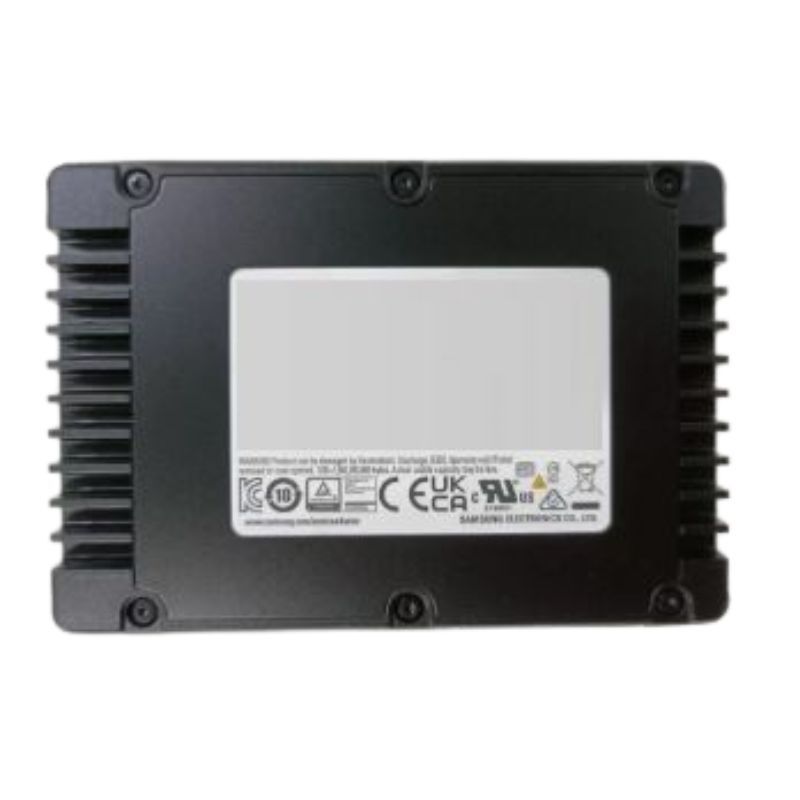
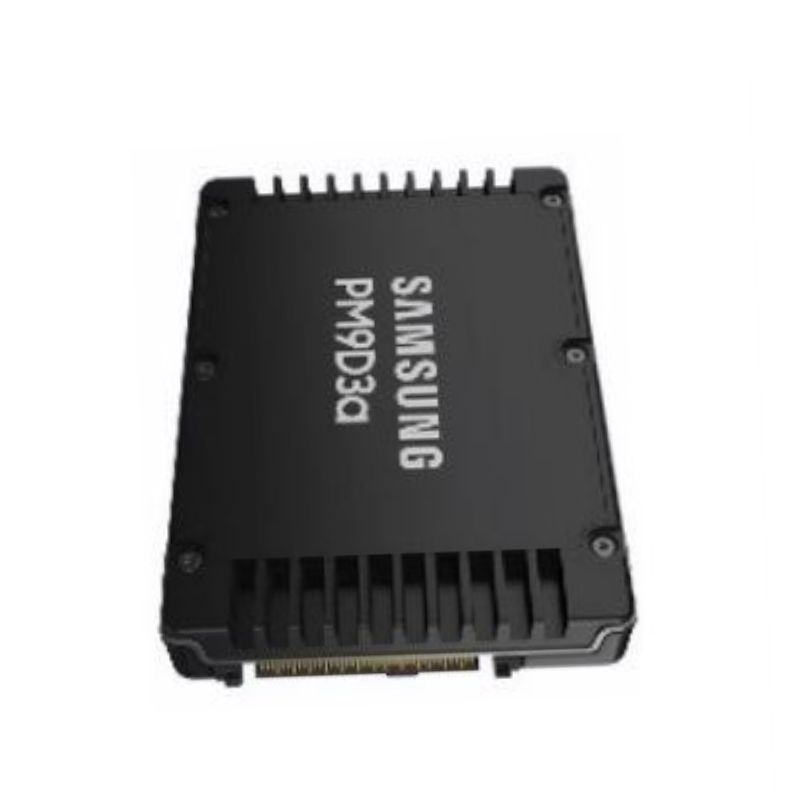
Samsung MZWL615THBLF-00BW7 15.36TB PCIe NVMe Solid State Drive. New Sealed in Box (NIB) with 3 Years Warranty
Built for intensive data tasks, the SAMSUNG PM9D3a delivers next-generation throughput on a compact 2.5-inch form factor. With PCIe 5.0 x4 connectivity, this enterprise-grade NVMe drive supplies blazing sequential speeds and exceptional random I/O performance for modern servers and storage arrays.
PCIe 5.0 x4 bandwidth dramatically accelerates large sequential transfers and reduces wait times for data-hungry applications.
15.36 TB per drive enables dense builds and fewer devices to manage, helping cut power, cabling, and rack overhead.
High IOPS ratings ensure rapid response during peak activity, with the endurance to sustain heavy write cycles day after day.
Confirm server backplane and controller support for PCIe 5.0 x4 NVMe SSDs in a 2.5-inch bay before deployment. Firmware and driver updates may be required for optimal performance.
The Samsung PM9D3a MZWL615THBLF-00BW7 15.36TB PCIe 5.0 x4 2.5-inch SSD represents a premium class of enterprise solid-state storage designed for high-throughput, low-latency environments. As organizations consolidate workloads, virtualize more aggressively, and deploy latency-sensitive applications at scale, a high-capacity NVMe drive in the 2.5-inch form factor offers a practical balance of density, performance, and serviceability. Built for continuous duty in data centers, this model—often integrated through U.2 or U.3 backplanes—aims to deliver consistent quality of service (QoS), endurance tuned for enterprise write patterns, and robust power-loss protection to protect in-flight data. Beyond raw speed, the PM9D3a family is engineered for predictable behavior under mixed I/O, secure fleet management, and seamless integration with current-generation PCIe 5.0 infrastructure.
When you are evaluating a category anchored by the Samsung PM9D3a MZWL615THBLF-00BW7 15.36TB PCIe 5.0 x4 2.5-inch SSD, you are considering drives built for duty cycles far beyond typical client workloads. The emphasis is on sustained performance during concurrent operations, multi-tenant isolation for shared platforms, and the ability to maintain throughput while delivering tight latency distributions. Whether deployed in hyperscale clusters, enterprise SAN/NVMe-oF fabrics, or edge compute nodes with severe latency budgets, this category rewards those seeking a storage foundation that scales efficiently with CPU core counts and modern I/O stacks.
PCIe 5.0 essentially doubles the per-lane bandwidth of PCIe 4.0, which means a x4 link can carry dramatically more I/O than previous generations when the platform and backplane are designed accordingly. In a 2.5-inch enterprise form factor, that bandwidth lines up with hot-swap convenience, density-friendly rack layouts, and predictable thermals. For operators moving from mixed SATA/NVMe estates to all-NVMe fleets, the PM9D3a form factor supports a familiar service model while unlocking the parallelism of the NVMe protocol and neural-network-friendly throughput for AI/ML data pipelines.
Enterprise and cloud operators choose this class of drive for environments where both capacity and performance are first-class requirements. NVMe over PCIe 5.0 shines when I/O concurrency is high and latency variance directly affects user experience or job completion times. In such contexts, a 15.36TB device lets architects reduce the device count, simplify power and thermal planning, and still meet demanding service-level objectives (SLOs).
Even within a single product family, enterprise drives vary by endurance class, power profile, and firmware personality. When building a category trust profile around Samsung PM9D3a MZWL615THBLF-00BW7 15.36TB PCIe 5.0 x4 2.5-inch SSDs, architects focus on how the device behaves at scale, during maintenance events, and under blended traffic.
NVMe was created for parallelism, eliminating many of the legacy constraints that limited SATA/SAS device scaling. PCIe 5.0 extends the runway by providing significantly more per-lane bandwidth, allowing NVMe queues to breathe without saturating links too early. In production, this synergy appears as faster table scans, quicker compactions in LSM-tree databases, and lower-latency commit paths during daily peaks. The result is not only higher top-line performance but also reduced variability, which matters deeply for multi-tenant clouds where noisy neighbors can otherwise disturb shared SLAs.
While peak IOPS often catches the eye, enterprise deployments prioritize tail latency—e.g., the 99.9th percentile—because the slowest operations can define user experience. Drives in the PM9D3a class are tuned to keep tails tight across queue depths typical for virtualized deployments. With more PCIe bandwidth, controllers spend less time congested, and firmware can better schedule background tasks such as garbage collection without introducing visible performance cliffs during bursts.
Enterprise NVMe categories generally segment into read-intensive (RI), mixed-use (MU), and write-intensive (WI) endurance classes. A 15.36TB device can appear in one or more endurance variants depending on intended use. Capacity-oriented SKUs often target read-intensive or mixed-use patterns common to VM fleets and content platforms. For log-heavy or high-ingest scenarios, opting for a higher endurance class within the same family helps preserve performance across the drive’s service life.
The 2.5-inch form factor remains a data center staple because it standardizes cabling, airflow, and caddies across generations. Many enterprise chassis include NVMe backplanes supporting U.2 or U.3 connectors, providing hot-swap convenience and service indicators (activity/fault LEDs). This significantly reduces mean time to repair (MTTR) compared to internal M.2-only layouts, especially in dense rack environments where front-accessible drives simplify logistics and compliance procedures.
PCIe 5.0 devices can draw more power at peak performance, making thermal design a critical part of capacity planning. The PM9D3a category is engineered for data center airflow, but enclosure planning still matters: ensure sufficient front-to-back flow, observe recommended intake temperature ranges, and allow for dynamic fan curves that respond to sustained write bursts or rebuild events. Consistent thermals stabilize QoS and prolong component life, while also keeping power budgets predictable.
Power-loss protection is a non-negotiable feature for enterprise drives. When an unexpected outage hits, drives in this category are designed to flush in-flight data to non-volatile media to maintain metadata consistency and prevent partial writes from corrupting higher-level structures. For operators, PLP reduces recovery time, simplifies incident response, and avoids the chain-reaction of resync workloads that can follow corrupted metadata in clustered systems.
Large estates rely on reliable device telemetry and secure, low-disruption firmware processes. The PM9D3a category aligns with common enterprise expectations: SMART attribute visibility, namespace management for multi-tenant or multi-application isolation, and support for secure firmware updates with signed images. Administrators can stage rolling updates, validate performance baselines, and enforce consistent device policies across clusters with minimal downtime.
While datasheets highlight throughput and IOPS, the storage planner’s lens includes how those metrics hold under steady-state pressure, mixed I/O sizes, and maintenance operations. A 15.36TB drive reduces device count per node, which can shrink failure domains and simplify cabling, but it also concentrates capacity; RAID design, erasure coding parameters, and rebuild strategies should be tuned accordingly.
As capacity per device increases, the blast radius of a single failure can grow if redundancy policies remain unchanged. Many operators respond by moving from classic RAID to distributed erasure coding across nodes, or by increasing parity/replica counts to maintain recovery time objectives (RTOs). PCIe 5.0 bandwidth helps by accelerating rebuilds and recoveries when a device is replaced or data is redistributed, reducing exposure windows.
Enterprise SSD firmware strives to minimize write amplification, especially in steady-state conditions with mixed random writes. The more efficiently the controller handles internal housekeeping, the less performance drift you see over time. In well-tuned PM9D3a deployments, background work like block erase and wear-leveling is orchestrated to avoid sharp latency spikes, which is vital for sensitive OLTP systems and real-time streaming analytics.
Shared platforms are the norm. The PM9D3a class is tuned for consistent QoS amid noisy neighbor patterns—think a backup job colliding with peak user activity, or compactions triggering during a busy business window. Ensuring that the slowest operations stay within tight bounds preserves application-level SLOs and reduces the need for heavy overprovisioning.
Security and compliance requirements increasingly shape storage choices. Enterprise NVMe SSDs commonly support namespace-level isolation, secure erase functions, and optional encryption features designed to integrate with platform key managers. Within this category, look for secure boot of drive firmware, signed updates, and mechanisms for cryptographic sanitization when decommissioning hardware or rotating assets between tenants.
Getting the most out of the Samsung PM9D3a MZWL615THBLF-00BW7 15.36TB PCIe 5.0 x4 2.5-inch SSD requires attention to system architecture, BIOS/UEFI configuration, and workload alignment. The following patterns help operators squeeze consistent value out of each rack unit.
Modern filesystems like XFS, ext4, and ZFS can benefit from queue depth tuning and I/O scheduler adjustments. For NVMe devices, multi-queue aware schedulers typically outperform legacy options. Pinning I/O queues to CPU cores local to the NVMe controller reduces cross-NUMA overhead. On virtualized hosts, ensure that paravirtualized storage interfaces expose enough queues to each guest to parallelize effectively.
When carving the PM9D3a capacity into volumes or namespaces, align storage classes with workload needs: faster tiers for transaction logs, balanced tiers for general VM disks, and capacity tiers for large object caches. Container orchestrators can map persistent volumes to NVMe namespaces to enforce performance isolation and simplify capacity accounting across teams.
Benchmarks highlight ceilings; production mixes expose averages and tails. To translate the PM9D3a’s capabilities into business outcomes, align test plans with the actual block sizes, concurrency, and read/write ratios you expect in production. Measure not only peak IOPS and throughput but also latency distributions under mixed workloads and maintenance tasks.
Many enterprise applications blend small random I/O with larger sequential sweeps: databases compacting sstables while serving queries, VMs snapshotting while hosting web traffic, or log pipelines ingesting while queries scan. Create test matrices that include common block sizes (4K, 8K, 16K, 64K, 128K, 1M) and mixed ratios to see how the drive sustains performance across queues. The PCIe 5.0 x4 link gives the controller headroom to keep latencies tight even as throughput rises.
Most SSDs show their best numbers right out of the box before background housekeeping asserts itself. Plan for steady-state measurements after the drive has been cycled through sufficient write volume to simulate real life. In the PM9D3a category, enterprise firmware is designed to minimize the delta between FOB and steady state, which simplifies capacity planning and reduces surprises during production cutovers.
Workloads that oversubscribe queues can create self-inflicted latency. Tune thread pools, adjust I/O depths, and ensure that application-level batching strategies match the NVMe device’s optimal operating window. The PM9D3a class provides plenty of queues for parallelism; the art is to use enough to saturate the link without introducing head-of-line blocking.
Consistent latency is often more valuable than occasional bursts of speed. Monitor p99 and p99.9 metrics and establish alert thresholds that reflect end-user expectations. For multi-tenant platforms, define storage quality-of-service policies that prevent a single workload from hogging bandwidth during peak hours. NVMe namespaces on the PM9D3a family can be leveraged to separate noisy jobs from latency-sensitive ones.
Capacity consolidation through high-density NVMe helps lower watts per terabyte and reduces the number of devices needed to meet a capacity target. This has downstream benefits for power, cooling, and rack footprint. A 15.36TB Samsung PM9D3a drive can replace multiple lower-capacity devices in legacy arrays, trimming cabling complexity and improving airflow uniformity across the rack.
Create power envelopes that account for peak write bursts, rebuild traffic, and housekeeping. Intelligent power management features on enterprise NVMe SSDs can throttle modestly to respect thermal caps without jeopardizing data integrity. Align rack-level PDUs and UPS capacity with the worst-case duty cycle to avoid cascading throttles during maintenance windows.
Distribute high-power devices evenly across chassis zones to avoid hot spots. Monitor intake temperatures at the front of the rack and maintain adequate deltas between intake and exhaust. The 2.5-inch form factor enables tight packing, but it also demands consistent airflow—plan blanking panels and cable management to prevent recirculation and negative pressure pitfalls.
Longer-lived drives in the PM9D3a family and other enterprise SSDs reduce replacement cycles and the environmental footprint associated with frequent swaps. Standardizing on hot-swap 2.5-inch NVMe promotes reuse of carriers and simplifies spares management, while firmware-driven secure erase or cryptographic sanitization streamlines decommissioning.
Moving to PCIe 5.0-capable NVMe drives like the PM9D3a MZWL615THBLF-00BW7 requires a compatibility check at multiple layers: chassis, backplane, controller, BIOS/UEFI, operating system, and, if applicable, SDS stack. Conduct pilot deployments to validate link training at the expected speed, LED behavior on caddies, and hot-swap event logging. Ensure the OS and hypervisor see the correct NVMe telemetry and expose queues appropriately to guests.
Transitioning from legacy protocols to NVMe delivers large efficiency gains, but it also changes operational patterns. Expect faster rebuilds in parity arrays, different queue depth sweet spots, and lower CPU time per I/O. Update runbooks that reference SAS expanders or SATA controllers, and ensure tooling can handle NVMe device naming conventions and namespace abstractions. With the PM9D3a class, the migration path often involves swapping carriers in existing 2.5-inch bays, providing an approachable modernization route.
In software-defined storage and hyperconverged platforms, NVMe capacity like the PM9D3a 15.36TB acts as both performance and capacity tier. Erasure coding, compression, and deduplication can be tuned to harness the increased throughput without oversaturating CPU. Use per-volume policies to assign resilience and performance budgets that match the workload’s importance and access patterns.
Certain workload patterns extract outsized benefits from PCIe 5.0 NVMe in a dense 2.5-inch footprint. Understanding why can help you prioritize which clusters to upgrade first.
Small-block random I/O with strict latency targets characterizes OLTP. When transaction commits depend on storage latency, the tight tails provided by enterprise NVMe are decisive. Microservices architectures, which often stitch together numerous small databases and caches, magnify the benefit across hundreds of call paths. The PM9D3a class provides the concurrency and link speed to keep microservice queries snappy under simultaneous load.
Streaming systems write many small records with periodic compactions and segment merges. A 15.36TB PCIe 5.0 device can maintain high ingestion rates while compacting efficiently, reducing backlogs and minimizing consumer lag. Faster rebuilds reduce the risk window during broker failure or planned maintenance.
Training and inference commonly read shuffled batches and write checkpoints. High-throughput NVMe helps reduce stall time during sampling and cut iteration cycles. For feature stores, random reads over large datasets benefit from low latency and parallel queues, while the 15.36TB capacity supports generous retention windows for reproducible experiments.
Edge nodes must be compact, power-efficient, and serviceable. The 2.5-inch PM9D3a category hits the sweet spot: easy field replacement, stable thermals, and high capacity in limited space. CDNs and edge analytics leverage the high read throughput to minimize origin fetches and deliver consistent performance during regional peaks.
The Samsung PM9D3a MZWL615THBLF-00BW7 15.36TB PCIe 5.0 x4 2.5-inch SSD sits at the intersection of density, speed, and manageability. As organizations push more data-intensive workflows into production and seek predictable performance under concurrency, this category offers the fundamentals that matter: low and tight latency distributions, reliable power-loss behavior, steady-state consistency, and a form factor that respects existing operational realities. Whether you are tuning OLTP clusters, scaling an analytics lakehouse, hardening CI/CD artifact stores, or supporting AI pipelines, the PM9D3a family’s enterprise DNA aligns with the outcomes modern infrastructure teams pursue.
Teams consolidating storage nodes, migrating from SATA/SAS to NVMe, or refreshing PCIe 4.0 estates to PCIe 5.0 will see the most immediate gains. If your applications are constrained by storage queues, if backup windows encroach on production hours, or if tail latency spikes erode user satisfaction, moving to a category centered on the Samsung PM9D3a 15.36TB PCIe 5.0 x4 2.5-inch SSD provides a pragmatic step-change with minimal disruption.


 Contact Us
 Information
 Catalog
 Solid State Drives (SSD)
 Network Switches
 Hard Disk Drives
 HBA & Controllers
 PC & Servers
 PC & Server Memory
 CPU & Processors
 Network Routers
 Power Supplies
 Tape Drives & Libraries
 Network Devices
 Computer & Network Cables