(7% discount is applied at checkout)
Cart is empty
Your go-to destination for cutting-edge server products
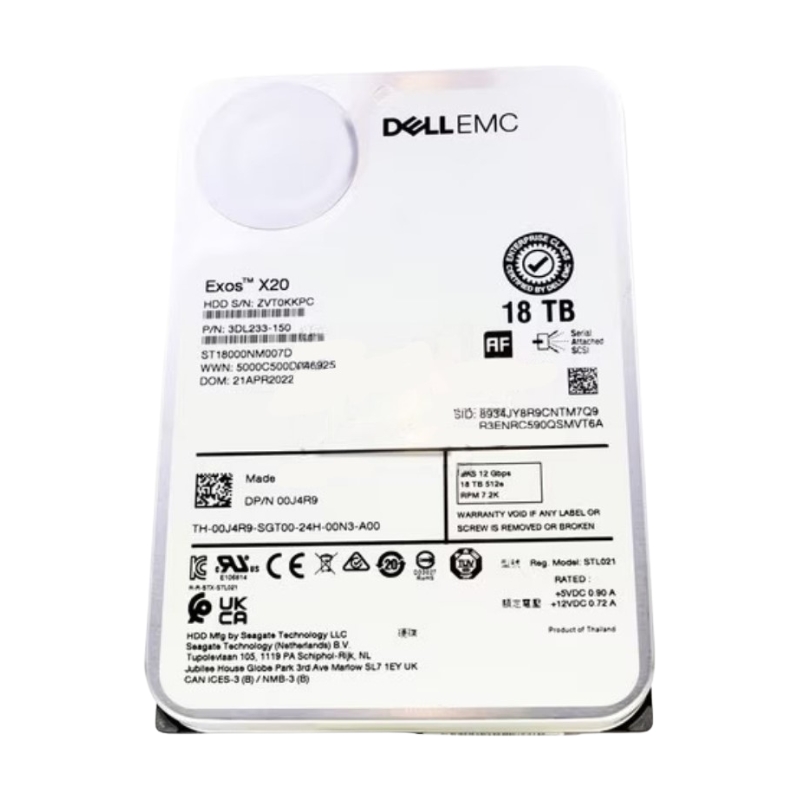


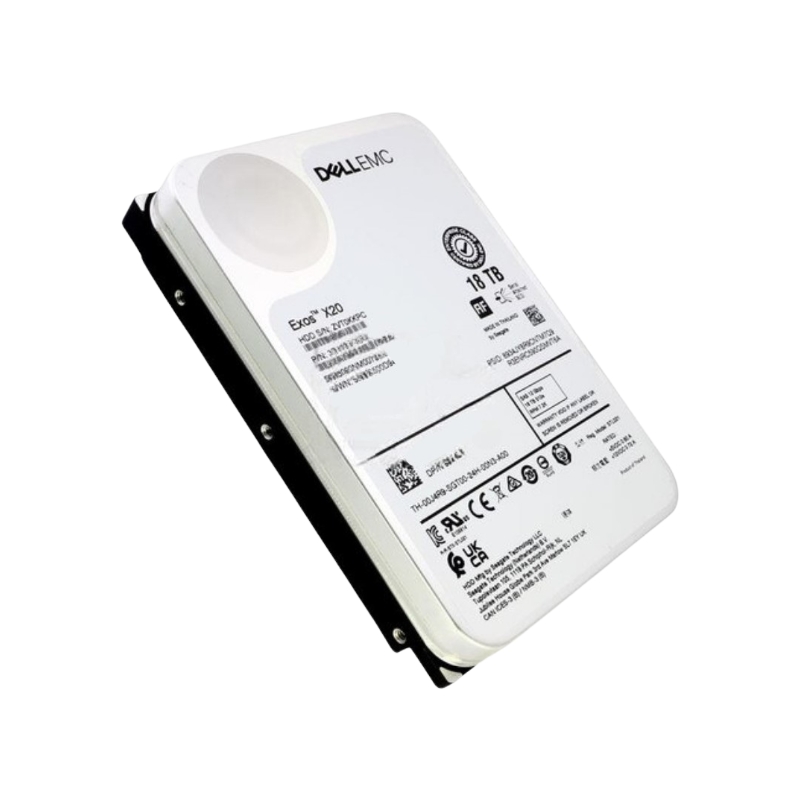
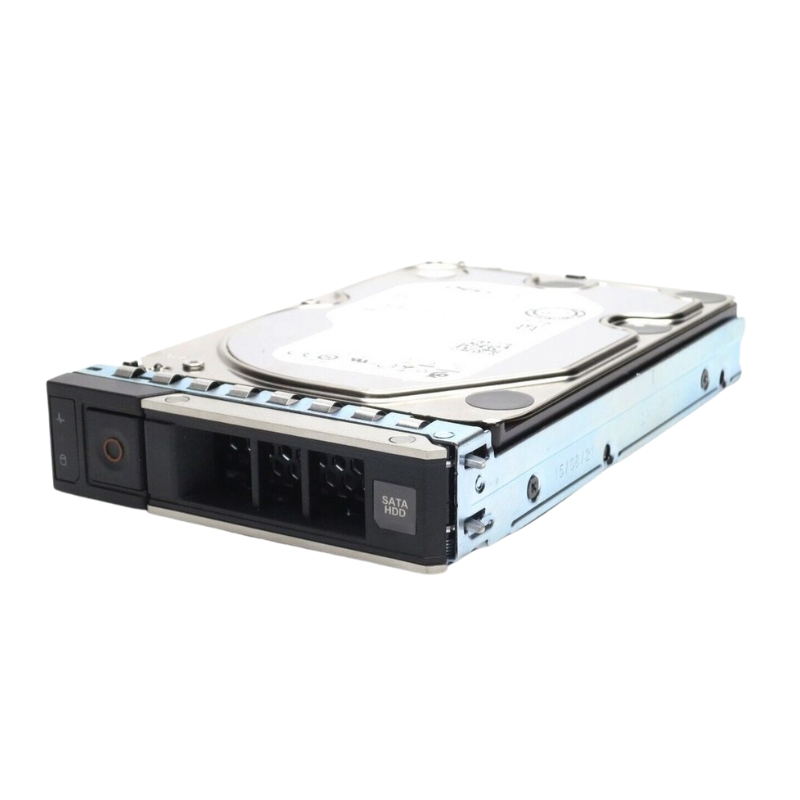
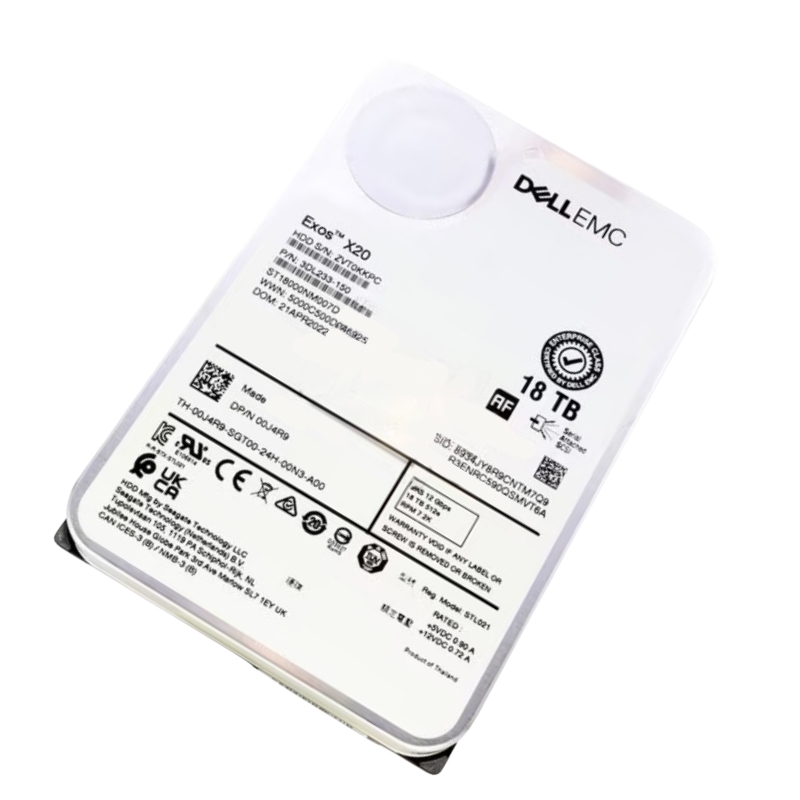
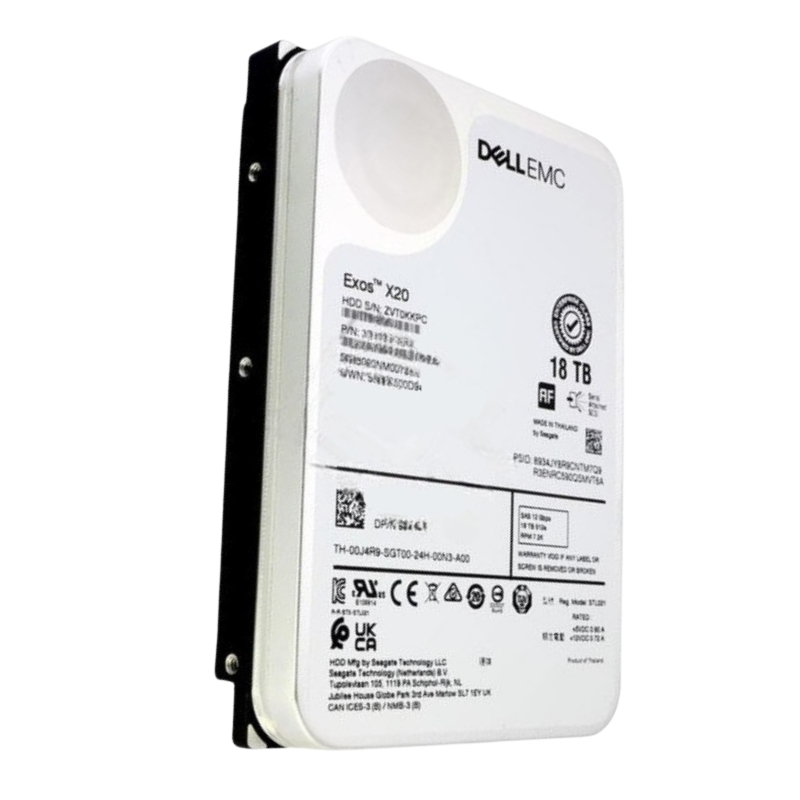
Seagate ST18000NM007D 18TB 7.2K RPM SAS-12GBPS Exos X20 256mb Buffer 3.5inch Enterprise Hard Disk Drive. Excellent Refurbished with 1 Year Replacement Warranty - Dell Version
The Seagate Exos X20 ST18000NM007D is an advanced enterprise-class hard drive engineered for massive storage infrastructures. With an impressive 18TB capacity, a rotational speed of 7200 RPM, and a SAS 12Gb/s interface, this HDD ensures dependable performance for critical workloads. Designed for data-intensive operations, it integrates a 256MB cache buffer and leverages helium-sealed technology to reduce power usage and maintain superior efficiency.
This enterprise-grade hard drive supports a variety of high-demand storage infrastructures:
Engineered for mission-critical enterprise environments, the Seagate Exos X20 ST18000NM007D offers consistent throughput and exceptional dependability:
The Seagate Exos X20 ST18000NM007D is optimized for use with a wide range of Dell enterprise storage solutions, making it highly versatile for IT administrators:
The Seagate ST18000NM007D (Exos X20) is an enterprise-grade, 3.5-inch hard disk drive engineered for data center reliability, high-density storage arrays, and mission-critical applications. With a massive 18TB capacity, 7,200 RPM performance profile, and SAS 12Gb/s interface, the Exos X20 targets workloads that demand sustained throughput, low latency, and consistent availability. This category covers the Exos X20 family, its technical strengths, appropriate use cases, compatibility considerations, and buying guidance for IT professionals, system integrators, and storage purchasers.
With 18 terabytes of raw capacity in a standard 3.5-inch form factor, the Seagate Exos X20 enables dense storage configurations that reduce rack space, cabling, and management overhead. Higher-capacity drives like the ST18000NM007D simplify expansion planning and are well-suited for archival storage, backup targets, object storage pools, and large-scale file systems.
The SAS (Serial Attached SCSI) 12Gb/s interface provides robust, full-duplex connectivity with enterprise-class features such as dual-port availability, higher command queue depth, and improved error recovery compared to SATA. Dual-port SAS allows multipath access for redundancy and load balancing, making the Exos X20 a good fit for SANs, RAID controllers, and virtualized storage clusters.
Running at 7,200 RPM and equipped with a 256MB buffer, the drive balances rotational latency, seek time, and caching to deliver steady sequential throughput and acceptable random I/O — critical for mixed workloads found in databases, virtualization hosts, and content delivery.
The standard 3.5-inch size ensures broad compatibility with enterprise servers and storage shelves. Hot-swap support and sled compatibility (varies by chassis) make the drive straightforward to deploy in modern data center hardware.
The Exos X20 excels at sequential read/write tasks typical of backup, archiving, media streaming, and object storage. Thanks to the large platters and high areal density, sequential throughput is optimized, delivering higher MB/s rates per drive than lower-capacity models. In object stores and cold-tier pools where large files are common, an 18TB Exos drive reduces the number of drives required and improves aggregate sequential performance.
While mechanical drives cannot match NVMe SSDs on random IOPS, the Exos X20 is tuned for enterprise mixed workloads through firmware optimizations and the relatively high platter count. Use cases such as virtual machine datastore layers, secondary database replicas, and content delivery nodes can benefit from strategic caching (SSD tiering or large controller caches) complemented by the Exos X20 for capacity.
Enterprise-class firmware provides consistent command handling and predictable latency under varied load. Predictability is essential in multi-tenant environments and service-level-agreement (SLA) driven operations. Combined with SAS's enterprise features, the ST18000NM007D offers consistent latency characteristics when correctly provisioned and monitored.
Higher-capacity drives consume more power per device than lower-capacity models, but because they deliver more terabytes per enclosure, power-per-TB often improves. Proper rack airflow, chassis compatibility, and power budgeting are important when populating dense storage arrays with Exos X20 drives.
Seagate engineers enterprise drives with higher Mean Time Between Failures (MTBF), workload ratings, and firmware features that reduce the risk of data loss. The Exos X20 is typically rated for heavy workloads (consult specific datasheets for workload rating in PB/year) and provides advanced error detection and correction routines to preserve data integrity.
Dual-port capability enables simultaneous connections to multiple controllers or paths for redundancy and failover. This is particularly important in SAN environments and clustered storage where drive accessibility must be maintained even during path failures.
The Exos family supports RAID operation and background media scanning (patrol read) to detect and remediate media issues before they escalate. Pairing the drive with intelligent RAID controllers enhances rebuild times and reduces the probability of unrecoverable read errors during rebuilds.
Enterprise drives include firmware that supports secure update mechanisms, telemetry, and SMART data reporting. Monitoring tools can ingest SMART attributes to predict drive degradation, trigger maintenance windows, and automate replacements.
Hyperscale operators prioritize density, cost per TB, and operational simplicity. The Exos X20's large capacity decreases the number of disks per PB and lowers rack footprint, cabling complexity, and management overhead — all critical for large object stores, cold archives, and bulk data retention.
Backup targets and secondary storage pools benefit from high-capacity HDDs that provide reliable, cost-effective retention. The Exos X20 can be used as the capacity tier behind faster snapshot or caching layers, hosting monthly/yearly backup images and long-term retention sets.
Media asset management, video surveillance storage, and CDN edge archives demand high sequential throughput and dense capacity. The Exos X20 supports large media libraries and long-term surveillance retention where write-once/read-many patterns are common.
For analytical workloads that scan large datasets, or for secondary database replicas where absolute minimum latency is not mandatory, an 18TB Exos drive provides an efficient balance between capacity and throughput.
When designing racks and shelves around 18TB drives, calculate raw capacity, RAID overhead, and hot-spare allocation. Consider how drive failure and rebuild times will affect overall performance and redundancy — higher capacity drives take longer to rebuild, so RAID level choices and spare policies are important.
A hybrid architecture combining low-latency NVMe or SAS/SATA SSDs for hot data and Exos X20 HDDs for capacity is a common design pattern. Use SSDs for metadata, write buffers, and random I/O acceleration, and place bulk cold data on HDD tiers to optimize cost and performance.
Ensure the server trays or JBOD enclosures provide adequate airflow and vibration isolation. High-density HDD populations increase acoustic and vibrational interactions, which can affect long-term reliability if chassis design is suboptimal.
Integrate SMART telemetry, HDD vendor tools, and build automation playbooks to regularly assess drive health, schedule replacements, and plan firmware updates. Automated alerting helps reduce mean time to detection for failing drives.
Verify that RAID controllers, HBAs, and backplanes support SAS 12Gb/s and the necessary port multipliers, cable lengths, and signal integrity for your chosen chassis. Check vendor compatibility lists and firmware notes to avoid interoperability issues.
Keep drive firmware consistent across arrays to avoid unexpected behavior. When mixing drive models or firmware revisions, test in staging environments to observe performance and compatibility impact under load.
Enterprise buyers can obtain Exos X20 drives through OEM channels pre-integrated into servers, retail channels for spare parts, or bulk procurement for large deployments. Consider warranty coverage, RMA terms, and vendor support when choosing where to source drives.
Choosing RAID 6, erasure coding, or modern parity schemes helps protect against multi-drive failures and long rebuild windows. Erasure coding across larger sets can improve storage efficiency compared to traditional RAID while providing similar resiliency characteristics.
Implement Quality of Service (QoS) policies to prevent noisy-neighbor effects, especially when Exos drives share enclosures with flash tiers. Limiting maximum IO burst rates and reserving throughput per tenant keeps multi-tenant clusters predictable.
Use vendor-recommended firmware profiles for enterprise use rather than desktop power-saving modes. Enterprise drives are tuned for responsiveness and predictable behavior rather than aggressive power gating that can harm performance under load.
When decommissioning drives, use certified secure erase methods or hardware-based crypto-erase (if available) to meet regulatory requirements. Verify erasure logs and maintain chain-of-custody documentation for compliance-heavy environments.
If hardware encryption is implemented at the drive or controller level, integrate keys with a centralized Key Management System (KMS) and follow best practices for key rotation and backup. Confirm that encryption schemes are compatible with multi-controller access in clustered deployments.


 Contact Us
 Information
 Catalog
 Solid State Drives (SSD)
 Network Switches
 Hard Disk Drives
 HBA & Controllers
 PC & Servers
 PC & Server Memory
 CPU & Processors
 Network Routers
 Power Supplies
 Tape Drives & Libraries
 Network Devices
 Computer & Network Cables