(7% discount is applied at checkout)
Cart is empty
Your go-to destination for cutting-edge server products
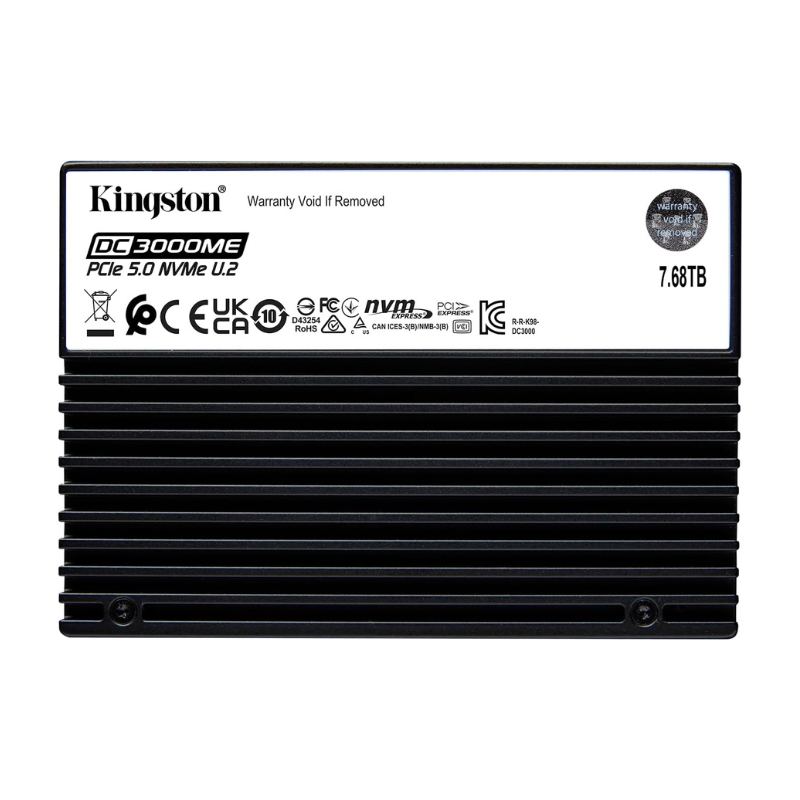


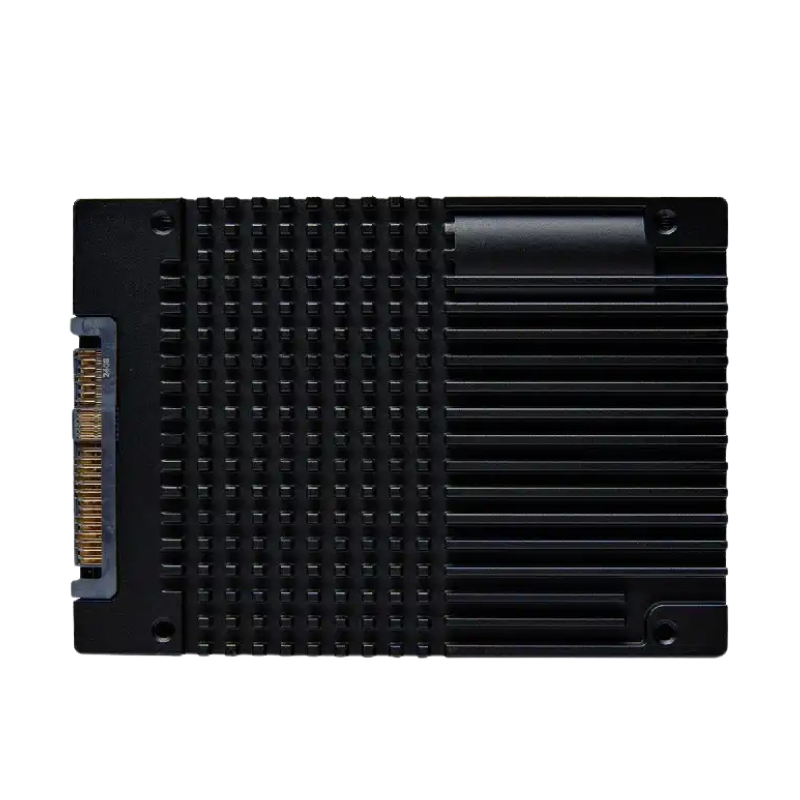
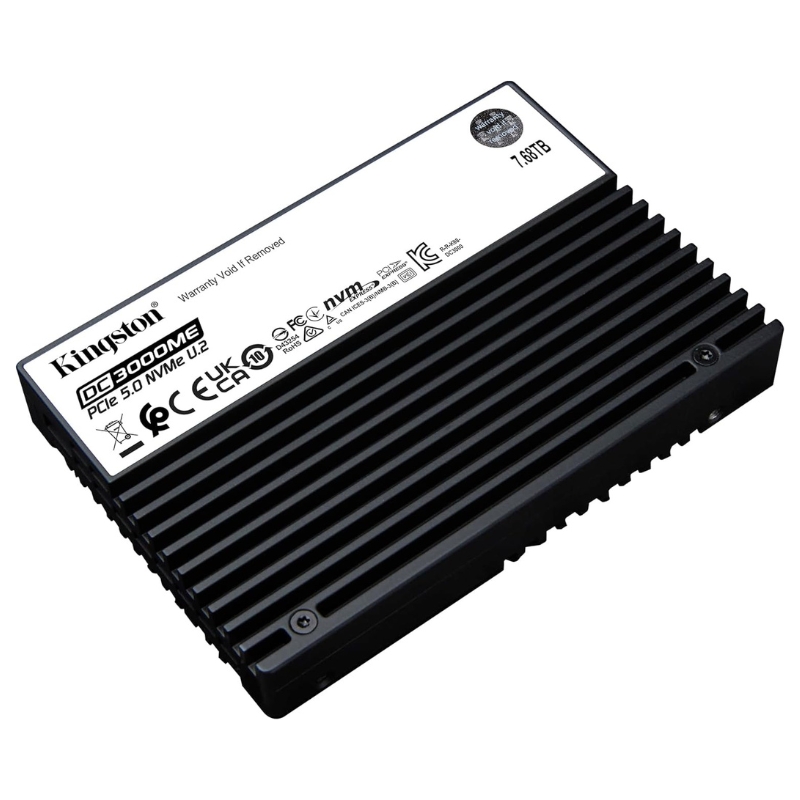
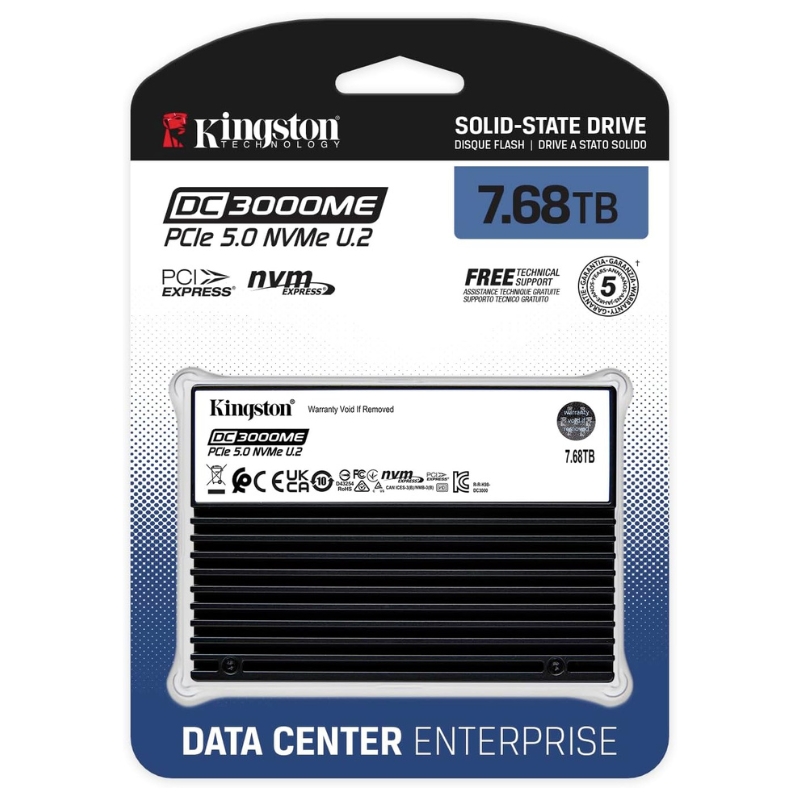
Kingston SEDC3000ME/7T6 7.68TB U.2 Nvme Gen5 X4 3D ETLC TCG Opal Enterprise Solid State Drive. New Sealed in Box (NIB) with 3 years Warranty
The Kingston SEDC3000ME/7T6 7.68TB U.2 NVMe Gen5 x4 SSD is a high-capacity, ultra-fast enterprise-grade solid-state storage solution. Designed for data centers and performance-intensive environments, this drive features top-tier reliability, speed, and data protection technologies.
The enterprise‑class solid state drive category to which the Kingston SEDC3000ME/7T6 belongs is designed to support demanding data centre, cloud infrastructure and high‑performance computing environments. Drives in this segment deliver large capacities, low latency, high I/O throughput and enterprise‑grade endurance. Within that, the sub‑category of U.2, 2.5″ × 15 mm NVMe Gen5 ×4 drives emphasises backwards compatibility and future‑proofing while maintaining the rugged reliability enterprises require. The Kingston SEDC3000ME/7T6 exemplifies this class by offering a 7.68 TB capacity, U.2 form factor, and PCIe 5.0×4 interface, making it suitable for next‑gen servers and storage arrays.
Within the enterprise SSD category, the U.2 2.5″ × 15 mm form factor is a preferred choice for data centre deployments. It combines ease of integration into standard 2.5″ drive bays with the mechanical and thermal advantages of the taller 15 mm height, enabling improved airflow and heat dissipation. The SEDC3000ME/7T6 adheres to this form factor, ensuring compatibility with typical rack‑mounted servers and storage enclosures.
This sub‑category emphasises adoption of the PCIe Gen5 x4 NVMe interface, delivering a significant leap in bandwidth and I/O performance compared to Gen4 drives. At the same time, backwards compatibility ensures that systems still running Gen4 can deploy the same drive without losing functionality. The SEDC3000ME/7T6 supports PCIe Gen5 x4 and is backward‑compatible with Gen4, making it a flexible choice for current and next‑generation infrastructures. :contentReference[oaicite:1]{index=1}
In the enterprise SSD category, a capacity such as 7.68 TB represents a high‑end tier designed to support applications that demand large data sets, including analytics, virtualization and caching layers. The SEDC3000ME/7T6 offers this capacity, ensuring that organisations can reduce drive count and lower the overhead of managing multiple smaller drives. :contentReference[oaicite:2]{index=2}
The memory technology underpinning this sub‑category is 3D eTLC (enterprise triple‑level cell) NAND, which provides a balanced mix of cost, capacity and endurance suitable for data centre workloads. The SEDC3000ME/7T6 uses 3D eTLC NAND, enabling it to deliver high capacity while maintaining enterprise performance and durability expectations. :contentReference[oaicite:3]{index=3}
This category targets very high sequential bandwidth to support large file movement, streaming, data loading and offloading. The SEDC3000ME/7T6 achieves up to 14,000 MB/s sequential read and up to 10,000 MB/s sequential write for the 7.68 TB model. :contentReference[oaicite:4]{index=4} These speeds help in scenarios like high‑throughput databases, live analytics pipelines and large virtual machine image transfers.
For transactional workloads, virtualization, and mixed read/write demands, random I/O performance is key. In this sub‑category, drives are engineered to deliver multi‑million IOPS values. The SEDC3000ME/7T6 offers up to 2,800,000 IOPS in 4K random read and up to 500,000 IOPS in 4K random write for the 7.68 TB variant. :contentReference[oaicite:5]{index=5} These figures place it among the top tier of enterprise SSDs focused on latency‑sensitive operations.
The category emphasises ultra‑low latency performance and consistent I/O delivery (QoS), even under sustained load. Controllers, firmware and power‑loss safeguards are designed to avoid large latency spikes. For the SEDC3000ME/7T6, latency metrics such as <10 µs read and <70 µs write have been quoted under 99 % QoS conditions. :contentReference[oaicite:6]{index=6} This ensures that high‑priority workloads do not suffer from performance degradation under heavy use.
In the enterprise SSD category, endurance is measured in DWPD (Drive Writes Per Day) and TBW (Terabytes Written). The sub‑category for mixed‑use or write‑intensive enterprise drives typically targets 1 DWPD over a warranty period. The SEDC3000ME/7T6 meets this with 1 DWPD and is rated for 14,016 TBW for the 7.68 TB model across the five‑year warranty period. :contentReference[oaicite:7]{index=7}
Reliability in the enterprise category also includes MTBF ratings often reaching multi‑million‑hour figures and onboard power‑loss protection (PLP) mechanisms. The SEDC3000ME/7T6 boasts an MTBF of 2 million hours. :contentReference[oaicite:8]{index=8} On‑board PLP helps safeguard data integrity in unexpected power‑down events. The combination of high endurance, long life ratings and PLP makes this sub‑category suitable for mission‑critical systems.
The enterprise SSD category places emphasis on data security, including hardware‑based encryption and support for self‑encrypting drive (SED) standards. The SEDC3000ME/7T6 supports AES‑256‑bit encryption and is compliant with TCG Opal 2.0 specifications, enabling secure data storage and regulatory compliance in enterprise environments. :contentReference[oaicite:9]{index=9}
An important aspect of the enterprise category is power efficiency under heavy usage. The SEDC3000ME/7T6 draws about 8 W at idle, roughly 8.2 W under max read, and up to 24 W under max write load. :contentReference[oaicite:12]{index=12} These efficiencies help data‑centre operators manage power budgets, cooling demand and rack density.
The enterprise SSD category supports large‑scale data centre deployments and cloud service infrastructures. With its large capacity, high I/O throughput, and enterprise reliability features, the Kingston SEDC3000ME/7T6 is well‑suited for high‑density storage racks, virtualised server clusters, hyper‑scale data farms and major cloud‑service providers seeking high performance with operational reliability. :contentReference[oaicite:13]{index=13}
Another sub‑category usage environment is high‑performance computing and analytics platforms where massive parallel workloads, large datasets and low latency are integral. The SEDC3000ME/7T6, with its 14,000 MB/s read speed and multi‑million IOPS capability, accommodates workloads such as real‑time analytics, simulation, AI model training, and large‑scale database processing without bottlenecking storage performance.
At the edge or in software‑defined infrastructure, storage devices must deliver consistent performance, manage temperature and vibration, and integrate with RAID architectures or namespace management at scale. The enterprise SSD category addresses this requirement and the SEDC3000ME/7T6 includes 128‑namespace support, wearable diagnostics, and operational resilience necessary for edge storage, software‑defined arrays and RAID deployments. :contentReference[oaicite:14]{index=14}
An important feature of the category is investing in forward‑looking infrastructure. Drives like the SEDC3000ME/7T6 bring PCIe Gen5 support — enabling organisations to leverage new server platforms and storage ecosystems — while retaining backwards compatibility with Gen4. This dual support means the drive can serve today’s infrastructure and transition smoothly into next‑generation platforms. :contentReference[oaicite:15]{index=15}
Because the category emphasises U.2 2.5″ form factor drives, system integrators and administrators should verify that their servers or storage arrays support the U.2 (SFF‑8639) connector and that the drive bays accommodate 15 mm height modules. Additionally, cooling and airflow within the chassis should be verified—higher performing SSDs such as the SEDC3000ME/7T6 generate heat under heavy sustained load and benefit from proper ventilation.


 Contact Us
 Information
 Catalog
 Solid State Drives (SSD)
 Network Switches
 Hard Disk Drives
 HBA & Controllers
 PC & Servers
 PC & Server Memory
 CPU & Processors
 Network Routers
 Power Supplies
 Tape Drives & Libraries
 Network Devices
 Computer & Network Cables