
(7% discount is applied at checkout)
Cart is empty
Your go-to destination for cutting-edge server products
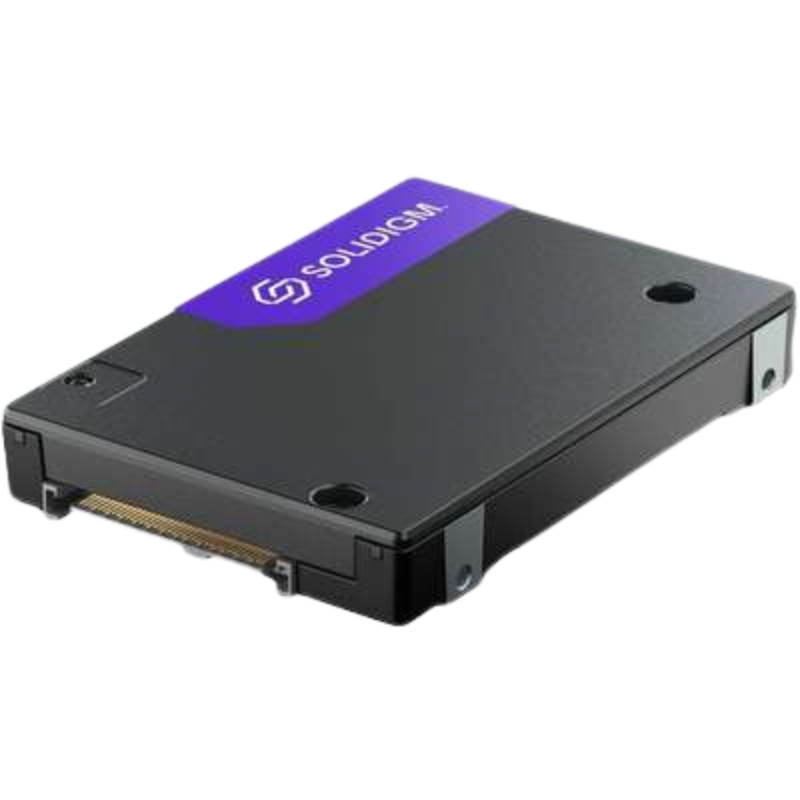
Solidigm SB5PH27E032T001 3.2TB PCI-Express NVMe 5.0 x4 V7 D7-PS1030 Series SFF TLC Generic No Opal Solid State Drive. New Sealed in Box (NIB) with 3 Years Warranty
| SKU/MPN | Warranty | Price | Condition | You save |
|---|---|---|---|---|
| SB5PH27E032T001 | 1 Year Warranty | Contact us for a price | New Sealed in Box (NIB) | |
| SB5PH27E032T001 | 1 Year Warranty | Contact us for a price | New (Box Not Sealed) |
The Solidigm SB5PH27E032T001 is part of the V7 D7-PS1030 product family that leverages the PCI-Express NVMe 5.0 x4 interface. That interface brings substantially higher theoretical bandwidth compared to previous generations, enabling intensive read/write operations at lower latency and greater parallelism. The 3.2TB capacity is an attractive middle ground between raw density and high IOPS performance, making it suitable for mixed and read-intensive enterprise workloads. The SFF (small form factor) physical profile optimizes rack density in servers and storage arrays. The drive uses 3D TLC NAND to balance cost per gigabyte with endurance and performance, and the “Generic No Opal” designation indicates it ships without TCG Opal hardware encryption enabled by default, an important detail for system integrators and security-minded organizations planning to implement their own encryption or rely on software-based safeguards.
By using PCIe 5.0 x4, this Solidigm SSD multiplies the per-lane throughput compared with PCIe 4.0, which directly benefits sequential throughput and can significantly improve sustained performance under heavy concurrency. NVMe as a protocol is purpose-built for flash media and unlocks a parallel command architecture that reduces I/O latency and CPU overhead. These combined attributes make the SB5PH27E032T001 ideal for applications such as high-transaction databases, virtual machine density increases, AI/ML model training datasets that require high read throughput, and real-time analytics where low-latency storage matters.
Performance for the SB5PH27E032T001 centers on three interrelated metrics: sequential throughput, random IOPS, and access latency. Sequential throughput measures the sustained transfer capacity for large contiguous reads and writes, and with the NVMe 5.0 x4 interface, this product category reaches levels that support fast staging of large datasets and quick cloning or snapshot operations. Random IOPS reflect how the SSD handles numerous small I/O operations per second, a crucial metric for databases and virtualized workloads. Low latency is the glue that holds the performance profile together; reduced command queuing delays and efficient NAND handling ensure that services dependent on real-time data retrieval see tangible improvements. Enterprise users should evaluate benchmark results for their specific queue depths and I/O sizes, as real-world performance depends on a mix of these factors, along with firmware optimizations and host system capabilities.
The 3D TLC (triple-level cell) NAND used in the V7 D7-PS1030 series presents a compelling balance between cost and endurance. While TLC stores more bits per cell than SLC or MLC, modern error-correction algorithms, wear-leveling schemes, and over-provisioning strategies significantly mitigate write amplification and ensure predictable endurance for enterprise use. Manufacturers typically rate drives with a drive write per day (DWPD) or total bytes written (TBW) metric, and system architects should match these endurance figures to workload characteristics—particularly for write-heavy applications. Data integrity is supported through on-drive ECC, power-loss protection mechanisms, and firmware-level safeguards that maintain consistent performance across the device lifespan.
The Solidigm 3.2TB NVMe 5.0 drive is well suited to a range of enterprise and prosumer scenarios. In high-density virtualization platforms, the combination of capacity and IOPS helps maximize VM per host ratios without sacrificing responsiveness. For database acceleration, the drive improves transaction latency and shortens query response times. Content delivery and caching layers benefit from the sequential throughput, enabling faster content refresh cycles and reduced backend pressure. AI/ML training pipelines that repeatedly read large data sets see accelerated data preparation and checkpointing operations. In addition, advanced analytics and real-time telemetry applications can leverage the lower access latencies and improved concurrency management delivered by the NVMe 5.0 interface.
Integration is often straightforward thanks to NVMe’s standardized interface, but attention to backplane compatibility, BIOS/UEFI NVMe firmware support, and host OS drivers is crucial. When installing multiple drives in a single chassis, consider thermal layouts and ensure power delivery meets peak consumption loads. NVMe-oF (NVMe over Fabrics) deployments may further leverage the drive’s capabilities by extending NVMe performance across network fabrics, allowing such drives to be part of disaggregated storage architectures where low-latency access is critical.
Most modern operating systems and hypervisors include NVMe drivers and storage management tools that recognize NVMe 5.0 devices, but verifying the firmware compatibility matrix and testing with your chosen hypervisor version (such as enterprise variants of Linux, VMware ESXi, or hyperconverged platforms) reduces integration risk. Storage orchestration layers and container platforms also benefit from fast persistent volumes backed by NVMe drives, especially when application-level caching or ephemeral data tiers depend on predictable IOPS and throughput.
When comparing the Solidigm V7 D7-PS1030 series to alternatives, evaluate cost per gigabyte, endurance ratings, and real-world tested performance at the queue depths and I/O mix representative of your workloads. While raw bandwidth is a headline metric for NVMe 5.0, practical performance depends on the controller’s firmware, NAND quality, over-provisioning, and the host environment. Consider lifecycle costs, vendor support contracts, and available tools for health monitoring and bulk firmware management. Price sensitivity often tilts decisions toward TLC-based drives, but for write-intensive workloads there may be value in higher endurance options or hybrid architectures that mix TLC with higher-endurance tiers.
The PCIe 5.0 specification and NVMe protocol are foundational technologies for ongoing data center evolution. Selecting drives that leverage these standards helps future-proof deployments by aligning with motherboards and host controllers that support higher lane speeds and increased I/O concurrency. For organizations planning phased upgrades, adopting NVMe 5.0-capable drives today creates a migration path that preserves investment as server platforms evolve. Additionally, the SFF format and high-capacity options like 3.2TB enable denser storage configurations that align with cost-per-rack optimizations.
To extract the best performance and lifetime from NVMe 5.0 drives like the SB5PH27E032T001, apply a few operational best practices. First, enable appropriate over-provisioning where possible to improve endurance and reduce write amplification. Second, ensure firmware is current and validated in a test environment before widespread deployment. Third, monitor SMART telemetry and integrate it into your observability stack to track wear levels, temperature trends, and media error rates. Fourth, design I/O scheduling and queue depths in application layers that align with the drive’s strengths—small random reads at moderate queue depths can be processed extremely quickly, while sustained large writes may require pacing or intentional caching to avoid thermal-induced throttling. Finally, align backup and snapshot strategies with predictable drive replacement cycles to avoid data loss in edge cases.


 Contact Us
 Information
 Catalog
 Solid State Drives (SSD)
 Network Switches
 Hard Disk Drives
 HBA & Controllers
 PC & Servers
 PC & Server Memory
 CPU & Processors
 Network Routers
 Power Supplies
 Tape Drives & Libraries
 Network Devices
 Computer & Network Cables