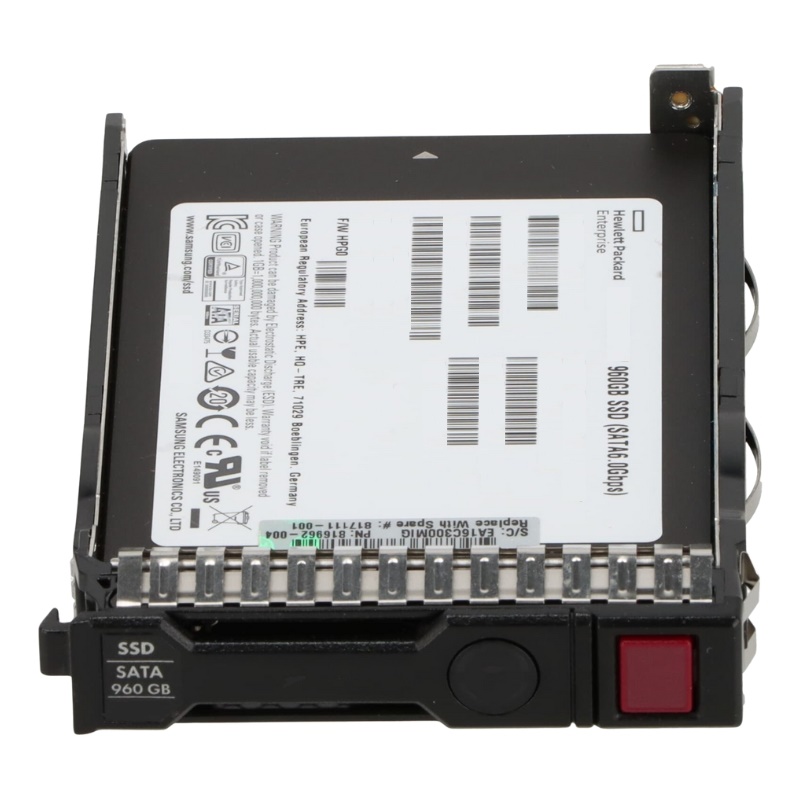
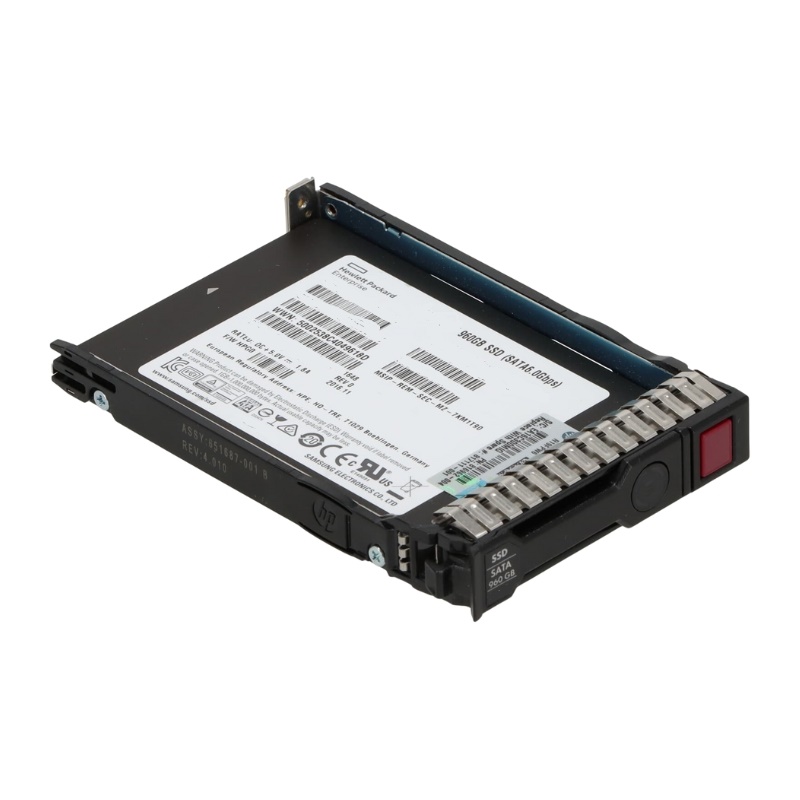
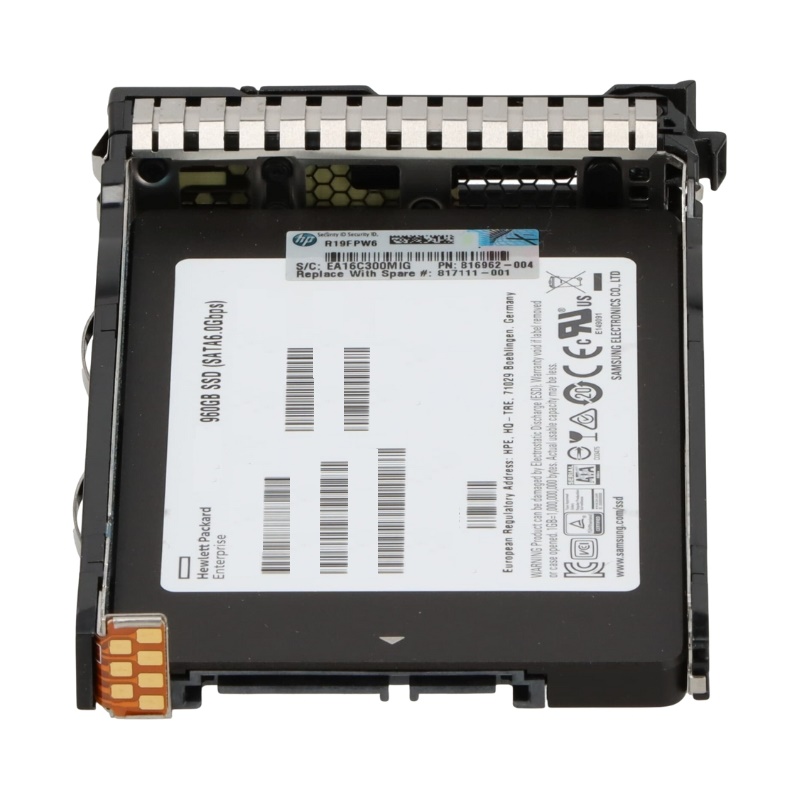
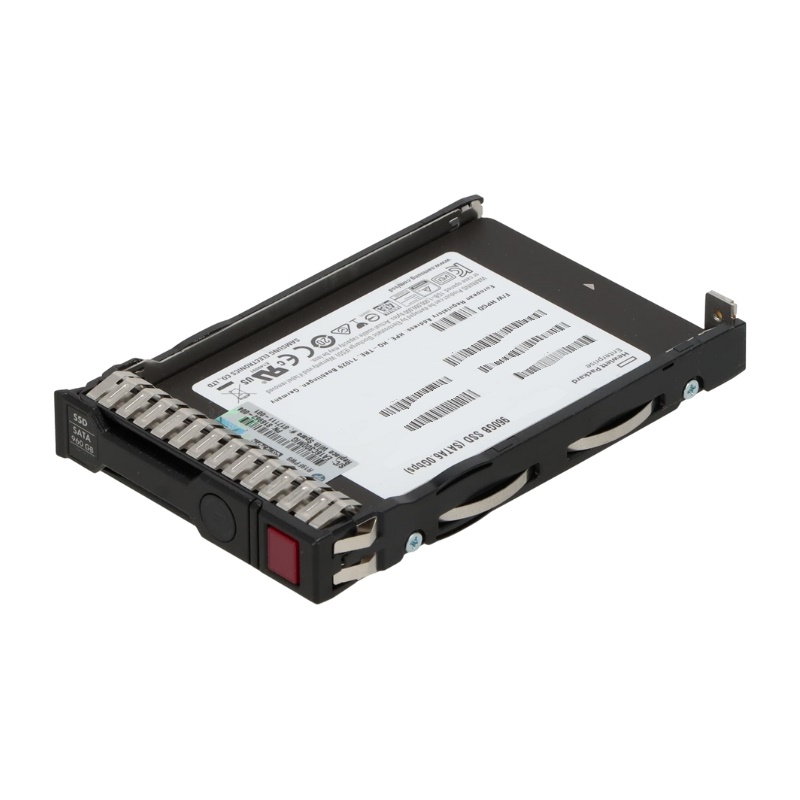
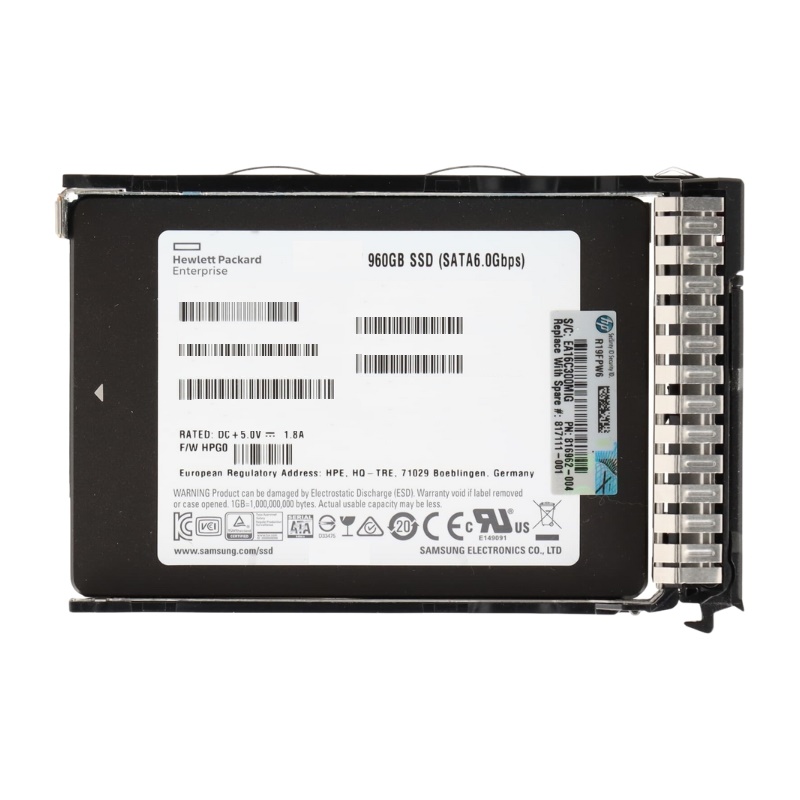
SSDSC2KG960G7P HPE 960GB SATA 6GBPS Mixed Use 2.5 Inch SC Solid State Drive
- — Free Ground Shipping
- — Min. 6-month Replacement Warranty
- — Genuine/Authentic Products
- — Easy Return and Exchange
- — Different Payment Methods
- — Best Price
- — We Guarantee Price Matching
- — Tax-Exempt Facilities
- — 24/7 Live Chat, Phone Support
- — Visa, MasterCard, Discover, and Amex
- — JCB, Diners Club, UnionPay
- — PayPal, ACH/Bank Transfer (11% Off)
- — Apple Pay, Amazon Pay, Google Pay
- — Buy Now, Pay Later - Affirm, Afterpay
- — GOV/EDU/Institutions PO's Accepted
- — Invoices
- — Deliver Anywhere
- — Express Delivery in the USA and Worldwide
- — Ship to -APO -FPO
- — For USA - Free Ground Shipping
- — Worldwide - from $30
Product Overview of HPE 960GB SATA 6GBPS SSD
The HPE 960GB SATA 6G MU SFF SC SPL DS SSD is built for high-performance enterprise applications requiring consistent speed, reliability, and endurance. Designed to meet the demands of data centers, it delivers impressive storage capacity in a compact format.
General Information
- Manufacturer: HPE
- Capacity: 960GB of high-speed solid-state storage
- Interface: SATA III (6G) for enhanced performance
- Form Factor: 2.5" SFF for compact deployment
- OEM: Intel hardware, rebranded for HPE enterprise systems
- Ideal Environment: Enterprise-class deployments
Massive Data Capacity in Compact Size
- Provides 960 gigabytes of flash-based storage, ideal for growing workloads
- Optimized for read-intensive applications and mixed-use environments
- Minimizes physical footprint with its 2.5-inch small form factor (SFF)
Reliable SATA Interface with High Throughput
- Utilizes Serial ATA (SATA) connection for broad compatibility
- Supports data transfer rates up to 6 gigabits per second (6Gbps)
- Engineered for enterprise-grade reliability and speed
Performance and Class
- Designed under the Mixed-Use (MU) classification — balancing read and write operations
- Tailored for intensive workloads in enterprise environments
- Delivers consistent I/O performance under pressure
Compatibility and Form Factor Benefits
- Conforms to SFF (Small Form Factor) standards, saving valuable rack space
- Compatible with HPE servers and storage arrays supporting 2.5” SATA drives
- Allows seamless integration into scalable IT infrastructures
OEM and Build Quality
- Powered by Intel technology, ensuring trust and durability
- Manufactured to HPE’s enterprise standards for performance and stability
- Ideal for mission-critical applications, virtualization, and databases
Additional Considerations
- No built-in encryption; external security measures may be required
- Sector size details not specified — verify compatibility with your system
- May ship without tray — ensure appropriate mounting hardware is available
Use Cases & Benefits
- Great for virtualization, backup, and database operations
- Boosts server response time with high-speed flash memory
- Ensures long-term reliability and lower latency under sustained workloads
The SSDSC2KG960G7P HPE 960GB SATA 6Gbps Mixed‑Use 2.5″ SC SPL DS SSD
The SSDSC2KG960G7P — an HPE‑branded, enterprise‑grade, solid‑state drive — delivers 960 gigabytes of high‑speed, reliable flash storage through a SATA interface at up to 6 gigabits per second. Crafted for mixed‑use workloads, this drive spans the spectrum between read‑intensive and write‑intensive tasks, balancing endurance, throughput, and latency. Suited for data centers, virtualization clusters, database servers, high‑performance computing, and demanding cloud infrastructures, it offers a robust alternative to consumer SSDs, designed specifically for enterprise environments where consistent performance under load is crucial.

Interface & Data Transfer Rate
- SATA Interface: SATA III standard supporting up to 6 Gbps (gigabits per second) exchange rate, ensuring backward compatibility with SATA II controllers albeit at lower speeds.
- Protocol Support: AHCI over SATA, ensuring native support in most operating systems and firmware designed for server/enterprise deployments.
- Throughput Potential: While maximum theoretical throughput is 6 Gbps, real‑world sustained rates depend on controller quality, firmware, and mixed read/write loads.
Mixed‑Use Classification & Endurance
- Mixed‑Use (MU) Class: The drive is rated for mixed workloads, meaning it supports both read heavy and write heavy operations with balanced endurance.
- Write Endurance: Measured in drive writes per day (DWPD) or total terabytes written (TBW), this SSD is engineered to tolerate steady writes over its service life without degradation of reliability.
- Data Integrity: Incorporates error correction code (ECC), wear‑leveling algorithms, bad block management, and spare capacity to maintain data reliability over long periods.
Performance Metrics
- Random Read/Write IOPS: Optimized for high input/output operations per second (IOPS) in mixed usage settings—especially critical for transactional databases, virtualization, and multi‑user file systems.
- Sequential Throughput: Large block read/write speeds that benefit large file transfers, backups, or logging tasks.
- Latency: Low latency under both idle and heavy load conditions, crucial for performance‑sensitive workloads like live virtual machines or online transaction processing (OLTP).
Design & Build Quality
OEM & Manufacturing Details
- Original Equipment Manufacturer: Intel, under the HPE umbrella, ensuring high manufacturing standards, quality control, and component reliability.
- Controller and NAND Technology: Enterprise‑grade controller with power loss protection, robust firmware, intelligent overprovisioning, and high quality NAND with endurance suited for mixed workload.
Physical Features & Mechanical Specifications
- Dimensions: Conforms to 2.5‑inch drive form factor (~100.45mm × 69.85mm × 7mm or 9.5mm depending on chassis allowance), easing deployment in blade servers, rack‑mount trays, or hot‑swappable drive bays.
- Weight: Typically light, owing to NAND flash, minimal moving parts; reduces mechanical stress and impact when racking or transporting hardware.
- Thermal Behavior: Designed for enterprise ambient operating conditions; optimized for airflow in server racks; supports operating temperature ranges typical for data center environments.
Reliability & Security Features
- Data Protection: Features like ECC, cyclic redundancy checks (CRC), and internal redundancy to maintain data correctness.
- Spare Capacity / Over‑Provisioning: Reserved flash sectors maintain performance over time and mitigate write amplification.
- Shock & Vibration Resistance: Solid‑state design avoids moving components, improving resistance to mechanical shocks, vibration, and physical stress compared to spinning disks.
Virtualization & Cloud Infrastructure
- Deploys virtual machines (VMs) requiring frequent reads and writes, benefiting from balanced performance.
- Facilitates cloud storage back‑ends, block storage, and virtual desktop infrastructure (VDI).
- Optimizes latency‑sensitive operations like boot storms, snapshots, and template spawning.
Databases, Transaction Systems & OLTP
- Supports small random reads/writes typical in relational databases, key‑value stores, and transactional workloads.
- Ideal for workloads with mixed query patterns—both read‑dominant and write bursts.
- Helps reduce tail latency for critical transactions, ensuring consistency under load.
Backup, Logging & Data Protection Workflows
- Useful for high‑volume logging systems, secure write‑intensive append operations.
- Can be used as cache or staging area in backup pipelines for faster read/write consolidation.
- Allows frequent snapshots or incremental backups without severely degrading performance.
Enterprise File Serving & Big Data Analytics
- Suitable for file servers managing shared files across many users simultaneously.
- Performs well in big data analysis tasks that require both large sequential scans and smaller random accesses.
- Feeds demands of content distribution, media rendering, or video editing starting within enterprise setups.
Operational Considerations
Compatibility & Integration
- Compatible with servers, storage arrays, blades, and chassis that accept 2.5‑inch SATA drives.
- Verify firmware compatibility with existing controllers, HPE BIOS/firmware versions, and storage management tools.
- Ensure chassis supports “SC SPL DS” form—drive slot, small case, single‑port low profile—to avoid airflow and fitting issues.
- Check power draw during peak writes; enterprise SSDs have higher active power consumption under load vs idle.
- Ensure server rack cooling is sufficient: airflow, ambient temperature, and chassis design must support thermal specs of the drive.
- Firmware thermal throttling might engage if drive exceeds operating temperature limits—affects throughput but protects hardware.
Keyword Opportunities & Phrasing
- “HPE 960GB SATA mixed‑use SSD”
- “SSDSC2KG960G7P enterprise SSD review”
- “2.5‑inch SATA 6Gbps drive for data center”
- “Mixed‑Use classification SSD endurance”
- “SC SPL DS form factor drive compatibility”
Content Themes to Address
- Durability: How the SSD handles frequent writes and mixed read/write patterns.
- Performance under load: Latency, throughput, and consistency during heavy operations.
- Power consumption & heat output: Important for server racks, cooling budgets, and energy costs.
- Compatibility: Matching firmware, compatibility with HPE servers, RAID controllers, and drive bays.
Electrical & Interface Specifications
- Interface Standard: SATA III (6.0 Gbps), ensuring high bandwidth, backward compatibility, and reliable signaling.
- Voltage Requirements: Typical 5V supply for SATA drives; operating and standby consumption vary by workload.
- Current Draw: Higher during active write/read; idle and standby currents much lower — check manufacturer datasheet for FW‑specific numbers.
Environmental Specifications
- Operating Temperature: Usually rated for enterprise ambient ranges (e.g. 0°C to ~70°C or as specified) for reliability.
- Non‑Operating / Storage Temperature: Broad range to allow shipping and storage without damage.
- Shock & Vibration: Tested to standards (e.g. multiple G’s of shock, vibration per MIL‑STD or manufacturer rating), enhancing durability in rack mount scenarios.
Mean Time Between Failures (MTBF) & Longevity
- High MTBF figures typical of enterprise drives—often millions of hours of expected usage before statistically probable component failure.
- Warranty tied to endurance metrics (DWPD, TBW), with practice often more conservative than maximum write ratings.
- Life extension via features like over‑provisioning, wear‑leveling, and background garbage collection to ensure stable performance over time.
Security & Data Safeguards
- While this model may not include built‑in encryption or self‑encrypting drive (SED) features, combining with software/hardware encryption layers is recommended.
- Data integrity tools (ECC, bit error rate (BER) targets, CRC) protect from data corruption over time.
- Firmware features to prevent data loss during power interruption where available (power loss protection capacitors or equivalent designs in controller).
Deployment Scenarios & Best Practices
Server Rack Integration
- Ensure drive bays are compatible with “SFF 2.5‑inch, SC SPL DS” dimensions for optimal fit and cooling.
- Provide proper airflow over the drive front to dissipate heat generated during continuous writes.
- Use drive trays or caddies matching HPE/Intel standards to avoid loosening or vibration.
RAID / Storage Array Configurations
-
<
- Can be deployed in RAID configurations to ensure redundancy (RAID‑1, RAID‑5, RAID‑6, RAID‑10) though mixed‑use endurance should be considered for write amplification.
- Use appropriate RAID controller firmware that supports SSD trim / garbage collection to maintain performance.
- Monitor RAID rebuild performance and impact on mixed workload to avoid bottlenecks.
Operation and Efficiency
- Energy usage under load: higher consumption of power during sustained writes; idle/standby power draws are lower but still relevant for dense rack deployments.
- Cooling & thermal management costs: racks may require better cooling, fans, airflow designs when many SSDs active.
- Maintenance labor: installing firmware updates, replacing failed units, monitoring health adds to operational overhead—mitigated by SSD’s reliability.
Keyword Strategy
- Include primary keywords: “SSDSC2KG960G7P”, “HPE 960GB SATA 6Gbps Mixed‑Use SSD”, “enterprise mixed‑use SATA SSD”, “2.5‑inch data center SSD”.
- Use secondary keywords: “drive endurance”, “IOPS performance”, “SATA 6G throughput”, “SFF DS drive slot”, “HPE/Intel OEM SSD”.
- Long‑tail phrases: “best mixed use SSD for virtualization”, “SATA SSD for OLTP workloads”, “HPE enterprise SSD review and specs”.
Content Depth & Relevance
- Provide detailed specs and comparisons (with read‑intensive and write‑intensive SSDs) to help buyers make informed choices.
- Use quantifiable metrics (TBW, DWPD, IOPS, sequential throughput) to back claims, which search engines favor.
- Address user pain points like how write endurance degrades, what to expect in worst‑case latency, and power/thermal constraints.
User Experience & Rich Media
- Include diagrams or tables showing performance under mixed loads vs pure reads or writes.
- Offer visuals of form factor “SC SPL DS” to illustrate compatibility with server slots.
- Provide downloadable spec PDFs or datasheets to increase trust and dwell time.
Advantages & Potential Limitations
Advantages
- High storage capacity (960 GB) in a compact 2.5‑inch enterprise form factor.
- Mixed‑use endurance enabling balanced read/write performance over heavy workloads.
- Solid SATA III (6Gbps) interface with broad compatibility and mature ecosystem support.
- Robust reliability via OEM Intel manufacturing, excellent firmware, and strong build quality.
- Suitable for diverse enterprise workloads: virtualization, databases, file services, backups, analytics.
Potential Limitations
- No built‑in encryption – additional security layers may be required.
- Write performance under extremely heavy, continuous writes will lag behind write‑intensive SSDs.
- Power consumption and heat generation during high writes may require attention in dense rack environments.
- Initial cost higher than consumer‑grade SSDs; total cost must factor in lifespan and duty cycle.
- Compatibility issues if chambers or racks cannot accommodate “SC SPL DS” form factor or lack sufficient cooling.