
(7% discount is applied at checkout)
Cart is empty
Your go-to destination for cutting-edge server products
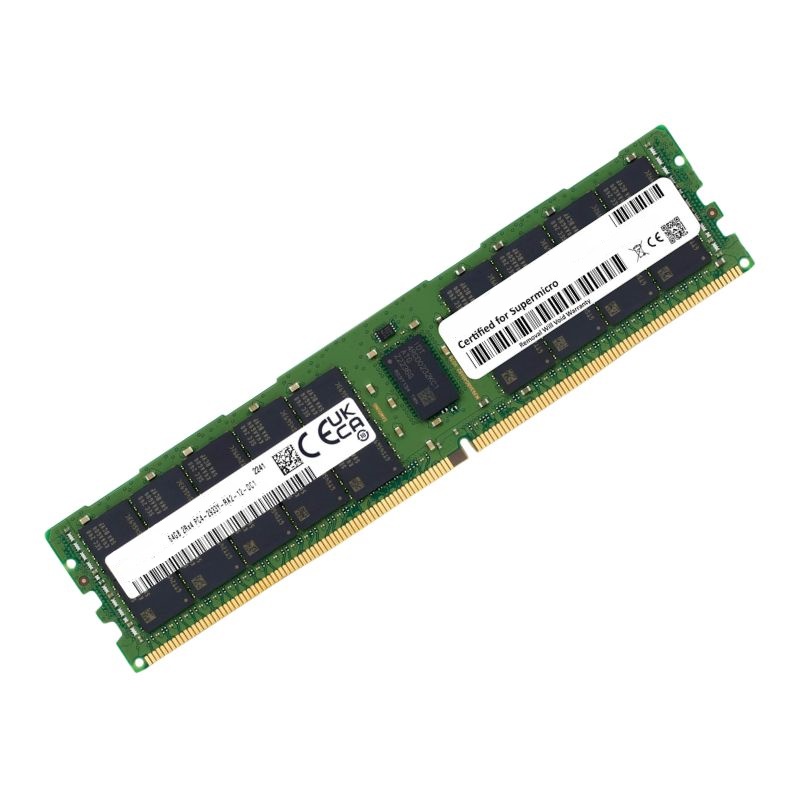
Supermicro MEM-DR564L-011 64GB DDR5 4800MHz Pc5-38400 Dual Rank ECC Registered 1.1v Cl40 DDR5 SDRAM 288-pin RDIMM Memory Module For Server. New (System) Pull with 1 year replacement warranty- Hynix Version
The Supermicro MEM-DR564L-011 is a high-capacity 64GB PC5-38400 DDR5 4800MHz 2Rx4 ECC Registered DIMM designed for enterprise-grade servers and advanced computing environments. This premium memory module ensures superior speed, reliability, and efficiency for mission-critical workloads.
The Supermicro MEM-DR564L-011 64GB DDR5 4800MHz RDIMM belongs to the advanced enterprise server memory category designed to meet the growing demands of modern data centers, cloud infrastructure, virtualization platforms, and high-performance computing environments. This category focuses on high-density, high-bandwidth, and highly reliable memory modules that are purpose-built for continuous workloads and mission-critical applications. DDR5 server memory represents a significant architectural evolution compared to DDR4, delivering improved bandwidth efficiency, better power regulation, and enhanced scalability for multi-socket server platforms.
Server-grade DDR5 RDIMM modules such as this one are engineered for stability and compatibility across validated server motherboards, particularly within Supermicro server systems. The category emphasizes error correction, signal integrity, and long-term operational reliability, which are essential in enterprise environments where uptime, data accuracy, and predictable performance are critical. With a 64GB capacity in a single module, this class of memory enables higher memory density per system while reducing slot population complexity.
DDR5 SDRAM introduces fundamental improvements over previous memory generations by doubling bank groups and enhancing burst length, which collectively increase memory throughput without proportionally increasing latency. The Supermicro MEM-DR564L-011 operates at DDR5-4800 speeds, corresponding to PC5-38400 bandwidth, making it suitable for next-generation processors that demand higher memory data rates for compute-intensive workloads.
Within this category, DDR5 memory incorporates on-die error correction capabilities that complement traditional ECC functions, helping improve yield and reliability at higher densities. The architectural changes in DDR5 allow for better scaling as system memory requirements continue to expand, especially in virtualized environments where memory contention can impact performance. These improvements position DDR5 RDIMM modules as a foundational component for future-ready server infrastructures.
Power efficiency is a defining characteristic of the DDR5 server memory category. Operating at 1.1 volts, the Supermicro MEM-DR564L-011 consumes less power compared to DDR4 modules, which typically operate at higher voltages. This reduction in operating voltage contributes to lower overall power draw, reduced thermal output, and improved energy efficiency at scale.
In large data center deployments, even marginal power savings per module can translate into significant reductions in operational costs. DDR5 memory also integrates power management circuitry directly onto the module, allowing for more granular voltage regulation and improved stability under fluctuating workloads. This design aligns with enterprise sustainability goals while maintaining consistent performance.
Error Correcting Code registered memory is a cornerstone of enterprise server memory categories. The Supermicro MEM-DR564L-011 utilizes ECC technology to detect and correct single-bit memory errors, significantly reducing the risk of data corruption. In environments where databases, virtualization hosts, and enterprise applications run continuously, ECC memory plays a crucial role in maintaining system integrity.
Registered DIMM architecture further enhances signal integrity by placing a register between the memory controller and the DRAM chips. This buffering reduces electrical load on the memory controller, enabling higher memory capacities and improved stability in multi-DIMM configurations. As a result, RDIMM memory is the preferred choice for enterprise servers with large memory footprints.
The dual rank design of this 64GB DDR5 RDIMM module allows for improved memory interleaving, which can enhance effective bandwidth utilization. Dual rank modules present multiple memory ranks to the controller, enabling better command scheduling and data access efficiency under parallel workloads.
In server environments running virtualization, analytics, or transactional workloads, dual rank memory can contribute to more consistent performance under load. This configuration supports balanced memory access patterns and complements modern multi-core CPUs that rely on efficient memory subsystems to avoid bottlenecks.
This memory category is specifically aligned with contemporary server processors that support DDR5 technology. The Supermicro MEM-DR564L-011 is designed for compatibility with Supermicro server motherboards and platforms built around the latest Intel Xeon Scalable and AMD EPYC processors that support DDR5-4800 RDIMM memory. Platform validation ensures stable operation, firmware compatibility, and optimal performance when deployed in supported systems.
Server memory compatibility is a critical consideration in enterprise environments, as unvalidated modules can lead to unpredictable behavior or reduced performance. Supermicro-certified memory modules undergo extensive testing to ensure seamless integration with BIOS, memory controllers, and system management features. This compatibility focus distinguishes enterprise memory categories from consumer-grade alternatives.
The 288-pin RDIMM form factor is standard for DDR5 server memory, ensuring mechanical and electrical compatibility with supported server slots. The physical design of this module adheres to strict industry specifications, allowing for reliable installation and secure retention within server chassis designed for high airflow and thermal management.
DDR5 RDIMM modules are optimized for dense server configurations, where multiple DIMMs are installed in close proximity. The layout and component selection are engineered to maintain signal integrity and thermal stability, even under sustained workloads. This design philosophy supports long-term reliability in always-on enterprise environments.
Thermal efficiency is an essential aspect of server memory categories, particularly in high-density deployments. The Supermicro MEM-DR564L-011 is designed to operate within defined thermal envelopes, ensuring stable performance when installed in properly cooled server systems. Lower operating voltage and efficient power regulation contribute to reduced heat generation.
In data centers, maintaining consistent thermal conditions is critical to system longevity and performance predictability. DDR5 memory modules benefit from improved thermal behavior, which supports higher memory densities without compromising reliability. This makes them suitable for blade servers, rack servers, and modular infrastructure solutions.
The DDR5-4800 speed rating of this memory module delivers substantial bandwidth improvements over previous generations. With PC5-38400 throughput, the Supermicro MEM-DR564L-011 supports data-intensive applications that rely on rapid memory access, such as in-memory databases, real-time analytics, and large-scale virtualization platforms.
Memory performance in server environments directly impacts application responsiveness and overall system efficiency. Higher memory bandwidth allows CPUs to process data more efficiently, reducing idle cycles and improving throughput. This performance class is well-suited for enterprises transitioning to next-generation server architectures.
CAS latency is an important metric in evaluating memory responsiveness. This module operates at CL40 timings, which are optimized for DDR5 server environments where stability and sustained throughput take precedence over minimal latency. When combined with higher data rates, the effective performance remains highly competitive for enterprise workloads.
In real-world server applications, memory latency must be evaluated in the context of overall system architecture. DDR5 memory's increased bandwidth and improved efficiency often offset nominal latency increases, resulting in balanced performance for multi-threaded and memory-intensive tasks.
Server memory categories that include high-capacity DDR5 RDIMM modules are essential for scalable virtualization and cloud deployments. A 64GB module enables administrators to populate systems with substantial memory capacity using fewer DIMMs, simplifying configuration and reducing potential points of failure.
This scalability supports higher virtual machine density, improved workload isolation, and more efficient resource allocation. As cloud and private virtualization environments continue to grow, memory density and reliability remain critical factors in infrastructure planning.
The Supermicro MEM-DR564L-011 fits within a memory category tailored for diverse enterprise use cases. These include database servers, application servers, virtualization hosts, and high-performance computing nodes. The combination of DDR5 technology, ECC reliability, and registered architecture ensures suitability for workloads that demand consistent performance and data integrity.
Enterprise IT environments often require predictable memory behavior under sustained load. Server-grade DDR5 RDIMM modules are validated for continuous operation, making them appropriate for production systems where downtime or data errors can have significant consequences.
Modern databases increasingly rely on large memory pools to cache data and accelerate query performance. High-capacity DDR5 RDIMM memory enables larger datasets to reside in memory, reducing disk access and improving response times. This category of memory supports both traditional relational databases and modern in-memory platforms.
By providing stable, high-bandwidth memory access, DDR5 server memory enhances transactional throughput and analytical performance. This is particularly valuable in enterprise environments where data-driven decision-making is critical.
High-availability systems depend on components that minimize failure risk and support redundancy strategies. ECC registered memory is a fundamental requirement in such systems, as it helps prevent silent data corruption and system crashes caused by memory errors.
The Supermicro MEM-DR564L-011 aligns with these requirements by offering robust error correction and validated compatibility. This makes it suitable for financial services, healthcare systems, and other mission-critical applications where reliability is paramount.
Modern servers incorporate advanced management and monitoring capabilities that rely on predictable component behavior. DDR5 RDIMM memory integrates seamlessly with these systems, enabling accurate reporting of memory status, error events, and performance metrics.
This integration supports proactive maintenance and capacity optimization, helping administrators identify potential issues before they impact production workloads. Memory reliability and transparency are key attributes of enterprise-class server components.
As server processors continue to evolve, memory technology must keep pace with increasing core counts and parallel processing demands. DDR5 server memory categories are designed to support this evolution by offering higher bandwidth, improved efficiency, and greater scalability.
The Supermicro MEM-DR564L-011 exemplifies this forward-looking approach, providing a foundation for next-generation server architectures. By adopting DDR5 RDIMM memory, organizations can prepare their infrastructure for future workloads while maintaining compatibility with current enterprise platforms.


 Contact Us
 Information
 Catalog
 Solid State Drives (SSD)
 Network Switches
 Hard Disk Drives
 HBA & Controllers
 PC & Servers
 PC & Server Memory
 CPU & Processors
 Network Routers
 Power Supplies
 Tape Drives & Libraries
 Network Devices
 Computer & Network Cables