
(7% discount is applied at checkout)
Cart is empty
Your go-to destination for cutting-edge server products
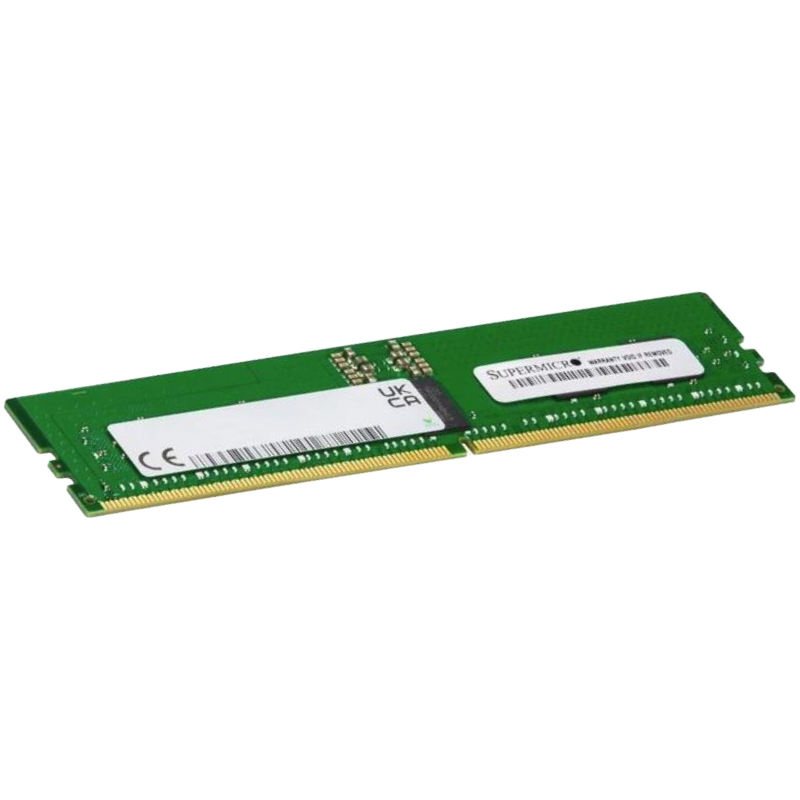
Supermicro MEM-DR596L-003 96GB ECC Memory Module DDR5-4800Mbps PC5-38400 2RX4. New Sealed in Box (NIB) with 3 Year Warranty - Samsung Version
| SKU/MPN | Warranty | Price | Condition | You save |
|---|---|---|---|---|
| MEM-DR596L-003 | 1 Year Warranty | Contact us for a price | New (System) Pull | |
| MEM-DR596L-003 | 1 Year Warranty | $5,280.00 | New Sealed in Box (NIB) | You save: $1,848.00 (26%) |
The Supermicro DDR5-4800Mbps 96GB ECC Memory Module PC5-38400 2RX4 is a high-performance memory module designed to enhance the performance and reliability of your server or workstation. With a capacity of 96GB, this memory module provides ample space for running memory-intensive applications, handling large datasets, and multitasking with ease.
The MEM-DR596L-003 Supermicro DDR5-4800Mbps 96GB ECC Memory Module represents a high-capacity server memory category designed for next-generation data centers, enterprise computing environments, and performance-critical workloads. This category focuses on large-capacity DDR5 ECC memory modules optimized for stability, scalability, and long-term reliability in professional server and workstation platforms. Built to meet the demands of modern CPUs and chipsets, these memory modules support advanced data integrity mechanisms while delivering increased bandwidth and improved power efficiency over previous DDR generations.
DDR5 memory marks a significant evolution in system memory architecture, offering higher data transfer rates, improved channel efficiency, and enhanced power management. The 4800Mbps speed rating provides ample throughput for data-intensive tasks, while the 96GB capacity per module enables dense memory configurations ideal for virtualization, in-memory databases, artificial intelligence workloads, and enterprise applications that require large addressable memory pools. This category emphasizes compatibility with server-grade hardware, including Supermicro systems engineered to leverage DDR5 memory advancements.
DDR5 memory introduces architectural improvements that directly impact performance and scalability. Compared to DDR4, DDR5 modules operate with higher base frequencies, increased burst lengths, and dual independent 32-bit channels per module. These enhancements reduce memory access latency bottlenecks and improve parallelism, allowing CPUs to retrieve data more efficiently. In server environments where multiple cores and threads compete for memory bandwidth, these improvements translate into measurable performance gains.
The MEM-DR596L-003 category leverages these DDR5 advancements to deliver consistent throughput under sustained workloads. The 4800Mbps data rate supports modern processors designed to scale memory bandwidth alongside increasing core counts. Applications such as real-time analytics, high-performance computing, and large-scale transaction processing benefit from faster memory access and reduced contention.
DDR5 memory modules integrate advanced power management capabilities that shift voltage regulation from the motherboard to the module itself. This design improves power delivery stability and efficiency, particularly in high-density memory configurations. By operating at lower voltages than previous generations while maintaining higher speeds, DDR5 memory reduces overall power consumption per bit transferred.
In enterprise data centers, where energy efficiency directly impacts operational costs, this category of DDR5 ECC memory contributes to more sustainable and cost-effective infrastructure. Improved power efficiency also supports better thermal behavior, helping maintain consistent performance in densely populated server chassis.
Error Correcting Code (ECC) memory is a critical requirement for enterprise and mission-critical computing environments. The MEM-DR596L-003 category includes ECC functionality designed to detect and correct single-bit memory errors and detect multi-bit errors, significantly reducing the risk of data corruption. In workloads where data accuracy and system uptime are essential, ECC memory provides an additional layer of protection that non-ECC memory cannot offer.
Server-grade ECC memory is particularly important for applications such as financial modeling, scientific simulations, healthcare data processing, and cloud infrastructure services. Memory errors in these environments can lead to system crashes, corrupted datasets, or inaccurate computational results. By incorporating ECC technology, this category supports stable long-term operation even under continuous heavy workloads.
Enterprise servers are often expected to operate continuously for extended periods without interruption. The design and validation standards applied to DDR5 ECC memory modules in this category prioritize long-term stability. Rigorous testing ensures consistent performance across a wide range of operating conditions, including sustained high utilization and varying thermal environments.
This focus on reliability aligns with the needs of organizations that depend on uninterrupted service delivery. From private data centers to managed hosting environments, DDR5 ECC memory helps minimize unexpected downtime caused by memory-related faults.
The 96GB capacity offered by this category enables servers to support larger memory footprints with fewer physical modules. High-capacity DIMMs reduce the total number of slots required to achieve target memory configurations, leaving room for future expansion or supporting systems with limited DIMM slots. This flexibility is especially valuable in compact server designs and high-density compute nodes.
Memory-intensive workloads such as virtualization platforms, container orchestration systems, and in-memory databases benefit significantly from larger per-module capacities. By allocating more memory per DIMM, system architects can optimize memory layouts for performance and scalability while simplifying configuration and maintenance.
Virtualized environments rely heavily on available system memory to allocate resources efficiently across multiple virtual machines or containers. High-capacity DDR5 ECC memory modules support higher VM densities and more complex workloads without compromising performance. This category is well-suited for hypervisors and cloud platforms that require predictable memory behavior and strong data integrity guarantees.
Increased memory capacity also allows for more aggressive caching strategies and improved application responsiveness, particularly in multi-tenant environments where memory contention can impact service quality.
This category of memory modules is designed for seamless integration with Supermicro server platforms that support DDR5 technology. Compatibility considerations include electrical specifications, firmware support, and mechanical fit within server chassis. Supermicro systems are engineered to recognize and optimize supported memory configurations, ensuring stable operation and full utilization of DDR5 features.
Using memory modules aligned with system manufacturer specifications helps reduce deployment risks and simplifies system validation. IT administrators benefit from predictable behavior, streamlined firmware updates, and consistent performance across deployments.
Enterprise memory categories emphasize validation processes that ensure compatibility with supported server platforms. Modules undergo extensive testing for signal integrity, thermal performance, and error handling. This attention to quality assurance minimizes compatibility issues and supports reliable system operation in production environments.
For organizations managing large fleets of servers, standardized memory components simplify inventory management and maintenance procedures. Consistent module specifications across systems enable easier troubleshooting and replacement when necessary.
The MEM-DR596L-003 DDR5 ECC memory category supports a wide range of enterprise and industry-specific use cases. In financial services, large memory capacities and high bandwidth enable faster risk analysis, trading simulations, and real-time data processing. In scientific research, DDR5 memory accelerates simulations and modeling tasks that require rapid access to large datasets.
Media and entertainment workflows, including video rendering and content delivery networks, benefit from improved memory throughput and capacity. Similarly, healthcare and life sciences applications rely on stable, high-capacity memory for imaging, genomic analysis, and patient data management.
AI and machine learning workloads often involve processing large datasets in memory to reduce latency and improve training efficiency. High-capacity DDR5 ECC memory modules support larger model sizes and more complex data pipelines. Faster memory access helps keep CPUs and accelerators fed with data, reducing idle time and improving overall system utilization.
ECC protection is particularly valuable in AI workloads where silent data corruption can compromise model accuracy and training outcomes. Reliable memory operation ensures consistent results across training runs and inference tasks.
High-density memory modules generate heat under sustained workloads, making thermal management a key consideration in server design. DDR5 memory modules in this category are engineered to operate within specified temperature ranges while maintaining performance and reliability. Improved power efficiency contributes to lower heat output compared to earlier memory generations.
Proper airflow and chassis design complement these memory modules, enabling consistent thermal performance even in densely populated systems. Data center operators benefit from reduced cooling requirements and improved overall energy efficiency.
As organizations scale their infrastructure, memory requirements often increase alongside compute and storage demands. High-capacity DDR5 ECC memory categories provide a foundation for scalable growth, allowing systems to be upgraded incrementally without complete hardware replacement. This scalability supports evolving business needs and long-term infrastructure planning.
By investing in advanced memory technologies, enterprises can extend the useful life of their server platforms while maintaining compatibility with future software and workload requirements.
DDR5 ECC memory modules in this category adhere to industry standards governing electrical characteristics, signaling, and error correction behavior. Compliance with these standards ensures interoperability with supported platforms and consistent behavior across different deployment scenarios. Adhering to established specifications also supports long-term availability and support.
Standards-based design simplifies integration into existing infrastructure and reduces the risk of vendor lock-in. Organizations can plan deployments with confidence, knowing that memory components align with widely adopted industry requirements.
Enterprise hardware lifecycles demand predictable availability, consistent specifications, and reliable support. Memory modules within this category are positioned to meet these expectations, supporting long-term procurement strategies and maintenance planning. Stable product lifecycles help organizations maintain homogeneous environments and reduce operational complexity.
This focus on lifecycle management aligns with the needs of enterprises that prioritize stability, compliance, and controlled infrastructure evolution over frequent component changes.


 Contact Us
 Information
 Catalog
 Solid State Drives (SSD)
 Network Switches
 Hard Disk Drives
 HBA & Controllers
 PC & Servers
 PC & Server Memory
 CPU & Processors
 Network Routers
 Power Supplies
 Tape Drives & Libraries
 Network Devices
 Computer & Network Cables