(7% discount is applied at checkout)
Cart is empty
Your go-to destination for cutting-edge server products
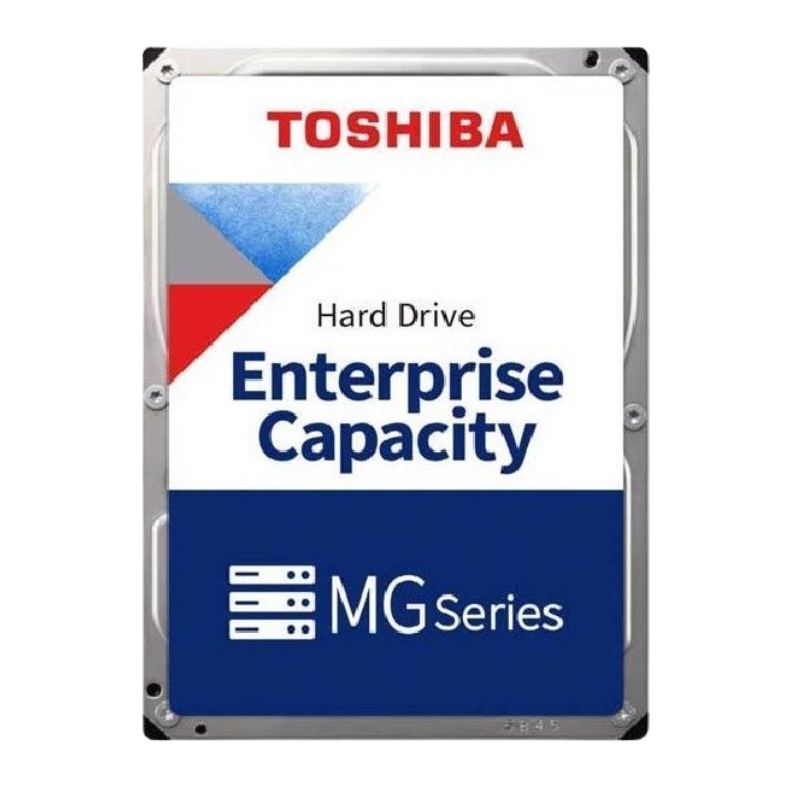


Toshiba HDEPY11GEA51 Enterprise 16TB 7200RPM SAS 12GBPS 512MB Buffer 512e 3.5inch Internal Hard Disk Drive. New Sealed in Box (NIB) with 3 Years Warranty
The TOSHIBA HDEPY11GEA51 enterprise-class 16TB hard disk delivers high-capacity storage designed for demanding server and data center workloads. With a 7200RPM spindle speed, 512MB cache buffer, and SAS 12Gbps interface, it ensures exceptional performance, dependability, and scalability for mission-critical IT infrastructure.
This high-performance enterprise drive combines storage density with advanced reliability. Its key technical highlights include:
The TOSHIBA 16TB SAS HDD is optimized for energy-conscious data centers. With an operating power draw of just 4.49W, it minimizes running costs while maintaining performance output.
This model is ideal for a wide range of enterprise environments:
With a Mean Time Between Failures (MTBF) of 2.5 million hours, this drive ensures business continuity. It is specifically engineered for non-stop 24/7 enterprise environments, reducing downtime and safeguarding mission-critical data.
Designed for scalability, performance, and durability, the TOSHIBA HDEPY11GEA51 enables businesses to handle massive datasets and high-demand applications efficiently. Its enterprise-grade engineering ensures seamless integration into modern IT infrastructures where both speed and reliability are paramount.
The engineering of the HDEPY11GEA51 focuses on stable mechanical design, error recovery tailored for RAID operation, and firmware optimized for sustained transfer rates. Toshiba's servo and head technology deliver precise seek control, while vibration-robust firmware lowers the performance penalties that can arise in multi-drive enclosures. The 512MB cache acts as a short-term buffer for random write bursts and read-ahead operations, reducing back-end latency for many enterprise tasks.
The drive adheres to the standard 3.5-inch mechanical envelope commonly used in server racks and storage arrays. Its mounting points and connector layout allow drop-in compatibility with most enterprise chassis and drive sleds. Cable and sled compatibility should be checked when migrating older equipment to SAS 12Gb/s infrastructure.
Enterprise drives in this class are specified to operate across extended temperature and humidity ranges. Typical operating guidelines include continuous 24/7 operation, with a tolerance for elevated ambient temperatures encountered in densely packed racks. Built-in thermal sensors and firmware throttle mechanisms help maintain reliability under heavy sustained I/O.
The HDEPY11GEA51 delivers strong sequential throughput due to its 7200RPM spindle and SAS 12Gb/s interface, making it well-suited for large-file workloads such as backup targets, media repositories, and cold-to-warm object stores. Random I/O performance is respectable for a high-capacity magnetic disk, and the sizable cache helps smooth bursty traffic typical in virtualization hosts or mixed-read/write database operations.
When designing systems, understand that high-capacity 7200RPM platters favor sequential transfers (large, contiguous reads/writes) over extremely low-latency random I/O. For workloads dominated by small-block random reads/writes (for example, active database log volumes or hypervisor boot stores), combining these Toshiba drives with an SSD tier for hot data is a common architectural pattern. However, for bulk capacity where throughput and cost-per-terabyte matter most, the HDEPY11GEA51 is a top-tier choice.
The 512e sector emulation ensures legacy operating systems and storage controllers that expect 512-byte sectors will continue to function without requiring immediate software updates. SAS 12Gb/s compatibility with modern HBA controllers and RAID cards is standard, but administrators should verify firmware support and multipath driver compatibility for seamless integration into Windows Server, Linux, VMware, or other enterprise stacks.
For best results, install the Toshiba drive into certified enclosures or storage arrays with vendor-validated firmware. Many SAN and NAS systems support Toshiba enterprise drives; still, cross-check the vendor's compatibility lists for firmware specifics and power/thermal profiles. Dual-port SAS (if applicable on the SKU) enables high-availability topologies and multipathing in SAN deployments.
Enterprise-class drives like the HDEPY11GEA51 include firmware features designed to coexist with RAID controllers—such as controlled error recovery and predictable timeouts—reducing the chance of unnecessary drive dropouts. When configuring RAID levels, consider:
Toshiba's enterprise drives typically ship with SMART reporting, thermal monitoring, and a suite of diagnostic tools that report the drive's health and predicted failures. The HDEPY11GEA51's mechanical design targets high Mean Time Between Failures (MTBF) and enterprise workload ratings measured in drive writes per year (DW/yr) or equivalent TB/year metrics. For production deployment, combine SMART monitoring with higher-level telemetry in your storage management software to preemptively replace drives showing signs of degradation.
Keep an eye on critical SMART attributes such as reallocated sector count, pending sectors, read error rate, and temperature. Modern monitoring stacks can ingest SMART over SAS or via BMC and alert administrators before drives fail catastrophically. The 512e sector format hides the physical sector alignment from the host but still reports underlying physical errors via SMART.
The drive is built to endure continuous enterprise workloads. Typical duty-cycle expectations for this class include 24/7 operation and workload ratings that enable use in multi-drive arrays. For particularly write-heavy use cases, evaluate the drive's TBW-equivalent rating and consider hybrid architectures (SSD caching, write-optimized tiers) to reduce long-term mechanical stress.
The versatility of the HDEPY11GEA51 makes it applicable across several enterprise scenarios:
For object stores and cold-to-warm archives where petabyte-scale capacity and favorable cost per TB are primary goals, this 16TB drive is ideal. Its relatively low power-to-capacity ratio (compared with many smaller drives) reduces rack power draw and lowers total cost of ownership when deployed at scale.
Backup systems and nearline storage can benefit from the drive's high capacity and steady sequential throughput. When used as backup targets (tape replacement or duplicate copies), the HDEPY11GEA51 accelerates full backups and restores with predictable performance.
Regulatory retention and compliance systems that require large immutable datasets are a natural match. Pair the drives with erasure coding and robust snapshotting to achieve durable, long-lived storage repositories.
In hyperconverged infrastructure (HCI) deployments where hot data sits on all-flash tiers, the HDEPY11GEA51 fits as a capacity tier for VMs, ISO storage, and less-frequently accessed virtual disks. This layered approach balances cost and performance.
When planning rack layouts and power budgets, account for the drive's active and idle power specifications. High-capacity drives can increase chassis thermal load; ensure adequate airflow and temperature monitoring to avoid throttling or premature wear.
Follow these practical steps to ensure a successful deployment:
During initial formatting, choose filesystem block sizes and partition alignment that complement 512e emulation. For example, align partitions on 1MiB boundaries to avoid misaligned I/O. If the target OS uses Advanced Format optimizations, verify that alignment-aware formatting utilities are used.
When selecting drives for an enterprise fleet, compare the HDEPY11GEA51 against alternatives in capacity, RPM class, interface, and endurance. If lower latency is required, consider enterprise SSDs for hot tiers; if cost per TB is paramount, compare to other 16TB SATA or SMR offerings (bearing in mind SMR's suitability limitations). SAS 12Gb/s and dual-port modes provide advantages in SANs versus single-port SATA drives.
Higher-RPM drives (10K/15K) provide lower average latency for random I/O but at significantly higher cost per TB and often lower capacity. The 7200RPM 16TB Toshiba drive optimizes density and cost while delivering acceptable latency for many enterprise applications—especially where sequential throughput dominates.
For sub-millisecond latency needs or high-frequency random write workloads, all-flash arrays are the superior option. The HDEPY11GEA51 is best used as a capacity layer in hybrid systems where SSDs accelerate hot data paths and HDDs handle bulk storage.
Evaluate drive-level and system-level security options. While this Toshiba model focuses on core mechanical reliability and performance, many deployments require encryption at rest. If hardware-based encryption is a requirement, confirm whether the SKU supports self-encrypting drive (SED) features or whether encryption will be provided at the controller/enclosure level.
When decommissioning drives, follow NIST SP 800-88r1 guidelines or your organization's data destruction policies. Secure erase tools, vendor-provided utilities, and physical destruction are valid options depending on the sensitivity of stored content.
Drive noise, elevated SMART reallocated sectors, or increased retry counts indicate potential problems. Troubleshooting steps include verifying enclosure power and cooling, checking firmware compatibility, reviewing SMART logs for predictive attributes, and replacing drives returning persistent errors under warranty.
Maintain a change log for firmware updates and coordinate updates with storage-array vendors. Avoid mixing firmware families in a production RAID set without vendor guidance.


 Contact Us
 Information
 Catalog
 Solid State Drives (SSD)
 Network Switches
 Hard Disk Drives
 HBA & Controllers
 PC & Servers
 PC & Server Memory
 CPU & Processors
 Network Routers
 Power Supplies
 Tape Drives & Libraries
 Network Devices
 Computer & Network Cables