(7% discount is applied at checkout)
Cart is empty
Your go-to destination for cutting-edge server products
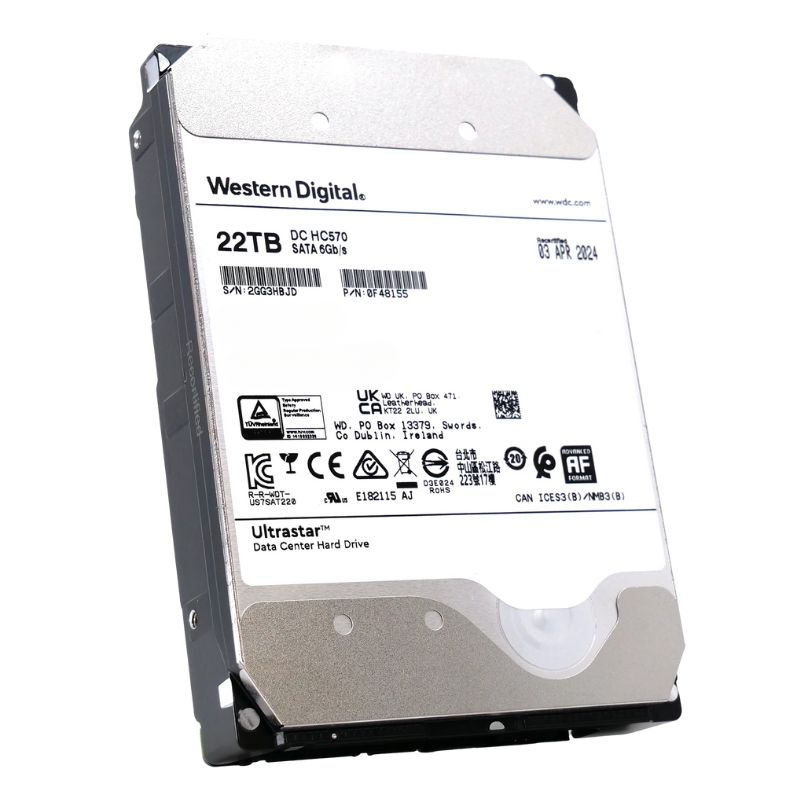


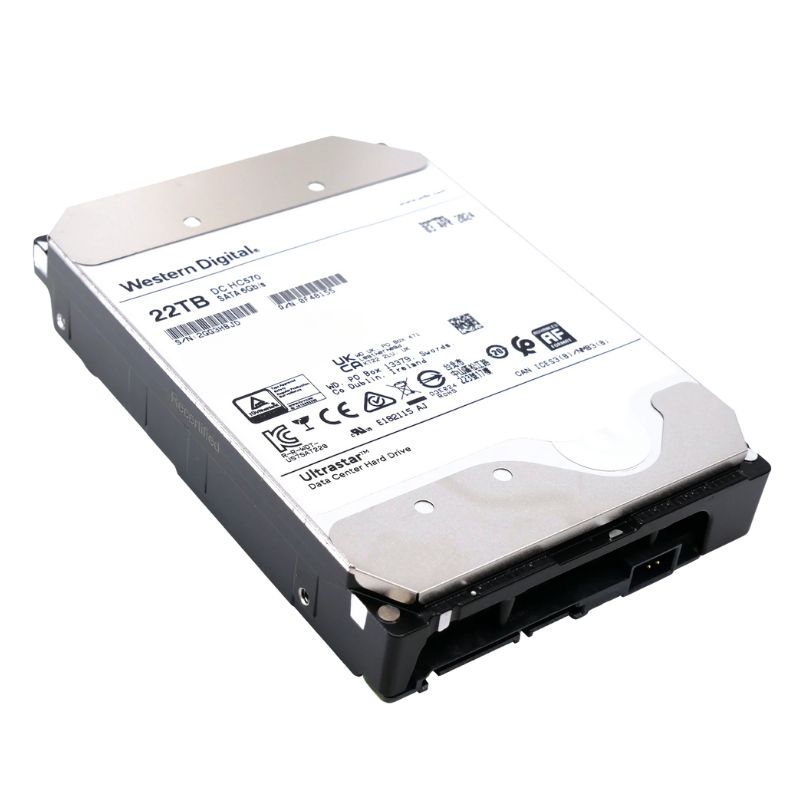
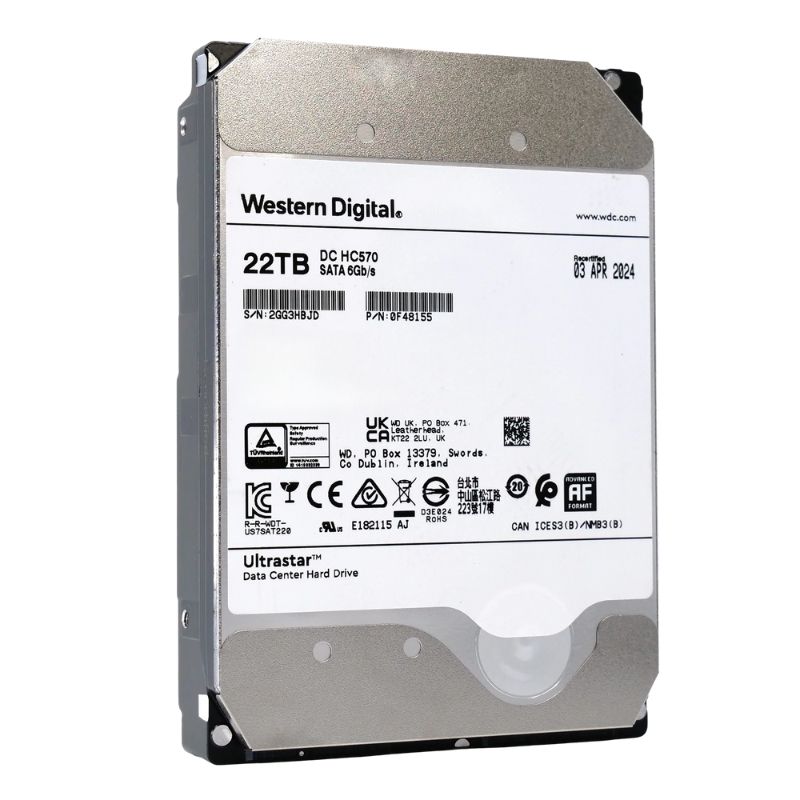
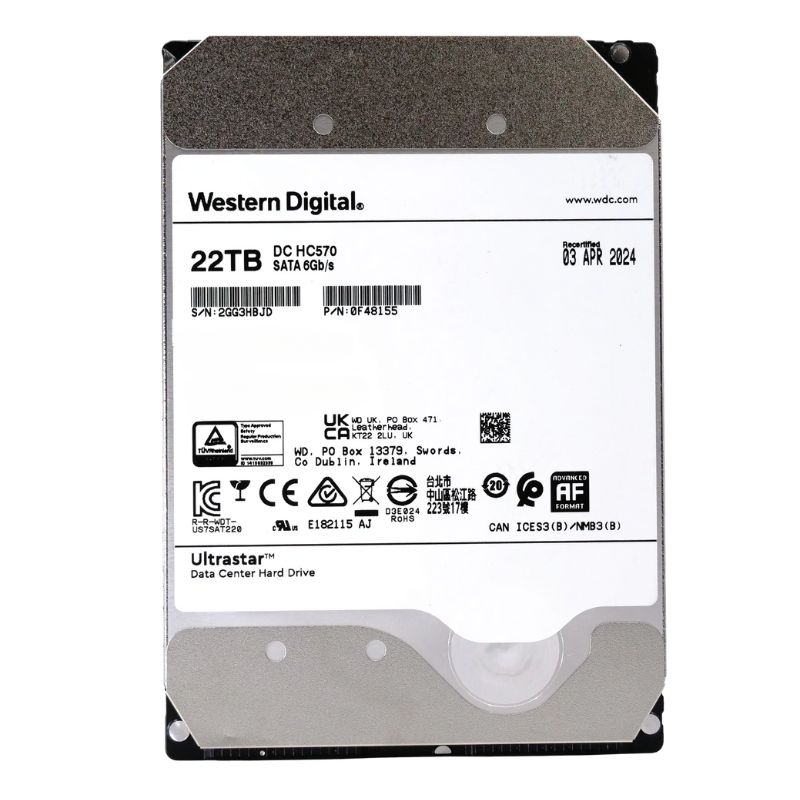
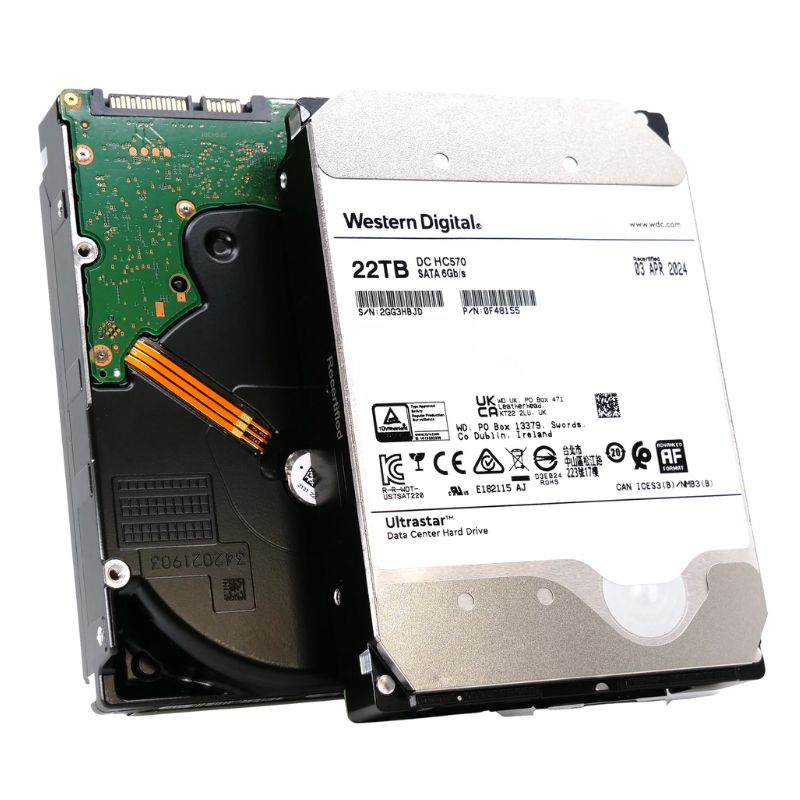
Western Digital WUH722222ALE604 Ultrastar DC Hc570 22TB 7.2K RPM SATA 6GBPS 512MB Buffer 512e 3.5 Inch Hard Disk Drive. Excellent Refurbished with 1 year replacement warranty
The Western Digital WUH722222ALE604, part of the Ultrastar DC HC570 series, is a high-capacity enterprise-grade hard disk drive designed for large-scale storage environments. Engineered to deliver robust performance and exceptional reliability, this 22TB drive is ideal for modern data centers and cloud storage solutions.
This enterprise HDD is optimized for demanding workloads, including:
The Western Digital WUH722222ALE604 Ultrastar DC Hc570 brings massive 22TB capacity to mainstream enterprise storage, combining 7,200 RPM performance, a SATA 6Gbps interface, and a large 512MB buffer within a standard 3.5 inch form factor. Designed for scale-out data centers, private clouds, content delivery platforms, and high-density NAS arrays, this hard disk delivers dependable, cost-efficient storage with sector formatting in 512e to maximize compatibility with a wide range of operating systems and host bus adapters. Its Ultrastar heritage emphasizes predictable latency, consistent throughput, and enhanced reliability features that help administrators build resilient pools for cold, warm, and even mixed workloads without compromising on TCO objectives.
By pairing high areal density with helium-sealed architecture and enterprise-grade firmware tuning, the Ultrastar DC Hc570 strikes a balance between capacity per rack unit and sustained performance across sequential and random access patterns. The model identifier WUH722222ALE604 denotes a SATA drive with 512e emulation and an extensive cache to smooth bursty traffic while keeping transfer rates steady under sustained load. The advanced cache algorithms further optimize read-ahead and write coalescing, improving application responsiveness for backup targets, log aggregation, video surveillance retention, and large-object storage.
The 22TB footprint allows architects to consolidate spindles, reduce enclosure counts, and increase density in existing 3.5 inch backplanes. A single chassis populated with the Ultrastar DC Hc570 can reach multi-petabyte raw capacities, simplifying scale plans and lowering power, cooling, and cabling overhead per terabyte. The 7.2K RPM spindle speed provides the balanced performance characteristics expected in capacity-optimized tiers, while the helium-filled construction reduces fluid friction to lower vibration and acoustic output compared to traditional air-filled designs. This benefits multi-drive enclosures where cross-talk and rotational vibration can otherwise degrade throughput under simultaneous workloads.
Reliability is maintained through enterprise firmware controls, error recovery policies suitable for RAID and erasure-coded arrays, and extended environmental tolerances appropriate for data center racks. The Ultrastar line is engineered for continuous operation, ensuring predictable duty cycles for 24x7 use, while the SATA 6Gbps interface aligns with cost-sensitive architectures that do not require SAS features. Administrators get the benefit of modern SATA command sets with native power management, SMART telemetry, and configurable features that harmonize with popular storage platforms.
The 512MB buffer on the WUH722222ALE604 plays a central role in smoothing I/O patterns that alternate between sequential streaming and bursty random transactions. By tightly integrating dynamic caching algorithms and adaptive prefetch, the drive accelerates large block transfers common in video ingest, backup windows, and bulk replication tasks. When deployed in multi-drive RAID groups, the cache contributes to faster stripe writes by aggregating small writes into optimal segments, aiding controllers in maintaining high efficiency during parity calculations.
While the Ultrastar DC Hc570 is capacity-optimized, sustained sequential read and write speeds benefit from high areal density and refined servo control. This combination means fewer disk revolutions are required to read large files, leading to more predictable throughput for object stores, immutable log repositories, and archival datasets. Random performance is strengthened by precise head actuation and firmware tuned to minimize command overhead, delivering the consistency needed for metadata operations, index lookups, and directory traversals across massive namespaces.
Enterprise environments demand robust data integrity, and the Ultrastar DC Hc570 implements advanced error correction, write-path protection mechanisms, and comprehensive SMART attributes to monitor health. The 512e format emulates 512-byte sectors on 4K physical media, which maintains compatibility with legacy stacks while retaining the benefits of 4K internal error correction efficiency. Enhanced ECC algorithms reduce the probability of uncorrectable errors, and firmware policies are tuned to cooperate with array controllers, reducing prolonged error recovery events that can jeopardize RAID rebuilds.
SMART telemetry exposes drive temperature, reallocated sector counts, wear indicators, and error statistics so administrators can act proactively. When paired with monitoring platforms, alerts can trigger preemptive maintenance, redistribution of data, or targeted scrubbing to ensure that rebuild windows remain within acceptable risk thresholds. This visibility is especially vital at 22TB scale, where rebuild planning and data protection strategies must be deliberate and informed by real-time health signals.
The WUH722222ALE604 variant uses 512e sectors, enabling drop-in use with many existing filesystems, hypervisors, HBA firmwares, and NAS operating systems. Applications that assume 512-byte logical sectors operate normally, while the drive’s internal translation preserves the performance and integrity advantages of 4K physical sectors. For environments that have standardized on 512e across mixed generations of hardware, this model simplifies fleet management and minimizes the need for extensive revalidation or reconfiguration.
Compatibility extends to common backplanes, trays, and caddies used across enterprise storage servers and professional NAS appliances. The standard 3.5 inch form factor assures straightforward deployments in top-loading or front-loading chassis. SATA cabling and power connections remain conventional, easing swaps during maintenance windows and facilitating staged capacity expansions without requiring wholesale infrastructure changes.
Large-scale backup and recovery infrastructures benefit immediately from 22TB spindles. With higher capacity per slot, backup targets can hold longer retention chains, reduce tape export frequency, and enable more restore points on disk for rapid recovery. Deduplication appliances see improved density, and sequential ingest performance keeps backup windows predictable even as datasets grow. Object storage platforms such as private S3-compatible clusters are another ideal match. The Ultrastar DC Hc570 supports the throughput characteristics required for multipart uploads, replication, and erasure coding tasks while offering high capacity per node to lower the cost of durable, geo-redundant storage.
Media and entertainment workflows that archive raw footage, mezzanine assets, and final masters gain the economics of high-capacity HDDs with consistent streaming performance. Editorial departments and VFX teams can keep more content online for collaborative access, reducing shuttling between tiers. In video surveillance, where continuous writes are the norm, the drive’s sustained write performance and reliability profile allow longer retention periods and high camera counts per recorder. For big data and analytics, cold and warm tiers backed by the Hc570 can stage data cost-effectively, keeping historical partitions readily accessible for periodic queries while hot datasets live on flash.
Helium-sealed construction reduces drag on the spinning stack, enabling lower power consumption per terabyte relative to air-filled counterparts. This reduction propagates into cooling savings at the rack level, decreasing TCO and contributing to sustainability goals. The drive’s thermal design enables predictable operation within typical data center ambient ranges, and firmware events can throttle activity if thresholds are approached, protecting media and maintaining service continuity.
Power management capabilities allow administrators to define idle behaviors that trim consumption during periods of low activity. In tiered storage architectures, policy engines can schedule background operations to off-peak windows, further optimizing power draw. When multiplied across dozens or hundreds of spindles, these efficiencies have a meaningful impact on operating budgets.
When designing pools with 22TB hard disks, resilience schemes and rebuild strategies deserve special attention. Larger drive sizes mean more data per spindle, so erasure coding with wider parity stripes or dual-parity RAID levels often strikes the right balance between capacity efficiency and fault tolerance. Background scrubbing and proactive disk replacement policies help ensure latent sectors are remapped ahead of rebuild events. The Ultrastar’s consistent performance and telemetry give operators the predictability required to plan for these realities and maintain service-level objectives.
Capacity forecasting becomes simpler because each incremental node or chassis contributes significantly to total pool size. Whether building a dense 2U, 4U, or top-loader enclosure, high-capacity SATA drives minimize cabling complexity and lower the per-node cost. Administrators can combine nodes with different flash-to-disk ratios, using NVMe SSDs for metadata or small hot objects and relying on Ultrastar DC Hc570 arrays for bulk payloads and cold tiers. This hybrid approach captures the best attributes of each storage medium while maintaining budget discipline.
Within high-density enclosures, sustained vibration from neighboring spindles can challenge seek accuracy and throughput. The Ultrastar DC Hc570 employs sophisticated servo algorithms and rotational vibration safeguards to maintain performance under multi-drive loads. Firmware parameters can be tailored by the host to balance error recovery time limits with array-level fault tolerance, ensuring that RAID controllers and distributed filesystems remain in control during exceptions rather than ceding long timeouts to individual devices.
Workload profiles in real deployments vary from mostly sequential to mixed small-block patterns. The 512MB cache and adaptive write strategies help normalize these variations, while the 7.2K RPM mechanics offer reliable latency for capacity roles. Where datasets require frequent large rehydrations, such as during analytics backfills or content re-indexing, the drive’s high areal density becomes a practical contributor to shorter job durations.
For NAS arrays, the WUH722222ALE604 provides a straightforward path to scale. Popular NAS operating systems support 512e sector formatting, SMART diagnostics, and drive management features that surface key health metrics. ZFS, Btrfs, and other copy-on-write filesystems can leverage the drive’s consistent streaming throughput for scrub operations and parity reconstruction, while snapshots and replication pipelines benefit from steady sequential IO. In SAN contexts where SATA connectivity is exposed through JBOD shelves or unified controllers, the drive presents a robust target for block storage volumes backing archival LUNs and low-IOPS datasets.
Direct-attached storage in content servers, backup gateways, and cold data nodes also sees advantages. Since the form factor and interface adhere to established standards, upgrades can proceed with minimal downtime. Systems can be expanded incrementally by replacing smaller spindles during rolling maintenance cycles, allowing administrators to grow capacity as data footprints evolve without re-architecting the entire stack.
Beyond core ECC and SMART features, the Ultrastar DC Hc570 platform integrates reliability enhancements designed for always-on operation. Firmware is validated under enterprise duty cycles, and the mechanical design emphasizes durability. Drive health indicators feed into modern observability stacks, where thresholds can be tuned to trigger service tickets, spare assignment, or heat map visualizations that highlight localized thermal or vibration anomalies. At 22TB, early detection and measured response strategies reduce the likelihood of surprise outages and shorten recovery timelines when a component does require replacement.
Predictive analytics tools can trend attributes like reallocation events, head-flying hours, and read error rates to forecast when a drive approaches the end of its optimal service window. The metadata gleaned from these attributes informs stocking strategies for spares and helps determine ideal replacement intervals, minimizing both risk and waste. Because the WUH722222ALE604 exposes rich telemetry, it fits neatly into these best practices without requiring custom adapters or proprietary tooling.
Transitioning from 8TB, 10TB, 12TB, or 14TB spindles to 22TB media can be staged through rolling replacement. Enclosures often house diverse capacities during intermediate phases, and 512e formatting ensures that host stacks remain consistent as capacity rises. Data can be rebalanced gradually to exploit the larger spindles, and tiering policies can be updated to account for the new economics per terabyte. The result is a smooth migration path that avoids disruptive forklift upgrades.
Standardizing on the WUH722222ALE604 across multiple nodes reduces the variety of firmware baselines in the fleet, simplifying patch management and documentation. Spare inventories become more straightforward, and performance baselines are easier to compare. Capacity planning models also benefit from consistent drive specifications, producing reliable forecasts for rack space, power budgets, and cooling requirements under different growth scenarios.
To take full advantage of 22TB spindles, tuning at the filesystem and application layers can yield measurable gains. Aligning allocation sizes with 4K physical sectors, even when the host perceives 512-byte logical blocks, improves write efficiency and reduces read-modify-write penalties. Many modern filesystems automatically align to 4K boundaries, but validation ensures sustained best-case behavior. For backup applications, increasing block sizes for synthetic full operations and replication pipelines complements the drive’s strengths in sequential transfers.
Database archives, large log stores, and analytical columnar formats can be staged to avoid unnecessary fragmentation. When practical, batching writes improves cache effectiveness, letting the 512MB buffer coalesce small I/O into smoother patterns that the mechanical subsystem handles efficiently. Read-ahead settings can be tuned to reflect typical object sizes in object storage or media streaming platforms, producing more cache hits and consistent throughput across parallel sessions.
As capacity per spindle grows, attention to airflow, vibration isolation, and balanced workload assignment becomes more important. Enclosures should maintain clear airflow paths across the drive faces and through the backplanes, and fan curves should be profiled to match the thermal characteristics of helium-filled drives. When installing mixed generations of disks, placing higher-power units in positions with the strongest airflow helps keep temperatures evenly distributed. The Ultrastar DC Hc570’s telemetry offers temperature readings that can be plotted over time to verify that conditions remain well within nominal ranges.
Rotational vibration can be mitigated by using chassis with rigid construction and appropriate damping. Spreading heavy write workloads across multiple enclosures or shelves reduces localized stress and leads to more consistent performance. Where erasure coding is used, distributing fragments across enclosures adds fault domain separation, and the drive’s steady performance aids in sustaining reconstruction rates during maintenance events or unexpected failures.
The substantial 512MB cache is not merely a buffer for burst traffic; it also enables intelligent reordering and prefetch behavior. In backup targets, for example, the cache absorbs spiky write bursts from multiple clients and writes them to media in more orderly sequences. In content repositories, read-ahead anticipates sequential reads of large objects or media files, reducing mechanical waits and smoothing playback or replication streams. Over large arrays, these effects aggregate into significant efficiency gains.
Helium inflow sealing minimizes turbulence inside the enclosure, allowing tighter track spacing and smoother head movement. This translates into higher areal density and more stable head positioning under multi-drive vibration. For operators, the practical impact is better performance consistency at scale, even when dozens of drives work in concert within a single chassis. The Ultrastar DC Hc570 leverages these mechanical advantages alongside refined firmware to deliver steady results shift after shift in always-on environments.
Ultrastar drives are validated across a broad matrix of server platforms, storage controllers, and NAS operating systems. The WUH722222ALE604’s 512e format dovetails with mainstream hypervisors, Linux distributions, and Windows Server configurations. Administrators can rely on well-worn deployment paths, documented best practices, and established monitoring plugins to integrate the drive into existing operations. This mature ecosystem shortens time to value during rollouts and reduces the learning curve for operations teams.
At 22TB, rebuild planning is a crucial part of design. Choosing redundancy levels that sustain node or disk failures while maintaining acceptable rebuild times is key. Background scrubbing and periodic media scans can proactively correct latent sectors before they complicate a rebuild. The Ultrastar DC Hc570’s dependable streaming performance gives arrays the sustained bandwidth needed to complete reconstruction tasks efficiently, reducing the risk window and supporting continuous service delivery.
Hybrid designs pair NVMe or SATA SSDs with Ultrastar HDD tiers to deliver balanced cost and performance. Hot data and metadata sit on flash for immediate responsiveness, while the 22TB HDD tier stores the bulk of the dataset. Modern data services orchestrate movement between tiers automatically based on access patterns, ensuring hot objects are promoted quickly and cold objects reside on the most economical medium. The WUH722222ALE604 serves as the dependable foundation for that cold and warm capacity, providing the density needed to keep unit economics attractive at scale.
Object stores thrive on dense, sequential writes and long-lived data. The Ultrastar DC Hc570’s performance profile aligns with multipart object uploads, background compaction, and erasure coding workflows. Immutable archives, whether for compliance or ransomware resilience, benefit from predictable cost per terabyte and steady read performance during periodic audits or eDiscovery events. Extended retention horizons become feasible within budget when each spindle contributes 22TB, helping organizations meet legal and business continuity requirements.
In media production, high-resolution formats push storage needs significantly. The 22TB capacity accommodates longer shooting days and larger project libraries in on-premise systems, allowing teams to keep assets accessible without frequent offloading. Surveillance systems storing continuous streams gain longer retention times per recorder, simplifying compliance with local regulations. At the edge, appliances that aggregate data before sending it to the core or cloud use high-capacity spindles to buffer intermittent connectivity, and the Ultrastar DC Hc570’s resilience under continuous write load supports such scenarios reliably.
Drive-level telemetry combined with capacity analytics assists in planning growth milestones. Trending utilization, temperature, and error metrics guides when to add nodes, shuffle workloads, or rebalance erasure coding widths. Because the WUH722222ALE604 provides consistent performance, planners can model future behavior with fewer unknowns, producing procurement schedules that align with actual growth instead of static estimates. This feedback loop saves capital and minimizes over- or under-provisioning.
The WUH722222ALE604 identifier distinguishes a SATA Ultrastar DC Hc570 with a 22TB native capacity, 7,200 RPM spindle speed, 512MB cache, and 512e logical sector format in a 3.5 inch helium-sealed housing. It is intended for 24x7 enterprise duty cycles in environments where capacity density, predictable streaming performance, and broad compatibility are prioritized. The model sits comfortably in capacity tiers of scale-out storage systems, acting as a reliable building block for petabyte-scale deployments.
In 12-bay to 60-bay enclosures, administrators can deploy the Ultrastar DC Hc570 to reach multi-petabyte raw capacities with conservative redundancy. Thoughtful placement across fault domains, use of dual power feeds, and careful cable management contribute to resilience. With high-capacity spindles, node balance matters; distributing high-IO workloads across multiple shelves avoids bottlenecks and prolongs component lifespans. The drive’s steady operational profile aids in maintaining this balance as datasets evolve.
From initial burn-in to end-of-life sanitization, lifecycle procedures are streamlined when hardware behaves predictably. New drives undergo qualification, baseline performance capture, and SMART attribute logging. During service, monitoring tools compare ongoing behavior to these baselines to identify anomalies. Firmware updates, when recommended by the vendor, can be scheduled during maintenance windows, with change control documenting the updates to maintain audit trails. At retirement, secure erase or cryptographic sanitization processes ensure data is irretrievably removed before disposal or redeployment.
Inventory systems can tag each WUH722222ALE604 with its slot location, service history, and health records. This granular view helps teams anticipate replacements and balance procurement cycles. The consistency of the Ultrastar platform reduces complexity in these routines, and clear documentation lowers the training curve for new administrators entering the rotation.
Before production use, many organizations subject newly received drives to burn-in procedures that include extended sequential writes, random read tests, and multi-pass verifications. The Ultrastar DC Hc570’s performance under these tests typically shows steady throughput and responsive error handling, enabling teams to qualify the drives efficiently. Logging SMART attributes throughout burn-in establishes a reference for future comparisons, while enclosure-level tests validate airflow and vibration behavior when shelves are fully populated.
Once in production, periodic workload simulations can verify that policy changes or software updates have not altered performance characteristics. As capacity tiers grow, synthetic benchmarks can help confirm that aggregate streaming rates meet or exceed targets for backup windows, replication cycles, or archival ingest schedules. Because 22TB disks handle large sweeps of data, maintaining sustained transfer rates is central to keeping these schedules on track.
Petabyte-scale pools must handle both expected maintenance and unexpected incidents without impacting service. With 22TB drives, erasure coding schemes often replace traditional RAID in large object stores, providing better durability with efficient capacity utilization. In block and file systems, dual-parity or triple-parity RAID variants balance rebuild duration against usable capacity. The Ultrastar DC Hc570 supports these models by delivering steady, predictable rebuild throughput and cooperating with array controllers during error recovery so that reconstruction proceeds smoothly.
Geo-replication and snapshot policies form another layer of resiliency. By coupling dense HDD tiers at multiple sites, organizations can meet recovery point and recovery time objectives even under adverse conditions. The economics of the WUH722222ALE604 help make multi-site durability financially viable, which is increasingly important as data governance requirements expand and cyber threats evolve.
Data centers focus intensely on energy efficiency and carbon footprint reduction. High-capacity helium-based HDDs contribute by lowering watts per terabyte and enabling denser racks with fewer enclosures. The Ultrastar DC Hc570’s design supports these goals, allowing operators to meet capacity targets with fewer components and less metal, plastic, and ancillary electronics per petabyte. Over the lifespan of a storage system, these reductions compound into meaningful environmental and financial savings, particularly when coupled with renewable energy procurement and intelligent workload placement that concentrates activity in the most efficient facilities.
Telemetry-driven power management, scheduled maintenance, and thoughtful hardware lifecycle policies further decrease waste. When replacement becomes necessary, proper recycling of components and documented chain-of-custody for sanitized media close the loop on responsible stewardship. The WUH722222ALE604’s predictable duty profile and long service life expectations align with these sustainability practices.
In a 24-bay 4U chassis dedicated to backup targets, populating each slot with a WUH722222ALE604 can yield a remarkably dense repository. Pairing the shelf with a controller tuned for large block writes and enabling periodic scrubbing keeps data healthy between restores. In an object storage cluster, nodes with twelve to sixteen Ultrastar DC Hc570 drives can be deployed in sets that balance network bandwidth against disk throughput, ensuring that background erasure coding tasks do not saturate the interconnect. For media archives, deploying mixed nodes with NVMe metadata drives and Ultrastar capacity tiers offers responsive directory operations without sacrificing bulk capacity.
Firmware settings should be aligned with array policies, including time-limited error recovery values that match controller expectations. Filesystems should be initialized with alignment appropriate for 4K physical sectors, and monitoring should graph key SMART metrics alongside enclosure temperatures and fan speeds. These straightforward practices preserve performance and extend the useful life of the hardware.
Within the Ultrastar DC Hc570 family, variants exist with different interfaces and sector formats. The WUH722222ALE604 is the SATA 512e model, favored in budgets that prioritize broad compatibility and low cost per terabyte. When comparing part numbers, paying attention to the logical sector format is essential to avoid mismatches with existing images or boot environments that assume particular sector sizes. Matching sleds, screws, and vibration isolation hardware to the target chassis further ensures a smooth installation.
Supply planning should account for lead times on high-capacity media. Aligning purchase cycles with data growth forecasts reduces the risk of urgent buys at unfavorable times. Because the Ultrastar platform is widely adopted, organizations benefit from established logistics channels and robust vendor support ecosystems that understand the nuances of shipping helium-sealed drives and handling them correctly during receiving and staging.
Hot-swap-capable enclosures allow technicians to replace drives without powering down nodes, maximizing uptime. The Ultrastar DC Hc570’s standard connectors and dimensions streamline field replacement processes. Labeling and inventory control make it easy to identify the WUH722222ALE604 by part number, and pre-staged firmware baselines reduce time on site. Post-replacement validation, including short diagnostics and SMART baselining, confirms that the new component integrates seamlessly with the array’s scrubbing and rebuild routines.
Consider a private cloud operator consolidating VM backups that previously spanned multiple shelves of lower-capacity disks. By moving to 22TB Ultrastar drives, the operator frees rack space, reduces power consumption, and shortens backup windows thanks to improved sequential throughput and cache behavior under bursty ingest. In another scenario, a video platform expands its origin storage for 4K and 8K content. With 22TB spindles, the origin can maintain a larger long-tail catalog locally, reducing cache misses and cutting egress costs from external providers. In research environments archiving instrument data or satellite imagery, the same density enables longer retention, more historical comparisons, and faster retrieval from on-premise stores compared to deep cold tiers that require hours to access.
Continuous duty demands media and firmware that maintain their characteristics over years of service. The Ultrastar DC Hc570 is engineered for such duty cycles, with design decisions that emphasize thermal stability, vibration tolerance, and consistent performance under parallel workloads. In many infrastructures, the drive’s predictability becomes more valuable than peak benchmark numbers because service commitments hinge on steady throughput and minimal performance drift as arrays age. This stability helps storage planners meet customer expectations and internal SLAs with fewer contingencies.
Modern data protection stacks integrate compression, deduplication, and replication to lower footprint and strengthen resiliency. The WUH722222ALE604 complements these technologies by providing the capacity headroom and sustained streaming required to keep pipelines moving. Deduplicated blocks stored on high-density spindles remain accessible for rapid restore, and replication schedules that span sites maintain their rhythm because underlying media delivers the consistent flow they require. The result is a cohesive system where software efficiency and hardware density reinforce each other.
Hybrid models increasingly move datasets between on-premise stores and public clouds based on demand. High-capacity Ultrastar tiers act as landing zones that buffer uploads, hold pre-processed results, and stage data for periodic synchronization. Because the economics of the WUH722222ALE604 are favorable, organizations can keep larger working sets locally, minimizing transfer costs and reducing sensitivity to network variability. When bursting to the cloud, predictable read performance accelerates pre-flight validation and packaging of objects destined for external services.
Clear documentation of procedures around initialization, monitoring, firmware updates, and retirement shortens onboarding time for operations staff. The Ultrastar platform’s consistency aids in writing reusable runbooks that apply across multiple generations of hardware. By standardizing on a model like the WUH722222ALE604 for capacity roles, teams reduce the number of edge cases and tribal-knowledge dependencies, improving resilience to staff turnover and enabling smoother handoffs during shifts.
Risk management at scale includes maintaining a pool of spares, tracking failure rates, and staging parts near the racks they will serve. With high-capacity drives, a measured spare strategy balances capital efficiency with rapid response capability. The Ultrastar DC Hc570’s health telemetry informs these strategies, allowing dynamic adjustments as real-world behavior is observed. When health indicators suggest rising risk on a subset of drives, spares can be positioned proactively, minimizing the interval between detection and replacement.
The Western Digital WUH722222ALE604 Ultrastar DC Hc570 22TB SATA drive delivers a compelling mix of massive capacity, steady 7.2K RPM performance, broad 512e compatibility, and enterprise-grade reliability. Its 512MB cache and firmware optimizations sustain throughput across diverse workloads, while helium-sealed mechanics promote energy efficiency and consistent behavior in dense enclosures. For organizations building cost-effective, scalable storage tiers, this model offers an attractive path to higher density with operational predictability.
Data volumes expand as organizations adopt richer media, higher telemetry granularity, and longer retention mandates. Drives like the Ultrastar DC Hc570 anticipate this growth with capacities that postpone the next rack expansion and reduce procurement frequency. When coupled with robust data management practices—tiering, deduplication, and replication—22TB spindles help maintain agility in the face of rising demands. The WUH722222ALE604 model gives architects a dependable building block for these strategies, reinforcing a storage foundation that can scale alongside applications and users.
As platforms evolve to support additional analytics, machine learning pipelines, and AI-assisted discovery across archival datasets, the ability to keep more data online becomes strategically important. High-capacity HDDs provide the economical bedrock that makes such access feasible. The Ultrastar DC Hc570 fits this role neatly, ensuring that historical context remains only a query away rather than locked in deep offline vaults.


 Contact Us
 Information
 Catalog
 Solid State Drives (SSD)
 Network Switches
 Hard Disk Drives
 HBA & Controllers
 PC & Servers
 PC & Server Memory
 CPU & Processors
 Network Routers
 Power Supplies
 Tape Drives & Libraries
 Network Devices
 Computer & Network Cables