(7% discount is applied at checkout)
Cart is empty
Your go-to destination for cutting-edge server products
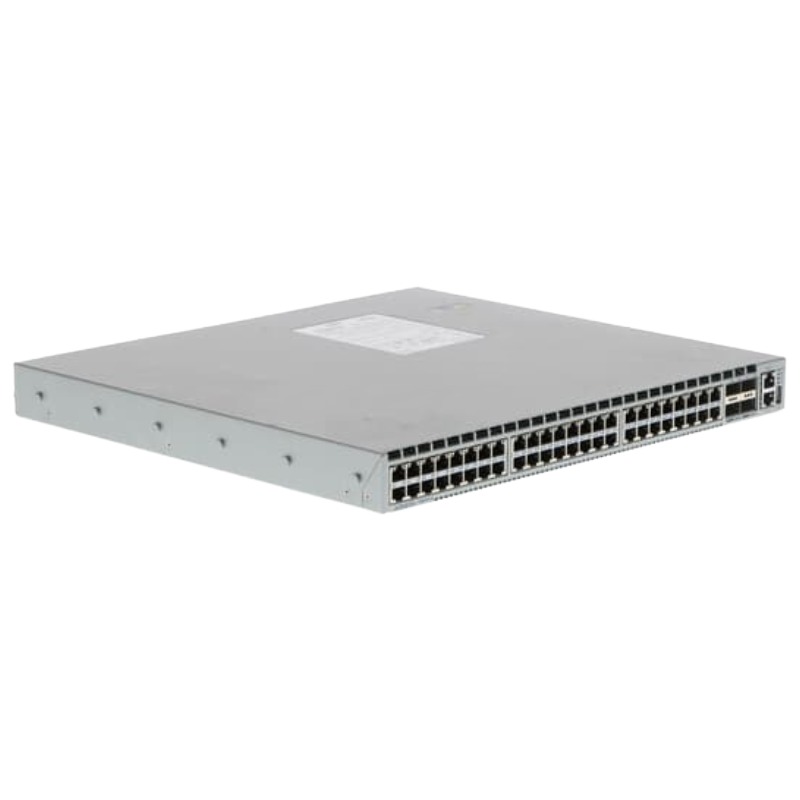


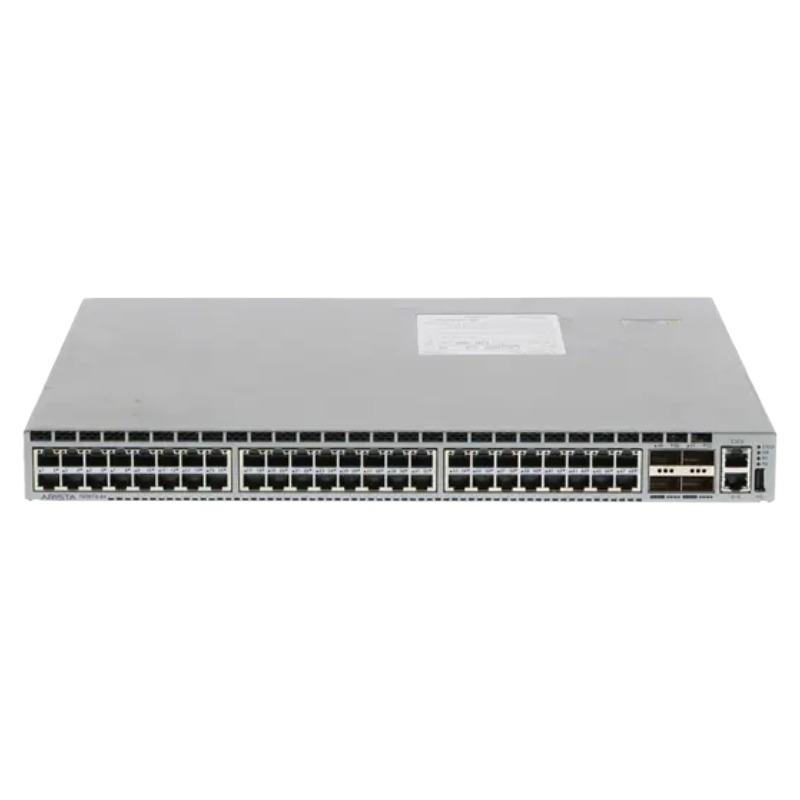
Arista DCS-7050TX-72Q-F 7050TX 10GB 6x 40GB QSFP+ Front-to-Rear 48 Ports Airflow Layer 3 Managed Switch. Excellent Refurbished with 1 Year Replacement Warranty
The Arista DCS-7050TX-72Q-F belonging to the 7050TX series is engineered for modern data centers and high-bandwidth enterprise networks requiring low-latency, non-blocking Layer 3 switching. This specific model combines 48 ports of 10GBASE-T (copper) with 6 ports of 40GbE QSFP+ uplinks, delivering a versatile yet powerful forwarding architecture.
The Arista DCS-7050TX-72Q-F switch is engineered for high-density 10 Gigabit Ethernet aggregation and ultra-low latency data center networking environments. Built as part of the Arista 7050TX Series, this enterprise-grade Layer 3 managed switch delivers scalable switching performance for virtualization clusters, cloud computing infrastructures, enterprise campus cores, and large-scale storage networking deployments. The switch combines forty-eight 10GBASE-T RJ-45 ports with six 40GbE QSFP+ uplink interfaces, creating a flexible platform for spine-leaf architectures, top-of-rack deployments, and east-west traffic optimization. Designed with front-to-rear airflow technology, the Arista DCS-7050TX-72Q-F is optimized for hot aisle and cold aisle containment systems commonly implemented in modern data centers. The airflow configuration improves thermal efficiency while supporting high-density rack environments where cooling optimization and power efficiency are critical operational requirements. Its compact 1U rack-mountable form factor enables organizations to maximize rack utilization without sacrificing network throughput or management capabilities.
The switching fabric integrated into the Arista DCS-7050TX-72Q-F supports wire-speed forwarding across all ports simultaneously. The switch architecture is engineered to handle intensive Layer 2 and Layer 3 workloads while maintaining predictable low-latency performance under peak traffic conditions. This capability is essential for cloud service providers, virtualization hosts, software-defined networking infrastructures, and high-performance computing environments that require deterministic network responsiveness. With forty-eight dedicated 10 Gigabit Ethernet interfaces, the switch provides dense copper connectivity for servers, storage appliances, virtualization nodes, and converged infrastructure deployments. The inclusion of six QSFP+ uplink ports allows organizations to deploy high-bandwidth aggregation links for inter-switch communication, backbone connectivity, and uplink expansion to spine switches or core routers.
The Layer 3 managed switching functionality of the Arista DCS-7050TX-72Q-F enables sophisticated routing operations across enterprise and cloud networks. The switch supports dynamic routing protocols, static routing configurations, multicast traffic management, and advanced traffic segmentation policies that improve scalability and network resilience. Routing optimization capabilities allow organizations to reduce bottlenecks, improve traffic distribution, and support latency-sensitive applications such as virtualization migration, database clustering, real-time analytics, and software-defined storage systems. The hardware-based routing acceleration further ensures that routing operations are processed efficiently without introducing unnecessary forwarding delays.
The Arista DCS-7050TX-72Q-F incorporates forty-eight high-performance 10GBASE-T RJ-45 ports designed for enterprise copper Ethernet deployments. These interfaces support flexible network integration with existing twisted-pair cabling infrastructures while delivering high-speed data transmission capabilities required for modern workloads. The 10 Gigabit copper interfaces provide compatibility with Category 6A and Category 7 cabling standards, supporting reliable high-speed communication between servers, storage systems, hyper-converged infrastructure platforms, and enterprise computing resources. This flexibility simplifies network migrations from legacy Gigabit Ethernet environments to 10GbE architectures without requiring a complete fiber infrastructure replacement.
Each RJ-45 interface supports auto-negotiation and backward compatibility with lower-speed Ethernet standards, including 1000BASE-T and 100BASE-TX environments. This compatibility enables phased infrastructure upgrades where organizations can integrate legacy networking devices while gradually transitioning to full 10GbE connectivity. The auto-sensing capabilities of the ports simplify deployment and minimize manual configuration requirements, reducing operational complexity in mixed-speed networking environments. This flexibility is especially valuable in enterprise data centers supporting diverse server generations and varying application performance requirements.
The switch architecture is highly optimized for server aggregation and virtualization connectivity. High-density 10GbE connectivity enables virtualization hosts to support multiple virtual machines, high-throughput storage access, and live migration operations simultaneously without congestion issues. Organizations deploying private cloud infrastructures benefit from the scalable server connectivity provided by the DCS-7050TX-72Q-F, particularly in environments utilizing VMware vSphere, Microsoft Hyper-V, containerized workloads, and software-defined storage platforms. The switch supports high-bandwidth communication channels required for distributed computing applications and modern cloud-native architectures.
The six integrated QSFP+ uplink ports significantly enhance the scalability and backbone integration capabilities of the Arista DCS-7050TX-72Q-F switch. These interfaces support high-bandwidth uplink aggregation for spine-leaf topologies, inter-switch connectivity, and core network integration. QSFP+ technology enables the switch to deliver 40 Gigabit Ethernet uplink performance, reducing oversubscription ratios and supporting bandwidth-intensive east-west traffic patterns common in modern data centers. The high-speed uplink capacity improves workload distribution efficiency and enhances application responsiveness across distributed environments.
The QSFP+ ports support multiple deployment scenarios including direct-attach copper cabling, optical transceivers, and breakout cable configurations. This versatility allows organizations to customize uplink connectivity according to infrastructure requirements, distance limitations, and scalability objectives. Breakout cable support further extends deployment flexibility by allowing individual QSFP+ interfaces to operate as multiple 10GbE connections where required. This capability enables administrators to maximize port utilization and optimize aggregation layer architectures for specific networking environments.
The uplink architecture of the Arista DCS-7050TX-72Q-F is particularly suitable for spine-leaf networking designs implemented in cloud-scale and enterprise data centers. The 40GbE uplinks provide the bandwidth density necessary to support low-latency east-west traffic flows while maintaining predictable network performance under dynamic workloads. In spine-leaf deployments, the switch functions effectively as a top-of-rack leaf switch connecting compute resources to high-capacity spine switches. The architecture minimizes bottlenecks and improves application scalability across distributed server clusters and storage infrastructures.
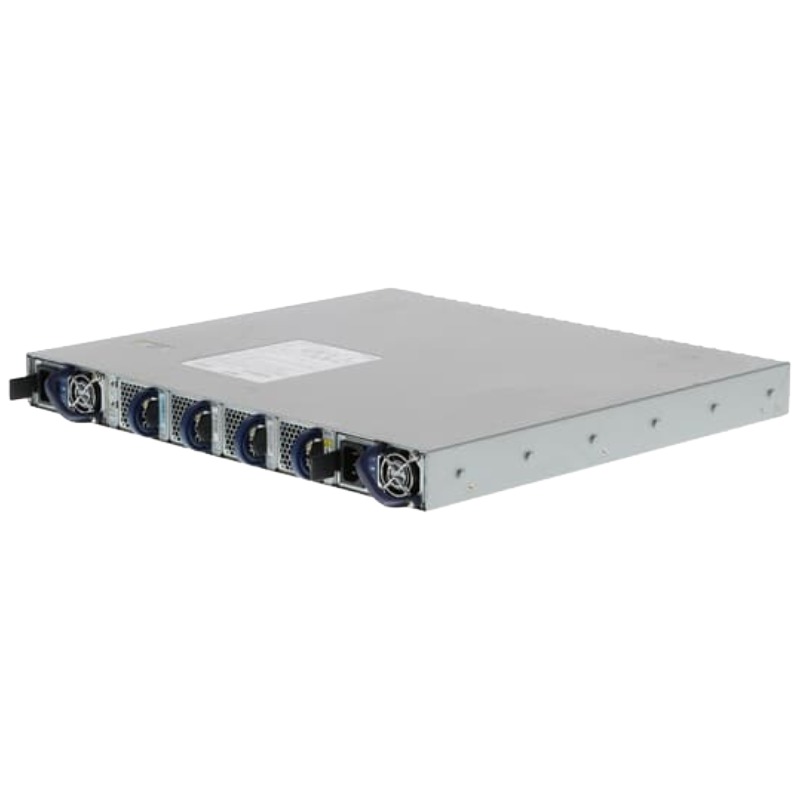
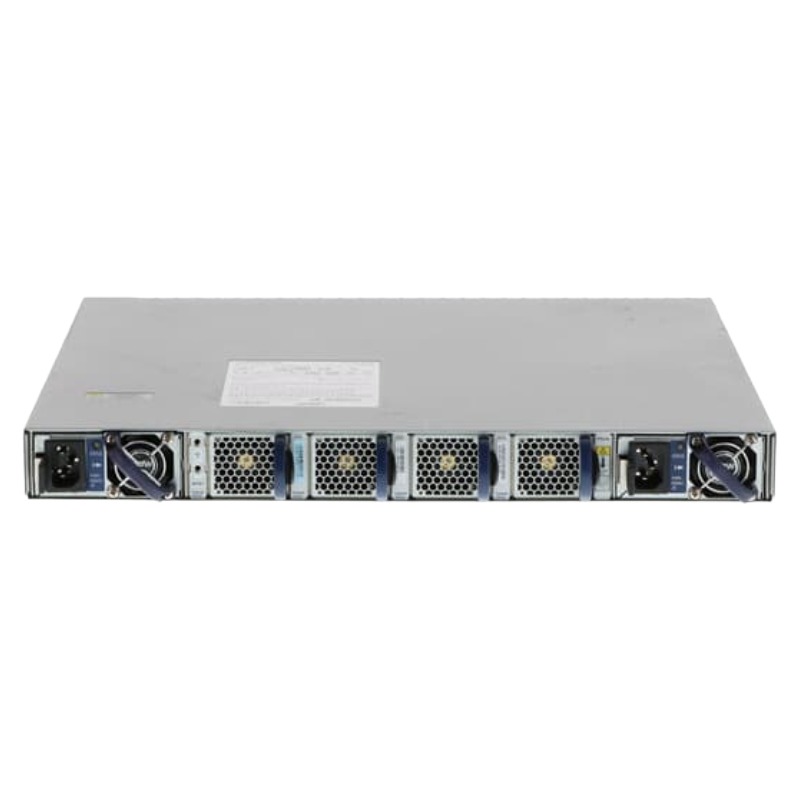
The front-to-rear airflow configuration of the Arista DCS-7050TX-72Q-F is specifically engineered for structured data center cooling environments. Air intake occurs at the front of the chassis while heated air is exhausted through the rear, aligning with standard hot aisle and cold aisle containment designs. This airflow strategy contributes to improved thermal management efficiency by maintaining consistent airflow direction across server racks and networking cabinets. The cooling optimization reduces hot spot formation and enhances operational stability in densely populated data center environments.
Modern enterprise and hyperscale data centers commonly implement hot aisle and cold aisle containment systems to maximize cooling effectiveness and reduce energy consumption. The DCS-7050TX-72Q-F integrates seamlessly into these structured cooling architectures due to its directional airflow design. Efficient airflow management helps maintain optimal operating temperatures for switching components, power supplies, and processing hardware, contributing to improved hardware longevity and operational reliability.
The switch incorporates advanced thermal engineering principles that minimize power consumption while maintaining reliable operating conditions under heavy traffic loads. Intelligent fan control mechanisms dynamically adjust cooling performance according to temperature conditions and workload intensity. Energy-efficient thermal management contributes to reduced operational costs in large-scale data center deployments where cooling expenses represent a significant portion of total infrastructure expenditure.
The Arista DCS-7050TX-72Q-F is designed to deliver extremely low forwarding latency, making it suitable for performance-sensitive networking applications. Low-latency operation is critical in environments such as financial trading platforms, real-time analytics systems, high-performance computing clusters, and distributed storage infrastructures. The switch architecture minimizes packet processing delays through hardware-accelerated forwarding engines and optimized switching silicon. This design approach ensures consistent application responsiveness even under intensive traffic conditions.
Predictable forwarding behavior is essential for applications that require deterministic network performance. The DCS-7050TX-72Q-F maintains consistent latency characteristics during high throughput operations, supporting real-time communications, virtualization traffic, and latency-sensitive transactional workloads. Advanced buffering technologies and congestion management mechanisms further improve traffic handling efficiency while reducing packet loss and transmission delays during peak utilization periods.
The switching platform supports large-scale packet processing operations across Layer 2 and Layer 3 environments. Hardware-assisted forwarding capabilities ensure that network traffic is processed efficiently while maintaining maximum throughput across all active interfaces. High packet-per-second processing performance allows the switch to support demanding enterprise applications, cloud orchestration platforms, and distributed computing workloads without compromising forwarding efficiency.
The Arista DCS-7050TX-72Q-F provides extensive Layer 2 switching features for enterprise-grade traffic management and network segmentation. VLAN support, link aggregation, spanning tree protocols, multicast handling, and traffic prioritization capabilities enable administrators to create scalable and resilient network infrastructures. These Layer 2 management functions improve traffic isolation, enhance security policies, and optimize bandwidth allocation across multi-tenant or multi-department enterprise environments. Flexible VLAN architecture simplifies network segmentation for virtualization, storage, and application-specific traffic flows.
Link aggregation support allows multiple physical interfaces to operate as a single logical connection, increasing bandwidth availability and improving redundancy. Aggregated links help eliminate single points of failure while maximizing throughput between switches, servers, and storage platforms. The switch supports dynamic and static aggregation configurations, enabling compatibility with diverse enterprise networking architectures and infrastructure requirements.
Advanced Layer 3 capabilities enhance network scalability by enabling intelligent traffic routing across distributed infrastructures. The switch supports static routing, dynamic routing protocols, Equal-Cost Multi-Path routing, and IPv4 and IPv6 network operations. These routing capabilities enable the DCS-7050TX-72Q-F to function effectively in enterprise cores, aggregation layers, cloud infrastructures, and data center fabrics where scalable routing intelligence is essential.
Dual-stack IPv4 and IPv6 support ensures long-term infrastructure compatibility as organizations transition toward next-generation IP networking standards. The switch accommodates modern addressing requirements while maintaining compatibility with existing IPv4 deployments. Comprehensive IPv6 functionality supports future-ready networking architectures and facilitates large-scale cloud and enterprise deployment strategies.
The switch supports dynamic routing protocols that enable automated route exchange, network convergence optimization, and traffic resiliency. Dynamic routing enhances scalability in large enterprise and cloud environments by reducing manual configuration requirements and improving failover responsiveness. Fast convergence mechanisms minimize service interruptions during topology changes or link failures, supporting continuous application availability and reliable network operations.
The Arista DCS-7050TX-72Q-F incorporates enterprise-grade hardware reliability features designed for continuous network operation. High-quality switching components, advanced thermal management systems, and robust internal architectures contribute to long-term operational stability. Data center environments require switching platforms capable of sustaining continuous workloads while minimizing downtime risks. The switch is engineered to support mission-critical operations where network availability directly impacts business continuity and application performance.
High availability technologies improve fault tolerance and operational resilience within enterprise and cloud infrastructures. Rapid failover mechanisms, redundant uplink configurations, and advanced traffic recovery features reduce service interruptions caused by hardware or link failures. These capabilities support mission-critical environments where continuous connectivity and predictable performance are essential operational requirements.
The switch is designed for long-term deployment in demanding enterprise and hyperscale environments. Stable switching performance under continuous high-bandwidth workloads ensures reliable connectivity for servers, storage arrays, and distributed application platforms. Consistent operational behavior contributes to simplified infrastructure management and improved network predictability across large-scale deployments.
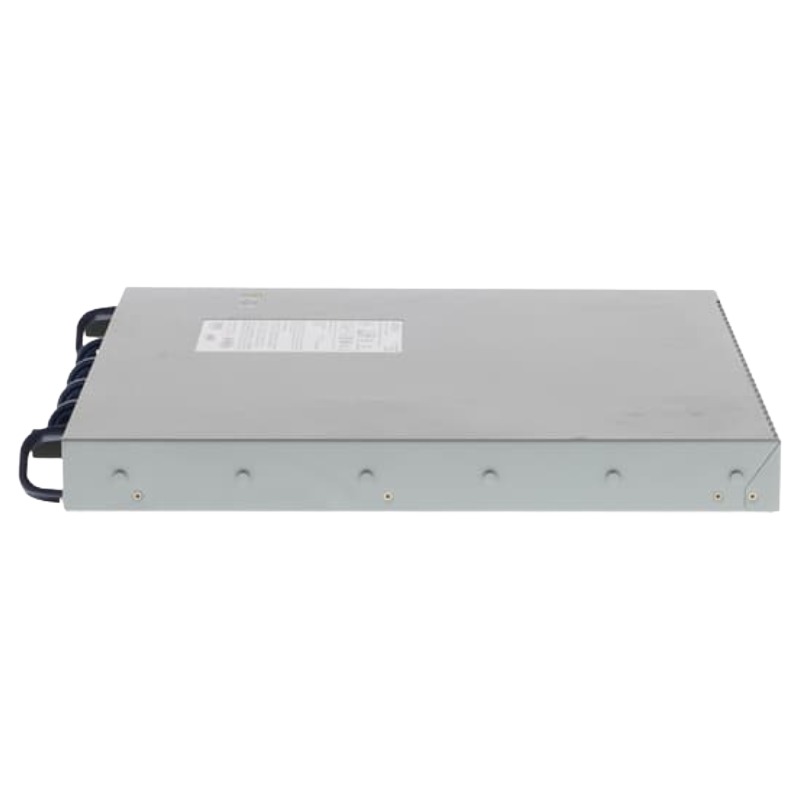
The 1U rack-mountable chassis of the Arista DCS-7050TX-72Q-F provides exceptional port density while minimizing rack space consumption. This compact design allows organizations to maximize networking capacity within standard data center cabinets and co-location environments. Efficient space utilization is particularly important in high-density data centers where rack capacity and cooling efficiency directly influence infrastructure scalability and operational costs.
The integration of forty-eight 10GbE ports and six 40GbE uplinks within a single rack unit creates a highly efficient switching platform for enterprise and cloud deployments. High-density configurations reduce the number of required switches, simplifying cable management and lowering infrastructure complexity. The compact architecture also supports streamlined deployment strategies in environments with limited rack space availability.


 Contact Us
 Information
 Catalog
 Solid State Drives (SSD)
 Network Switches
 Hard Disk Drives
 HBA & Controllers
 PC & Servers
 PC & Server Memory
 CPU & Processors
 Network Routers
 Power Supplies
 Tape Drives & Libraries
 Network Devices
 Computer & Network Cables