(7% discount is applied at checkout)
Cart is empty
Your go-to destination for cutting-edge server products



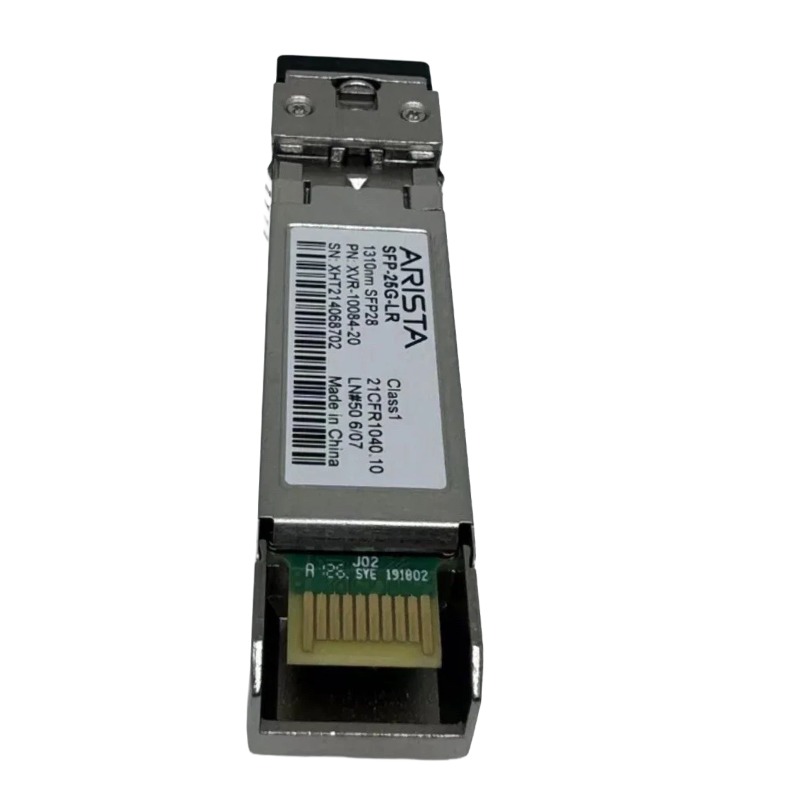
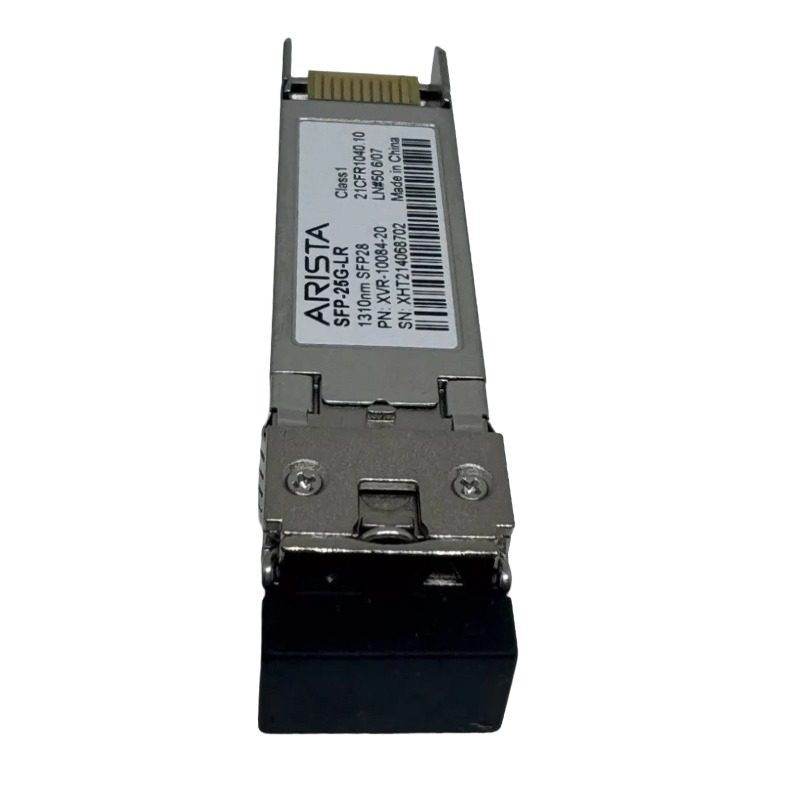
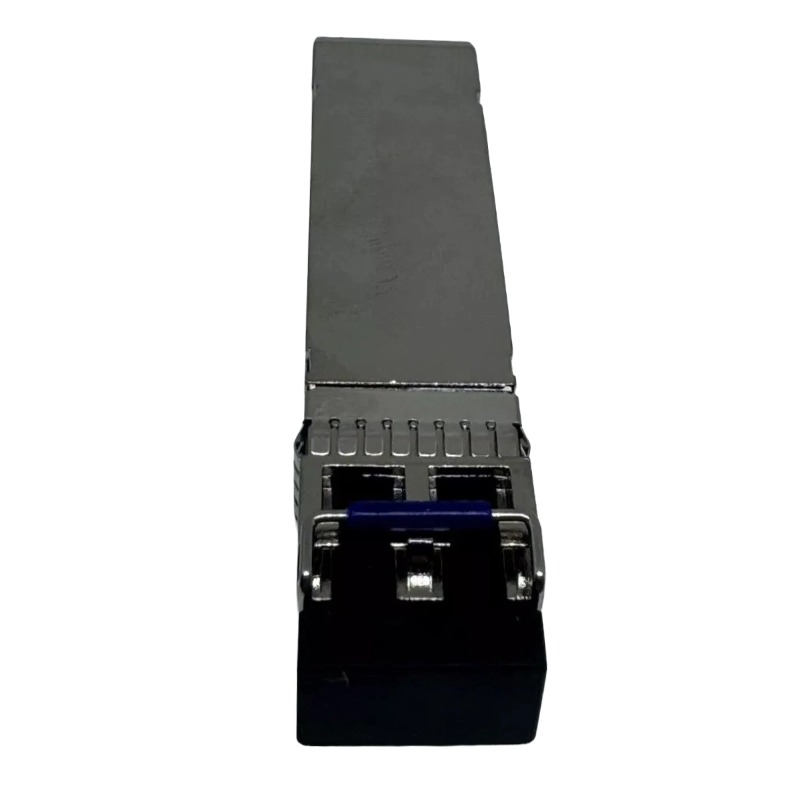
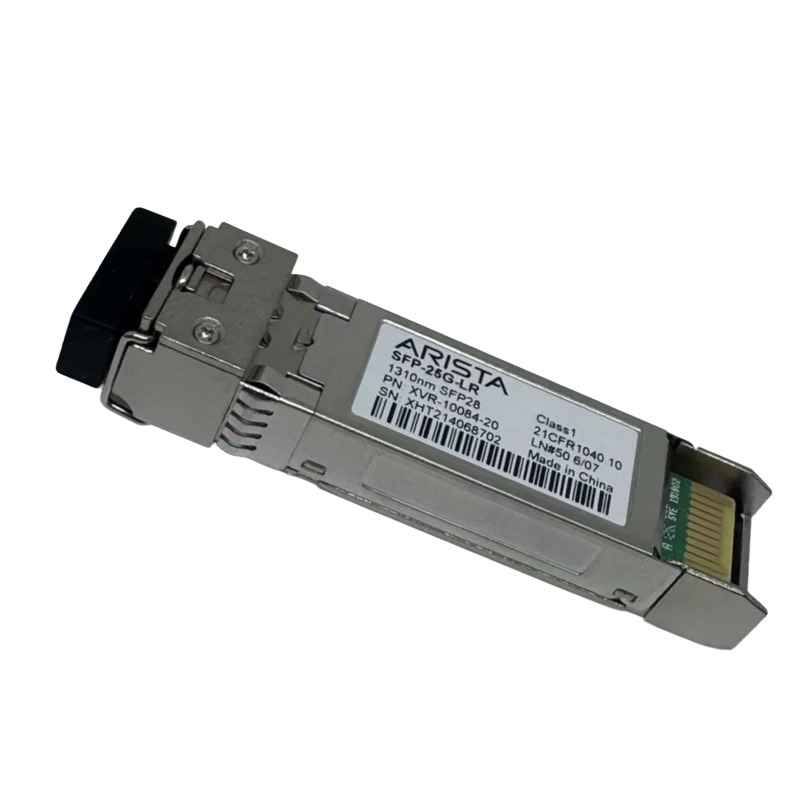
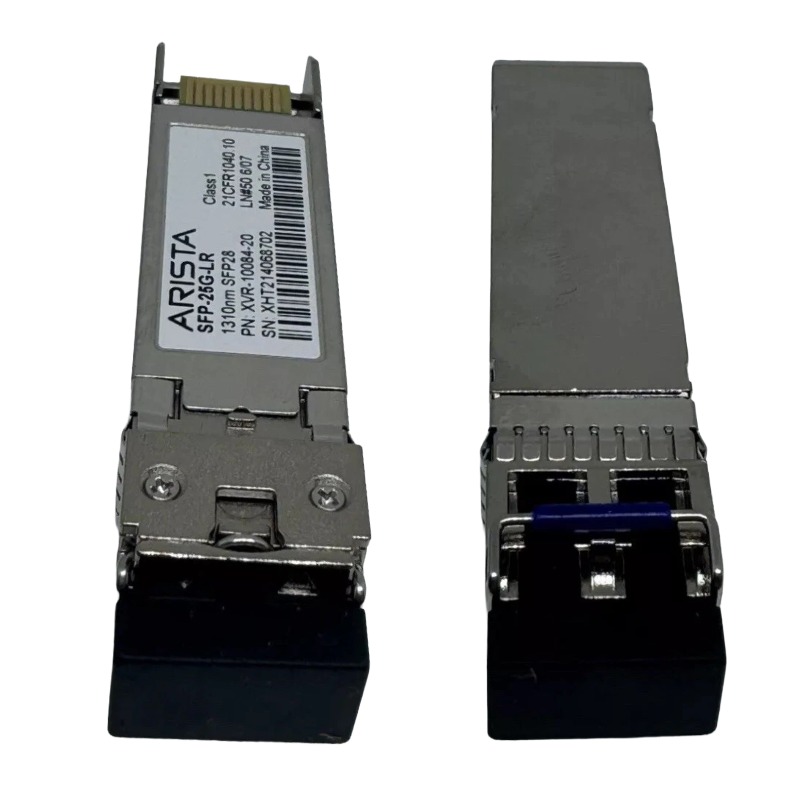
Arista XVR-10084-20 25GBASE-LR SFP Up to 10 km Over Duplex SMF Transceiver Module. Excellent Refurbished with 1 Year Replacement Warranty
The Arista XVR-10084-20 is a high-performance 25GBASE-LR SFP28 transceiver module engineered for reliable long-range fiber networking. Designed for enterprise networks, cloud computing environments, hyperscale data centers, and carrier-grade infrastructure, this optical module delivers stable 25 Gigabit Ethernet connectivity over single-mode fiber connections up to 10 kilometers.
The Arista XVR-10084-20 25GBASE-LR SFP28 optical transceiver module is engineered to support high-speed data transmission across enterprise, hyperscale, and cloud networking environments that demand stable long-range fiber connectivity. Designed for 25 Gigabit Ethernet applications, this advanced SFP28 transceiver enables seamless communication over duplex single-mode fiber links at distances reaching up to 10 kilometers. Modern data centers, carrier-grade infrastructures, and distributed enterprise networks depend on reliable optical connectivity to maintain low latency, high throughput, and uninterrupted operational efficiency, making the Arista XVR-10084-20 an essential component in next-generation networking architecture.
As networking environments continue evolving toward higher bandwidth demands and lower latency expectations, organizations increasingly deploy 25GbE solutions to bridge the gap between traditional 10GbE infrastructure and higher-cost 40GbE or 100GbE deployments. The Arista XVR-10084-20 transceiver supports these evolving infrastructure requirements by providing efficient optical transmission performance with reduced power consumption, enhanced signal integrity, and dependable interoperability with compatible networking hardware.
25GBASE-LR technology represents a major advancement in Ethernet networking by delivering 25 Gigabit data rates over long-distance single-mode fiber cabling. Unlike short-range multimode solutions intended for limited-distance connectivity within server racks or adjacent cabinets, LR optical technology is specifically optimized for extended reach applications where network devices are separated by several kilometers.
The Arista XVR-10084-20 leverages long-range optical signaling capabilities to support stable data communication over duplex SMF infrastructure. This allows enterprises and service providers to interconnect switches, routers, storage systems, and aggregation platforms across geographically distributed environments while maintaining excellent transmission quality and low bit error rates.
Long-range SFP28 transceivers have become increasingly important in modern enterprise networking because organizations now require reliable connectivity between separate buildings, branch offices, campus environments, and colocation facilities. By supporting transmission distances up to 10 km, the Arista XVR-10084-20 enables flexible deployment strategies without requiring intermediate signal amplification equipment.
The rapid increase in data-intensive workloads, virtualization technologies, cloud computing platforms, and AI-driven applications has significantly increased network bandwidth requirements across enterprises and service providers. Traditional 10GbE connectivity is no longer sufficient for many modern workloads, while higher-speed alternatives often introduce increased costs and power requirements.
The 25GbE standard offers an ideal balance between performance, scalability, and operational efficiency. The Arista XVR-10084-20 transceiver supports this networking evolution by enabling organizations to deploy higher bandwidth connectivity using cost-effective optical infrastructure. Compared to older 10GbE technologies, 25GbE provides substantially improved throughput while utilizing a similar single-lane signaling architecture, resulting in more efficient switch and server connectivity.
In large-scale data center environments, 25GbE connectivity helps reduce network bottlenecks, improve storage access performance, and accelerate east-west traffic communication between servers and virtualization hosts. This contributes to lower application latency, improved user experiences, and better overall network efficiency.
The Arista XVR-10084-20 transceiver module is specifically designed for operation over duplex single-mode fiber infrastructure. Single-mode fiber technology enables light signals to travel over significantly longer distances compared to multimode fiber by reducing modal dispersion and signal attenuation. This makes SMF ideal for long-range networking applications where transmission quality and signal reliability are critical.
Single-mode optical infrastructure is widely used across metropolitan area networks, enterprise campuses, telecom backbones, cloud facilities, and carrier interconnection environments. The Arista XVR-10084-20 supports this infrastructure by utilizing precision optical components that deliver stable transmission performance over extended distances.
The duplex transmission architecture used by the Arista XVR-10084-20 allows simultaneous bidirectional communication using two separate optical fiber strands. One strand handles data transmission while the other handles data reception, ensuring efficient full-duplex communication between connected network devices.
This architecture improves communication stability and reduces the risk of data collisions or transmission interruptions. Duplex single-mode connectivity is commonly used in enterprise core switching environments, aggregation layers, spine-leaf architectures, and storage networking applications where reliable high-speed communication is essential.
The transceiver’s support for standard LC optical connectors further enhances deployment flexibility and compatibility with modern fiber patch panels, structured cabling systems, and optical distribution frames commonly used in enterprise and telecom environments.
Long-distance optical transmission capabilities provide organizations with significant deployment flexibility. The Arista XVR-10084-20 enables network administrators to extend high-speed 25GbE connectivity across large campuses, metropolitan facilities, and distributed enterprise infrastructures without sacrificing network performance.
In enterprise environments with multiple buildings or remote facilities, long-range optical modules eliminate the limitations associated with copper-based Ethernet technologies. Copper cabling solutions often face severe distance restrictions and electromagnetic interference concerns, whereas optical fiber provides superior signal integrity and immunity to electrical noise.
The 10 km transmission capability also supports disaster recovery architectures, remote storage replication, and geographically separated data center interconnects. These capabilities are increasingly important for organizations prioritizing business continuity, high availability, and resilient network design.
The compact SFP28 form factor used by the Arista XVR-10084-20 allows high-density deployment within modern switches, routers, and networking appliances. Data centers and enterprise networks increasingly prioritize port density to maximize rack space efficiency while supporting growing bandwidth demands.
SFP28 technology builds upon the widely adopted SFP+ form factor while supporting higher data transmission rates required for 25GbE applications. This backward-compatible physical design simplifies migration paths for organizations upgrading existing infrastructure from 10GbE to 25GbE networking.
The hot-swappable modular design of the Arista XVR-10084-20 allows network administrators to install or replace transceivers without interrupting switch operation or shutting down critical network services. This capability significantly reduces maintenance downtime and improves operational efficiency within mission-critical networking environments.
Compact transceiver modules also simplify cable management and improve airflow within high-density networking racks. Efficient airflow management is particularly important in modern data centers where thermal control directly affects equipment reliability, cooling efficiency, and operational costs.
The lightweight construction and standardized dimensions of SFP28 transceivers contribute to scalable infrastructure deployments, enabling organizations to expand network capacity incrementally as bandwidth requirements increase.
The Arista XVR-10084-20 is engineered for compatibility with supported Arista networking equipment designed for 25GbE optical connectivity. Compatibility plays a critical role in ensuring stable operation, optimal performance, and seamless integration across enterprise networking infrastructures.
Modern network environments often include complex switching architectures with spine-leaf topologies, virtualization platforms, and software-defined networking frameworks. Reliable transceiver compatibility ensures consistent optical communication across these interconnected systems.
Organizations deploying Arista switches benefit from integrated optical monitoring capabilities, diagnostic support, and enhanced interoperability validation provided by officially supported transceiver modules. This helps reduce troubleshooting complexity while improving long-term network reliability.
The Arista XVR-10084-20 transceiver module is widely applicable across modern enterprise and hyperscale data center environments where high-speed optical connectivity is essential for operational performance. Data centers require reliable low-latency communication between servers, storage systems, virtualization clusters, and network aggregation layers.
25GbE connectivity has emerged as a preferred networking standard for modern server environments because it delivers significantly improved bandwidth efficiency compared to legacy 10GbE infrastructure. The Arista XVR-10084-20 supports these deployments by providing stable optical transmission over long-range fiber links.
Spine-leaf architectures are increasingly deployed in modern data centers to provide scalable east-west traffic communication between servers and application workloads. These architectures require high-speed low-latency optical links between leaf switches and spine switches to maintain predictable performance under heavy traffic loads.
The Arista XVR-10084-20 enables efficient 25GbE optical connectivity within spine-leaf environments by supporting long-distance communication between switching layers. This contributes to improved workload mobility, faster application access, and enhanced virtualization performance.
Scalable optical connectivity also supports future infrastructure growth by enabling organizations to expand network capacity while preserving existing fiber investments and maintaining operational consistency.
Cloud computing environments require highly reliable network connectivity to support virtual machines, distributed storage systems, containerized applications, and software-defined networking frameworks. Optical transceivers such as the Arista XVR-10084-20 play a critical role in maintaining stable communication between cloud infrastructure components.
Long-range optical connectivity enables cloud providers and enterprise IT teams to distribute workloads across multiple facilities while maintaining high-speed data synchronization and application availability. This flexibility supports hybrid cloud strategies, multi-site deployments, and geographically redundant infrastructure architectures.
As organizations continue migrating toward cloud-native applications and virtualized services, dependable 25GbE optical networking becomes increasingly important for maintaining performance consistency and operational scalability.
Reliable signal integrity is essential for maintaining consistent high-speed data communication across enterprise optical networks. The Arista XVR-10084-20 incorporates advanced optical engineering technologies designed to minimize signal degradation, reduce transmission errors, and ensure stable operation under demanding networking conditions.
Optical signal quality directly impacts network reliability, latency performance, and packet transmission accuracy. Poor signal integrity can result in retransmissions, application slowdowns, and degraded user experiences. High-quality transceivers help prevent these issues by maintaining stable optical communication across extended fiber distances.
Energy efficiency is an increasingly important consideration in modern networking infrastructure. Large-scale data centers often deploy thousands of optical transceivers simultaneously, making power consumption and thermal management critical operational concerns.
The Arista XVR-10084-20 is designed to support efficient power utilization while maintaining high-speed optical performance. Reduced power consumption contributes to lower operational expenses, decreased cooling requirements, and improved environmental sustainability within enterprise and cloud facilities.
Thermal efficiency also improves transceiver reliability by reducing heat-related stress on optical components. Stable operating temperatures help extend equipment lifespan while minimizing the risk of performance degradation under continuous network workloads.
High-speed optical communication requires precise signal transmission and reception to maintain data integrity across long distances. The Arista XVR-10084-20 utilizes advanced optical components and signal processing technologies to minimize transmission errors and improve overall network stability.
Reduced bit error rates contribute to more reliable application performance, smoother virtualization operations, and improved storage access efficiency. These characteristics are especially important in mission-critical enterprise environments where downtime or communication instability can disrupt business operations.
Reliable optical transmission also supports latency-sensitive applications including financial trading systems, cloud analytics platforms, media streaming environments, and real-time collaboration services.
Scalability remains a major priority for organizations investing in modern networking infrastructure. The Arista XVR-10084-20 supports scalable network expansion by enabling higher bandwidth connectivity without requiring complete infrastructure redesign.
As digital transformation initiatives continue accelerating across industries, enterprises require networking solutions capable of supporting increasing data volumes, expanding user populations, and evolving application demands. Optical transceivers supporting 25GbE connectivity help organizations prepare for these future requirements while maintaining operational efficiency.
Many enterprises continue operating legacy 10GbE infrastructure that may no longer provide sufficient bandwidth for modern workloads. Transitioning directly to very high-speed networking technologies can introduce significant costs and operational complexity.
The Arista XVR-10084-20 supports a practical migration strategy by enabling organizations to upgrade incrementally toward 25GbE connectivity. Because 25GbE technology offers improved bandwidth efficiency using a familiar single-lane architecture, enterprises can modernize network performance while minimizing infrastructure disruption.
This migration flexibility allows businesses to extend the value of existing optical investments while preparing for future networking expansion. Incremental upgrades also simplify budgeting and reduce deployment risks associated with large-scale infrastructure replacements.
Virtualization platforms and storage networking environments generate substantial east-west traffic that requires low-latency high-bandwidth communication between servers and storage arrays. The Arista XVR-10084-20 provides the optical connectivity necessary to support these demanding workloads.
Modern enterprise storage technologies including distributed storage clusters, NVMe-over-Fabric deployments, and software-defined storage systems depend on fast reliable network communication to maintain performance consistency. High-speed 25GbE optical links help reduce storage bottlenecks and improve data access responsiveness.
Virtual machine migration, backup replication, and disaster recovery synchronization processes also benefit from the enhanced throughput provided by 25GbE networking infrastructure. These capabilities contribute to improved operational agility and better overall infrastructure resilience.
Mission-critical networking environments require dependable connectivity solutions capable of maintaining stable operation under continuous workloads. The Arista XVR-10084-20 is designed to support enterprise-grade reliability standards for applications where network downtime can significantly impact business continuity.
Industries including finance, healthcare, telecommunications, education, cloud services, and manufacturing increasingly depend on high-speed optical infrastructure to support critical operational processes. Reliable optical transceivers help ensure uninterrupted communication between essential systems and services.
Enterprise networks often operate continuously with minimal downtime windows, placing significant demands on optical networking components. The Arista XVR-10084-20 is engineered for stable operation within high-traffic environments where consistent performance is essential.
Continuous data transmission across enterprise networks can generate substantial thermal and operational stress on optical components. High-quality transceiver construction helps maintain signal stability and communication reliability under these demanding conditions.
Stable optical performance also contributes to predictable network behavior, enabling administrators to maintain service-level agreements and support business-critical applications with greater confidence.
High-availability network architectures rely on redundant connectivity paths and resilient communication infrastructure to minimize downtime risks. The Arista XVR-10084-20 supports these architectures by providing dependable long-range optical connectivity for redundant network links and failover configurations.
Organizations deploying active-active or active-passive network designs require reliable optical modules capable of maintaining communication stability across primary and backup pathways. Long-range 25GbE optical connectivity helps support these resilient infrastructure strategies.
High-availability optical networking is especially important within distributed enterprise environments, cloud platforms, and large-scale data center operations where service interruptions can impact multiple applications and users simultaneously.
Digital transformation initiatives continue driving demand for faster, more scalable, and more efficient networking infrastructure. Organizations adopting AI platforms, machine learning environments, big data analytics, and high-performance computing require optical networking solutions capable of supporting substantial data movement across distributed systems.
The Arista XVR-10084-20 supports these evolving technology requirements by delivering reliable 25GbE long-range optical connectivity for modern enterprise and cloud environments. High-speed optical communication enables organizations to maintain operational agility while supporting increasingly complex digital workloads.
Artificial intelligence and analytics platforms generate enormous amounts of network traffic due to distributed computing operations, large dataset transfers, and parallel processing requirements. Reliable optical networking infrastructure is essential for maintaining efficient communication between compute clusters and storage resources.
The Arista XVR-10084-20 helps support these environments by providing high-bandwidth low-latency optical connectivity capable of handling substantial data transmission demands. Stable 25GbE communication contributes to improved processing efficiency and faster workload execution across AI infrastructure.
As enterprises continue expanding data-driven operations, scalable optical networking solutions become increasingly important for maintaining infrastructure performance and supporting future technological innovation.
Next-generation enterprise networking increasingly depends on scalable optical technologies capable of supporting higher bandwidth requirements while maintaining operational efficiency. The Arista XVR-10084-20 represents a critical component within this evolving networking landscape by delivering dependable long-range 25GbE optical communication.
Organizations investing in modern data center modernization, cloud transformation, and distributed infrastructure expansion require optical transceivers designed for performance consistency, compatibility, and future scalability. The combination of SFP28 efficiency, long-range SMF support, and high-speed transmission capability makes the Arista XVR-10084-20 well suited for these advanced networking applications.
By supporting reliable optical communication across enterprise, cloud, and carrier-grade environments, the Arista XVR-10084-20 contributes to more resilient, scalable, and high-performing digital infrastructure capable of meeting the demands of modern business operations and future network expansion initiatives.


 Contact Us
 Information
 Catalog
 Solid State Drives (SSD)
 Network Switches
 Hard Disk Drives
 HBA & Controllers
 PC & Servers
 PC & Server Memory
 CPU & Processors
 Network Routers
 Power Supplies
 Tape Drives & Libraries
 Network Devices
 Computer & Network Cables