(7% discount is applied at checkout)
Cart is empty
Your go-to destination for cutting-edge server products


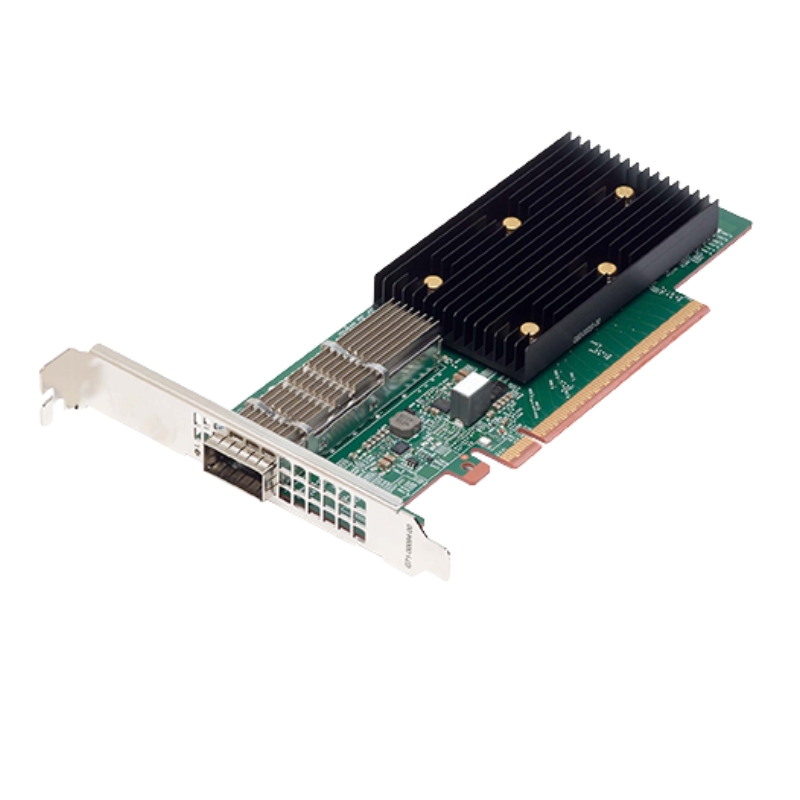
Broadcom BCM957608-P1400GDF00 Single-port 400 GBs QSFP-DD PCI Network Card. Factory-Sealed New in Original Box (FSB) with 3 Year Warranty
The Broadcom BCM957608-P1400GDF00 is a high-speed single-port 400 Gbps QSFP-DD PCI network adapter designed for advanced data centers, AI workloads, and cloud computing environments.
The Broadcom BCM957608-P1400GDF00 Single-port 400 GBs QSFP-DD PCI Network Card belongs to the advanced 400 Gigabit Ethernet PCIe adapter category engineered for hyperscale data centers, high-performance computing clusters, cloud infrastructure, artificial intelligence training environments, and ultra-low-latency enterprise networking. This category represents the highest tier of Ethernet connectivity currently deployed in production data center environments, where bandwidth density, packet processing efficiency, and scalability determine overall system throughput.
400GbE network interface cards are designed to eliminate bottlenecks between compute nodes, storage subsystems, and switching fabrics. As processor core counts increase and distributed workloads become more data-intensive, network infrastructure must scale proportionally. A single-port 400GbE adapter provides massive throughput in a compact PCI Express form factor, allowing servers to achieve high bandwidth density without consuming multiple expansion slots. This efficiency is especially critical in dense rack deployments where power, cooling, and physical space are tightly optimized.
The QSFP-DD interface is a defining characteristic of this network adapter category. QSFP-DD, or Quad Small Form-factor Pluggable Double Density, supports eight high-speed electrical lanes, enabling 400GbE throughput within a compact pluggable module. This design allows data center operators to deploy high-speed optical transceivers or direct attach copper cables depending on distance requirements and cost considerations.
The single-port QSFP-DD configuration maximizes bandwidth per port while simplifying cabling architecture. Rather than managing multiple lower-speed connections, administrators can deploy a streamlined high-capacity link that reduces switch port consumption and improves rack-level cable management.
400GbE PCI network cards rely on high-bandwidth PCI Express interfaces to prevent internal bottlenecks. This category typically utilizes PCIe Gen4 or Gen5 x16 connectivity, ensuring that the host system can sustain full 400Gbps throughput without congestion. The integration between the network controller and the PCIe subsystem is critical for maintaining line-rate performance during high packet-per-second workloads.
Advanced DMA engines and optimized memory buffering allow efficient data movement between the NIC and system memory. This reduces CPU overhead and enables the server processor to focus on application-level tasks rather than packet handling.
At 400GbE speeds, signal integrity becomes a major engineering challenge. The QSFP-DD standard employs eight electrical lanes operating at high signaling rates, requiring precision PCB design, low-loss materials, and carefully tuned equalization techniques. The network card category incorporates advanced retimers and signal conditioning technologies to ensure stable data transmission under variable environmental conditions.
These hardware optimizations contribute to consistent performance across large-scale deployments, where thousands of adapters operate simultaneously within high-density racks.
At the core of this category is Broadcom’s high-performance Ethernet controller architecture. Broadcom network silicon is widely deployed across enterprise and hyperscale environments due to its reliability, scalability, and advanced offloading capabilities. The BCM957608-P1400GDF00 integrates controller technologies that support high packet throughput, deep buffering, and sophisticated traffic management features.
Broadcom controllers are engineered to support hardware-based acceleration for virtualization, storage protocols, and security functions. This hardware acceleration reduces CPU utilization and enhances deterministic performance under mixed workload scenarios.
Remote Direct Memory Access support is a critical capability in the 400GbE NIC category. RDMA allows direct memory-to-memory data transfers between servers without involving the host CPU in packet processing. This significantly lowers latency and improves throughput efficiency for applications such as distributed databases, AI model training clusters, and real-time analytics platforms.
By minimizing software overhead and kernel intervention, RDMA-capable adapters deliver predictable latency characteristics, which are essential in environments where microseconds can impact performance outcomes.
The 400GbE PCIe network adapter category commonly supports RoCE and iWARP implementations to facilitate RDMA over Ethernet networks. These protocols enable high-performance interconnects within standard Ethernet infrastructures, eliminating the need for proprietary fabrics. This compatibility enhances deployment flexibility while preserving Ethernet interoperability.
Protocol support at the hardware level ensures efficient packet encapsulation and congestion management, reducing retransmissions and maintaining high throughput under load.
Cloud service providers require network interfaces capable of handling massive multi-tenant traffic with strict isolation guarantees. The 400GbE NIC category incorporates virtualization acceleration features such as SR-IOV, virtual function provisioning, and hardware-based traffic steering. These capabilities allow multiple virtual machines or containers to share a single physical network port without sacrificing performance or security.
Advanced queue management and traffic classification ensure that workloads receive consistent bandwidth allocation. This is particularly important in Infrastructure-as-a-Service deployments where unpredictable customer traffic patterns can strain network resources.
Data Center Bridging technologies enhance Ethernet performance by enabling lossless transport for storage and latency-sensitive applications. 400GbE adapters integrate priority-based flow control, enhanced transmission selection, and congestion notification mechanisms to maintain stable throughput under high utilization conditions.
These traffic management features reduce packet drops and retransmissions, improving overall efficiency in converged network environments where storage, compute, and general traffic coexist.
Security is a fundamental consideration in high-speed networking. The 400GbE NIC category supports hardware-based encryption, secure boot mechanisms, and advanced packet filtering. By offloading encryption tasks to the network controller, systems can maintain high throughput without compromising data protection.
Integrated security features protect sensitive workloads in financial services, healthcare systems, and government infrastructure, where compliance requirements mandate robust data safeguarding mechanisms.
Modern GPU-accelerated servers demand network interfaces capable of sustaining extreme throughput. 400GbE NICs complement high-performance GPUs by preventing network congestion during distributed workloads. Integration with advanced PCIe architectures ensures that data flows seamlessly between accelerators and network interfaces.
This synergy between compute and networking components enhances cluster efficiency and supports scalable AI infrastructure growth.
The 400GbE category plays a critical role in modern storage architectures, particularly NVMe over Fabrics deployments. High-speed Ethernet enables low-latency access to remote NVMe storage devices, effectively extending local storage performance across the network. This approach simplifies storage scaling while maintaining high throughput.
By supporting storage protocol acceleration, 400GbE adapters minimize latency penalties traditionally associated with network-attached storage systems. This capability enables hyper-converged infrastructure models and distributed storage platforms to achieve near-local performance characteristics.
Large-scale analytics environments depend on rapid data ingestion and retrieval. 400GbE network cards enable high-speed connectivity between compute nodes and storage arrays, facilitating real-time processing of massive datasets. Financial modeling platforms, IoT telemetry systems, and business intelligence tools all benefit from the bandwidth density provided by this category.
As data volumes continue to expand, the ability to move information quickly across distributed systems becomes a competitive advantage. High-speed Ethernet infrastructure ensures that analytics pipelines remain efficient and responsive.
Despite delivering 400Gbps throughput, modern network adapters are engineered for optimized power efficiency. Advanced semiconductor fabrication processes reduce energy consumption per transmitted bit, lowering operational costs in large-scale deployments. Efficient thermal design ensures stable operation within high-density server chassis, preventing performance degradation under sustained loads.
Thermal management considerations include optimized heatsinks, airflow compatibility, and temperature monitoring capabilities. These features help maintain consistent performance across extended operational periods.
The 400GbE PCIe network card category represents a strategic investment in long-term infrastructure scalability. As network traffic continues to grow due to digital transformation, edge computing expansion, and AI-driven services, 400GbE connectivity provides the headroom required to accommodate future demands.
Interoperability with evolving Ethernet standards ensures that organizations can integrate new switching platforms and optical technologies without replacing existing adapters prematurely. This forward compatibility supports gradual infrastructure evolution rather than disruptive overhauls.
Compliance with IEEE 802.3 Ethernet standards ensures seamless integration with compatible networking equipment. The 400GbE category adheres to established specifications for signaling, error correction, and interoperability, simplifying deployment in multi-vendor environments. This adherence to standards reduces integration complexity and enhances system stability.


 Contact Us
 Information
 Catalog
 Solid State Drives (SSD)
 Network Switches
 Hard Disk Drives
 HBA & Controllers
 PC & Servers
 PC & Server Memory
 CPU & Processors
 Network Routers
 Power Supplies
 Tape Drives & Libraries
 Network Devices
 Computer & Network Cables