(7% discount is applied at checkout)
Cart is empty
Your go-to destination for cutting-edge server products
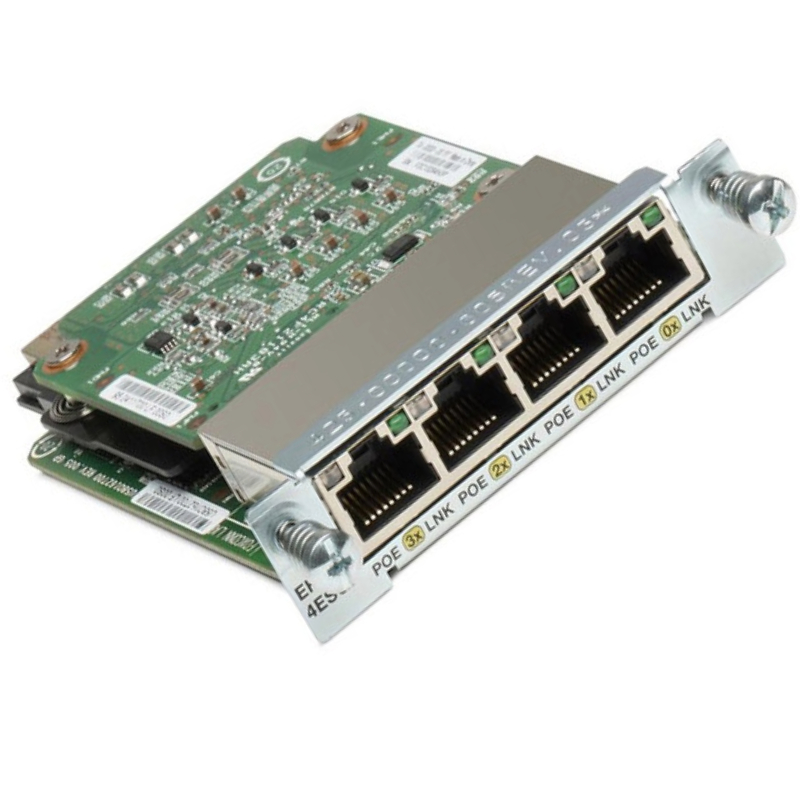


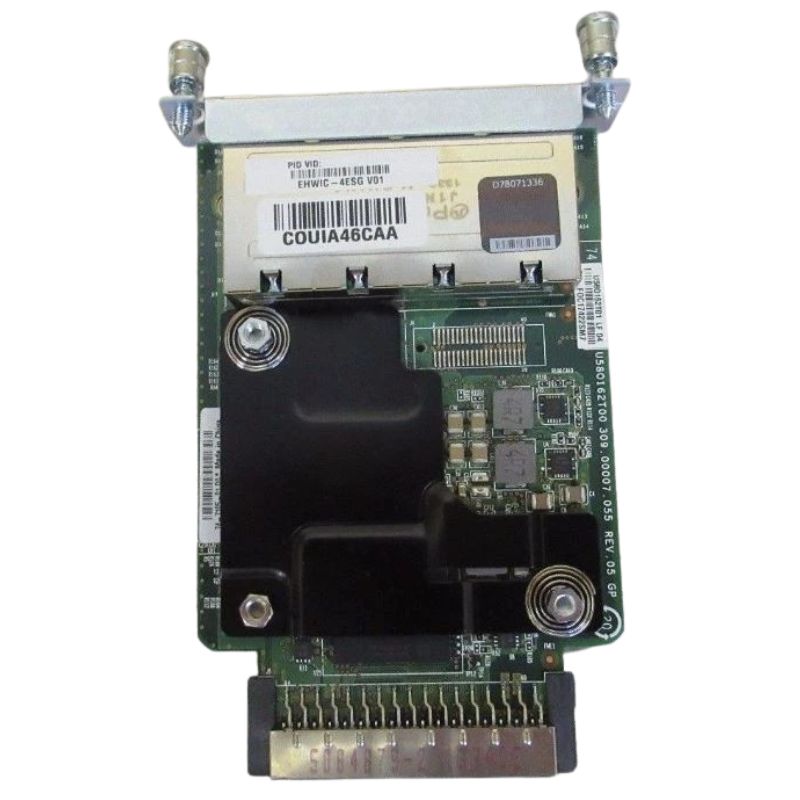
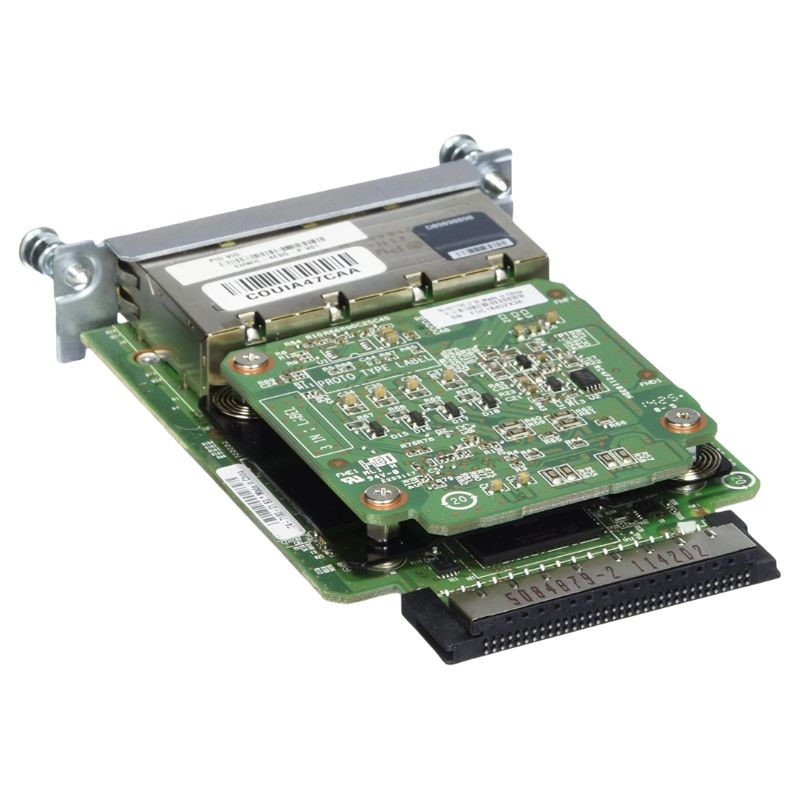
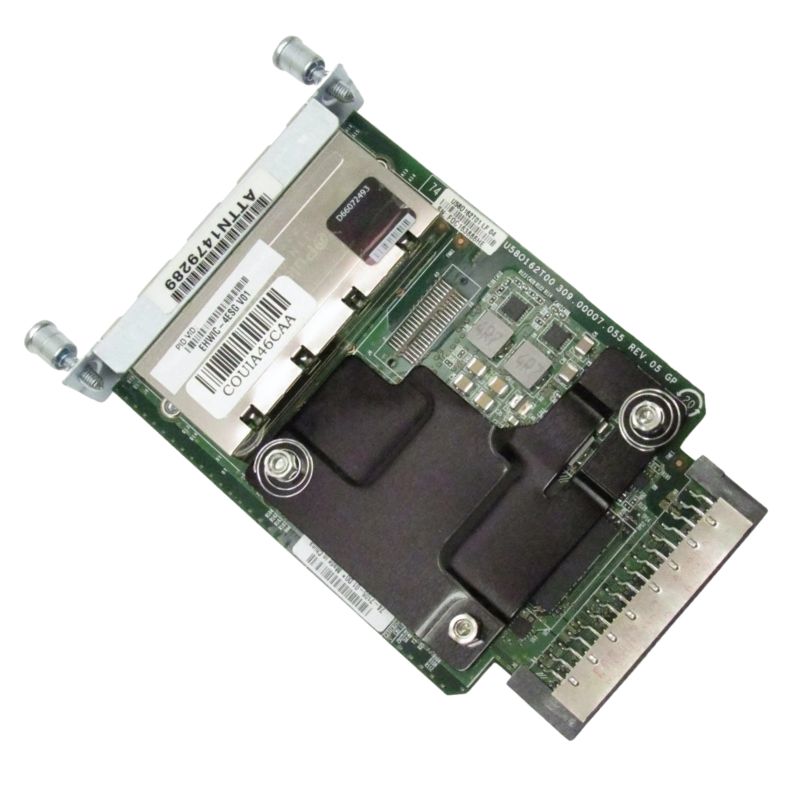
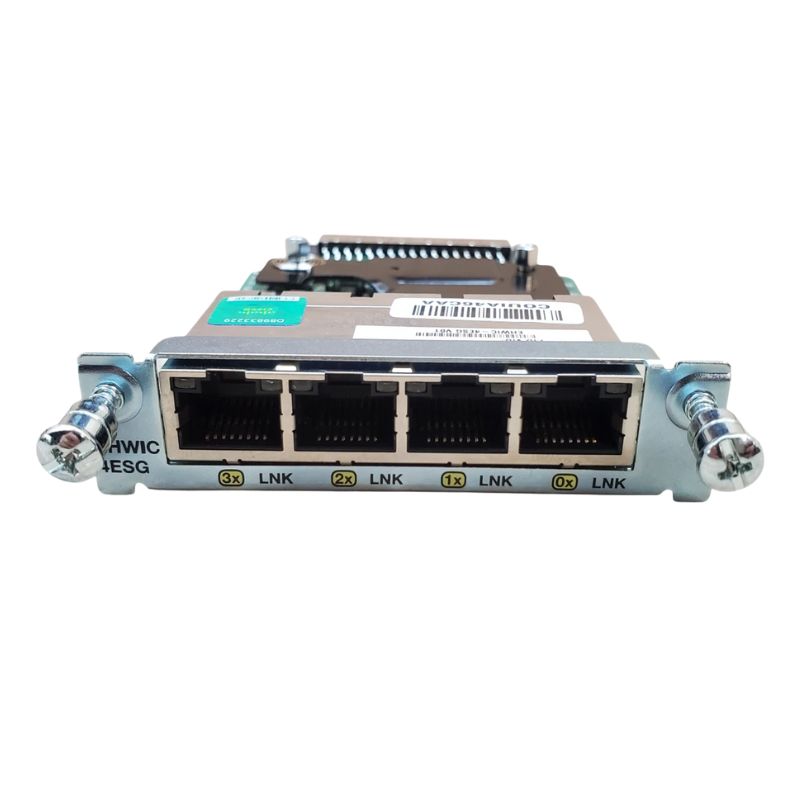
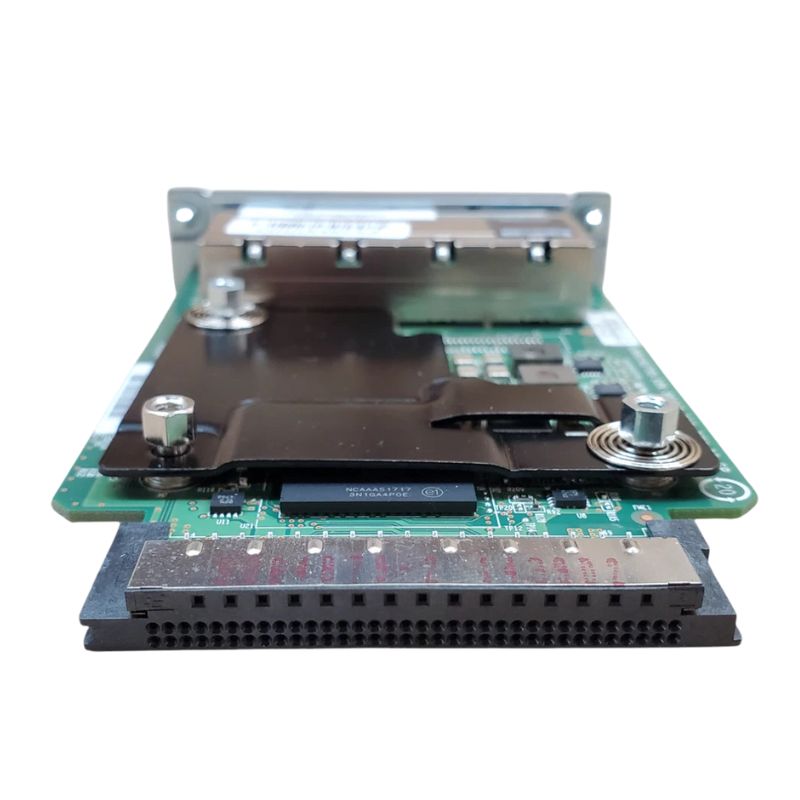
Cisco EHWIC-4ESG= 4 Ports Gigabit Ethernet Interface Module. Excellent Refurbished with 1 year replacement warranty
| SKU/MPN | Warranty | Price | Condition | You save |
|---|---|---|---|---|
| EHWIC-4ESG= | 1 Year Warranty | $65.00 | Excellent Refurbished | You save: $22.75 (26%) |
| EHWIC-4ESG= | 1 Year Warranty | $95.00 | Factory-Sealed New Retail in Original Box (FSB) | You save: $33.25 (26%) |
Cisco EHWIC-4ESG= is a high-performance networking expansion module designed with four integrated Gigabit Ethernet interfaces, engineered to enhance connectivity and support efficient data transmission across enterprise-grade systems. This advanced WAN interface module delivers reliable switching and routing capabilities for modern business network environments requiring stable and scalable performance.
The Cisco EHWIC-4ESG= 4 Ports Gigabit Ethernet Interface Module is engineered as an Enhanced High-Speed WAN Interface Card designed to extend the Ethernet capabilities of compatible Cisco Integrated Services Routers. Its architecture is built around modular expansion principles, allowing enterprise and service provider networks to scale LAN and WAN connectivity without replacing core routing hardware. The module integrates directly into an EHWIC slot, enabling four independent Gigabit Ethernet interfaces that function as fully operational Layer 2 and Layer 3 ports depending on router configuration.
At the core of its design is a focus on high throughput forwarding and deterministic packet handling. Each of the four ports operates at Gigabit line rate, enabling simultaneous data streams without congestion at the interface level when properly provisioned. The module is optimized for environments that require consistent bandwidth allocation, such as branch office aggregation, secure enterprise segmentation, and distributed application delivery.
The physical construction of the module reflects Cisco’s enterprise-grade hardware standards. The interface card is built with a compact PCB layout that aligns with thermal efficiency and signal integrity requirements. Each Gigabit Ethernet port is shielded to minimize electromagnetic interference and ensure stable link quality even in high-density rack environments.
The module’s port controllers are designed to maintain low latency switching between ingress and egress traffic. This is particularly important in deployments where real-time applications such as voice, video conferencing, and transactional systems rely on predictable network behavior. The internal switching fabric is optimized for wire-speed forwarding, reducing bottlenecks at the interface layer.
Data flow within the module follows a structured pipeline that prioritizes packet inspection, classification, and forwarding efficiency. Incoming frames are processed through hardware-assisted pathways that reduce CPU overhead on the host router. This allows the main router processor to focus on routing logic, policy enforcement, and higher-level services rather than raw packet switching.
The module supports full-duplex communication on all ports, ensuring simultaneous transmission and reception without collision domains. This design is essential for modern switched Ethernet environments where bidirectional traffic flows dominate application behavior.
Thermal considerations are integrated into the module’s engineering to ensure stable operation under sustained high traffic loads. Heat dissipation is managed through strategic component placement and airflow alignment with Cisco ISR chassis designs. Power draw is optimized to remain within the host router’s internal power budget while still delivering consistent Gigabit performance.
The balance between performance and power efficiency is particularly important in branch office deployments where environmental controls may be limited. The module maintains operational stability even in compact network enclosures where airflow is constrained.
The four Gigabit Ethernet ports provided by the module are designed for flexible assignment across LAN, WAN, or hybrid network roles. Each interface supports standard Ethernet framing and can be configured for routing, switching, or bridging functions depending on the network architecture.
The Gigabit speed capability ensures that the module can handle modern enterprise workloads such as cloud connectivity, virtualization traffic, and high-volume data replication. Unlike lower-speed interface modules, this design eliminates common bottlenecks in access-layer aggregation scenarios.
The module supports Layer 2 switching capabilities that allow segmentation of traffic using VLAN tagging. This enables network administrators to logically separate departments, applications, or security zones while maintaining a single physical interface infrastructure. VLAN segmentation improves both security posture and traffic management efficiency.
In environments where multiple VLANs traverse the same physical port, the module maintains strict frame tagging consistency, ensuring interoperability with enterprise switching infrastructure and downstream access devices.
When configured for Layer 3 operation, each port on the module functions as a routed interface with its own IP configuration. This allows the module to participate directly in routing protocols and inter-network communication without requiring external switching devices.
The integration with Cisco ISR routing engines enables dynamic routing protocol support such as OSPF and EIGRP, depending on router capability. This enhances network convergence speed and improves resilience in multi-path environments.
The Cisco EHWIC-4ESG= module is commonly deployed in enterprise branch environments where multiple network segments must be aggregated into a single routing platform. Its four-port design allows organizations to connect internal LAN segments, dedicated server networks, guest access zones, and WAN uplinks simultaneously.
This modular approach reduces the need for external switches in smaller deployments, simplifying infrastructure design while maintaining enterprise-grade functionality. It also allows for incremental scalability, where additional modules can be added as network demands increase.
In branch office environments, the module provides a compact solution for integrating local networks with central data centers or cloud services. Each port can be assigned to different WAN providers or redundant uplink paths, enhancing resilience and failover capabilities.
The ability to configure multiple uplinks supports load distribution strategies where traffic is balanced across available connections, improving bandwidth utilization and reducing latency for end users.
At the edge of data center environments, the module can serve as an aggregation point for smaller network segments. Its Gigabit throughput ensures that data-intensive applications such as backup replication, virtualization migration, and storage synchronization are handled efficiently.
The deterministic performance characteristics of the module make it suitable for environments where predictable latency and throughput are critical for application stability.
Security functionality is a key aspect of the module’s integration within Cisco networking ecosystems. While the module itself focuses on interface delivery, it operates in conjunction with router-based security features such as access control lists, firewall policies, and encrypted tunneling protocols.
Traffic entering each Gigabit interface can be filtered and classified according to security policies defined at the router level. This allows organizations to enforce granular control over inbound and outbound traffic flows.
Packet filtering mechanisms applied to the module’s interfaces allow administrators to define rules based on IP addresses, protocols, and port numbers. These rules help prevent unauthorized access and reduce exposure to malicious traffic.
The integration of hardware-assisted forwarding ensures that security policies do not significantly degrade throughput performance, maintaining a balance between protection and efficiency.
Network segmentation supported by the module enhances security by isolating different operational zones. For example, guest networks can be separated from corporate internal systems while still sharing the same physical infrastructure.
This segmentation reduces the risk of lateral movement in the event of a security breach, limiting potential exposure across the network.
Quality of Service capabilities are essential for managing mixed traffic environments where latency-sensitive applications coexist with bulk data transfers. The module supports QoS policies that prioritize voice, video, and critical business applications over less time-sensitive traffic.
Traffic classification can be applied at ingress points, ensuring that packets are marked and queued appropriately before being forwarded through the routing infrastructure.
The module is designed for compatibility with a range of Cisco Integrated Services Routers that support EHWIC expansion slots. This ensures broad deployment flexibility across different network sizes and architectures.
Compatibility also extends to Cisco IOS feature sets, allowing administrators to leverage advanced routing, security, and monitoring capabilities depending on installed software versions.
The module is engineered to maintain consistent throughput across all four Gigabit interfaces. Performance optimization is achieved through hardware-based forwarding paths and efficient packet buffering mechanisms.
This ensures that even under high utilization conditions, packet loss and latency remain within acceptable operational thresholds for enterprise applications.
Scalability is a key advantage of modular interface design. Organizations can expand network capacity incrementally by adding additional modules or redistributing traffic loads across available ports.
This approach reduces the need for large-scale infrastructure replacement, providing cost efficiency and operational flexibility.
The module supports a wide range of advanced networking scenarios including hybrid cloud connectivity, distributed application hosting, and secure branch interconnection. Its flexibility allows it to adapt to evolving enterprise requirements without requiring significant hardware changes.
In cloud-integrated environments, the module facilitates secure and high-speed connections to remote infrastructure, supporting data synchronization and application delivery across geographically distributed systems.
Virtualized environments benefit from the module’s ability to handle multiple isolated traffic streams simultaneously. Each interface can support different virtual network segments, enabling efficient resource utilization across shared infrastructure.
Multi-service integration allows voice, data, and video services to coexist on the same physical hardware while maintaining performance isolation through QoS and VLAN mechanisms.


 Contact Us
 Information
 Catalog
 Solid State Drives (SSD)
 Network Switches
 Hard Disk Drives
 HBA & Controllers
 PC & Servers
 PC & Server Memory
 CPU & Processors
 Network Routers
 Power Supplies
 Tape Drives & Libraries
 Network Devices
 Computer & Network Cables