(7% discount is applied at checkout)
Cart is empty
Your go-to destination for cutting-edge server products
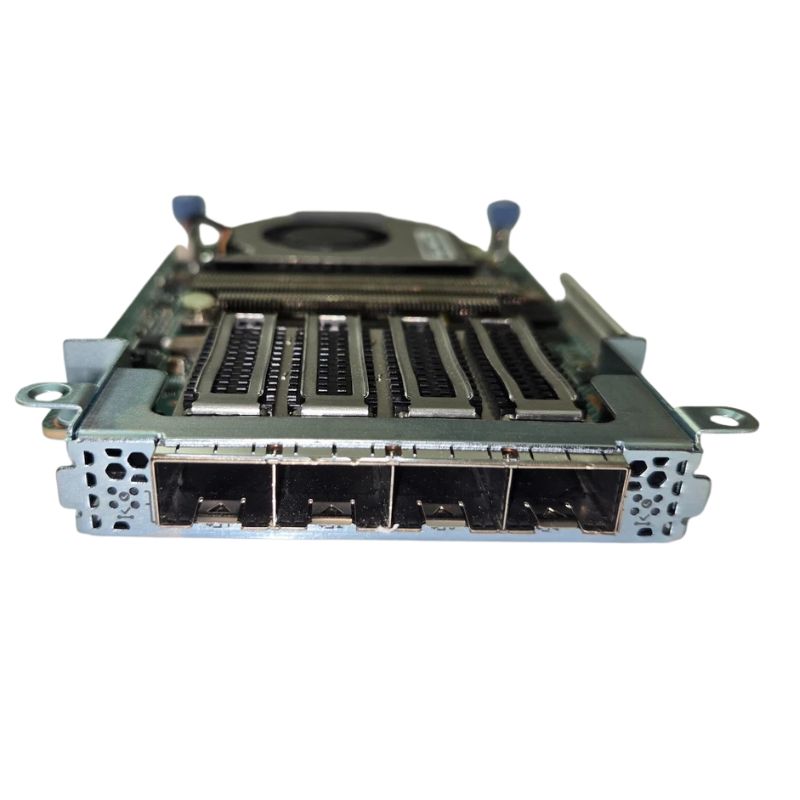


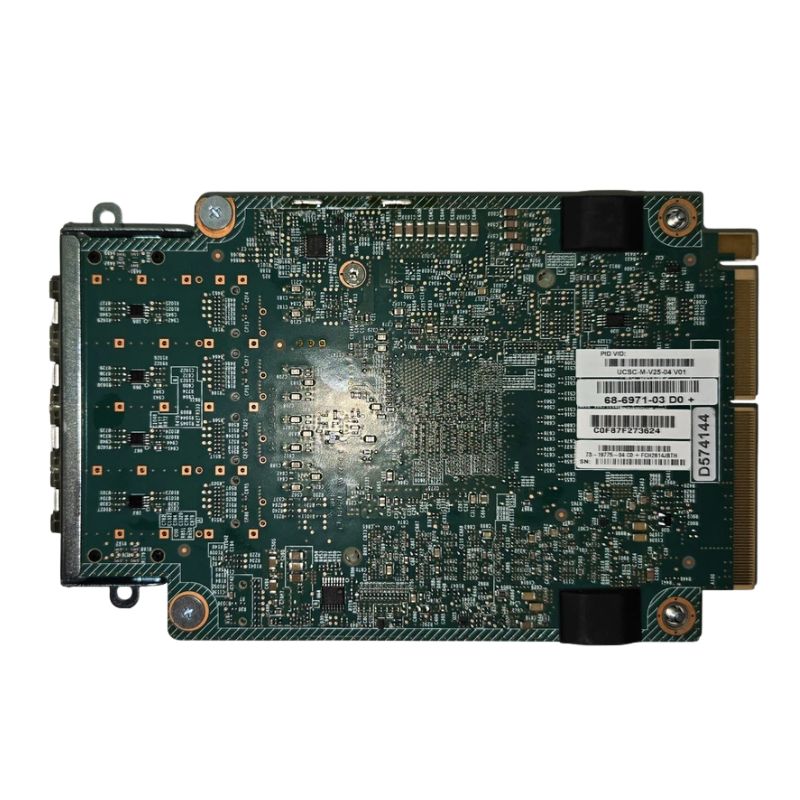
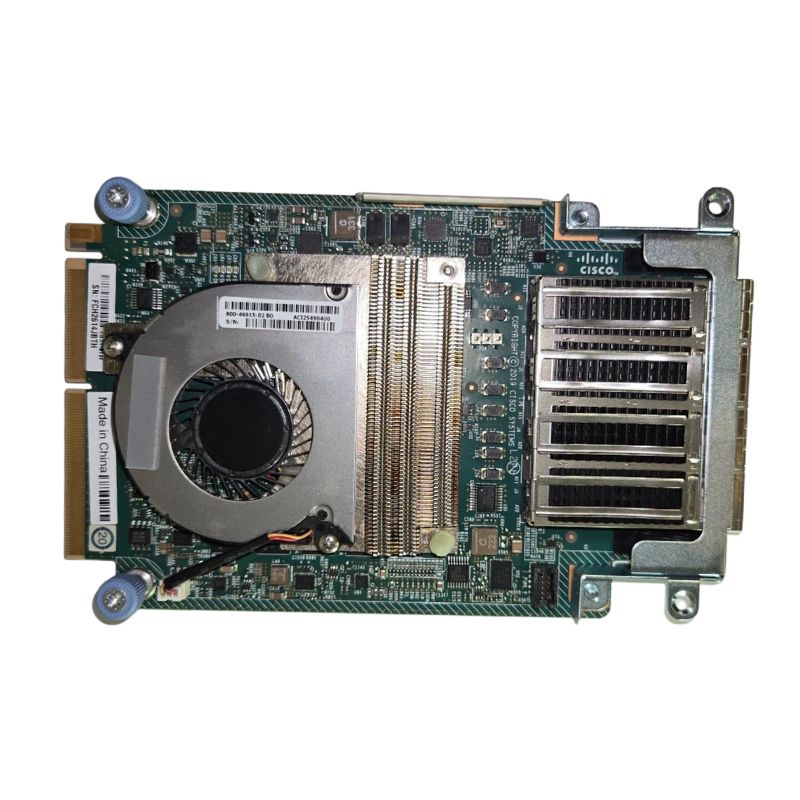
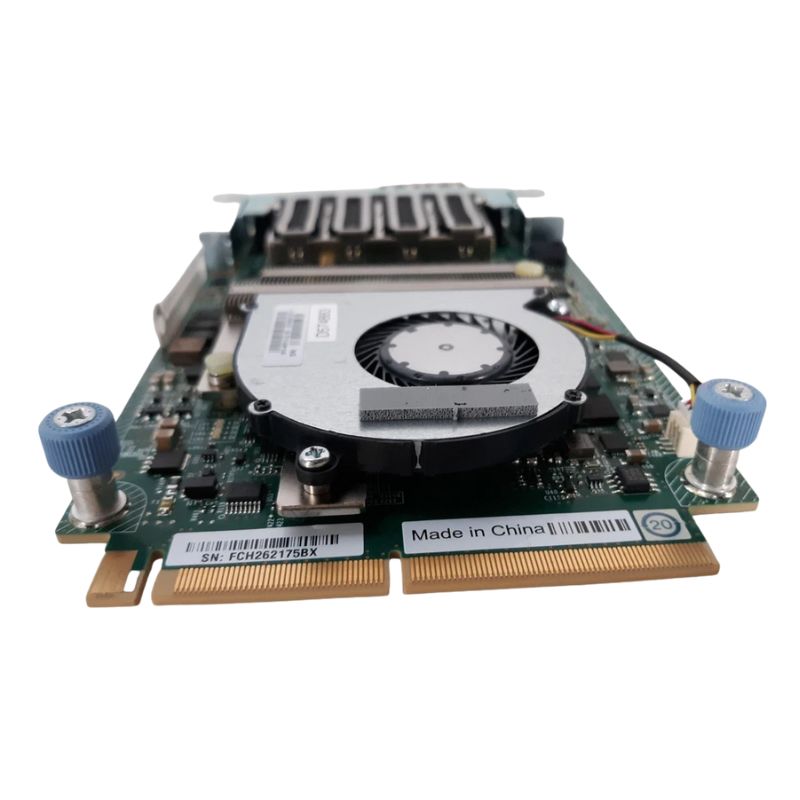
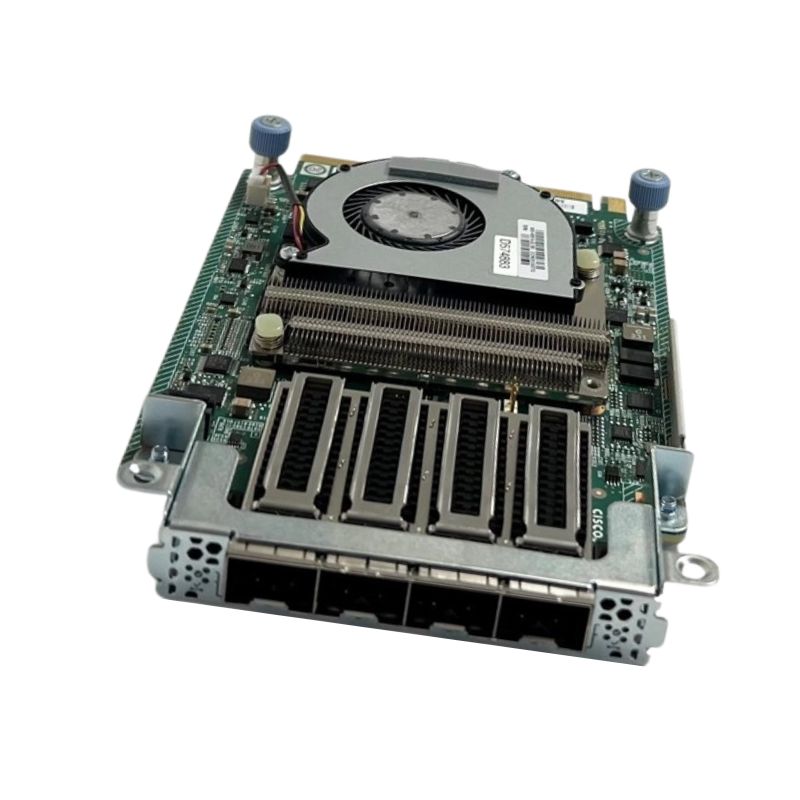
Cisco UCSC-M-V25-04 UCS 25 Gigabits Quad Ports 10/25G SFP28 Virtual Interface Card. Excellent Refurbished with 1 year replacement warranty
Overview of Cisco UCSC-M-V25-04 Virtual Interface Card
The Cisco UCSC-M-V25-04 Virtual Interface Card delivers accelerated data throughput and advanced virtualization capabilities for modern enterprise workloads. Designed for compatibility with Cisco UCS C220 M6, C240 M6, C225 M6, and C245 M6 servers, this quad-port 10/25G SFP28 mLOM adapter optimizes network performance while reducing operational overhead. Its PCI Express architecture ensures stable, high-bandwidth communication, making it ideal for dense compute nodes, virtualized environments, and multi-tenant infrastructures.
The Cisco UCSC-M-V25-04, commonly referenced as the UCS 1467 quad port 10/25G SFP28 mLOM Virtual Interface Card, is a high-performance server adapter engineered for modern data center demands. This mLOM (modular LAN on motherboard) Virtual Interface Card—often abbreviated as VIC—provides four SFP28-capable 10/25 Gigabit ports built specifically for Cisco UCS blade and rack server platforms. Designed to deliver flexible connectivity with reduced latency and enhanced throughput, the VIC serves as a central component in virtualization-focused deployments, converged infrastructure, and high-performance compute clusters. The card supports both 10G and 25G Ethernet speeds, enabling incremental upgrades in network capacity while maintaining investment protection for existing 10G infrastructures.
At its core, the UCSC-M-V25-04 integrates directly with compatible Cisco UCS chassis and motherboards through the mLOM interface, permitting a compact physical footprint while preserving PCIe lanes for other server resources. The adapter leverages SFP28 transceiver interfaces for each of its four ports, allowing administrators to choose a range of optical or direct attach copper cabling options according to deployment needs. The card supports advanced offloads and hardware acceleration functions tailored to virtualization and high-throughput workloads, helping reduce CPU utilization for packet processing. Support for features such as TCP/UDP segmentation offload, large send offload, and advanced checksum offload improves host efficiency and application responsiveness.
The mLOM form factor caters to density-optimized server designs by embedding network connectivity in a modular fashion directly on the server’s board stack. The SFP28 connectors deliver backward compatibility with SFP+ optics while enabling 25G performance when paired with SFP28 transceivers and compatible cabling. This flexibility is an advantage for administrators who need a bridge between existing 10G environments and emerging 25G fabrics without wholesale hardware replacement. The physical design also reduces cable clutter and simplifies airflow management within blade enclosures and rack-mounted servers, contributing to better thermal profiles and lower cooling overhead.
Compatibility with Cisco UCS platforms is a central selling point for the UCSC-M-V25-04. The card is engineered to operate seamlessly with specific Cisco UCS B- and C-series servers and certain UCS chassis models that provide mLOM slots. Firmware compatibility and driver support are essential for optimal performance; Cisco publishes a compatibility matrix and recommended firmware levels for UCS interconnects, server BIOS, and VIC firmware. Administrators planning a rollout should cross-reference server model numbers, Fabric Interconnect generation, and UCS Manager versions to ensure the VIC functions as expected. While many enterprise-grade features are available across multiple UCS generations, some capabilities such as advanced telemetry and offload features may be constrained by older motherboards or legacy firmware versions.
The UCS 1467’s performance profile emphasizes low latency and high throughput for demanding workloads. By offloading common networking tasks from the host CPU, the card lets compute resources concentrate on application processing. Features like Receive Side Scaling (RSS) distribute incoming traffic across multiple CPU cores, while Flow Director capabilities allow the NIC to classify and steer flows directly, minimizing software-based handling. Support for SR-IOV (Single Root I/O Virtualization) enables hardware partitioning of physical ports into multiple virtual functions that can be assigned directly to virtual machines, improving I/O determinism and reducing hypervisor overhead. This combination of offloads and virtualization-friendly features makes the VIC particularly well-suited for NFV (network functions virtualization), high-performance database clusters, and latency-sensitive trading platforms.
Virtualized environments benefit from the card’s virtualization-aware features. The support for SR-IOV gives hypervisors the ability to bypass the host network stack for selected virtual machines, assigning virtual functions that appear as discrete hardware NICs. This results in lower latency and reduced jitter for critical virtualized workloads. The VIC’s tight integration with Cisco UCS Manager and the platform’s service profile abstraction enables administrators to define networking policies that persist across hardware changes—such as server replacements or re-blading—ensuring tenant configurations remain intact. Additionally, features like virtual machine failover handling and consistent MAC/VLAN assignment promote stability in environments with frequent virtual machine migrations.
Network security is an important dimension of the VIC’s design. Native VLAN segregation, private VLAN support through downstream switching fabrics, and secure boot of the NIC firmware help reduce exposure to common network threats. When used in conjunction with UCS Manager, administrators can enforce strict separation between management, storage, and application traffic at the hardware abstraction layer. Further security is possible by enabling MAC spoofing protection, port-level policy enforcement, and limiting which virtual functions can be exposed to specific hypervisors or virtual machines. For environments requiring encryption, the VIC supports transport-level security mechanisms provided by the broader Cisco UCS ecosystem, although end-to-end encryption may be implemented at higher network layers depending on the use case.
The adaptive nature of the UCSC-M-V25-04 makes it appropriate for a wide array of deployment scenarios. Hyperscale web services and cloud providers can leverage the card to densify their connectivity and move to 25G aggregation layers where needed. High performance computing clusters benefit from the low-latency fabric and offload capabilities that minimize CPU overhead for I/O-heavy tasks. Enterprise private clouds and multi-tenant service providers gain operational simplicity by using service profiles and centralized management to provision network resources consistently across multiple servers. In converged infrastructure designs where storage and network traffic co-reside on the same server, the VIC can carry both storage and network overlays, leveraging advanced features such as Data Center Bridging (DCB) and priority flow control when supported by the downstream fabric.
For storage-attached workloads, administrators should evaluate whether they plan to run FCoE (Fibre Channel over Ethernet) or iSCSI over the VIC. FCoE can be advantageous in environments aiming to consolidate Fibre Channel and Ethernet fabrics, but it requires end-to-end DCB support in the switches. The VIC supports the necessary offloads and lossless Ethernet features to transport FCoE reliably when the data center fabric is correctly configured. iSCSI traffic, while less demanding of lossless behavior, benefits from NIC offloads and TCP acceleration to reduce CPU load during heavy storage operations. Selection between protocols will depend on existing storage infrastructure, performance requirements, and the maturity of the switching fabric.
The SFP28 interface provides flexibility in choosing physical media. Optical SFP28 transceivers support multimode and single-mode fiber, enabling both short-range and long-range links. For short interconnects inside racks or across adjacent racks, direct attach copper (DAC) SFP28 passive or active cables can be cost-effective and power-efficient. When deploying across the data center fabric or between aggregation layers, administrators may choose SR (short reach) multimode optics or LR (long reach) single-mode optics depending on distance and link budget requirements. It is important to adhere to Cisco’s compatibility lists for optics and cables to ensure link stability and full feature support, as third-party optics may work but sometimes restrict features or require manual intervention in firmware and configuration.


 Contact Us
 Information
 Catalog
 Solid State Drives (SSD)
 Network Switches
 Hard Disk Drives
 HBA & Controllers
 PC & Servers
 PC & Server Memory
 CPU & Processors
 Network Routers
 Power Supplies
 Tape Drives & Libraries
 Network Devices
 Computer & Network Cables