
(7% discount is applied at checkout)
Cart is empty
Your go-to destination for cutting-edge server products
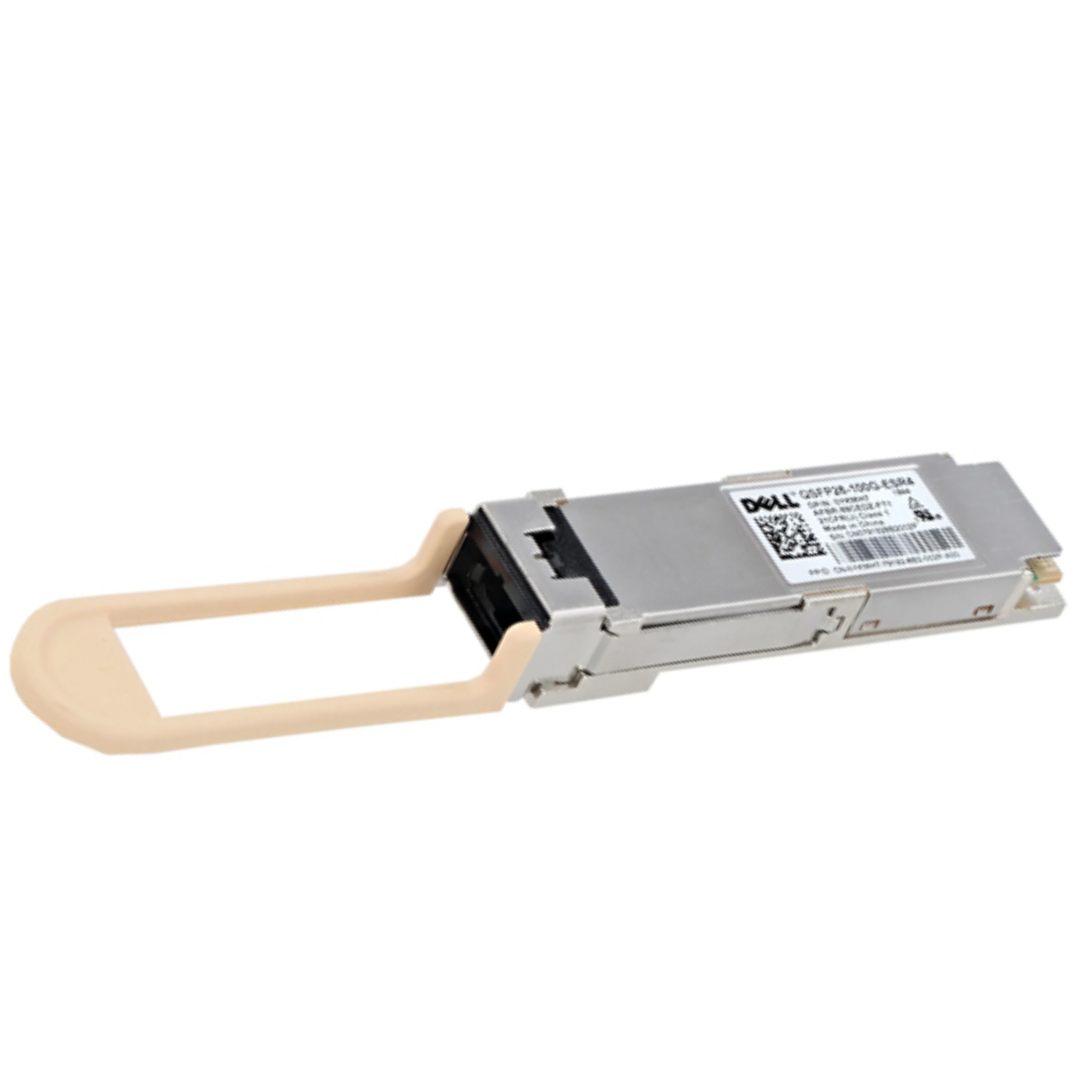
Dell YKMH7 100GB Mpo Qsfp28 Short Range Transceiver. New Sealed in Box (NIB) with 1 Year Warranty
The Dell YKMH7 100G MPO QSFP28 Transceiver is a high-performance networking component engineered for modern data center and enterprise-grade optical communication. Designed to deliver ultra-fast 100 Gigabit Ethernet connectivity, this short-range optical transceiver ensures reliable, scalable, and energy-efficient network performance.
The Dell YKMH7 100Gb MPO QSFP28 Short Range Transceiver category represents a high-performance segment of modern optical networking components designed for ultra-fast data center connectivity. Built to support 100 Gigabit Ethernet environments, this class of transceivers is engineered to deliver maximum bandwidth efficiency, low latency communication, and reliable short-range optical transmission over multimode fiber infrastructure.
Within advanced enterprise networks, cloud computing environments, and hyperscale data centers, high-speed optical transceivers such as this QSFP28 SR4 module play a crucial role in maintaining seamless data flow between switches, routers, and high-density server architectures. The demand for scalable and energy-efficient networking hardware has positioned this category as a core element of next-generation IT infrastructure.
QSFP28 technology is designed to support four independent channels, each capable of transmitting data at 25Gbps, combining to deliver an aggregated throughput of 100Gbps. This architecture allows the transceiver to efficiently manage high-bandwidth workloads while maintaining signal integrity across short-distance multimode fiber links.
The module format ensures compact integration into high-density networking equipment, enabling data center operators to maximize port utilization without compromising performance or thermal efficiency. The 100G MPO interface further enhances connectivity by enabling parallel optical transmission through multiple fiber strands.
The short-range (SR4) designation in this category refers to optimized optical performance over multimode fiber (MMF), typically OM3 or OM4 cabling. These transceivers are designed for distances up to 70 meters on OM3 and up to 100 meters on OM4 fiber, making them ideal for intra-rack and inter-rack communication within data centers.
The SR4 standard utilizes parallel optics, where multiple laser lanes transmit data simultaneously, significantly increasing bandwidth while reducing latency and improving signal stability across short-range links.
Modern data centers rely heavily on consistent and scalable high-speed interconnects. The Dell YKMH7 100G QSFP28 module enables seamless connectivity between spine-leaf network architectures, ensuring that large-scale data transfers occur without bottlenecks or packet loss.
As enterprises transition toward cloud-native environments and virtualization-heavy workloads, the need for robust 100G optical links continues to grow. This transceiver category supports such transitions by offering reliable short-range connectivity optimized for dense switching environments.
In cloud computing infrastructures, latency and bandwidth efficiency are critical. The YKMH7 transceiver supports rapid data exchange between compute nodes, storage arrays, and network fabrics. This improves workload distribution, virtualization performance, and application responsiveness across distributed systems.
Enterprise environments utilizing high-performance computing clusters also benefit from this technology, particularly in scenarios involving AI processing, big data analytics, and real-time financial systems where uninterrupted high-speed communication is essential.
The MPO (Multi-fiber Push-On) connector is a critical component in this category, enabling simultaneous transmission across multiple optical fibers. Typically configured with 12 or 8 fiber strands, MPO interfaces allow parallel data lanes that support 100Gbps throughput efficiently.
This connector design reduces cable clutter and simplifies high-density fiber management in enterprise racks. It also ensures precise alignment of optical channels, improving signal accuracy and reducing insertion loss in high-speed networks.
These transceivers are specifically designed for multimode fiber environments. OM3 and OM4 fibers are commonly used due to their ability to support high-bandwidth transmission over short distances with minimal attenuation. The compatibility with existing fiber infrastructure makes deployment cost-effective and scalable.
Parallel optics technology enables multiple independent laser channels to operate simultaneously. This structure significantly enhances data throughput while maintaining low latency. Each channel contributes to the aggregate 100G performance, ensuring consistent and balanced signal distribution across all lanes.
One of the key advantages of this transceiver category is its ability to deliver extremely high bandwidth efficiency. By leveraging QSFP28 architecture, it ensures optimal utilization of network resources while minimizing overhead and reducing congestion in high-traffic environments.
Low latency is essential for applications such as real-time analytics, virtualization, and financial trading systems. The Dell YKMH7 transceiver minimizes transmission delay by using short-range optimized optical signaling, ensuring rapid packet delivery between network nodes.
Energy efficiency is a critical consideration in modern data center design. These modules are engineered to consume less power compared to older-generation transceivers while maintaining superior performance. This contributes to reduced operational costs and improved sustainability in large-scale deployments.
As part of the Dell networking ecosystem, the YKMH7 transceiver is designed for seamless compatibility with supported Dell switches and routers. This ensures optimized performance, firmware alignment, and enhanced system reliability within integrated infrastructures.
Due to its compact design, the transceiver is ideal for high-density rack environments. It allows data centers to maximize port utilization while maintaining efficient airflow and thermal management across networking hardware installations.
Hyperscale facilities require massive interconnect bandwidth to support distributed computing workloads. The YKMH7 100G transceiver supports these environments by enabling high-speed spine-leaf architecture connectivity, ensuring efficient scaling of cloud infrastructure.
Enterprise core networks depend on stable and high-capacity links between aggregation layers. This transceiver category ensures reliable backbone connectivity, supporting mission-critical applications and enterprise resource planning systems.
In HPC environments, fast inter-node communication is essential for processing complex computations. The 100G SR4 module facilitates rapid data exchange between compute nodes, improving processing speed and computational efficiency.
The short-range design of this transceiver ensures strong signal integrity across multimode fiber connections. Reduced attenuation and controlled dispersion contribute to stable data transmission even in dense networking environments.
Advanced encoding and optical modulation techniques help reduce bit error rates. This ensures high data accuracy and minimizes retransmission requirements, improving overall network performance.
Efficient thermal management is essential for maintaining transceiver reliability. The QSFP28 SR4 module is designed to operate within controlled temperature ranges, ensuring consistent performance under heavy workloads.
The Dell YKMH7 transceiver category is designed to support scalable infrastructure expansion. As organizations grow their data requirements, these modules allow seamless upgrades from lower-speed links to 100G environments without major infrastructure overhauls.
Modern network designs such as spine-leaf and leaf-spine topologies benefit significantly from 100G interconnects. These transceivers ensure smooth data flow between layers, improving network efficiency and reducing congestion.
As networking evolves toward 200G and 400G standards, 100G SR4 modules continue to serve as foundational building blocks. They provide compatibility and transitional support for evolving data center architectures.
The integration of 100G QSFP28 SR4 transceivers significantly enhances network efficiency by enabling faster data transfer and reducing congestion in core switching layers. This directly contributes to improved application performance and user experience.
As organizations adopt digital transformation strategies, high-speed connectivity becomes a foundational requirement. This transceiver category supports such initiatives by enabling scalable, reliable, and high-bandwidth communication across IT systems.
Data-driven enterprises rely on rapid data access and processing capabilities. The YKMH7 100G module facilitates real-time data movement across systems, enabling advanced analytics and decision-making processes.


 Contact Us
 Information
 Catalog
 Solid State Drives (SSD)
 Network Switches
 Hard Disk Drives
 HBA & Controllers
 PC & Servers
 PC & Server Memory
 CPU & Processors
 Network Routers
 Power Supplies
 Tape Drives & Libraries
 Network Devices
 Computer & Network Cables