(7% discount is applied at checkout)
Cart is empty
Your go-to destination for cutting-edge server products
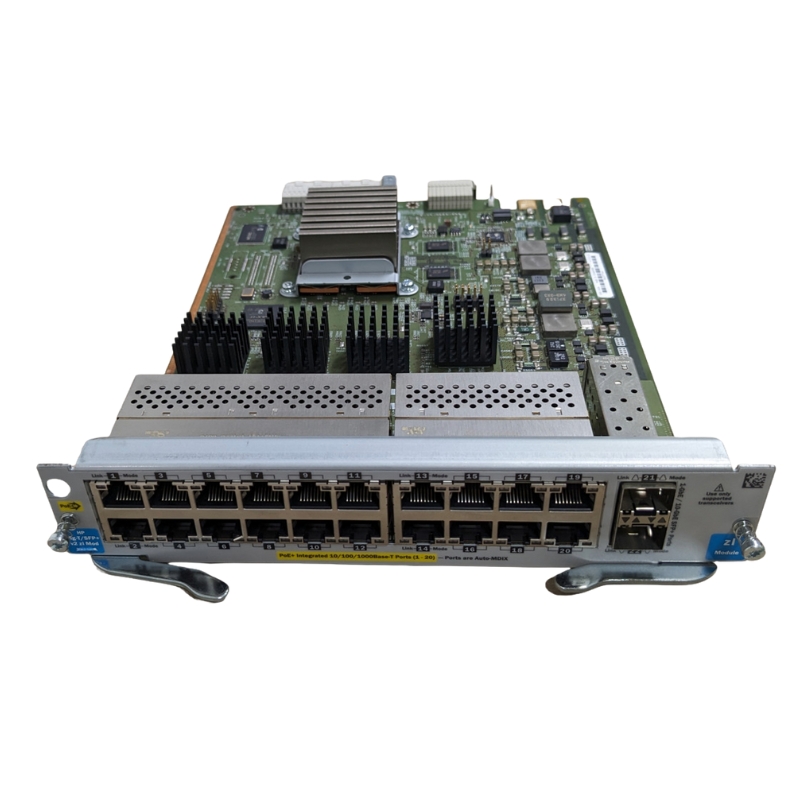


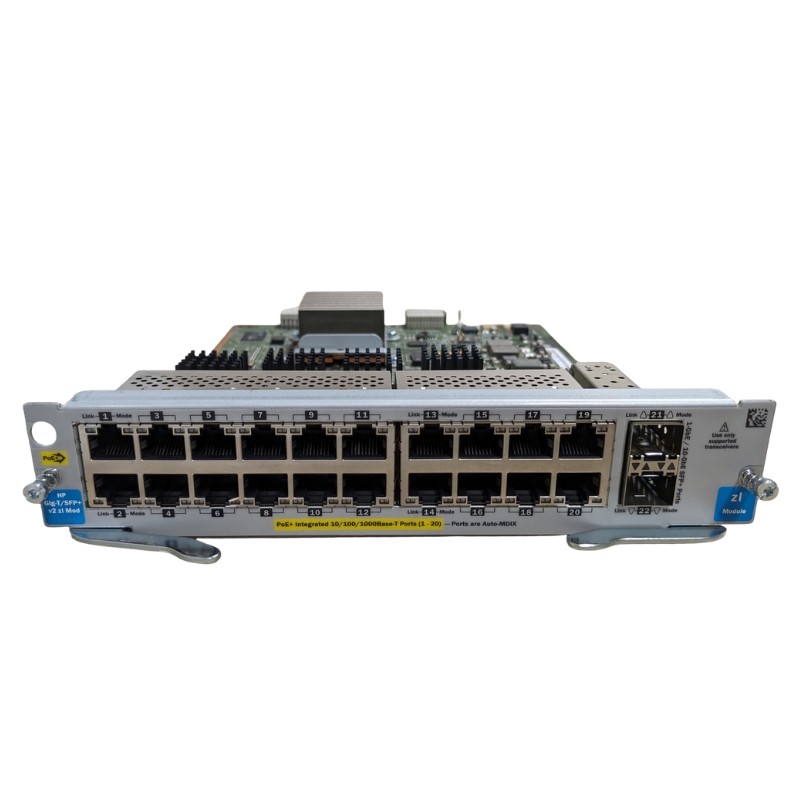
HPE S0U64-61001 Aruba 20ports 10M/100M/1G Cx 5420 Class4 PoE 2P SFP28 1G/10G/25G Module. New Sealed with 1-Year Replacement Warranty
Network Switching Solution
The HPE Aruba Networking CX 5420 20-port switch delivers enterprise-grade performance with comprehensive Layer 3 management capabilities, designed for modern network infrastructure demands.
This 1U form factor plug-in module features front-to-back airflow optimization for efficient thermal management in rack-mounted environments.
This advanced Layer 3 managed switch provides comprehensive protocol support including:
With PoE Class 4 support, the switch delivers up to 90W per port (IEEE 802.3bt) to power connected devices such as:
Multiple management interfaces provide flexible administration options:
Enterprise-grade security features include:
Sophisticated traffic prioritization mechanisms ensure optimal performance:
Comprehensive IEEE standards support guarantees broad compatibility:
Advanced capabilities for enterprise deployment scenarios:
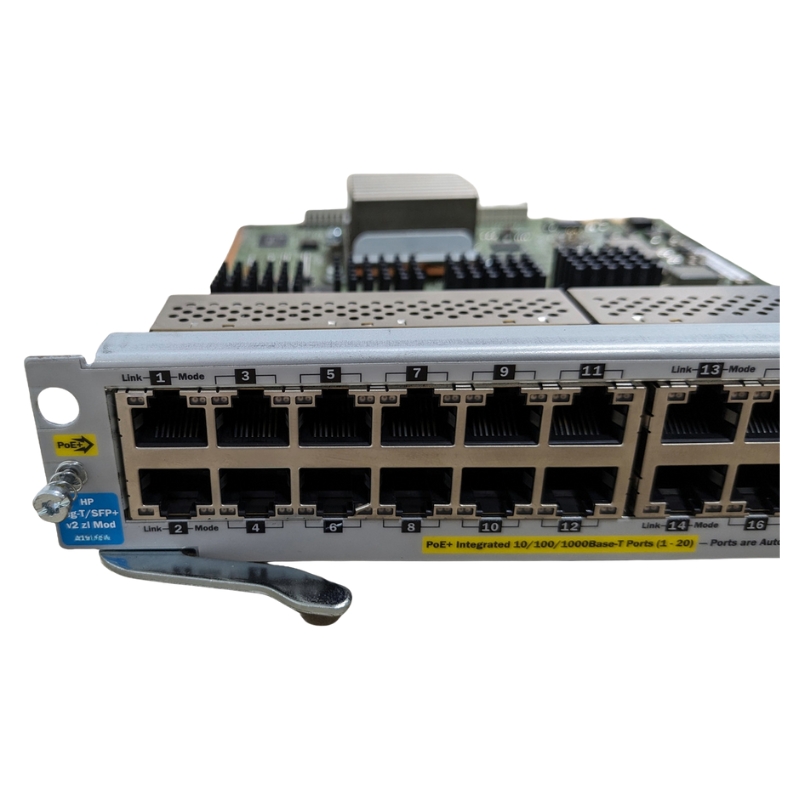
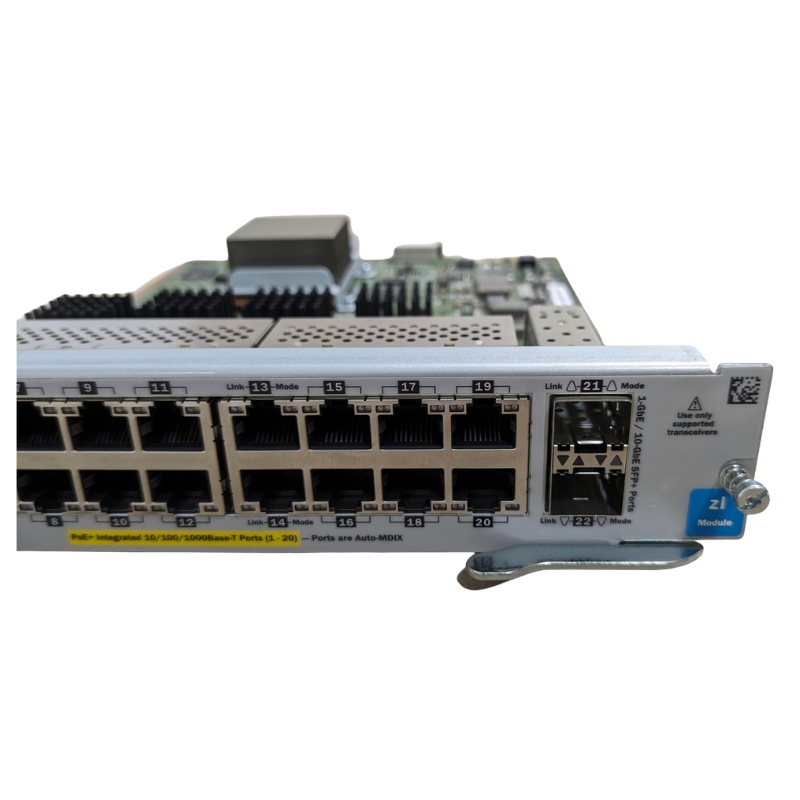
The module provides 20 x 10/100/1000BASE-T RJ-45 ports intended for edge devices such as IP phones, wireless access points, security cameras, and shallow-buffered endpoints. Those access ports are coupled with 2 x SFP28 uplink slots that accept 1G/10G/25G module optics, enabling flexible aggregation to distribution or spine devices and future-proofing uplink capacity. This port mix is ideal for dense small/medium campus wiring closets where a compact footprint is required.
The "Class 4" PoE designation indicates support for higher PoE power draw per port than older PoE classes — suitable for devices that need more than basic 802.3af levels, such as advanced wireless access points or pan-tilt-zoom cameras. Because this module is a plug-in half-width unit for the CX 5420 chassis, total PoE budget and delivery are dependent on the chassis power supplies and system-level PoE capacity; when planning deployments, always match chassis PSU and module PoE needs for continuous operation under full load.
Typical deployments use a mix of powered devices (PDs) — access points, IP phones, cameras — and non-PD endpoints. For predictable results, inventory PD wattage needs (including any burst/boot overhead) and allocate chassis power accordingly. If you plan to power many Class 4 devices simultaneously, provision redundant power modules and select a chassis configuration that provides the required sustained PoE budget per module slot.
The SFP28 uplink slots accept a range of optics: 1G SFP, 10G SFP+, and 25G SFP28 transceivers. This allows mixed uplink speeds based on aggregation requirements — single 25G links for higher throughput aggregation or dual 10G/1G uplinks when connecting to older distribution devices. The multi-rate uplink capability helps stretch lifecycle of existing distribution infrastructure while enabling incremental upgrades to higher bandwidth.
As part of the Aruba CX switching portfolio, the CX 5420 modules, including the S0U64-61001, operate within a modern, programmable Layer 3 software architecture. Expect feature parity for core campus needs: static routing, OSPF/BGP capability on the platform (where licensed or configured), robust QoS, ACLs, and virtualization/segmentation features that are common to Aruba's CX line. These features make the module appropriate for enterprise access where routed access, segmentation, and QoS are required for voice and video traffic.
The switch chassis family is designed for high aggregate throughput; the module contributes to the chassis' overall switching capacity and line-rate forwarding on all 20 access ports. For environments with bursty traffic (video surveillance ingest, wireless controller uplinks), the combination of access port buffering and fast SFP28 uplinks helps prevent congestion at the aggregation layer. For sizing, consider simultaneous full-line-rate utilization scenarios and plan uplink bandwidth accordingly (for example, many gigabit clients aggregated over two 10G uplinks create potential oversubscription that should be managed by QoS policies).
The Aruba CX OS provides scriptable, model-driven configuration, telemetry, and automation capabilities. This module benefits from platform features like REST APIs, streaming telemetry, and intent-based configuration constructs that reduce manual configuration overhead and enable integration with orchestration tools. For managed environments, this simplifies tasks like mass provisioning of VLANs, PoE scheduling, and telemetry collection from the 20 access ports.
Standard security controls are available at the platform level: port security, 802.1X authentication for endpoint onboarding, dynamic segmentation through policy enforcement, and ACLs for east-west traffic control. When deploying in sensitive campus environments, combine 802.1X endpoint posture checks with Aruba ClearPass or equivalent NAC systems to maintain tokenized, policy-based access. The hardware module simply provides the physical ports — the enforcement and telemetry are delivered by the CX OS and management ecosystem.
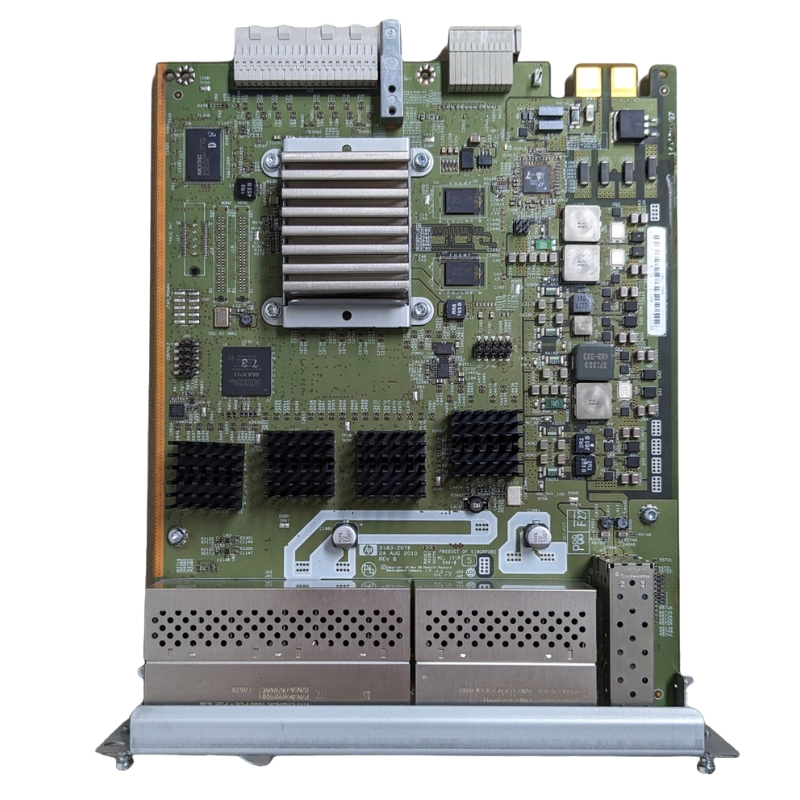
The S0U64-61001 is a hot-swappable half-width plug-in module intended for the modular CX 5420 chassis. Its design allows data center or wiring closet technicians to populate chassis slots with different port types as requirements change — for example combining 20p copper modules, fiber modules, or higher-density uplink modules in the same chassis. Hot-swap capability helps reduce planned downtime when adding or replacing modules.
The product datasheets and distributor listings indicate a front-to-back airflow orientation for this module. Confirm chassis cooling configuration and rack airflow planning to avoid hot spots — front-to-back airflow is often preferred in modern data center racks where cold aisle / hot aisle separation is employed. Always follow documented site power and cooling requirements when planning high-density PoE deployments.
This module is specifically numbered for the Aruba CX 5420 switch series and should be validated against HPE Aruba compatibility matrices and part number guides (S0U64A / S0U64-61001 variants appear in official and reseller SKUs). Confirm that the chassis firmware and modular slot support the S0U64-61001 before purchase and installation; firmware mismatches can limit feature availability or module recognition.
The SFP28 slots accept industry-standard SFP/SFP+/SFP28 optics. When selecting transceivers, adhere to vendor compatibility lists for guaranteed performance — 25G SFP28 optics offer single-lane 25G uplinks for high throughput aggregation, while 10G and 1G optics support mixed environments. Choose multimode or singlemode optics based on your fiber plant design and distance requirements. For critical links, prefer HPE-validated optics or qualified third-party modules listed by Aruba/HPE to ensure proper auto-negotiation and link stability.
The module is ideal for a campus access closet needing to serve a single wiring panel: 20 gigabit access ports provide edge connectivity for dozens of endpoints when used with structured cabling and patch panels. Class 4 PoE supports modern APs and PDs, and the SFP28 uplinks give facilities the option to connect to distribution switches at 10G or 25G for future capacity growth. In this role, the module acts as a compact, powerful access shelf that simplifies wiring and consolidates powered device management.
For enterprise branch offices that require local aggregation, secure VLAN segmentation, and powered endpoint density without a large footprint, S0U64-61001 provides the right balance of access ports and high-capacity uplinks. Combined with Aruba's centralized management, branch IT teams can apply consistent policies and monitoring while minimizing onsite hardware counts.
Building automation deployments (access control, environmental sensors) and IP surveillance networks benefit from centralized PoE delivery. The module's Class 4 power class supports more demanding cameras and analytics devices, and the chassis-level redundancy options add resilience for always-on security systems. When deploying on the edge, segment camera traffic with dedicated VLANs and apply QoS to protect management and control channels.
Compared to non-PoE or fiber-only modules, the S0U64-61001 uniquely combines 20 powered RJ-45 access ports with multi-rate SFP28 uplinks in a half-width module. This makes it more suitable for PoE-heavy access closets where some uplink flexibility is required, whereas alternative modules may offer higher port counts, larger PoE budgets, or pure fiber density for different use cases. :contentReference[oaicite:19]{index=19}
Choose this module when you already own or plan to adopt the CX 5420 chassis for centralized management, redundancy, and modular growth. If you require standalone fixed switches without chassis dependency, a fixed 1RU PoE switch might make more sense; however, the modular approach centralizes power/management and simplifies future expansion for medium-sized campus networks. :contentReference[oaicite:20]{index=20}
The module commonly appears as S0U64A / S0U64-61001 on HPE and reseller sites. When collecting quotes, request full details including warranty length, support option (next business day vs 24x7), and whether transceivers or power supplies are included. Resellers often bundle modules with maintenance contracts or offer trade-in options for older hardware — evaluate total cost of ownership rather than only sticker price. :contentReference[oaicite:21]{index=21}
Certified refurbished modules can deliver cost savings, but ensure refurbished SKUs include a warranty and verification of firmware/updateability. For critical deployments that must meet uptime SLAs, new units with manufacturer support are recommended. Keep spare modules on hand if your environment requires rapid in-place swap capability to minimize downtime.
For authoritative technical specifications, consult HPE/Aruba official product pages and the CX 5420 series datasheets. Distributor pages provide reseller SKUs and pricing but always cross-check with HPE's documentation for firmware, compatibility, and installation instructions. If in doubt about power or airflow orientation, the official installation guide lists exact chassis requirements


 Contact Us
 Information
 Catalog
 Solid State Drives (SSD)
 Network Switches
 Hard Disk Drives
 HBA & Controllers
 PC & Servers
 PC & Server Memory
 CPU & Processors
 Network Routers
 Power Supplies
 Tape Drives & Libraries
 Network Devices
 Computer & Network Cables