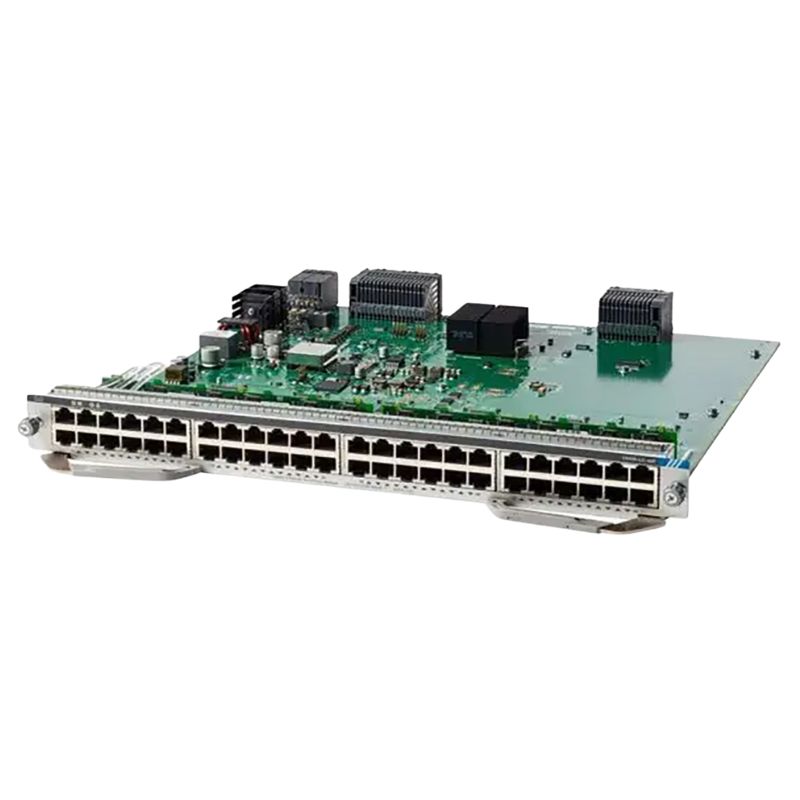
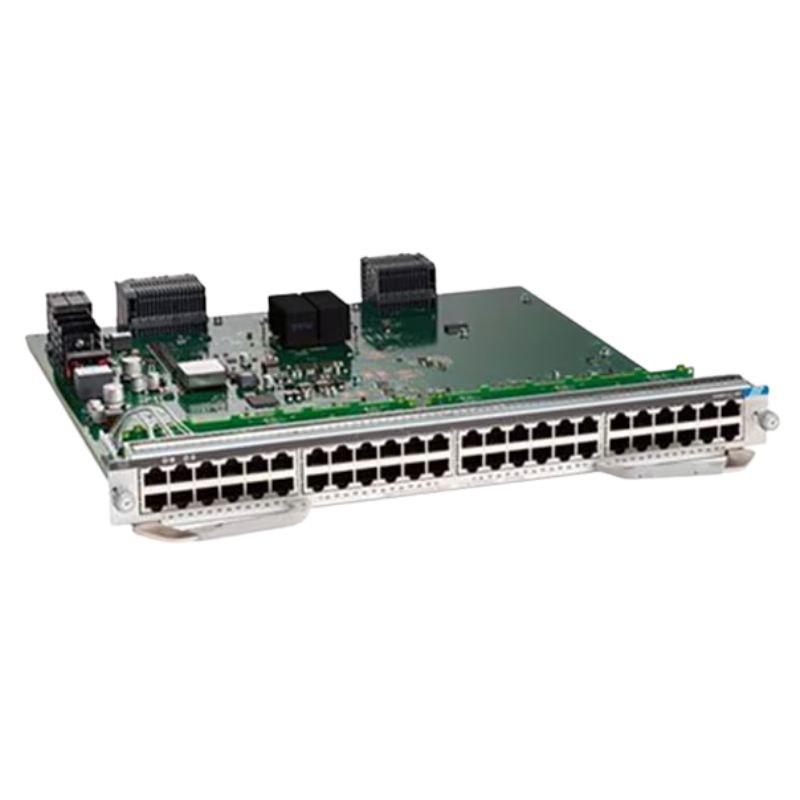
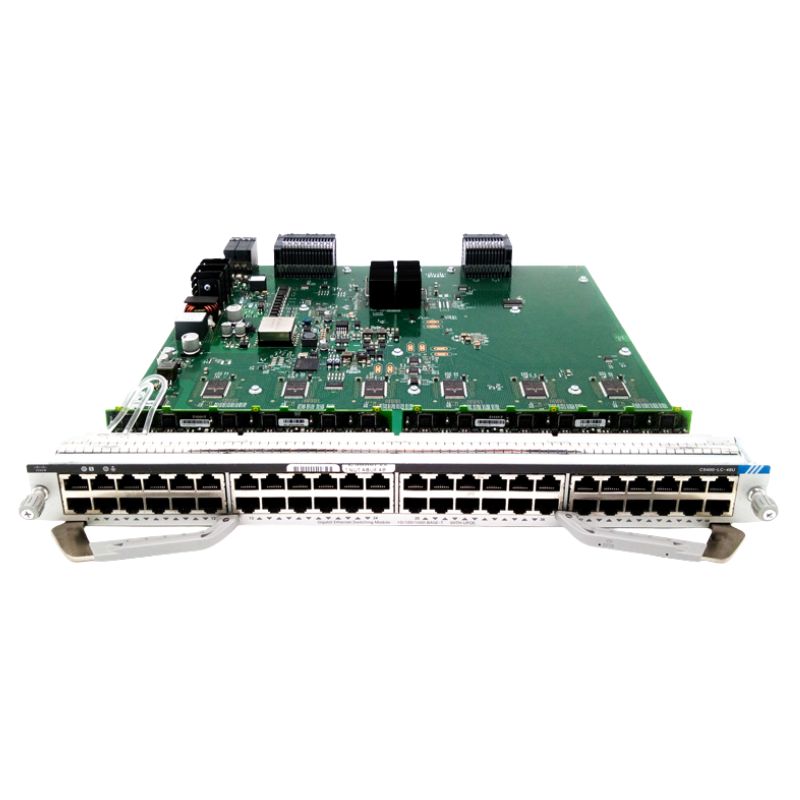
Cisco C9400-LC-48HN — Catalyst 9400 Series 48-Port Line Card (UPOE+, 5G Multigigabit)
The Cisco C9400-LC-48HN is a high-density 48-port line card designed for the Catalyst 9400 family, delivering multi-gigabit connectivity, Power over Ethernet Plus (UPOE+) capability, and resilient performance for modern enterprise access layers. Engineered for demanding campus and branch deployments, this module combines flexible port speeds with advanced switching intelligence to support bandwidth-hungry applications, converged voice/video, and dense wireless infrastructure.
At a glance — product identity and fit
This line card is a native Catalyst 9400 component that drops into compatible chassis to expand access capacity. It pairs high port counts with multi-speed Ethernet to future-proof wired access and reduce the need for intermediate aggregation devices.
- Manufacturer: Cisco
- Part Number / SKU: C9400-LC-48HN
- Product family: Catalyst
- Product series: 9400
- Form factor: 48-port fixed RJ-45 line card
- Primary use case: Access/edge switching for enterprise networks
Ports & interface details
Each of the 48 RJ-45 interfaces supports 5GBase-T speeds, enabling organizations to take advantage of faster edge links without replacing cabling infrastructure. The ports automatically negotiate to the optimal speed (1G, 2.5G, 5G) so connectors, switches and end devices interoperate seamlessly.
- Total ports: 48
- Port type: 5GBase-T RJ-45
- Supported link speeds: 1G, 2.5G, 5G (auto-negotiation)
- Ethernet technology: Multi-Gigabit Ethernet (5 Gigabit Ethernet supported)
Power delivery — UPOE+ capabilities
The C9400-LC-48HN supports UPOE+ power delivery to attached devices, making it ideal for powering next-generation access points, video endpoints, and IoT devices that demand higher wattage. Centralized power simplifies installations and reduces the need for separate power injectors.
- PoE type: UPOE+ (Universal Power Over Ethernet Plus)
- Ideal for: High-power APs, PTZ cameras, thin clients, and integrated endpoints
- Benefit: Single-cable deployment for data and power, cleaner cabling and simpler maintenance
Performance & deployment advantages
As a Catalyst 9400 line card, the C9400-LC-48HN integrates with Cisco’s software and hardware ecosystem to provide predictable performance, granular policy control, and secure segmentation. Its multi-gigabit ports allow organizations to scale wireless backhaul and wired access bandwidth without wholesale infrastructure changes.
- Optimized for dense wireless offload and converged access
- Reduces need for separate aggregation layers by increasing per-slot port density
- Helps future-proof networks for higher client throughput and richer applications
Security, manageability, and feature set
When installed in a Catalyst 9400 chassis, the module benefits from Cisco’s advanced control plane, programmable telemetry, and consistent policy enforcement across campus fabric. This gives administrators centralized visibility and the ability to apply identity-based access controls.
- Integration with Cisco IOS XE for unified management and automation
- Support for advanced security constructs: segmentation, TrustSec, and access control
- Telemetry and analytics for proactive troubleshooting and capacity planning
Why choose the C9400-LC-48HN?
Organizations should consider this line card when they need a high-density, power-capable access expansion that supports multi-gigabit rates. It is particularly well suited for campuses upgrading wireless networks to Wi-Fi 6/6E/7, for buildings with dense user populations, or where convergence (voice, video, IoT) increases per-port power and bandwidth demands.
- High port density combined with 5GBase-T reduces hardware footprint
- UPOE+ eliminates separate power supplies for many endpoints
- Seamless integration into the Catalyst 9400 family simplifies operations
Recommended deployment scenarios
Common environments where this line card shines include enterprise campuses, education facilities, hospital networks, and stadium/venue backbones. It is also a strong choice for IT teams seeking an upgrade path to multi-gigabit access without rewiring copper infrastructure.
- Campus access switches feeding high-density Wi-Fi 6/7 APs
- Wired edge ports for multimedia workstations and telepresence systems
- Environments requiring centralized UPOE+ delivery to power devices
Compatibility & ordering tips
Before purchasing, confirm chassis compatibility and required supervisor engines or fabric modules for the Catalyst 9400 platform. Check power budgets and slot availability to ensure the chassis can supply sufficient UPOE+ capacity to the line card.
- Verify chassis model and supervisor engine compatibility with Cisco documentation
- Plan power and cooling based on the number of UPOE+ devices you intend to support
- Consider spare modules and maintenance contracts for high-availability environments
Cisco C9400-LC-48HN Line Card — High-density 48-Port UPOE+ Multigigabit Expansion
The Cisco C9400-LC-48HN Catalyst 9400 Series 48 Port Line Card is engineered to deliver high-density access at the network edge, combining multigigabit RJ-45 connectivity with Cisco’s advanced Unified Power over Ethernet Plus (UPOE+) capabilities. Designed as an expansion module for Catalyst 9400 chassis-based deployments, this line card provides organizations with flexible port density, robust power delivery, and simplified migration paths for converged enterprise access—supporting everything from high-performance wireless access points to next-generation endpoint devices and IoT sensors.
Core benefits and value propositions
- High port density: Forty-eight RJ-45 ports in a single line card streamline rack space and reduce chassis real estate compared with multiple smaller modules.
- Multigigabit performance: Supports multigigabit speeds over copper to enable faster access-layer uplinks and deliver bandwidth to modern endpoints without immediate cabling upgrades.
- UPOE+ power delivery: Provides enhanced PoE capabilities to power demanding devices such as high-density Wi-Fi 6/6E/7 access points, PTZ cameras, collaboration devices, and edge compute nodes.
- Modular scalability: Works as an integrated expansion option within Catalyst 9400 chassis, making staged upgrades and capacity planning straightforward.
- Enterprise feature set: Leverages Catalyst OS feature parity for security, telemetry, QoS, and programmability consistent with Cisco’s access-layer best practices.
Technical overview and typical specifications
This section outlines the commonly sought technical characteristics and design considerations for the C9400-LC-48HN line card. Exact values will vary by firmware and chassis configuration; consult product documentation or your Cisco representative for precise interoperability matrices.
Porting and speed capabilities
- 48 RJ-45 access ports supporting 1G, 2.5G, 5G multigigabit speeds (auto-negotiation dependent)
- SFP/SFP+ uplink or stacking ports on chassis backplane (as provided by the Catalyst 9400 platform)
- Auto MDI/MDIX and link negotiation for backward compatibility with legacy endpoints
Power and PoE features
- UPOE+ (Unified Power over Ethernet Plus) — supports higher per-port power budgets than standard PoE/PoE+ to meet the requirements of modern edge devices
- Power allocation policies configurable per-port and per-device class to optimize chassis power shelf usage
- Power redundancy and graceful power-backoff behavior to ensure critical devices remain online during constrained power events
Chassis & hardware compatibility
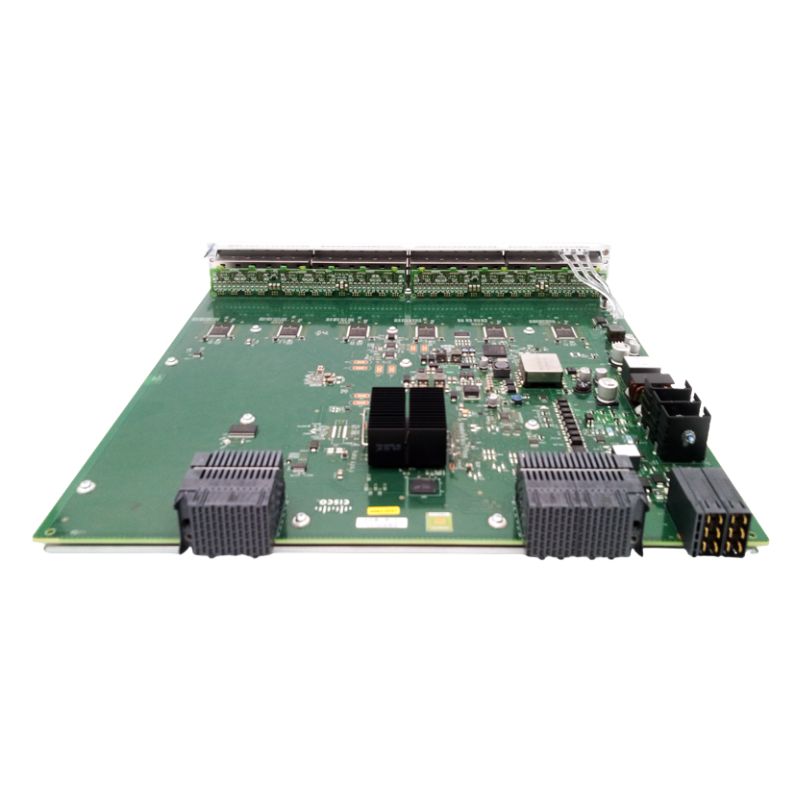
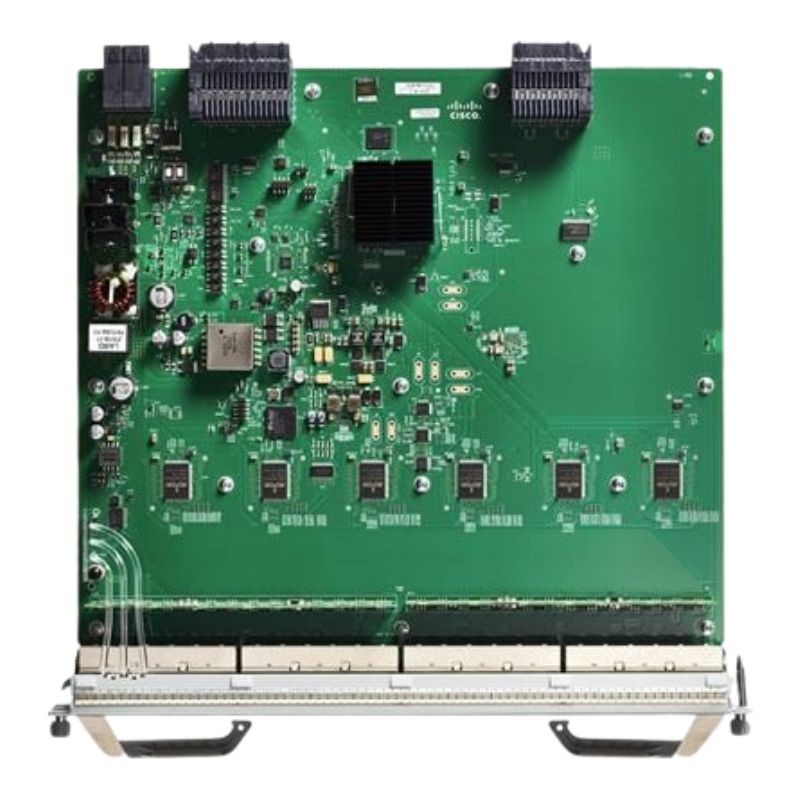
The line card is intended for Catalyst 9400 series chassis deployments; it integrates with the platform’s shared backplane, supervisor engines, and power shelf design. Deployment considerations include matching the line card to supported supervisor and power-supply combinations as well as taking the chassis slot architecture into account when planning mixed line card configurations.
Common compatibility checkpoints
- Verify supported supervisor engine firmware versions
- Confirm available chassis slots and airflow/power provisioning
- Check software image compatibility for advanced features (telemetry, SD-Access integration, DNA Center management)
Who should consider this line card?
The C9400-LC-48HN is ideal for enterprises and service providers that need:
- High-density copper access in a modular chassis
- Robust PoE for powering modern Wi-Fi APs, cameras, phones, and IoT
- Multigigabit copper connectivity without a wholesale rewire to fiber
- Investment protection through modular upgrades and consistent software feature sets across the Catalyst family
Common deployment scenarios
Campus access layer
Use the line card to aggregate edge users and devices across high-density wiring closets. Multigigabit copper supports the latest WLAN APs and high-throughput endpoints while UPOE+ supplies power hungry devices—simplifying cabling and reducing the need for local power injectors.
Branch aggregation
In medium to large branch locations where a Catalyst 9400 chassis provides a resilient aggregation and services platform, the 48-port copper line card consolidates user access and reduces operational complexity by centralizing power and management.
Converged collaboration rooms & digital signage
Rooms with multiple PoE devices—video conferencing endpoints, directional microphones, ambient sensors, and interactive signage—benefit from multigigabit speed and the extended power delivery of UPOE+.
Feature deep-dive: networking, manageability & security
Advanced networking capabilities
- Quality of Service (QoS): Prioritization for voice, video and mission-critical traffic to ensure predictable performance under congestion.
- Link aggregation: LACP support for multi-link resiliency and higher throughput for aggregation uplinks.
- VLAN and routing features: Full support for Layer 2 and Layer 3 constructs as permitted by Catalyst 9400 supervisor modules and software images.
Visibility, analytics, and telemetry
Use Catalyst telemetry (streaming telemetry, SNMP, NetFlow/IPFIX) and integrated monitoring tools (Cisco DNA Center, Cisco Prime) to gain deep operational insight into port utilization, power consumption, and link health. Proper telemetry configuration enables proactive troubleshooting and capacity planning.
Security and policy enforcement
- 802.1X and MACsec: Port-based access control and encryption options to protect enterprise traffic at the edge.
- Access control lists (ACLs): Granular packet filtering to enforce segmentation and reduce attack surface.
- TrustSec and SGT: Scalable segmentation and policy enforcement for modern zero-trust access strategies.
Design & planning considerations
Deploying a high-density line card in a Catalyst 9400 chassis requires planning across power, cooling, slot assignment and software licensing. Consider the following checklist as part of your design review:
Power and thermal planning
- Assess total UPOE+ power budget vs. expected powered devices (peak and average power usage)
- Ensure chassis power supplies and optional power shelves support maximum simultaneous draw
- Account for thermal dissipation—high PoE loads increase chassis temperature and may require tailored airflow management
Slot assignment & mixing line cards
Verify compatible slot population rules—mixing line cards or different port types in the same chassis can create asymmetric resource constraints. Follow vendor guidance on slot placement, supervisor pairing, and best practices for even distribution of traffic and power.
Software licensing and feature entitlements
Catalyst feature sets are controlled by software images and licenses (for example, Enterprise or DNA subscription tiers). Ensure you have the correct entitlements for advanced features such as SD-Access, MACsec, or enhanced telemetry.
Operational best practices
Staging and configuration
- Validate firmware compatibility in a test bench before production rollout.
- Use consistent configuration templates and automation (Ansible, Cisco DNA Center) to reduce human error.
- Document per-port power policies and attach records for powered devices to aid troubleshooting.
Monitoring & lifecycle management
- Implement continual telemetry collection and set threshold alerts for port errors, utilization spikes, and power draw anomalies.
- Schedule firmware and software updates during maintenance windows; apply vendor-recommended patches for security and stability.
- Run periodic audits of connected devices to ensure power and bandwidth allocations still match business needs.
Backup and redundancy planning
Keep configuration backups and maintain spare line cards or modular spares to reduce mean time to repair (MTTR). Where possible, design redundant paths and supervisor failover to minimize service disruption from a single component failure.
Migration strategies — from Gigabit to Multigigabit
Many organizations face the challenge of migrating from 1Gb copper edge environments to multigigabit access without re-cabling. The C9400-LC-48HN enables staged migration strategies:
- Hybrid deployment: Upgrade critical closets first—install multigigabit line cards in select chassis to service high-density APs and bandwidth-hungry endpoints while maintaining legacy 1G connectivity for other devices.
- Auto-negotiation enablement: Use link negotiation settings to support both legacy 1G devices and new multigigabit endpoints, simplifying cutover.
- Power-first rollouts: Evaluate PoE/UPOE+ demand and upgrade power shelves before rapid expansion to avoid supply shortfalls.
Compatibility with wireless access points and IoT
The move to Wi-Fi 6/6E and 7 introduces APs that demand higher throughput and more power. Multigigabit copper plus UPOE+ supports these devices with minimal disruption:
- Multigig uplinks reduce contention between wired and wireless traffic.
- UPOE+ supplies the additional power required by APs that include radios, onboard compute, or integrated sensors.
- Edge security integration (e.g., 802.1X) ensures authenticated network access for managed IoT endpoints.
Purchase, lifecycle & total cost of ownership (TCO)
When evaluating the C9400-LC-48HN from a procurement perspective, consider both immediate CapEx and longer-term OpEx impacts:
Initial acquisition considerations
- Unit cost of the line card and any associated supervisor or power shelf upgrades.
- Required software licensing for the desired feature set.
- Cabling or rack changes if consolidating multiple closet devices into a single chassis.
Operational cost drivers
- Energy costs driven by UPOE+ device consumption—measure average versus worst-case power draws.
- Maintenance contracts, spare inventory, and support tiers (SMARTnet or equivalent).
- Administrative overhead associated with lifecycle management and firmware updates.
Cost optimization tips
- Right-size power provisioning—allocate per-port power classes strategically rather than provisioning maximum across all ports.
- Phase upgrades according to usage patterns—prioritize high-bandwidth floors or zones.
- Leverage automation for patching and monitoring to reduce operational labor.
Maintenance, firmware upgrades & support
Maintaining optimal performance requires disciplined processes for firmware and hardware lifecycle management.
Firmware lifecycle best practices
- Apply vendor-recommended baseline images and test in a lab before production deployment.
- Maintain a documented rollback plan in case of unexpected regressions.
- Coordinate upgrades across supervisor engines and line cards to preserve compatibility.
Hardware care and diagnostics
- Enable chassis and port-level diagnostics to surface emergent failures early.
- Track power usage per port to spot failing PDs (powered devices) or short circuits.
- Keep a small pool of spare transceivers and line card modules for rapid swap-out.
Security & compliance considerations
Enterprise deployments often require alignment with regulatory or internal compliance frameworks. Plan security controls accordingly:
- Use port-level authentication (802.1X) and dynamic VLAN assignment to segregate device classes.
- Encrypt sensitive traffic at the access layer using MACsec where supported.
- Implement logging and SIEM integration for centralized audit and incident response.
Physical security
Chassis and wiring closets should be secured to prevent unauthorized physical access that could bypass logical protections or disrupt power delivery to critical devices.
Comparisons & alternative options
When selecting a line card, compare feature tradeoffs such as copper vs. fiber, PoE budget, density, and license requirements. Alternatives might include:
- Fiber-based line cards for environments with future-proofed fiber cabling and where copper noise or distance is a concern.
- Lower-density copper cards for smaller closets where power or cost is a limiting factor.
- Third-party chassis options in specialized environments, noting differences in vendor support and software ecosystems.
When to choose the C9400-LC-48HN
- Need for a high number of RJ-45 multigigabit ports in a compact modular footprint.
- Desire to centralize PoE/UPOE+ delivery and simplify powered device management.
- Existing or planned Catalyst 9400 chassis investment and desire for feature continuity across the access layer.
Frequently asked questions (FAQ)
Can the line card power Wi-Fi 6/6E/7 access points?
Yes — the UPOE+ capability is designed to meet the higher power requirements of next-generation access points. That said, verify total power budgets and per-port allocations against the combined PD (powered device) list in your deployment.
Do I need new cabling to get multigigabit speeds?
Often no. Multigigabit (2.5G/5G) is designed to run over existing Cat5e/Cat6 copper for typical short-to-medium run lengths. However, for consistent performance at longer runs or for future scalability, review your cabling plant and consider Cat6A or fiber where appropriate.
How does UPOE+ differ from PoE and PoE+?
UPOE+ extends the standard PoE/PoE+ power envelope by increasing the maximum deliverable power per port. This enables powering more energy-intensive devices without separate power supplies. Always track both per-port limits and chassis total power availability.
Is software licensing required to use advanced features?
Advanced features may require specific software images or subscriptions (for example, DNA subscription tiers). Confirm the licensing requirements for features such as SD-Access, MACsec, or extended telemetry before purchase.
What redundancy options are recommended?
Implement supervisor engine redundancy and redundant power supplies. Deploy redundant uplinks and design for graceful failover for mission-critical services. Maintain spare modules to accelerate hardware replacements.
Checklist before ordering
- Confirm Catalyst 9400 chassis slot availability and slot compatibility.
- Verify supervisor engine software and firmware compatibility with the line card.
- Calculate total UPOE+ power requirements and verify power shelf capacity.
- Review per-port usage profiles to determine whether 48-port density is appropriate.
- Assess cabling plant and identify any runs that may require upgrades for sustained multigigabit throughput.
- Plan licensing and support contracts (e.g., maintenance and software subscriptions).
Example configuration patterns
High-density campus closet
- Catalyst 9400 chassis with two C9400-LC-48HN cards for maximum copper access
- Redundant supervisors and dual power shelves for full resilience
- Policy enforcement via 802.1X, QoS for voice/video, and centrally managed templates
Branch consolidation
- Single chassis with one C9400-LC-48HN line card to aggregate user access and wired IoT
- Local UPS for critical chassis and network edge devices
- Remote management using secure telemetry pipelines back to central NOC
Key takeaways for technical buyers
- The C9400-LC-48HN is purpose-built for organizations that require a high density of multigigabit RJ-45 access ports combined with strong PoE capabilities.
- It enables staged migration to multigigabit access without wholesale rewiring, reducing disruption while delivering higher throughput to modern endpoints.
- Comprehensive planning around power, cooling, and software licensing is essential to realize the full benefits of the module.
- When paired with Catalyst 9400 supervisor and management platforms, the line card supports enterprise features—security, telemetry, and automation—that simplify large-scale operations.
Next steps
Network architects should incorporate the C9400-LC-48HN into detailed rack and power diagrams, confirm supported firmware stacks with their Cisco channel partner, and run a pilot deployment to validate power and performance profiles against real workloads. Properly dimensioned and managed, this line card can be a powerful building block in a modern, secure, and scalable campus access architecture.
Related resources to review
- Vendor compatibility guides (supervisor and chassis interoperability)
- PoE power calculators and per-port power class planning templates
- Migration playbooks for staging multigigabit rollouts and automation scripts for configuration management
Use this content as a foundation for product pages, procurement specifications, and technical design documentation. Tailor the configuration details and exact power figures to your environment by referencing the official product data sheets and support announcements to ensure alignment with the latest vendor guidance.





 Contact Us
 Information
 Catalog
 Solid State Drives (SSD)
 Network Switches
 Hard Disk Drives
 HBA & Controllers
 PC & Servers
 PC & Server Memory
 CPU & Processors
 Network Routers
 Power Supplies
 Tape Drives & Libraries
 Network Devices
 Computer & Network Cables