
(7% discount is applied at checkout)
Cart is empty
Your go-to destination for cutting-edge server products
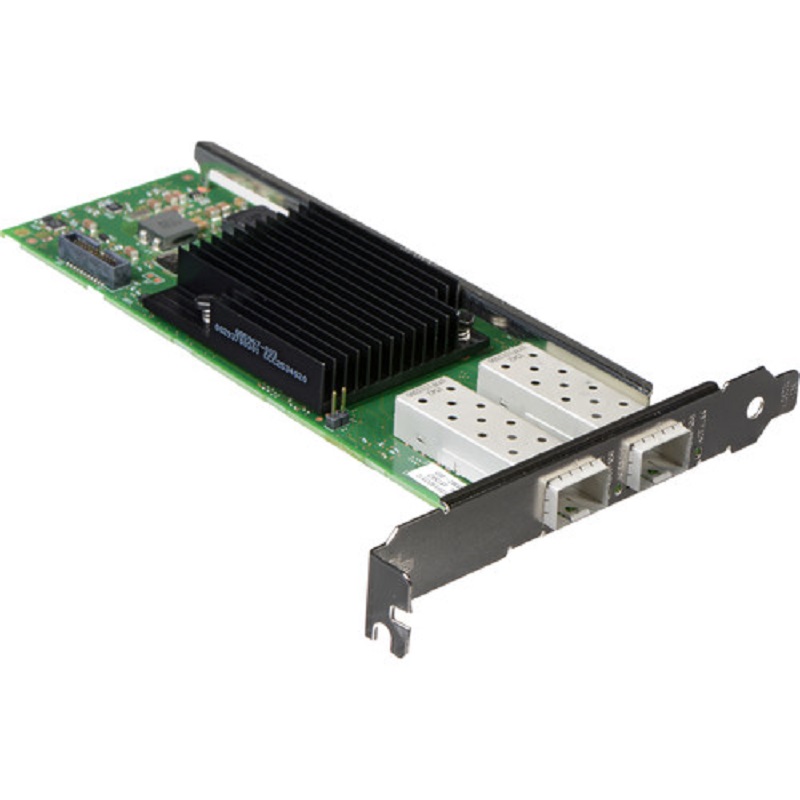
Intel X710DA2BLK Dual Port 10 Gigabit Ethernet SFP+ PCI-Express Converged Network Adapters. Excellent Refurbished with 1 year replacement warranty - Dell Version
| SKU/MPN | Warranty | Price | Condition | You save |
|---|---|---|---|---|
| X710DA2BLK | 1 Year Warranty | $90.00 | Excellent Refurbished | You save: $31.50 (26%) |
| X710DA2BLK | 1 Year Warranty | $298.00 | New Sealed in Box (NIB) | You save: $104.30 (26%) |
The Intel X710DA2BLK Dual Port 10 Gigabit Ethernet SFP+ PCI-Express Converged Network Adapter is a high-performance networking solution designed to deliver advanced throughput, optimized virtualization support, and reliable data center connectivity. Built on a dual-port 10GbE SFP+ architecture, this adapter enhances network efficiency by supporting accelerated packet processing, reduced CPU overhead, and intelligent traffic handling for enterprise-grade environments requiring stable and scalable communication performance.
The Intel X710DA2BLK Dual Port 10 Gigabit Ethernet SFP+ PCI Express Converged Network Adapter represents a high-performance networking solution engineered for enterprise environments that require stable throughput, low latency, and flexible connectivity options. Built on advanced controller architecture, this adapter is designed to support modern data center workloads, virtualization platforms, storage networking, and cloud-scale infrastructure deployments where consistent bandwidth delivery is essential.
This class of converged network adapter integrates Ethernet connectivity with advanced offload capabilities, reducing CPU overhead while enabling efficient packet processing at wire speed. It is widely adopted in environments that demand deterministic network performance such as virtualization clusters, high-performance computing nodes, and storage-intensive applications. The dual-port SFP+ configuration allows simultaneous high-speed connections, enabling redundancy and load distribution across multiple network paths.
The Intel X710DA2BLK Dual Port 10 Gigabit Ethernet SFP+ PCI Express Converged Network Adapter is optimized for scalability, making it suitable for both small enterprise deployments and large-scale distributed systems. Its design philosophy emphasizes performance consistency, hardware-level acceleration, and compatibility with a broad range of server platforms.
The architecture of this adapter is centered around convergence, meaning that multiple networking functions are handled within a unified hardware framework. Instead of relying heavily on CPU-based processing, the adapter integrates specialized hardware engines to manage packet classification, routing assistance, and data segmentation. This reduces system overhead and improves overall efficiency in environments where network traffic is continuous and unpredictable.
A key advantage of this design is the reduction of latency during data transmission. By offloading repetitive networking tasks to dedicated silicon, the system CPU can focus on application-level workloads rather than packet management. This becomes especially valuable in virtualized environments where multiple virtual machines share the same physical hardware resources.
The converged nature of the adapter also allows integration with storage traffic protocols, making it suitable for environments that combine traditional networking with storage area network operations. This ensures that a single hardware component can handle diverse traffic types without requiring separate physical interfaces.
At the core of the adapter lies a hardware acceleration layer that handles packet processing at line rate. This layer is responsible for tasks such as checksum offloading, segmentation offloading, and traffic prioritization. These capabilities significantly reduce CPU cycles consumed by network operations, improving server efficiency under heavy load conditions.
The acceleration layer also enhances performance consistency during peak traffic bursts. Instead of experiencing performance degradation when network demand increases, the adapter maintains stable throughput by distributing processing tasks across dedicated hardware components.
The PCI Express interface provides a high-bandwidth communication channel between the adapter and the host system. This ensures that data can be transferred rapidly between system memory and network interfaces without creating bottlenecks. The adapter is designed to leverage multiple PCIe lanes, ensuring that it can fully utilize available system bandwidth in modern server architectures.
This integration is critical for high-performance workloads where even minor latency variations can impact application performance. The direct connection to the system bus ensures that network traffic flows efficiently between hardware and software layers.
The dual port SFP+ configuration provides flexibility in deployment scenarios, allowing administrators to configure redundant links or separate traffic streams. Each port supports 10 Gigabit Ethernet connectivity, making the adapter suitable for high-throughput environments such as virtualization clusters, database servers, and media streaming platforms.
SFP+ modules offer modular transceiver support, allowing users to select optical or direct attach copper connections depending on infrastructure requirements. This flexibility is essential in environments where cabling distance, power efficiency, and signal integrity vary across deployments.
The ability to independently configure each port enhances network resilience. In redundant configurations, one port can serve as a failover link while the other handles primary traffic. In load-balanced configurations, both ports can operate simultaneously to distribute traffic evenly across available bandwidth.
Modern virtualization environments require network adapters capable of handling multiple isolated traffic streams without interference. This adapter is designed with virtualization awareness, enabling efficient handling of virtual machine traffic separation and prioritization. It supports advanced virtualization technologies that allow direct assignment of network resources to virtual instances.
In cloud infrastructure environments, network efficiency directly impacts service responsiveness. The adapter’s ability to manage multiple concurrent flows ensures that cloud-based workloads maintain predictable performance even under high utilization conditions. This makes it particularly suitable for infrastructure-as-a-service platforms and private cloud deployments.
The convergence of networking and virtualization support enables reduced hardware complexity in server deployments. Instead of requiring multiple network interface cards for different workloads, a single adapter can handle multiple virtualized traffic paths efficiently.
In data center environments, scalability is a critical factor in infrastructure planning. The adapter supports high-density server deployments where multiple nodes must communicate efficiently over high-speed links. Its architecture is designed to maintain stable performance even as network demand scales across hundreds or thousands of connected systems.
The dual-port design allows for flexible network topology configurations including spine-leaf architectures, redundant ring setups, and segmented traffic domains. This adaptability ensures compatibility with modern data center design methodologies that prioritize resilience and scalability.
As workloads increase, the adapter maintains consistent throughput without introducing significant jitter or packet loss. This reliability is essential for mission-critical applications such as financial systems, real-time analytics platforms, and distributed storage systems.
Beyond traditional Ethernet connectivity, this adapter is capable of supporting storage-oriented networking workloads. In environments where storage traffic is transmitted over Ethernet infrastructure, performance stability becomes essential to avoid bottlenecks.
The adapter ensures efficient handling of large data transfers, making it suitable for backup systems, distributed storage clusters, and high-speed database replication. Its offload capabilities reduce system overhead during sustained storage operations, allowing servers to maintain responsiveness even during heavy data movement.
Energy efficiency is an important consideration in modern data centers. The adapter is engineered to provide high performance while maintaining optimized power consumption levels. Its hardware acceleration reduces the need for excessive CPU usage, indirectly contributing to lower system-wide energy consumption.
Thermal management is also a key aspect of its design. Efficient heat dissipation ensures stable operation under continuous heavy workloads. This allows deployment in high-density server environments where thermal constraints are tightly managed.
This network adapter is designed for broad compatibility across enterprise server platforms. It supports major operating systems commonly used in data centers, including Linux-based distributions, Windows Server environments, and virtualization hypervisors. This ensures seamless integration into existing infrastructure without requiring extensive configuration adjustments.
Hardware compatibility extends to a wide range of server motherboards that support PCI Express expansion slots. This flexibility allows deployment in both modern and legacy systems, provided they meet interface requirements.
The adaptability of the adapter makes it suitable for mixed environment deployments where different operating systems and virtualization technologies coexist within the same infrastructure.
Reliability is a fundamental requirement in enterprise networking hardware. The dual-port configuration enables redundant network paths, ensuring continuous connectivity even in the event of link failure. This redundancy is essential for systems that require uninterrupted uptime.
Fault tolerance mechanisms ensure that network disruptions are minimized and quickly resolved. In high-availability configurations, traffic can be automatically rerouted through alternate paths without manual intervention.
This resilience makes the adapter suitable for critical infrastructure environments such as healthcare systems, financial networks, and large-scale cloud platforms where downtime is not acceptable.
The adapter incorporates advanced packet processing technologies that improve network efficiency and reduce system overhead. These capabilities include intelligent traffic classification, segmentation handling, and prioritization of critical workloads.
By handling these tasks at the hardware level, the adapter ensures that the host system can dedicate more resources to application processing rather than network management.
Investing in high-performance network adapters contributes to long-term infrastructure stability. As data demands continue to grow, scalable networking solutions become essential for maintaining system performance. This adapter provides a foundation for future expansion by supporting high-speed connectivity and flexible deployment configurations.
Its architecture ensures that it remains relevant in evolving data center environments where traffic density and computational demands continue to increase. Organizations benefit from reduced hardware replacement cycles and improved infrastructure longevity.


 Contact Us
 Information
 Catalog
 Solid State Drives (SSD)
 Network Switches
 Hard Disk Drives
 HBA & Controllers
 PC & Servers
 PC & Server Memory
 CPU & Processors
 Network Routers
 Power Supplies
 Tape Drives & Libraries
 Network Devices
 Computer & Network Cables