
(7% discount is applied at checkout)
Cart is empty
Your go-to destination for cutting-edge server products
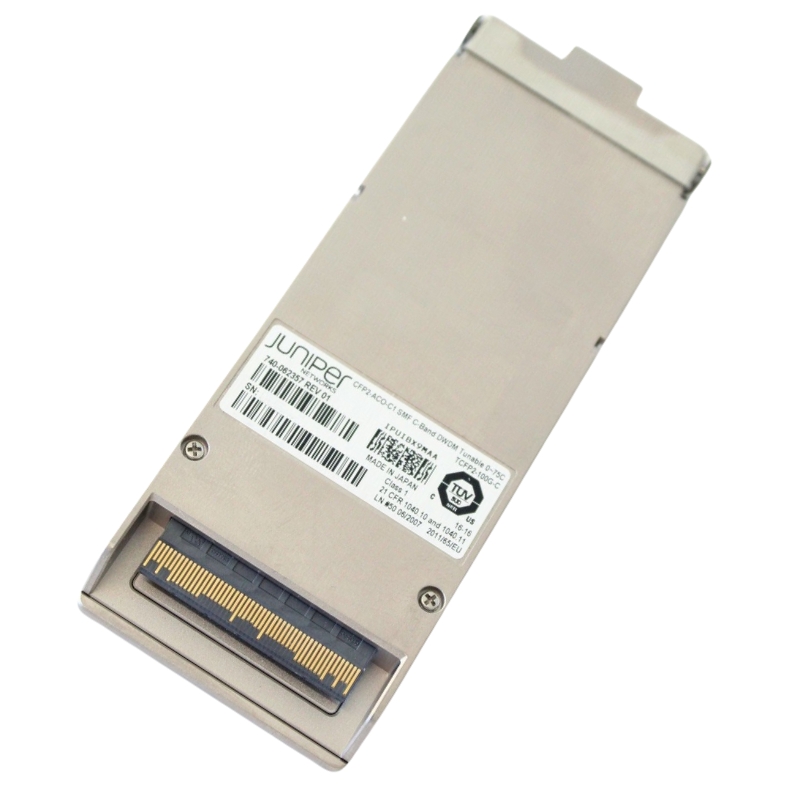
Juniper Networks TCFP2-100G-C CFP2 100 Gigabit Ether Transceiver Module. Excellent Refurbished with 1 year replacement warranty
The Juniper Networks TCFP2-100G-C CFP2 100G Ethernet optical transceiver is a high-performance coherent optical module engineered for dense, long-haul, and metro network deployments. Designed to deliver stable 100 Gigabit Ethernet connectivity, this CFP2-ACO form factor device supports advanced optical transport efficiency with tunable wavelength capability, making it suitable for scalable carrier-grade infrastructure and high-capacity backbone communication systems.
Line Encoding Rates
Input Power Range
Receiver Sensitivity
Minimum OSNR (Typical)
Minimum OSNR (Worst Case)
The evolution of optical transport systems has been driven by the exponential increase in global data consumption, cloud service expansion, and the transformation of enterprise connectivity models. Modern carrier networks require dense, power efficient, and highly reliable optical transceiver modules capable of delivering consistent performance under long distance and high traffic conditions. The Juniper Networks CFP2 class optical ecosystem is designed to support these demands by integrating advanced photonic technologies into compact form factors suitable for dense routing and switching environments. In earlier optical generations, SFP and XFP modules were sufficient for lower bandwidth requirements. However, as data centers, service providers, and telecom operators migrated toward 40G and 100G architectures, more sophisticated transceiver designs became necessary. CFP2 modules represent a significant leap in miniaturization and integration, allowing multiple high speed lanes or coherent optical processing within a reduced footprint while maintaining strict signal integrity standards.
Juniper Networks has developed a strong presence in the high performance networking domain, particularly in routing platforms and optical transport solutions. The company focuses on integrating optical transceivers with its switching and routing systems to ensure seamless interoperability, low latency transmission, and efficient bandwidth utilization. This integration allows service providers to deploy scalable infrastructure capable of supporting multi terabit backbones. The optical transceiver ecosystem associated with Juniper Networks emphasizes modularity, reliability, and thermal efficiency. These design principles ensure that transceiver modules such as CFP2 based systems can operate in dense chassis configurations without compromising performance. The alignment between hardware and software control layers enhances network visibility, fault detection, and adaptive traffic engineering.
The CFP2 form factor represents a compact evolution of the original CFP standard, engineered to support higher density deployments in modern network equipment. CFP2 modules are approximately half the size of earlier CFP designs, enabling greater port density on routing platforms while reducing overall power consumption per transmitted bit. Mechanical engineering within CFP2 modules involves precision alignment of optical components, including lasers, modulators, and photodetectors. The compact structure requires advanced thermal dissipation strategies to manage heat generated during high speed data transmission. Heat sinks, conduction paths, and airflow optimization within chassis environments ensure operational stability across varying load conditions. Power efficiency is a critical design consideration, particularly in large scale deployments where hundreds of optical modules may operate simultaneously. CFP2 transceivers are designed to maintain a balance between optical output power and electrical consumption, ensuring sustainable operation in data center and carrier environments.
100 Gigabit Ethernet represents a major milestone in network throughput capability, enabling ultra high speed data transfer across core infrastructure. CFP2 based transceivers support this transmission rate through advanced modulation techniques and parallel data lane distribution. Depending on implementation, 100G optical transmission may utilize multiple 25G lanes or coherent optical processing for long haul communication. Signal integrity is maintained through forward error correction mechanisms, dispersion compensation, and adaptive equalization techniques. These technologies ensure that data packets remain accurate over long distances and through multiple network nodes. Electrical interfaces within CFP2 modules convert high speed digital signals into optical pulses using laser diodes or coherent transmit engines. On the receiving end, photodetectors interpret incoming optical signals and convert them back into electrical form for routing system processing.
Optical transceivers in the CFP2 category utilize advanced laser sources capable of producing stable wavelengths suitable for high speed transmission. These lasers are engineered for minimal noise and high spectral purity, ensuring signal clarity over extended fiber routes. Modulation techniques may include amplitude, phase, or hybrid modulation depending on system design. Coherent optical systems further enhance performance by encoding data into both amplitude and phase variations of light waves. This allows significantly higher data density and improved resilience against fiber impairments such as chromatic dispersion and polarization mode distortion. Signal reconstruction at the receiver end involves digital signal processing engines capable of interpreting complex optical waveforms. These systems perform real time correction and decoding to restore transmitted data with high accuracy.
CFP2 100G optical modules are widely deployed in data center interconnect (DCI) environments where high capacity and low latency are essential. These environments require consistent throughput between geographically distributed facilities to support cloud computing workloads, storage replication, and distributed application architectures. In metropolitan area networks, CFP2 modules serve as key components in backbone links connecting aggregation routers and core switches. Their compact size allows network operators to maximize port density while minimizing rack space consumption. Long haul deployments leverage coherent CFP2 optics to transmit data across hundreds or even thousands of kilometers. These systems are essential for national and international backbone infrastructure supporting internet traffic, enterprise connectivity, and telecommunications services.
Maintaining signal integrity at 100G speeds requires sophisticated error correction systems. Forward error correction algorithms are implemented to detect and correct transmission errors without requiring retransmission. This is particularly important in long distance optical links where latency must be minimized. Adaptive compensation techniques dynamically adjust signal parameters based on real time network conditions. These adjustments include power level tuning, dispersion compensation, and modulation optimization. The goal is to maintain consistent performance despite environmental changes or fiber degradation. Noise reduction is achieved through careful design of optical components and shielding of electrical pathways. High quality materials and precision manufacturing ensure minimal signal distortion throughout the transmission process.
Carrier grade networks demand extremely high levels of reliability, often measured in multiple nines of uptime. CFP2 optical modules are designed with robust components capable of operating continuously under demanding conditions. Redundancy is a key architectural principle in network design. Multiple optical paths and failover mechanisms ensure uninterrupted service in case of module or link failure. CFP2 modules support hot swap capabilities in many systems, allowing replacement without system downtime. Lifecycle performance is influenced by environmental factors, including temperature fluctuations, humidity, and physical vibration. High quality manufacturing processes ensure that CFP2 modules maintain consistent performance over extended operational periods.
Modern optical networks increasingly rely on automation and software defined control systems. CFP2 transceivers integrate with network management platforms that provide real time telemetry data, including power levels, signal quality, and temperature readings. This data enables predictive maintenance strategies where potential failures can be identified before they impact network performance. Automated systems can dynamically adjust routing and bandwidth allocation based on optical performance metrics. Software defined networking frameworks allow centralized control of optical resources, improving efficiency and reducing operational complexity. CFP2 modules play a critical role in enabling these advanced network architectures.
Hyperscale data centers require massive scalability in both compute and networking infrastructure. CFP2 100G modules provide the necessary density to support large scale port deployments within limited physical space. Bandwidth aggregation techniques allow multiple CFP2 links to be combined to form higher capacity channels. Load distribution mechanisms ensure that traffic is evenly balanced across available optical paths, preventing congestion and maximizing throughput efficiency. As cloud computing continues to expand, the demand for high speed optical interconnects will continue to grow, making CFP2 technology a foundational component of modern infrastructure.
Energy efficiency is a major concern in large scale network deployments. CFP2 transceivers are engineered to minimize power consumption while maximizing data throughput. This reduces the overall energy footprint of data centers and telecom facilities. Sustainable infrastructure design focuses on reducing the power required per transmitted bit. Advances in optical efficiency, signal processing, and cooling systems contribute to lower operational costs and reduced environmental impact. Network operators increasingly prioritize green technologies, and CFP2 optical systems align with these objectives by offering high performance with optimized energy usage.
The future of optical networking is moving toward even higher bandwidth standards, including 200G, 400G, and beyond. While CFP2 modules remain relevant for 100G deployments, newer technologies are emerging to support increased data demands. Advancements in photonic integration, silicon photonics, and coherent signal processing will continue to shape the evolution of optical transceivers. These innovations aim to further reduce size, power consumption, and cost while increasing transmission capacity. CFP2 technology serves as a critical transitional platform, bridging traditional 100G systems with next generation optical architectures.


 Contact Us
 Information
 Catalog
 Solid State Drives (SSD)
 Network Switches
 Hard Disk Drives
 HBA & Controllers
 PC & Servers
 PC & Server Memory
 CPU & Processors
 Network Routers
 Power Supplies
 Tape Drives & Libraries
 Network Devices
 Computer & Network Cables