
(7% discount is applied at checkout)
Cart is empty
Your go-to destination for cutting-edge server products
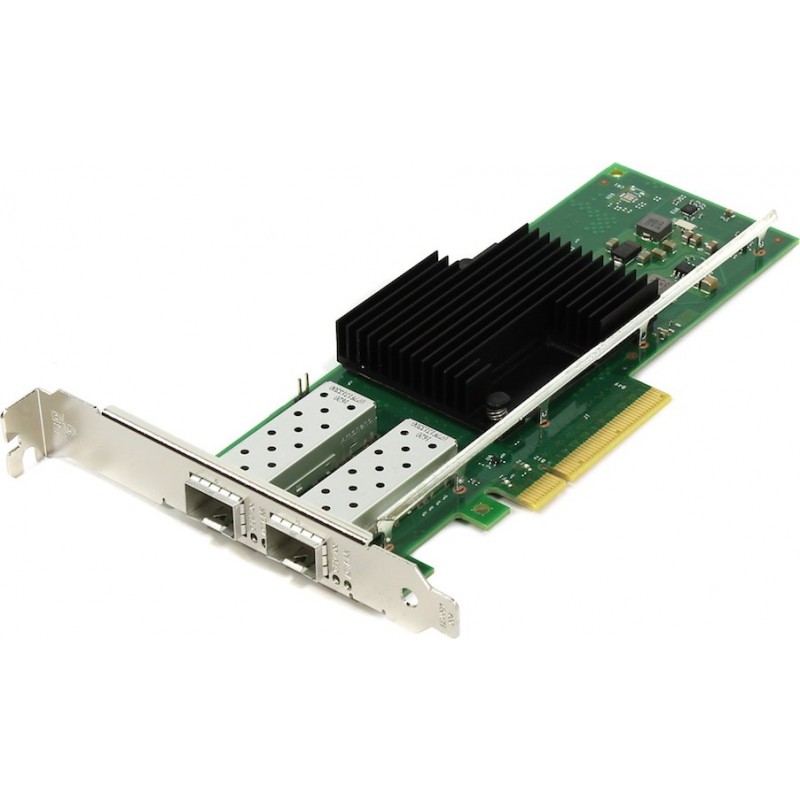
Intel X710-DA2BLK Dual Port 10 Gigabit Ethernet SFP+ PCI-Express Converged Network Adapters. New Sealed in Box (NIB) with 3 Years Warranty
| SKU/MPN | Warranty | Price | Condition | You save |
|---|---|---|---|---|
| X710-DA2BLK | 1 Year Warranty | Contact us for a price | Excellent Refurbished | |
| X710-DA2BLK | 1 Year Warranty | $118.00 | New Sealed in Box (NIB) | You save: $41.30 (26%) |
The Intel X710-DA2BLK Dual Port 10 Gigabit Ethernet SFP+ PCI-Express Converged Network Adapter is a high-performance networking solution engineered to deliver ultra-fast, stable, and efficient data transmission across modern data center and enterprise environments. Designed with dual SFP+ ports supporting 10GbE connectivity, this adapter enhances bandwidth capacity while optimizing virtualization, cloud workloads, and mission-critical applications. Built on Intel’s advanced networking architecture, it provides intelligent offloading capabilities, reduced CPU utilization, and seamless integration with high-demand server infrastructures, ensuring reliable and scalable network performance.
The Intel X710-DA2BLK Dual Port 10 Gigabit Ethernet SFP+ PCI Express Converged Network Adapter belongs to a highly specialized category of high performance networking interfaces designed for modern data center environments, cloud infrastructures, and enterprise scale server deployments. These adapters are engineered to deliver high throughput, low latency packet processing, and advanced offload capabilities that significantly reduce CPU overhead in demanding network workloads. The category represents a convergence of traditional Ethernet networking, virtualization aware communication, and storage transport optimization within a single hardware platform, enabling unified data movement across compute and storage layers.
Within this category, adapters are built around advanced silicon controllers that integrate multiple network acceleration engines. These engines support efficient packet classification, flow steering, and hardware based offloading for compute intensive operations. The Intel X710 family, including the dual port DA2BLK variant, is widely deployed in environments that require predictable performance under sustained network traffic loads. Such environments include virtualization clusters, high density server farms, storage replication systems, and high frequency transaction platforms.
The architecture of converged network adapters in this class is centered on maximizing bandwidth efficiency while minimizing latency variance. The PCI Express interface provides a direct communication channel between the server motherboard and the network adapter, ensuring that data transfers occur at speeds compatible with modern 10 Gigabit Ethernet links. This architecture supports deterministic performance behavior, which is critical in environments where packet delay variation can impact application stability.
The controller design incorporates multiple hardware acceleration blocks that handle checksum calculation, segmentation offload, and packet filtering. By delegating these tasks away from the central processing unit, the adapter allows server resources to focus on application level processing rather than network protocol handling. This separation of duties improves system efficiency and enables higher virtual machine density per physical server.
The dual port configuration of the Intel X710-DA2BLK enables simultaneous operation of two independent 10 Gigabit Ethernet channels. Each port utilizes SFP+ transceiver slots, providing flexibility in media selection such as direct attach copper cables or optical fiber modules. This flexibility allows network architects to deploy the adapter in a wide range of physical topologies, including short range rack connectivity and long distance inter rack communication.
The dual channel architecture also supports redundancy and load balancing strategies. In redundant configurations, one port can serve as a failover channel while the other handles active traffic. In load balanced configurations, traffic can be distributed across both ports to maximize throughput and improve network utilization efficiency. This adaptability makes the adapter suitable for mission critical deployments where continuous connectivity is required.
The PCI Express interface is a fundamental component of the adapter’s performance profile. By utilizing a high bandwidth bus architecture, the adapter ensures that network packets are transferred to and from system memory with minimal bottlenecks. This direct path reduces latency and increases packet processing efficiency, particularly in environments with high packet per second workloads.
Advanced queue management mechanisms are implemented within the adapter to distribute network traffic across multiple processing queues. These queues are mapped to CPU cores, enabling parallel processing of network streams. This design aligns with modern multi core server architectures and ensures consistent performance scaling as system load increases.
One of the defining characteristics of this category of converged network adapters is strong support for virtualization technologies. The Intel X710 series includes hardware based virtualization features that enable efficient operation in environments running multiple virtual machines or containers. These features reduce overhead associated with network packet virtualization and improve isolation between tenants.
Single Root Input Output Virtualization support allows a single physical adapter to present multiple virtual network interfaces directly to hypervisors. Each virtual interface can be assigned to a separate virtual machine, providing near native network performance. This capability is essential in cloud environments where resource sharing and workload isolation must coexist without performance degradation.
In virtualized environments, network performance often becomes a limiting factor for scaling compute resources. The Intel X710-DA2BLK addresses this limitation by offloading key networking functions to hardware. This reduces CPU contention and enables higher virtual machine density per physical host. Workloads such as database clusters, web hosting platforms, and distributed analytics systems benefit significantly from this architecture.
The adapter’s ability to distribute interrupts efficiently across multiple cores also contributes to improved virtualization performance. By balancing network processing loads, the system avoids CPU saturation and ensures that virtual machines receive consistent network service levels.
In modern data center environments, network adapters must support extremely high levels of traffic aggregation and distribution. The Intel X710-DA2BLK is designed to function effectively in leaf spine network architectures commonly used in cloud computing infrastructures. These architectures require predictable latency and high bandwidth throughput across multiple interconnected switches and servers.
Cloud service providers rely on converged network adapters to simplify infrastructure design while maintaining performance scalability. By integrating storage and network traffic handling, these adapters reduce the need for separate hardware components. This convergence lowers operational complexity and improves resource utilization efficiency across the data center.
Converged network adapters in this category are designed not only for traditional Ethernet traffic but also for storage transport protocols. This includes support for remote direct memory access technologies that allow servers to communicate with storage systems at high speed without excessive CPU involvement. The result is a unified transport layer that handles both compute and storage communication efficiently.
Storage traffic such as backup replication, distributed file system synchronization, and block level storage access benefits significantly from low latency network paths. The Intel X710 architecture ensures that storage packets are processed with minimal delay, improving overall system responsiveness and reducing storage access bottlenecks.
Low latency is a critical requirement for storage intensive applications. The adapter’s hardware offload capabilities help minimize the number of processing steps required to transmit storage data across the network. This leads to faster response times in applications such as transactional databases and real time analytics platforms.
By reducing software stack involvement in packet processing, the adapter ensures that storage communication remains consistent even under heavy network load conditions. This predictability is essential for enterprise grade storage systems.
The Intel X710-DA2BLK incorporates advanced packet processing engines designed to handle complex networking tasks at hardware level. These engines manage checksum validation, segmentation, reassembly, and flow classification. By performing these functions within the adapter itself, system resources are conserved and overall throughput is improved.
Flow steering capabilities allow the adapter to direct incoming traffic to specific processing queues based on predefined rules. This ensures that related packets are processed by the same CPU core, improving cache efficiency and reducing processing overhead.
Load distribution mechanisms built into the adapter ensure that network traffic is evenly distributed across available processing resources. This prevents bottlenecks and ensures consistent performance under varying traffic conditions. The ability to dynamically balance loads contributes to system stability in high demand environments.
In addition, interrupt moderation techniques help reduce CPU interruptions caused by excessive network events. This results in smoother system performance and improved application responsiveness.
High density server environments require network adapters that can scale efficiently without introducing performance bottlenecks. The dual port architecture of the Intel X710-DA2BLK provides sufficient bandwidth for multiple virtualized workloads operating on a single physical server. This enables efficient utilization of server resources and reduces infrastructure overhead.
In blade server and rack optimized configurations, space efficiency and power consumption are critical considerations. The compact form factor of the adapter allows it to be deployed in environments where physical space is limited while still delivering high performance network connectivity.
The adapter is designed to integrate seamlessly with modern virtualization platforms and network management systems. It supports a wide range of operating systems and hypervisors, making it suitable for heterogeneous infrastructure environments. This compatibility ensures that organizations can deploy the adapter without extensive reconfiguration of existing systems.
Network virtualization technologies benefit from the adapter’s ability to abstract physical network interfaces into virtual constructs. This abstraction enables flexible network provisioning and simplifies management of complex network topologies.
Scalability is a core requirement in cloud and enterprise environments. The Intel X710-DA2BLK supports scalable deployment models where additional servers and network resources can be added without disrupting existing configurations. This enables gradual infrastructure expansion based on workload growth.
The adapter’s consistent performance characteristics ensure that scaling operations do not introduce variability in network behavior, maintaining stability across the entire infrastructure.
Reliability is a key factor in enterprise networking environments. Dual port configurations inherently provide redundancy, allowing systems to maintain connectivity even if one network path becomes unavailable. This fault tolerance is essential for mission critical applications that require continuous uptime.
The adapter includes diagnostic and monitoring capabilities that help administrators detect and resolve network issues quickly. These capabilities contribute to reduced downtime and improved system resilience.


 Contact Us
 Information
 Catalog
 Solid State Drives (SSD)
 Network Switches
 Hard Disk Drives
 HBA & Controllers
 PC & Servers
 PC & Server Memory
 CPU & Processors
 Network Routers
 Power Supplies
 Tape Drives & Libraries
 Network Devices
 Computer & Network Cables