
(7% discount is applied at checkout)
Cart is empty
Your go-to destination for cutting-edge server products
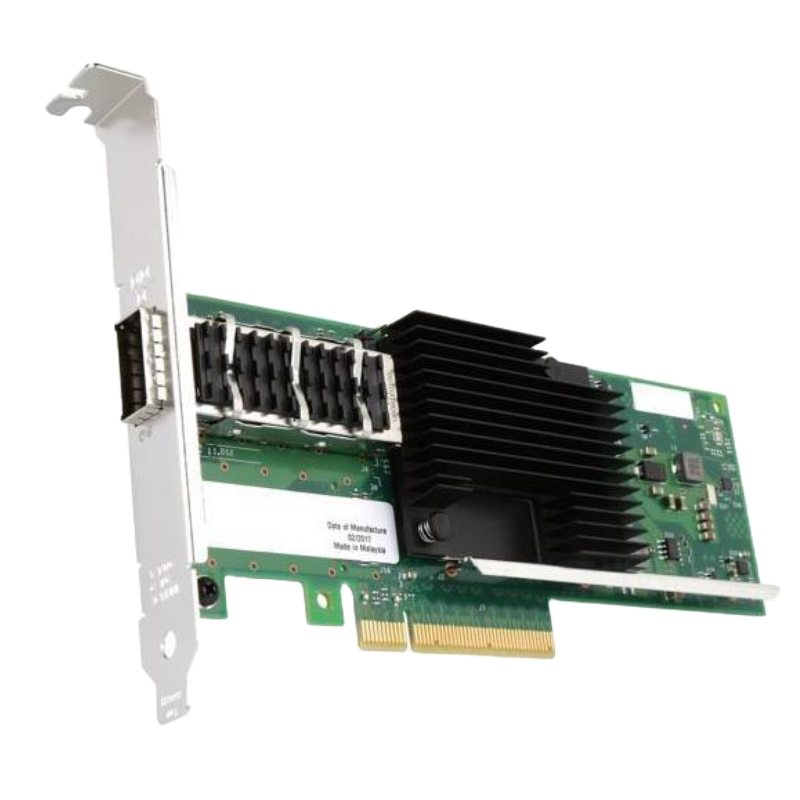
Intel XL710QDA1 4-Port 40 Gigabit Ethernet QSFP+ PCI-E Converged Network Adapter Card. Excellent Refurbished with 1 year replacement warranty
The Intel XL710QDA1 Converged Network Adapter Card is a powerful solution designed for enterprise-grade networking. Featuring 40 Gigabit Ethernet QSFP+ connectivity, this PCIe 3.0 x8 plug-in card delivers exceptional throughput, advanced virtualization support, and energy-efficient performance for modern data centers.
The Intel XL710QDA1 4-Port 40 Gigabit Ethernet QSFP+ PCI-E Converged Network Adapter Card represents a high-performance networking solution designed for modern data centers, enterprise servers, cloud infrastructure, and high-throughput computing environments. Built on advanced Intel Ethernet controller architecture, this adapter provides scalable bandwidth, low latency communication, and enhanced virtualization capabilities required for mission-critical workloads and bandwidth-intensive applications. It is engineered to support converged networking where storage, data, and management traffic can operate efficiently over a unified infrastructure.
The XL710 series is based on Intel’s next-generation Ethernet controller architecture, optimized for 40 Gigabit Ethernet connectivity. The design focuses on improving packet processing efficiency, reducing CPU overhead, and enabling hardware-based acceleration for network virtualization technologies. The architecture integrates multiple hardware offload engines that handle checksum computation, segmentation tasks, and virtualization packet steering, allowing server CPUs to focus on application-level processing rather than network tasks.
The adapter uses a PCI Express interface that ensures high-bandwidth communication between the network card and the host system. This high-speed interconnect reduces bottlenecks and ensures that multi-port 40GbE traffic flows efficiently into server memory. The PCIe design supports scalable throughput suitable for dense virtualization environments and large-scale distributed systems where network traffic consistency is essential for performance stability.
The QSFP+ interface provides flexible connectivity options, allowing the adapter to support both optical fiber transceivers and direct attach copper cables. This flexibility makes it suitable for short-range intra-rack connections as well as long-range data center interconnects. Each port is capable of delivering up to 40 Gigabit Ethernet throughput, making it suitable for aggregation layers and spine-leaf network architectures.
With four independent 40GbE ports, the adapter enables extremely high aggregate throughput, supporting demanding applications such as virtualization clusters, storage replication, and real-time analytics. Each port operates independently, allowing administrators to segment traffic loads or combine them for maximum bandwidth utilization depending on deployment requirements. This multi-port configuration enhances redundancy and load balancing capabilities in enterprise networks.
The adapter is designed to minimize latency through hardware-based packet handling mechanisms. By offloading critical network processing tasks from the CPU, the device reduces packet traversal delays, improving responsiveness for latency-sensitive applications such as financial trading systems, distributed databases, and cloud gaming platforms. The reduced latency also benefits storage area networks where rapid data exchange is essential.
Advanced traffic distribution mechanisms allow the adapter to balance network flows across available ports intelligently. This ensures optimal utilization of available bandwidth while preventing congestion on any single channel. The hardware-based load distribution enhances performance consistency in environments with unpredictable traffic patterns.
The converged network adapter architecture enables multiple types of traffic to operate over a single physical infrastructure. Data center environments benefit from reduced hardware complexity, lower operational costs, and simplified network management. By supporting convergence, the adapter eliminates the need for separate network interfaces for storage and data communication.
The adapter supports modern storage networking technologies that enable block-level storage communication over Ethernet. This capability is critical for virtualization platforms and cloud storage systems where shared storage access must be efficient and reliable. The hardware acceleration ensures storage traffic is prioritized appropriately to maintain performance consistency.
In addition to data and storage traffic, the adapter efficiently handles management traffic required for server orchestration and monitoring systems. This ensures that administrative communication does not interfere with application or storage performance, maintaining operational stability in large-scale deployments.
The adapter includes advanced virtualization features that enable efficient handling of virtual machine traffic. Hardware acceleration reduces hypervisor overhead and improves packet delivery performance between virtual machines and external networks. This is especially important in environments with high VM density where network performance directly impacts application responsiveness.
By supporting multiple hardware-based queues, the adapter ensures that virtual machines can communicate without contention. Each virtual instance can be assigned dedicated network resources, improving isolation and reducing performance variability. This structure is essential for multi-tenant cloud environments.
Single Root Input/Output Virtualization support enables the physical adapter to appear as multiple virtual network interfaces. This allows direct assignment of network resources to virtual machines, bypassing hypervisor bottlenecks and improving throughput. The result is a more efficient and secure virtualization architecture.
Cloud environments require flexible and scalable networking solutions capable of handling dynamic workloads. The adapter provides consistent performance under variable load conditions, ensuring that multiple tenants can operate independently without interference. This capability is essential for public cloud and hybrid cloud deployments.
The multi-port design enables redundancy configurations that ensure continuous network availability. In case of a port or path failure, traffic can be rerouted seamlessly to maintain service uptime. This redundancy is a key requirement for enterprise-grade cloud services and mission-critical systems.
The adapter supports hardware-based checksum computation and segmentation offloading, reducing CPU workload significantly. These features allow the server processor to dedicate more cycles to application processing rather than routine network tasks. The result is improved system efficiency and higher overall throughput.
By accelerating transport layer processing, the adapter improves the efficiency of both TCP and UDP traffic handling. This is particularly beneficial in environments with high packet volumes such as media streaming platforms, content delivery networks, and real-time analytics systems.
Advanced packet inspection and classification features allow the adapter to route traffic efficiently based on predefined rules. This enhances security, performance, and traffic segmentation in complex network environments where multiple applications share infrastructure resources.
In high-performance computing clusters, the adapter provides the necessary bandwidth to support distributed simulations, modeling tasks, and large-scale computations. The low latency and high throughput capabilities ensure efficient communication between compute nodes, reducing synchronization delays.
Parallel computing frameworks require fast and reliable interconnects to maintain processing efficiency across multiple nodes. The adapter’s architecture supports these requirements by minimizing packet processing overhead and maximizing data transfer speed between nodes.
The adapter supports high-speed connectivity for storage arrays and distributed storage systems. This enables faster data access, replication, and backup operations across enterprise storage infrastructures. The convergence of storage and data traffic improves operational efficiency.
Efficient handling of large data transfers ensures that backup and replication processes complete faster and with reduced impact on production workloads. This is essential for disaster recovery strategies and business continuity planning.
Enterprise databases require consistent low-latency network access to maintain transaction integrity and performance. The adapter supports high-speed communication that ensures database replication, query execution, and transaction processing occur efficiently.
Web servers and application clusters benefit from the adapter’s ability to handle high concurrent connection loads. This improves user experience in high-traffic environments such as e-commerce platforms and SaaS applications.
The adapter incorporates secure packet processing features that help mitigate unauthorized traffic manipulation and enhance data integrity. These features are essential for protecting sensitive enterprise data flowing through shared network infrastructures.
Traffic isolation mechanisms ensure that different workloads remain separated at the hardware level, reducing the risk of data leakage between tenants in multi-user environments. This is especially important in regulated industries.
The multi-port architecture allows for robust link aggregation strategies that improve both performance and reliability. In case of hardware or cable failure, traffic can be redistributed automatically without service disruption.
Efficient power management ensures that the adapter operates within optimal thermal limits even under sustained heavy workloads. This improves hardware longevity and reduces operational costs in large-scale deployments.
The adapter is designed to integrate seamlessly with a wide range of enterprise server platforms. Its standardized PCIe interface ensures compatibility across modern rack-mounted and blade server systems used in data centers.
Comprehensive driver support ensures compatibility with major operating systems used in enterprise environments. This allows for flexible deployment across diverse IT infrastructures without requiring extensive customization.
The adapter is optimized for integration with modern spine-leaf network architectures commonly used in large-scale data centers. Its high throughput capabilities align with high-capacity switching fabrics that support distributed computing environments.
Backward compatibility with Ethernet standards ensures that the adapter can be deployed in mixed-speed environments without disruption. This allows organizations to gradually upgrade infrastructure while maintaining operational continuity.
Administrators can implement traffic prioritization strategies to ensure critical workloads receive the necessary bandwidth. This is essential in environments where multiple applications compete for network resources.
Efficient queue handling ensures that packet processing remains smooth even under high load conditions. This reduces jitter and packet loss, improving overall network reliability.
Aligning network processing tasks with specific CPU cores enhances system performance and reduces context switching overhead. This improves throughput in high-performance environments.
Efficient memory allocation strategies ensure that packet buffers are managed effectively, reducing latency and improving data transfer consistency across the network stack.


 Contact Us
 Information
 Catalog
 Solid State Drives (SSD)
 Network Switches
 Hard Disk Drives
 HBA & Controllers
 PC & Servers
 PC & Server Memory
 CPU & Processors
 Network Routers
 Power Supplies
 Tape Drives & Libraries
 Network Devices
 Computer & Network Cables