
(7% discount is applied at checkout)
Cart is empty
Your go-to destination for cutting-edge server products
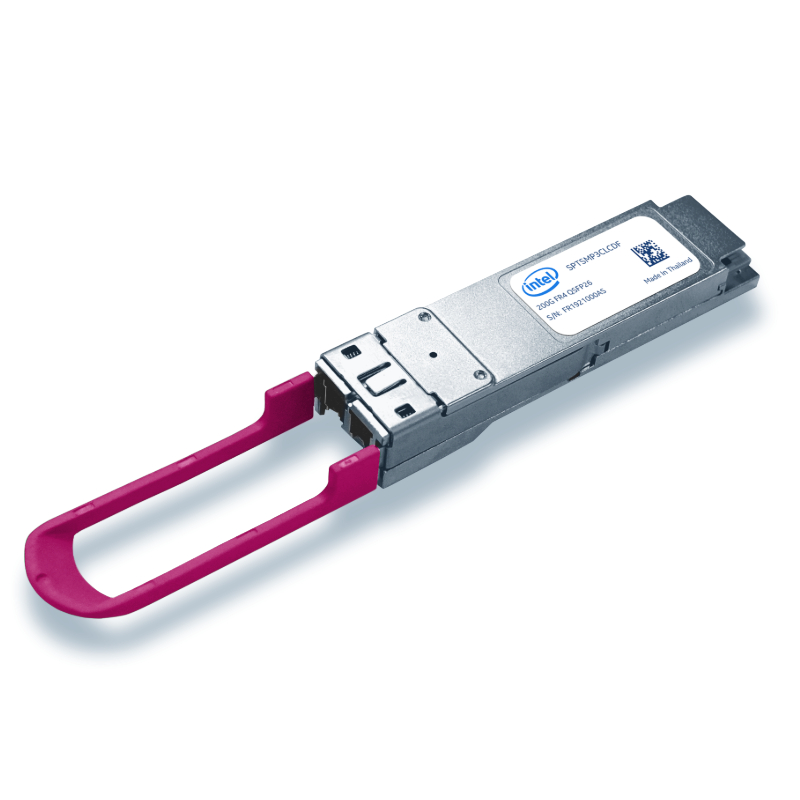
Intel SPTSHP3PMCDF Silicon Photonics Qsfp-dd 400 Gigabit Lan Transceiver Module. Factory-Sealed New in Original Box (FSB) with 3 Years Warranty
The Intel Silicon Photonics QSFP-DD 400 Gigabit LAN Transceiver Module (SPTSHP3PMCDF) is an advanced high-speed networking solution engineered to deliver ultra-fast optical data transmission for modern data center and enterprise infrastructure. Built on cutting-edge silicon photonics technology, this module ensures efficient bandwidth performance, low latency communication, and stable long-distance connectivity for demanding network environments.
The Intel SPTSHP3PMCDF Silicon Photonics QSFP-DD 400 Gigabit LAN Transceiver Module represents a highly advanced optical networking component designed for next generation high bandwidth data communication systems. Built on silicon photonics integration principles, this module combines optical and electronic functionalities within a compact form factor to enable extremely high data throughput, reduced latency, and improved energy efficiency in modern networking infrastructures. The QSFP-DD (Quad Small Form Factor Pluggable Double Density) standard extends traditional QSFP interfaces by doubling electrical lane capacity while maintaining backward compatibility considerations in structured deployments.
At its core, silicon photonics technology leverages silicon as an optical medium, enabling light-based data transmission directly through integrated photonic circuits. This eliminates many of the limitations associated with traditional copper interconnects and discrete optical assemblies. The result is a compact, scalable, and cost-efficient transceiver solution capable of handling 400 Gigabit per second Ethernet transmission requirements in cloud-scale environments, hyperscale data centers, and high-performance computing clusters.
The fundamental principle behind the Intel SPTSHP3PMCDF module lies in photon-based signal propagation. Instead of relying solely on electrical current, the system converts electrical signals into optical signals using integrated laser sources and modulators. These optical signals are then transmitted across fiber optic channels at extremely high speeds with minimal attenuation. At the receiving end, photodetectors convert the optical signals back into electrical data streams, ensuring seamless communication between network devices.
This method significantly reduces signal degradation over long distances, allowing for consistent high-speed performance even in large-scale distributed computing environments. It also reduces electromagnetic interference, which is a common challenge in high-density server racks.
Silicon photonics integration allows multiple optical components such as waveguides, modulators, multiplexers, and detectors to be fabricated on a single silicon substrate. This level of integration reduces manufacturing complexity while improving reliability and thermal stability. The Intel SPTSHP3PMCDF module benefits from this design by achieving high precision signal control within a compact QSFP-DD enclosure.
The use of silicon-based waveguides ensures efficient light propagation with controlled dispersion characteristics. This enables stable 400G transmission across multiple channels using wavelength division multiplexing techniques.
The QSFP-DD architecture introduces eight electrical lanes, each capable of carrying high-speed data streams. In a 400 Gigabit configuration, these lanes are typically operated using advanced modulation techniques such as PAM4 (Pulse Amplitude Modulation with four levels), effectively doubling the data rate per lane compared to traditional NRZ encoding schemes.
This increased lane density allows network operators to achieve significantly higher bandwidth within the same physical port footprint, making it ideal for space-constrained environments such as blade servers and high-density switch fabrics.
The module is engineered to support 400 Gigabit Ethernet standards, enabling ultra-fast data transmission across cloud computing environments and enterprise networking systems. This performance level is essential for workloads involving artificial intelligence training, real-time analytics, virtualization clusters, and large-scale storage replication.
By leveraging multiple optical lanes and advanced modulation schemes, the module maintains stable signal integrity even under heavy network traffic conditions. This ensures consistent latency performance and minimizes packet loss in mission-critical applications.
One of the key advantages of silicon photonics transceivers is their ability to reduce latency in signal conversion and transmission. The Intel SPTSHP3PMCDF module achieves this by integrating optical components directly on silicon, reducing the distance and complexity between electronic and photonic domains.
Lower latency is particularly important in financial trading systems, high-performance computing clusters, and distributed artificial intelligence workloads where microseconds can significantly impact performance outcomes.
Compared to traditional optical transceivers, silicon photonics-based modules are designed to operate with significantly reduced power requirements. The integration of optical functions on silicon reduces the need for discrete power-hungry components, improving overall energy efficiency in large-scale deployments.
This reduction in power consumption directly translates into lower operational costs for data center operators, particularly in environments where thousands of transceiver modules are deployed simultaneously.
In cloud computing environments, the demand for high-speed interconnects is continuously increasing. The 400G capability of this silicon photonics transceiver supports large-scale virtual machine migration, distributed storage systems, and high-speed database synchronization across geographically dispersed data centers.
The compact QSFP-DD design enables dense port configurations in top-of-rack and spine-leaf network architectures, optimizing physical space utilization while maximizing bandwidth capacity.
High-performance computing systems rely on ultra-low latency communication between compute nodes. The Intel SPTSHP3PMCDF module provides the necessary bandwidth and signal stability required for parallel processing workloads, scientific simulations, and complex computational modeling tasks.
By reducing communication bottlenecks, silicon photonics interconnects improve overall system efficiency and computational throughput.
Pulse Amplitude Modulation with four distinct signal levels is widely used in 400G transceiver systems to increase data throughput without requiring proportional increases in bandwidth. The Intel SPTSHP3PMCDF module utilizes PAM4 encoding to transmit multiple bits per symbol, effectively doubling spectral efficiency compared to traditional binary modulation schemes.
This approach allows higher data rates while maintaining compatibility with existing fiber optic infrastructure, reducing upgrade complexity for network operators.
Advanced error correction mechanisms are integrated into the transceiver architecture to maintain data integrity across high-speed transmission channels. These systems continuously monitor signal quality and adjust transmission parameters to minimize bit error rates.
Such adaptive signal control ensures stable performance even in environments with varying temperature conditions and electromagnetic interference.
Modern data center architectures rely heavily on spine-leaf topology to ensure efficient traffic distribution and minimal latency. The Intel SPTSHP3PMCDF module fits seamlessly into this architecture by providing high-speed interconnectivity between leaf switches and spine aggregation layers.
Its high bandwidth capacity ensures that traffic bottlenecks are minimized, even in highly virtualized environments with dynamic workload distribution.
As data consumption continues to grow exponentially, network infrastructure must be capable of scaling efficiently. Silicon photonics technology offers a path toward future-ready systems by enabling higher bandwidth density without proportional increases in power or space requirements.
This makes the QSFP-DD 400 Gigabit module a strategic component for long-term infrastructure planning.
The fabrication of photonic integrated circuits requires extreme precision at the nanoscale level. Silicon wafers are processed using advanced lithography techniques to create waveguides and optical components with highly controlled geometries.
This precision ensures consistent optical performance across production batches, improving reliability and reducing variability in large-scale deployments.
Each module undergoes rigorous testing to validate optical signal integrity, power efficiency, and thermal stability. Performance metrics are carefully evaluated to ensure compliance with 400 Gigabit Ethernet standards and operational reliability requirements.
This validation process is critical for maintaining consistent performance in mission-critical environments where downtime is not acceptable.
By lowering power consumption per transmitted bit, silicon photonics transceivers contribute to reduced energy usage in large-scale data centers. This has a direct impact on operational sustainability, helping organizations reduce their overall carbon footprint.
As global demand for digital services continues to rise, energy-efficient networking technologies play an increasingly important role in sustainable infrastructure development.
Efficient use of physical space and energy resources allows operators to deploy more computing capacity within existing infrastructure limits. This improves overall system efficiency and reduces the need for frequent hardware expansion.


 Contact Us
 Information
 Catalog
 Solid State Drives (SSD)
 Network Switches
 Hard Disk Drives
 HBA & Controllers
 PC & Servers
 PC & Server Memory
 CPU & Processors
 Network Routers
 Power Supplies
 Tape Drives & Libraries
 Network Devices
 Computer & Network Cables