(7% discount is applied at checkout)
Cart is empty
Your go-to destination for cutting-edge server products
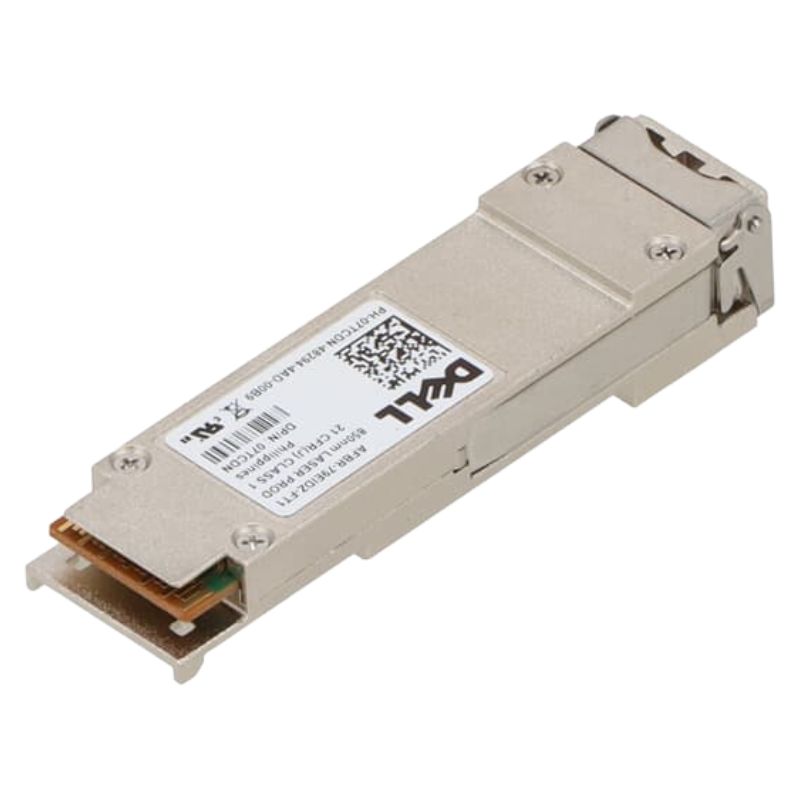


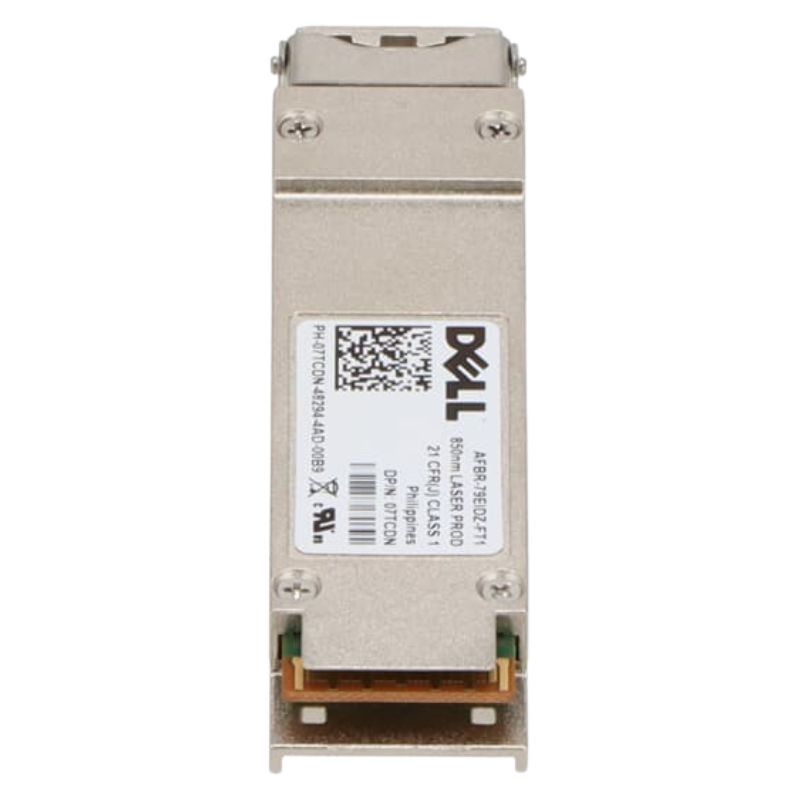
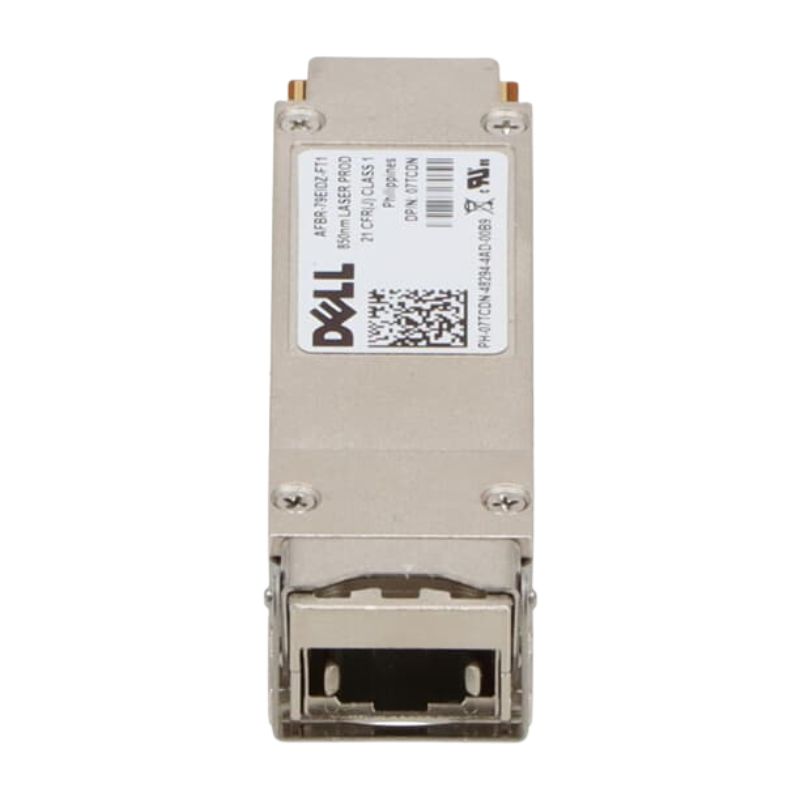
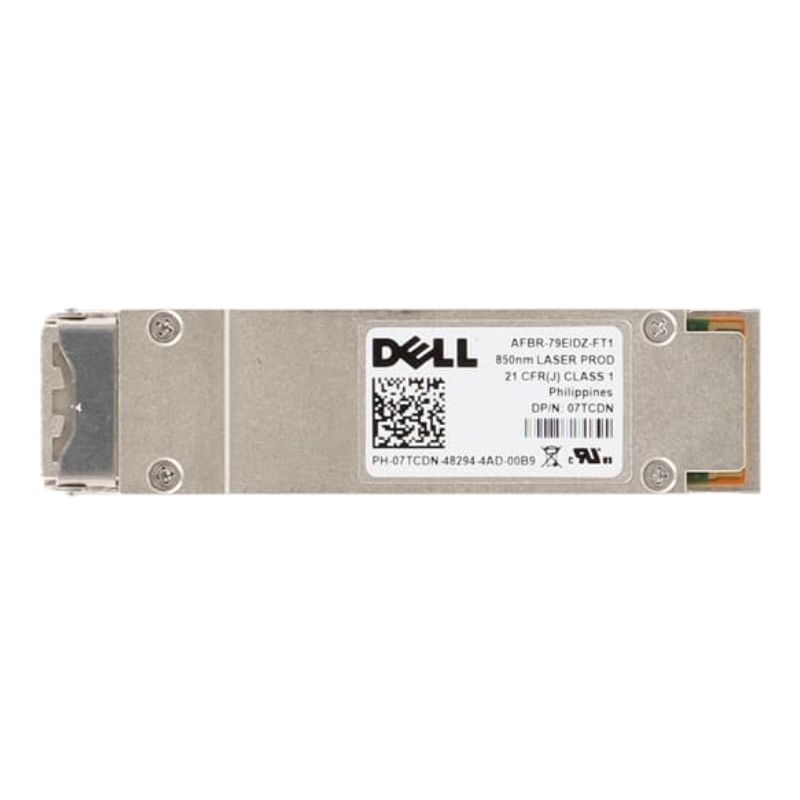
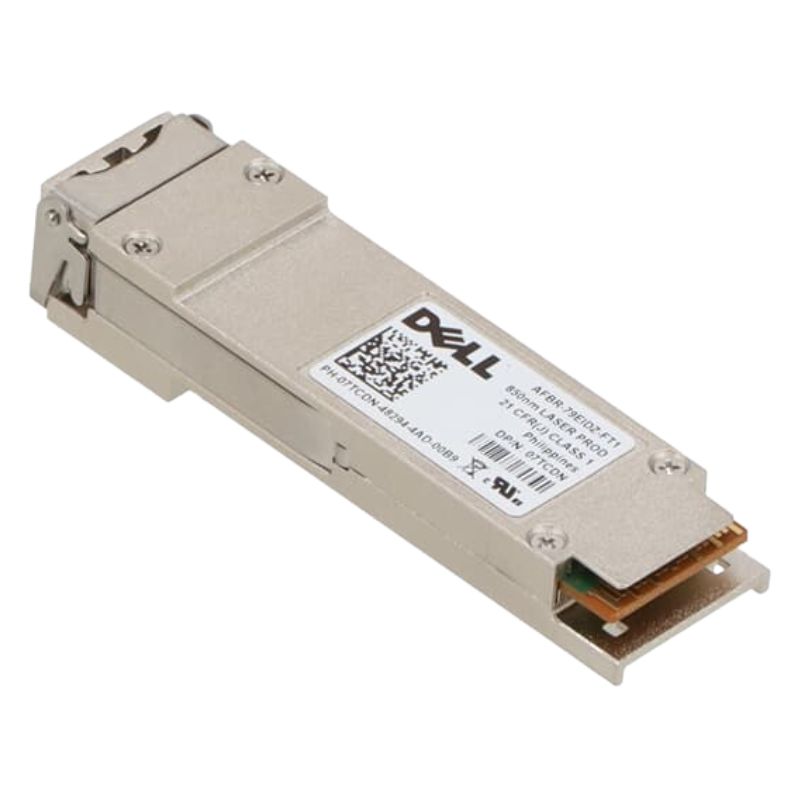
Dell 7TCDN 40GBE QSFP+ Sr4 Mpo Transceiver with 850nm Wavelength, 100-150 Meter Reach on Om3/om4. Excellent Refurbished with 1 year replacement warranty
| SKU/MPN | Warranty | Price | Condition | You save |
|---|---|---|---|---|
| 7TCDN | 1 Year Warranty | $85.00 | New Sealed in Box (NIB) | You save: $29.75 (26%) |
| 7TCDN | 1 Year Warranty | $56.00 | Excellent Refurbished | You save: $19.60 (26%) |
The Dell 7TCDN 40GbE QSFP+ SR4 MPO Transceiver is a high-speed fiber optic module engineered for short-range connectivity. Operating at 850nm wavelength, this plug-in unit delivers up to 40Gbps throughput with a reach of 100–150 meters on OM3/OM4 cabling, ensuring reliable wired communication for enterprise networking environments.
The Dell 7TCDN 40GbE QSFP+ transceiver designed for short-reach optical networking environments represents a critical component in modern high-density data center architectures. This optical module is engineered to deliver reliable 40 Gigabit Ethernet performance across OM3 and OM4 multimode fiber infrastructures, enabling seamless high-speed data transmission within enterprise switching, storage networking, and converged computing environments. Built with precision optics and advanced signal modulation techniques, the module supports link distances ranging from approximately 100 meters to 150 meters depending on fiber quality, cable condition, and installation parameters.
This category of QSFP+ optical transceivers is widely adopted in enterprise-grade switching platforms where scalability, bandwidth density, and low-latency communication are essential. The Dell 7TCDN unit is optimized for environments requiring stable throughput for virtualization clusters, high-performance computing workloads, and cloud-scale distributed systems. Its design ensures consistent signal integrity across multimode fiber links while minimizing attenuation and dispersion effects over supported distances.
The QSFP+ form factor represents a compact, high-density interface designed to accommodate four independent data lanes within a single transceiver module. Each lane operates at 10Gbps, collectively achieving an aggregated throughput of 40Gbps. The Dell 7TCDN transceiver adheres to this architectural standard, enabling compatibility with a wide range of networking equipment that supports QSFP+ interfaces.
This multi-lane architecture allows for efficient utilization of switch port density, reducing the physical footprint required for high-bandwidth deployments. In enterprise switching systems, this translates to improved scalability and reduced cabling complexity while maintaining robust performance characteristics across densely populated network racks.
The 40GbE transmission standard employed in this transceiver category is based on parallel optical signaling. Instead of relying on a single high-speed channel, data is distributed across multiple synchronized optical lanes. This approach significantly enhances signal stability and reduces the risk of transmission errors in comparison to single-lane high-frequency systems.
The Dell 7TCDN module leverages advanced laser-based optical emitters that ensure consistent modulation and reception of high-speed data streams. The synchronization of multiple channels enables deterministic latency performance, which is essential for mission-critical applications such as financial trading systems, real-time analytics, and distributed computing workloads.
This class of transceivers typically operates using optimized shortwave optical transmission within the 850nm wavelength range, which is standard for multimode fiber communication. The wavelength selection is specifically engineered to maximize performance over OM3 and OM4 fiber types, ensuring minimal modal dispersion and reduced attenuation over medium-range distances.
Signal integrity is maintained through integrated error correction mechanisms and precise laser calibration techniques. These enhancements ensure that transmitted data remains accurate even in high-density optical environments where multiple fiber channels operate in close proximity.
OM3 multimode fiber is widely deployed in enterprise data centers due to its cost efficiency and adequate bandwidth capabilities for short-to-medium range connections. The Dell 7TCDN 40GbE QSFP+ transceiver supports OM3 fiber for distances up to approximately 100 meters under optimal installation conditions. This includes properly polished connectors, minimal bending loss, and controlled environmental factors.
OM3 fiber utilizes laser-optimized construction that supports 40GbE transmission using parallel optics. However, performance margins depend heavily on installation quality, connector cleanliness, and overall optical budget management within the network architecture.
OM4 multimode fiber provides enhanced modal bandwidth compared to OM3, allowing extended reach up to approximately 150 meters for 40GbE transmission. The Dell 7TCDN module benefits significantly from OM4’s improved optical characteristics, making it suitable for larger data center layouts where switch-to-switch or switch-to-server distances exceed standard rack boundaries.
The improved performance of OM4 fiber is particularly beneficial in hyperscale environments where network topologies require flexible placement of aggregation switches and leaf-spine architectures. The extended reach capability reduces the need for intermediate switching layers, simplifying network design and improving latency efficiency.
Achieving maximum supported distance depends on multiple environmental and technical factors. Fiber cleanliness, connector alignment, and proper cable management significantly influence signal attenuation levels. Additionally, temperature variations within data center environments can affect optical performance stability over long operational cycles.
The Dell 7TCDN transceiver is designed with tolerance for minor variances in optical signal quality, ensuring reliable operation even in large-scale deployments where perfect environmental conditions are not always achievable.
In modern data centers, bandwidth density is a key design consideration. The Dell 7TCDN 40GbE QSFP+ transceiver enables aggregation of multiple high-speed links into compact switching infrastructures. This allows network architects to design high-throughput backbones that support virtualization, storage replication, and distributed computing tasks without congestion bottlenecks.
The transceiver supports deterministic traffic flow, making it suitable for spine-leaf architectures where consistent latency and throughput are essential. Its ability to maintain synchronized multi-lane transmission ensures smooth operation under heavy data loads.
Latency-sensitive applications require predictable transmission timing. The parallel optical design of the 40GbE QSFP+ system minimizes serialization delay by distributing traffic across multiple channels. The Dell 7TCDN module further enhances this by optimizing signal processing at both transmission and reception stages.
This low-latency behavior is particularly important in environments such as cloud computing platforms, enterprise storage clusters, and high-frequency transactional systems where microsecond-level delays can impact performance outcomes.
High-performance computing clusters require extremely fast interconnects to facilitate parallel processing workloads. The 40GbE capability of this transceiver supports large-scale simulations, scientific computations, and AI model training workloads that depend on rapid data exchange between compute nodes.
The consistent optical signaling ensures that large datasets can be transmitted with minimal interruption, supporting computational scalability in research and enterprise environments.
Storage area networks benefit significantly from high-speed optical links. The Dell 7TCDN module enables efficient replication and retrieval of large data volumes across distributed storage arrays. This ensures data redundancy, backup synchronization, and rapid recovery operations in enterprise storage ecosystems.
The stable performance over OM3 and OM4 fiber makes it suitable for both centralized and distributed storage architectures, reducing latency in data access operations.
The Dell 7TCDN transceiver is designed to operate seamlessly within Dell networking hardware environments, including enterprise-grade switches and modular chassis systems. It adheres to QSFP+ industry standards, ensuring compatibility with a wide range of networking equipment that supports 40GbE optical modules.
This interoperability reduces deployment complexity and ensures that organizations can integrate the transceiver into existing infrastructures without requiring extensive configuration changes or hardware modifications.
In heterogeneous networking environments, compatibility across different hardware vendors is essential. The standardized QSFP+ interface ensures that the Dell 7TCDN module can function within multi-vendor ecosystems, provided that optical specifications and firmware compatibility requirements are met.
This flexibility allows enterprise architects to design hybrid infrastructures without being locked into a single hardware provider.
Efficient cable management plays a crucial role in maintaining long-term network reliability. Excessive bending, tight routing, or improper strain relief can introduce optical loss. Structured cabling systems are recommended to ensure consistent performance across all installed transceiver modules.
Proper labeling and organized routing also simplify maintenance and troubleshooting in large-scale deployments.
The Dell 7TCDN 40GbE QSFP+ transceiver supports aggregation strategies where multiple high-speed links are combined to form larger logical bandwidth pools. This allows network engineers to distribute traffic efficiently across available paths while maintaining redundancy and fault tolerance.
Such configurations are commonly used in spine-leaf architectures where bandwidth scalability is a critical requirement.
Load balancing across multiple optical links ensures consistent utilization of network resources. The transceiver’s stable transmission characteristics enable predictable load distribution, reducing congestion and improving overall system efficiency.
This contributes to improved application performance and reduced packet loss in high-demand environments.
Optical transmission inherently provides a higher level of resistance to electromagnetic interference compared to copper-based solutions. The Dell 7TCDN module benefits from this characteristic, ensuring that data remains secure and unaffected by external electrical noise.
This enhances reliability in environments with high electromagnetic activity such as industrial data centers and densely packed server rooms.
Advanced signal correction techniques help minimize transmission errors across optical links. These mechanisms ensure that data integrity is preserved even under marginal optical conditions, improving overall network resilience.


 Contact Us
 Information
 Catalog
 Solid State Drives (SSD)
 Network Switches
 Hard Disk Drives
 HBA & Controllers
 PC & Servers
 PC & Server Memory
 CPU & Processors
 Network Routers
 Power Supplies
 Tape Drives & Libraries
 Network Devices
 Computer & Network Cables