(7% discount is applied at checkout)
Cart is empty
Your go-to destination for cutting-edge server products
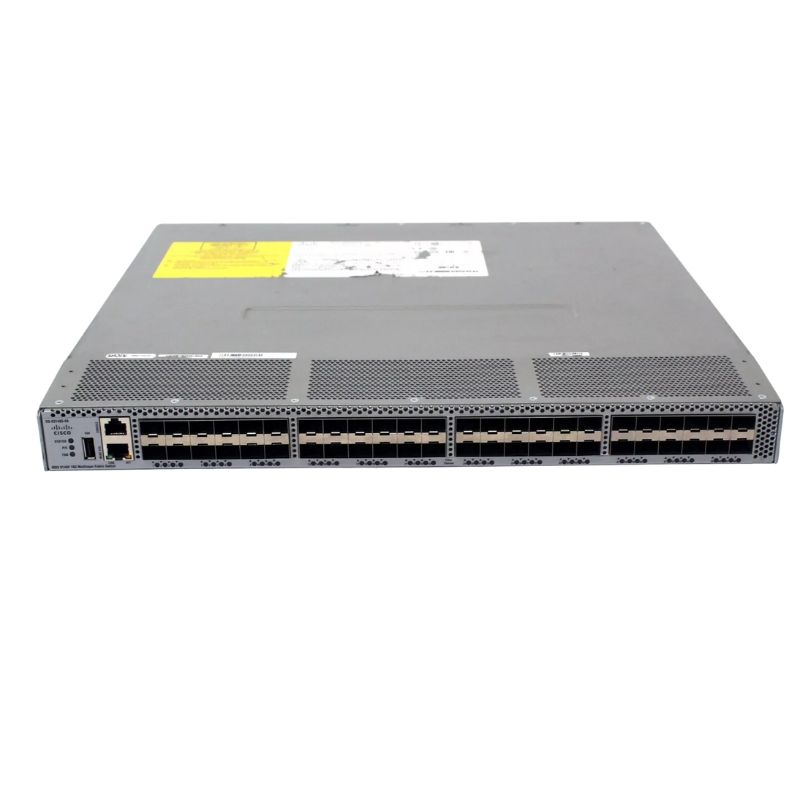


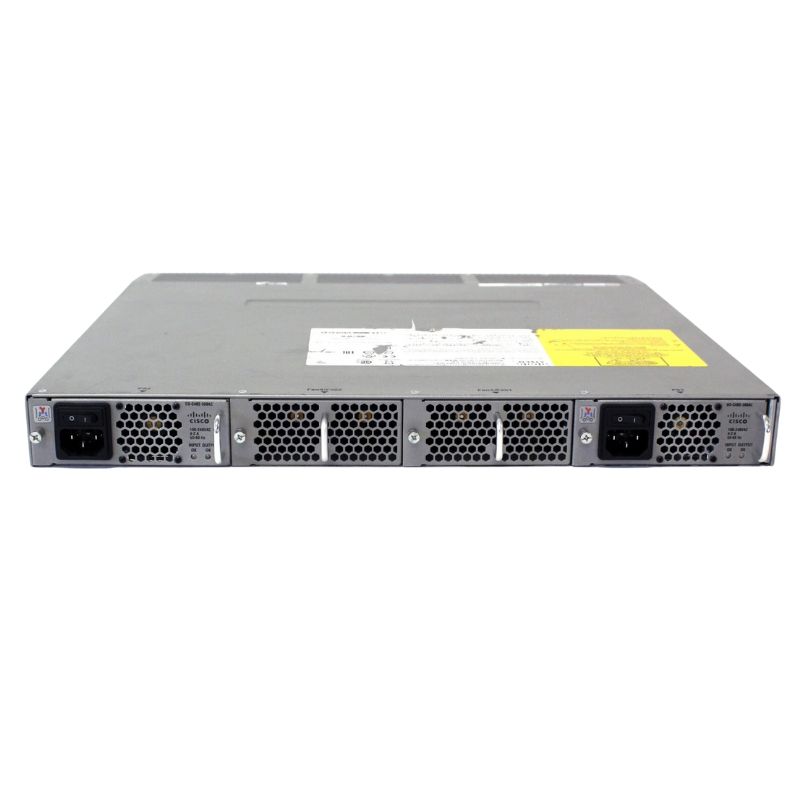
Cisco DS-C9148S-48PK9 48 Ports Manageable Switch. Excellent Refurbished with 1 year replacement warranty.
| SKU/MPN | Warranty | Price | Condition | You save |
|---|---|---|---|---|
| DS-C9148S-48PK9 | 1 Year Warranty | $3,790.00 | Factory-Sealed New Retail in Original Box (FSB) | You save: $1,326.50 (26%) |
| DS-C9148S-48PK9 | 1 Year Warranty | $1,480.00 | Excellent Refurbished | You save: $518.00 (26%) |
The Cisco DS-C9148S-48PK9 offers a highly scalable 48-port Fibre Channel architecture engineered for modern data centers requiring dependable throughput, strong security protocols, and flexible connectivity. Designed for demanding enterprise environments, this multilayer switch enhances storage performance while ensuring stable, low-latency data transfer across complex networks.
Crafted for rack-mount installations, this 1U unit uses a back-to-front airflow pattern to maintain thermal efficiency in dense deployments. Its Fibre Channel architecture supports extensive compatibility standards, guaranteeing smoother integration with enterprise storage frameworks.
This model adheres to an extensive list of FC standards such as FC-GS-3/4/5/6, FC-MI-2/3, FC-PI-2/3/4/5, FC-BB-2/3/4/5/6, FC-SW-2/3/4/5, FC-FS-2/3, FC-SP-2, FC-DA-2, FAIS/FAIS-2, and FCP 2–4 variations—ensuring forward-looking interoperability for evolving SAN architectures.
Flexible management interfaces simplify configuration and maintenance, while multiple Fibre Channel SFP+ ports enable large-scale extensions within a SAN environment.
Redundant hot-plug power units ensure non-stop operation, reducing risk during maintenance or fluctuations. Designed with enterprise continuity in mind, the switch supports dual power supplies with a 1+1 redundancy scheme.
The Cisco DS-C9148S-48PK9 48 Ports Multilayer Fabric Switch represents a powerful class of networking equipment designed to meet the growing demands of contemporary data centers, enterprise fabrics, and converged infrastructures. As a category, multilayer fabric switches combine high port density with advanced switching capabilities to provide deterministic performance, simplified operational models, and the flexibility required by cloud-first architectures. This category description explores the defining attributes of the Cisco DS-C9148S-48PK9 class, its strategic advantages, typical deployment patterns, and the considerations that matter during procurement and lifecycle management.
At the heart of the multilayer fabric switch category is the concept of a simplified, highly automated fabric that reduces network complexity while increasing resiliency and throughput. The Cisco DS-C9148S-48PK9 family is built to serve as a fabric leaf or spine node within modern Clos or spine-and-leaf topologies, enabling flattened network architectures that are easier to scale horizontally. This architectural approach emphasizes predictable latency, symmetric oversubscription ratios, and a forwarding plane capable of handling east-west traffic patterns that dominate virtualized and containerized workloads. The fabric-oriented design also supports consistent policy enforcement across the network and simplifies segmentation, making it possible to treat the network as a programmable platform rather than a collection of disjointed devices.
Port density is a defining characteristic of the Cisco DS-C9148S-48PK9 category, with the 48-port configuration optimized to balance high aggregation capacity with compact form factors. This density allows organizations to consolidate top-of-rack connectivity while maintaining headroom for bursty traffic typical of modern applications. The hardware design is engineered for sustained throughput with integrated buffering strategies and multilevel queuing to minimize packet loss under load. Redundancy and serviceability are key themes in the design philosophy, with hot-swappable modules, efficient thermal management, and maintenance-friendly component layouts that reduce operational disruptions during upgrades or preventive maintenance cycles.
Performance for the DS-C9148S-48PK9 category is measured not only in raw throughput but also in the predictability of forwarding behavior. Deterministic forwarding means predictable latency and jitter when carrying critical workloads such as real-time communications, storage replication, and high-frequency east-west flows. The switches in this category are engineered with hardware-accelerated forwarding tables, deep packet buffers, and quality-of-service mechanisms that prioritize mission-critical traffic. These capabilities make the Cisco DS-C9148S-48PK9 suitable for a wide range of scenarios from high-performance compute clusters to latency-sensitive storage fabrics.
Modern data centers demand programmable infrastructure that integrates with orchestration platforms and automation pipelines. The DS-C9148S-48PK9 category supports programmatic management through well-defined APIs and automation toolchains. This enables consistent configuration templates, infrastructure-as-code practices, and event-driven operational workflows. Integration with configuration management systems and telemetry frameworks allows network operations teams to move away from reactive troubleshooting toward predictive, analytics-driven maintenance. The ability to automate common tasks—software upgrades, configuration rollouts, and policy updates—reduces human error and accelerates time-to-service for new applications and tenants.
Security is a pervasive requirement for every layer of the network. The Cisco DS-C9148S-48PK9 class facilitates microsegmentation and fine-grained policy enforcement to isolate workloads and prevent lateral movement within the fabric. Security capabilities include support for role-based access control, dynamic policy attachment, and integration with identity and access management systems. Stateful inspection and packet filtering can be combined with monitoring telemetry to detect anomalies and trigger automated mitigations. When used as part of a broader security fabric, these switches contribute to a defense-in-depth strategy that protects sensitive applications and data while maintaining the performance characteristics required by modern workloads.
The rise of virtualization and multi-tenant cloud models has placed new demands on switch platforms. The Cisco DS-C9148S-48PK9 family is designed to support network virtualization constructs that allow multiple tenants or application domains to share physical infrastructure while preserving isolation and performance. Virtual routing and forwarding instances, overlay technologies, and quality-of-service policies enable administrators to create logical networks that mirror the needs of applications. This flexibility supports use cases ranging from enterprise private clouds to service provider environments where bandwidth, security, and operational separation are essential.
Scalability is central to the value proposition of the multilayer fabric switch category. The 48-port DS-C9148S-48PK9 devices are frequently deployed as modular building blocks in leaf-spine fabrics, allowing organizations to grow incrementally without major architectural changes. Capacity planning for these switches focuses on interface utilization, oversubscription ratios, and aggregate flows created by virtualized workloads. Thoughtful scaling strategies include planning for uplink bandwidth to spine nodes, reserving ports for predictable expansion, and ensuring that chassis or rack-level power and cooling constraints are accounted for when designing larger fabrics.
High availability measures are intrinsic to enterprise-grade fabric switches. The DS-C9148S-48PK9 category typically supports in-band and out-of-band management redundancy, fast failover mechanisms, and features that reduce the blast radius of faults. Fabric-level resiliency is achieved through redundancy at multiple layers: redundant power supplies, dual-management paths, and protocol-level mechanisms that provide rapid reconvergence. The result is a network substrate that supports continuous operations even in the face of component failures or planned maintenance, which is essential for environments with strict uptime requirements.
Operational visibility is crucial for troubleshooting, capacity planning, and security analytics. Switches in the Cisco DS-C9148S-48PK9 category provide rich telemetry and streaming telemetry options that feed performance and health metrics to monitoring systems. This telemetry includes interface statistics, flow-level details, and hardware health indicators. Tools that consume this information can produce dashboards, alerts, and trend analyses that reduce mean time to detection and resolution. Enhanced visibility is a differentiator in complex deployments where the ability to quickly isolate performance bottlenecks and misconfigurations has direct business impact.
Energy efficiency and thermal design are practical concerns for dense data center racks. DS-C9148S-48PK9 category hardware is engineered to deliver a favorable performance-per-watt ratio, helping organizations manage power and cooling costs as they scale. Efficient airflow design, power supply efficiency ratings, and intelligent power management features can reduce total cost of ownership. Environmental considerations also extend to end-of-life recycling and vendor support for hardware refreshes, which are important elements of a responsible infrastructure lifecycle strategy.
The versatility of the Cisco DS-C9148S-48PK9 category lends itself to a wide range of use cases. In enterprise data centers, these switches serve as top-of-rack or leaf nodes connecting racks of servers and storage to a high-performance spine. In private cloud environments, the switches provide the fabric foundation that supports virtualized workloads, container clusters, and software-defined networking overlays. Service providers and colocation facilities can leverage these devices for customer-facing aggregation layers where isolation, SLA-driven performance, and operational automation are required. High-performance computing clusters benefit from the low latency and predictable forwarding characteristics, while converged infrastructures use these switches to unify storage, compute, and management traffic over a consolidated fabric.
As application architectures evolve, network behavior must adapt to the needs of microservices, distributed databases, and realtime analytics. The DS-C9148S-48PK9 category supports application-aware networking through integration with orchestration platforms and telemetry-driven policy engines. This alignment allows the network to prioritize critical application flows, apply tailored security controls, and provide differentiated treatment for latency-sensitive traffic. Application-aware strategies reduce manual policy work and enable a proactive approach to maintaining application performance across complex multi-tier deployments.
Interoperability is a central consideration when selecting switches for heterogeneous environments. The Cisco DS-C9148S-48PK9 class adheres to industry standards that facilitate integration with existing switching and routing platforms. Standards-based protocols for layer 2 and layer 3 control planes reduce vendor lock-in and simplify integration into multi-vendor fabrics. Open APIs and extensible management frameworks further contribute to operational synergy, enabling these switches to fit into established automation and monitoring ecosystems without requiring a complete retooling of operational processes.
Software capabilities determine much of the functional value of modern switches. Feature sets for the DS-C9148S-48PK9 category typically include advanced routing, multicast optimizations, segmentation and policy controls, and network virtualization features. Licensing models may be tiered to unlock advanced features such as enhanced analytics, additional throughput capabilities, or extended support. Understanding the software feature map and license entitlements is essential for accurate total cost of ownership estimations and ensuring the deployed platform can meet evolving business needs.


 Contact Us
 Information
 Catalog
 Solid State Drives (SSD)
 Network Switches
 Hard Disk Drives
 HBA & Controllers
 PC & Servers
 PC & Server Memory
 CPU & Processors
 Network Routers
 Power Supplies
 Tape Drives & Libraries
 Network Devices
 Computer & Network Cables