(7% discount is applied at checkout)
Cart is empty
Your go-to destination for cutting-edge server products
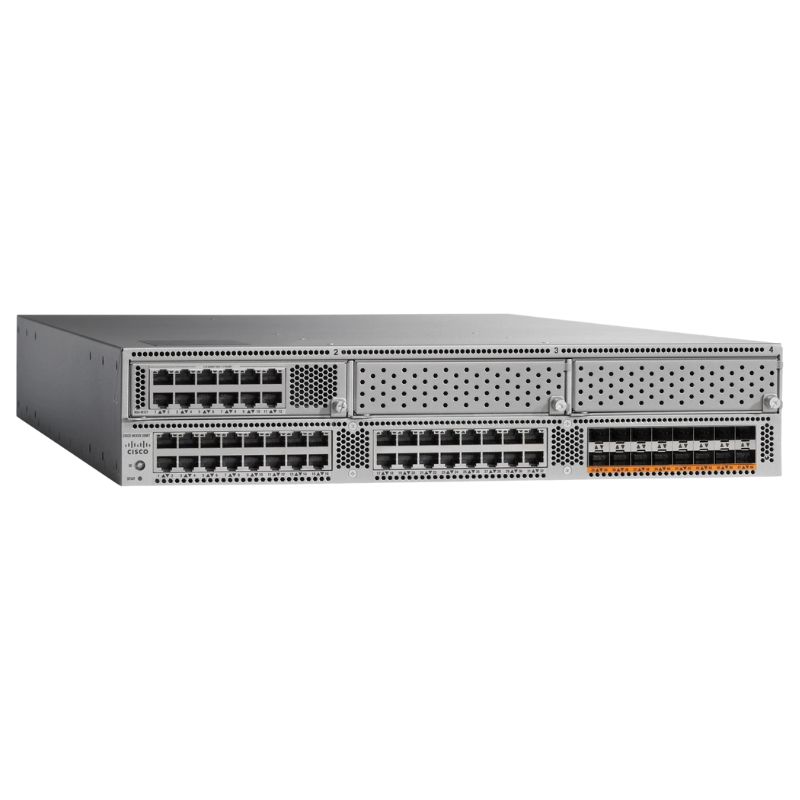


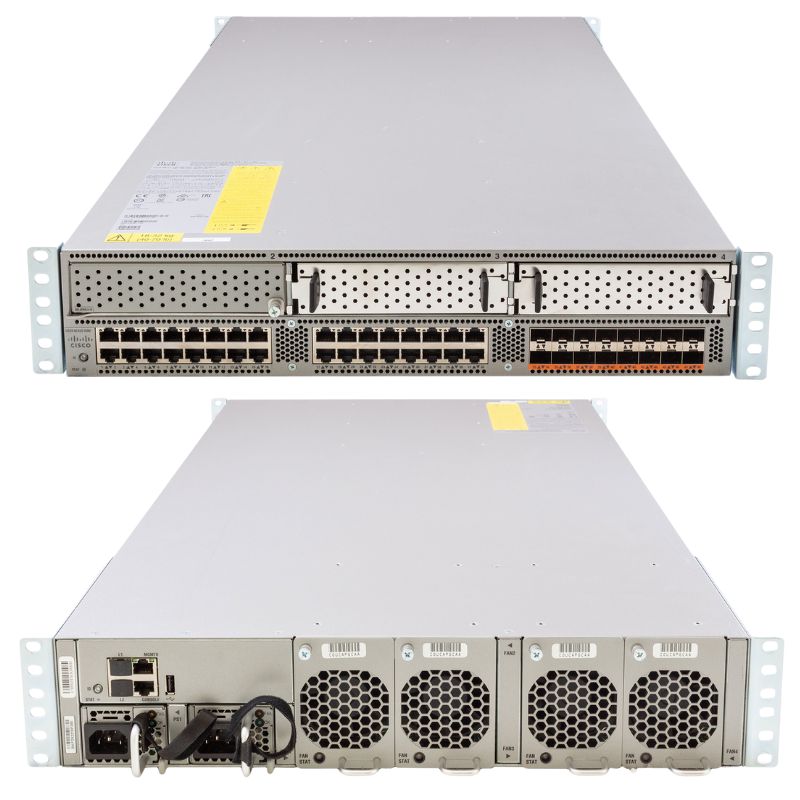
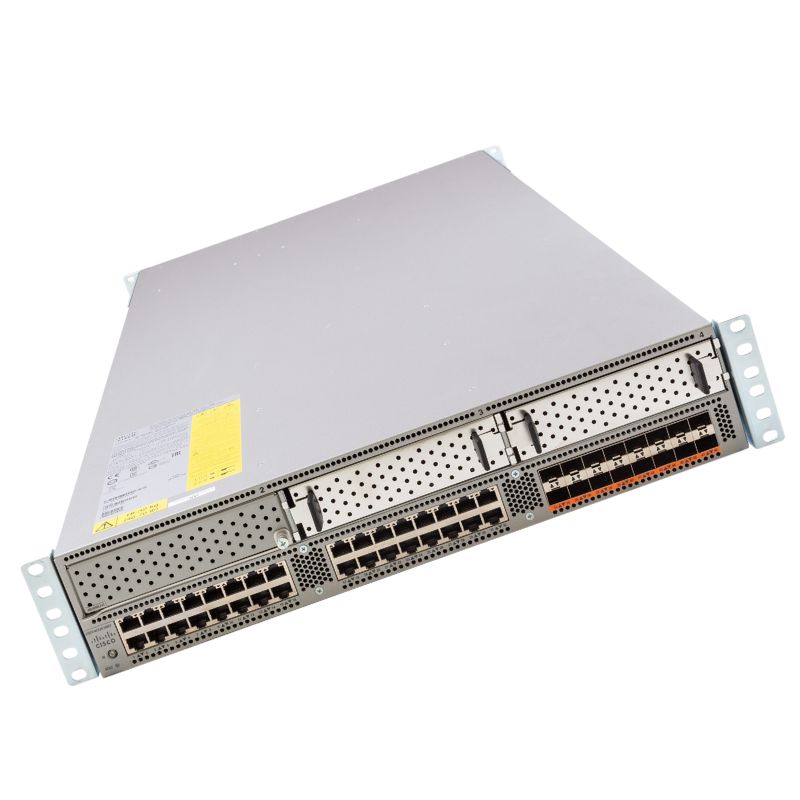
The Cisco C1-N5596T-FA ONE Nexus 5596T Managed Switch is a powerful enterprise-grade networking solution designed for data centers and high-performance business environments. Built by Cisco Systems, Inc., this Layer 3 switch delivers robust scalability, advanced routing, and ultra-fast 10 Gigabit Ethernet connectivity to support modern network infrastructures.
This Cisco Nexus 5596T switch is engineered to provide extensive port density and flexible networking options, making it ideal for high-throughput and low-latency applications.
Designed for performance-driven networks, the Cisco Nexus 5596T supports multiple media types and advanced Ethernet technologies to ensure reliability and speed.
The modular design of the Cisco Nexus 5596T allows organizations to adapt their network infrastructure as requirements grow.
At its heart, the Cisco Nexus 5596T is built for relentless performance and reliability. Its architecture is purpose-built to handle the intense East-West traffic flows characteristic of modern virtualized and cloud-native applications.
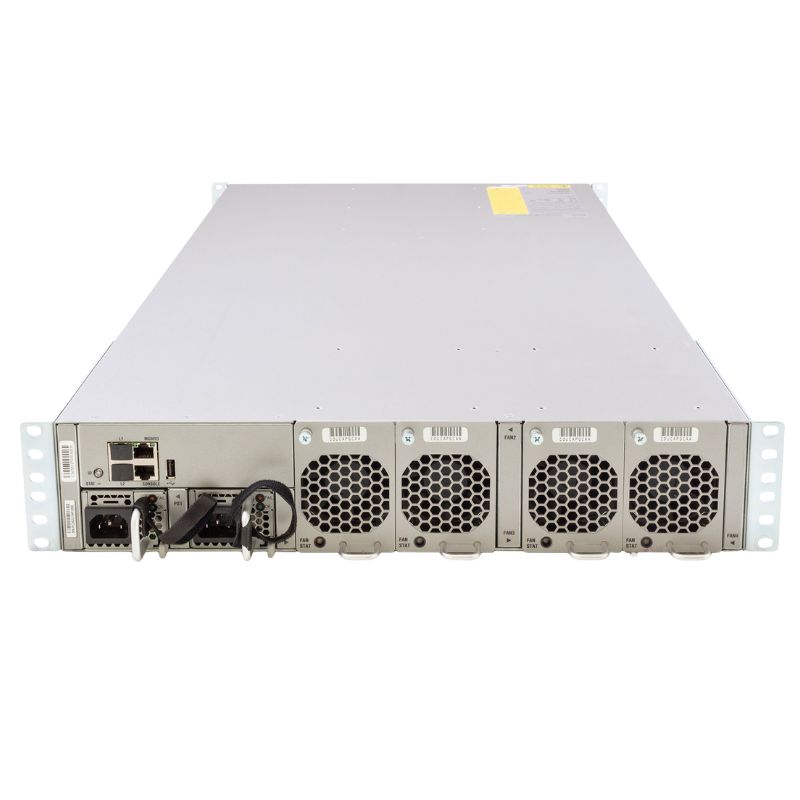
The switch occupies a 6-rack-unit (6RU) chassis, providing a dense form factor suitable for space-constrained data centers. Its design emphasizes efficient airflow and thermal management, crucial for maintaining stability in high-load scenarios. The chassis supports dual, hot-swappable power supplies and fan trays, ensuring no single point of failure in the critical cooling and power infrastructure.
With a non-blocking switching capacity of up to 2.6 Terabits per second (Tbps) and a forwarding rate of over 1.5 billion packets per second (Bpps), the 5596T can handle the most demanding workloads. This massive internal bandwidth ensures that all ports can run at line rate simultaneously, preventing bottlenecks during peak utilization periods.
Port Density: 48 fixed ports (32 x 10GBASE-T + 16 x SFP+) plus 8 expansion module slots.
Expansion Slots: 8 dedicated slots for Unified Fabric expansion modules, enabling connectivity scaling up to 96 ports of 10 Gigabit Ethernet or the addition of 40 Gigabit Ethernet uplinks.
Power Supplies: Supports AC and DC power supply units (PSUs) in a 1+1 redundant configuration.
Management: Dedicated 10/100/1000 management port, RS-232 serial console port, and USB port for software image management.
The hallmark of the Nexus 5596T is its hybrid port configuration, which strategically combines two dominant 10 Gigabit Ethernet technologies into a single platform.
These copper ports use the familiar RJ-45 connector and support 10GBASE-T, 1000BASE-T, and 100BASE-TX standards. Their primary advantage is the ability to use cost-effective Category 6a/7 copper cabling for distances up to 100 meters. This dramatically reduces the cost of connectivity for server attachments, especially in dense top-of-rack deployments where distances are short. The auto-negotiation and auto-MDI/MDIX features simplify deployment, allowing for seamless integration with existing 1GbE servers while providing a clear, in-place upgrade path to 10GbE.
The sixteen SFP+ ports provide flexibility for fiber optic or Direct Attach Copper (DAC) connectivity. They are ideal for longer-reach connections within the data center, such as linking to aggregation switches or storage arrays, or for creating low-latency, low-power interconnects using twinaxial cables.
SFP-10G-SR: Multi-mode fiber for distances up to 400 meters.
SFP-10G-LR: Single-mode fiber for distances up to 10 kilometers.
SFP-10G-CU: Passive or active Direct Attach Copper cables for cost-effective connections up to 7 meters.
SFP-H10GB-CU: Cisco's high-density Active Optical Cable (AOC) solution.
The Cisco Nexus 5596T is more than just an Ethernet switch; it is a cornerstone for building a Cisco Unified Fabric. This architecture converges LAN and SAN traffic over a single, high-efficiency network infrastructure.
The switch acts as a FCoE Forwarder (FCF), enabling the encapsulation of native Fibre Channel frames within Ethernet. This allows servers to carry both IP and storage traffic on a single 10 Gigabit Ethernet adapter (Converged Network Adapter or CNA), reducing adapter count, cabling complexity, and power consumption. Support for N-Port Virtualizer (NPV) and N-Port ID Virtualization (NPIV) enhances scalability and simplifies Fibre Channel fabric integration by reducing switch domain counts.
To ensure reliable, lossless transport for storage and clustered applications, the 5596T fully implements the IEEE Data Center Bridging standards:
Priority Flow Control (PFC - 802.1Qbb): Creates lossless classes of service, essential for FCoE and RoCE traffic.
Enhanced Transmission Selection (ETS - 802.1Qaz): Provides bandwidth allocation and management between traffic classes.
Congestion Notification (CN - 802.1Qau): Helps manage end-to-end congestion in the fabric.
Data Center Bridging eXchange (DCBX): A discovery and capability exchange protocol that simplifies DCB configuration.
Running on Cisco NX-OS, a dedicated, resilient operating system for data centers, the Nexus 5596T delivers a comprehensive feature set for modern network operations.
NX-OS offers carrier-class reliability with features like in-service software upgrades (ISSU), stateful process restart, and modular processes. Its CLI is similar to Cisco IOS but optimized for data center operations. Robust support for Python scripting and XML APIs enables network automation and integration with orchestration tools like Ansible and Chef.
This powerful feature allows a single physical Nexus 5596T to be partitioned into multiple logical switches (VDCs). Each VDC operates independently with its own management domain, control plane, software processes, and dedicated ports. This enables role-based administration, fault isolation, and the consolidation of multiple network functions onto a single platform.
The switch supports VXLAN (Virtual Extensible LAN) gateway functions, facilitating the creation of Layer 2 overlay networks over a Layer 3 IP underlay. This is critical for multi-tenant cloud environments, enabling scalable network segmentation that transcends the traditional 4094 VLAN limit.
High Availability: Virtual PortChannel (vPC), Graceful Insertion and Removal (GIR), Bidirectional Forwarding Detection (BFD).
Security: ACLs with TCAM optimization, Cisco TrustSec, IEEE 802.1X, Role-Based Access Control (RBAC).
Multicast: PIM Sparse Mode, Bi-Dir PIM, IGMP snooping.
Quality of Service (QoS): Sophisticated classification, marking, queuing, and scheduling policies across 8 queues per port.
The versatility of the Nexus 5596T makes it suitable for a wide range of data center deployment models.
Its hybrid port mix makes it an ideal ToR switch. The 10GBASE-T ports connect to a rack of servers using cost-effective copper, while the SFP+ ports provide high-bandwidth uplinks (via 10G or 40G expansion modules) to the data center core or spine layer. vPC can be used for resilient, active-active dual-homed server connectivity.
In converged environments, the switch serves as a Unified Fabric Access point. It aggregates traffic from servers equipped with CNAs, stripping FCoE traffic to pass to a Fibre Channel Forwarder (like a Nexus 5548UP or MDS switch) while forwarding LAN traffic upstream, all while maintaining a lossless fabric for storage.
For smaller or medium-sized data centers, a pair of Nexus 5596T switches in a vPC configuration can serve as a highly available, high-performance core, providing connectivity to server racks, storage networks, and WAN routers.


 Contact Us
 Information
 Catalog
 Solid State Drives (SSD)
 Network Switches
 Hard Disk Drives
 HBA & Controllers
 PC & Servers
 PC & Server Memory
 CPU & Processors
 Network Routers
 Power Supplies
 Tape Drives & Libraries
 Network Devices
 Computer & Network Cables