
(7% discount is applied at checkout)
Cart is empty
Your go-to destination for cutting-edge server products
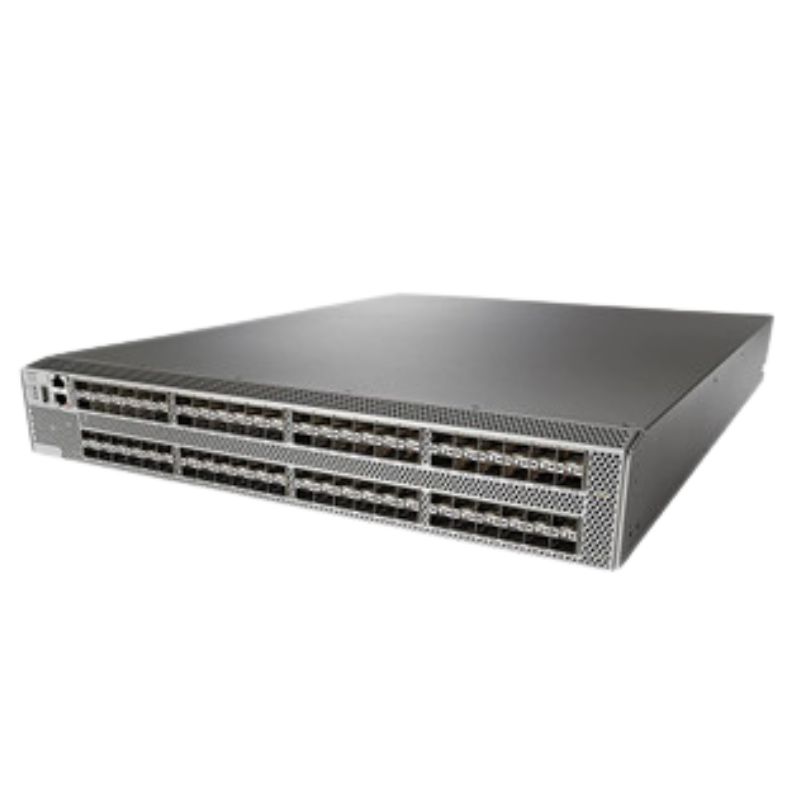
Cisco DS-C9396S-48IK9 MDS 9396s 16G FC Switch, W/ 48 Active Ports. Excellent Refurbished with 1 year replacement warranty
The Cisco DS-C9396S-48IK9 MDS 9396S offers a high-performance 16G Fibre Channel architecture designed for data-intensive storage networks. With 48 active ports and capacity for up to 96 Fibre Channel interfaces, it supports scalable SAN deployment, efficient throughput, and dependable connectivity for enterprise environments.
This switch is engineered to ensure stable and accelerated data transport across complex storage frameworks. Its 16 Gbit/s bandwidth enables rapid file handling, reduced latency, and smooth workload performance even during intensive operations.
Equipped with a C15 to C16 plug type and hot-swappable power supply, the unit minimizes downtime and streamlines hardware integration. Its compatibility with 2U rack setups ensures simple placement in existing server infrastructures.
The DS-C9396S-48IK9 is built with long-term durability, making it suitable for mission-critical environments requiring dependable switching performance.
The Cisco DS-C9396S-48IK9 MDS 9396S represents a compact, high-performance class of Fibre Channel SAN switches engineered for enterprise storage networks that demand predictable low-latency behavior, high port density, and the flexibility to grow without replacing chassis. This category entry focuses on the 48-active-port configuration identified by Cisco part number DS-C9396S-48IK9 and explains its role within modern SAN architectures, its core technical attributes, deployment patterns, and operational considerations that make the 9396S family a practical choice for data centers, private clouds, and storage consolidation projects.
The MDS 9396S product family is built as a 2 rack unit (2RU) fixed-configuration switch that packs high-density Fibre Channel connectivity into an unusually compact footprint, enabling dense SAN fabrics in constrained rack space. The DS-C9396S-48IK9 is supplied as a 48-active-port model out of a total hardware capacity that can be licensed up to 96 ports, allowing administrators to start with a smaller enabled port count and add capacity later without swapping chassis. The compact design reduces rack space and power footprint while still providing full line-rate performance on each enabled port, which is essential for predictable storage throughput in mission-critical environments.
At the heart of the DS-C9396S-48IK9 is a port architecture that autosenses and supports multiple Fibre Channel speeds, providing investment protection and mixed-speed connectivity. Each physical SFP+ receptacle is capable of supporting 2, 4, 8, 10, and 16 Gbps Fibre Channel links and operates at line-rate for the active ports. This autosensing behavior simplifies upgrades and device mix within a fabric because hosts, HBAs, and storage arrays operating at different generations can coexist and interoperate on the same switch. The 16G-capable SFP+ form factor ensures compatibility with a wide range of optics and active optical cable options, enabling flexible cabling strategies for short-reach and long-reach SAN links.
One of the defining characteristics of the MDS 9396S family is the ability to scale from 48 to 96 enabled ports via on-demand licensing increments, which allows procurement and growth to be decoupled. The DS-C9396S-48IK9 base configuration ships with 48 active ports enabled. Administrators can expand in 12-port increments by purchasing port-activation licenses, enabling additional physical port resources without replacing hardware or performing complex field upgrades. This licensing flexibility simplifies capacity planning, minimizes initial capital outlay, and provides a clear upgrade path when SAN growth necessitates more physical connectivity.
Designed as a line-rate fabric switch, the MDS 9396S provides the deterministic forwarding behavior storage fabrics require. When ports operate at 16 Gbps, the switch delivers predictable per-port bandwidth and low forwarding latency across the active port set. High switching capacity and optimized fabric forwarding semantics ensure that storage traffic such as synchronous replication, backup windows, and high-I/O database workloads are not constrained by the fabric itself. The overall switching capacity and packet forwarding performance are balanced to deliver both aggregated throughput and consistent latency across heavy mixed-use SAN workloads.
The MDS 9396S family supports the extensive suite of SAN services expected from Cisco MDS-class switches, including zoning, VSAN support, NPIV (N_Port ID Virtualization), fabric services, advanced diagnostics, and robust management options. Zoning and VSANs allow administrators to isolate traffic and logically partition the fabric for multi-tenant architectures or to protect sensitive storage arrays. NPIV support enables server virtualization environments to present multiple virtual ports per physical HBA, which is often essential for cloud, virtualization, and containerized workload deployments that require distinct WWN identities per virtual instance. The MDS software stack also includes features aimed at fabric health, diagnostics, and telemetry so that storage operations teams can proactively monitor link status, performance counters, and error conditions in production SANs.
Operational simplicity is a core part of the MDS proposition. The DS-C9396S-48IK9 supports standard management interfaces and integrates with Cisco management ecosystems, which facilitates both manual administration through command-line and GUI tools as well as automated workflows through APIs and management plugins. Centralized management and the ability to automate routine tasks such as fabric zoning, firmware upgrades, and inventory reconciliation reduce administrative overhead and the chance of human configuration errors. For organizations adopting infrastructure-as-code or pursuing continuous deployment methodologies, the switch’s programmability surface integrates with orchestration layers to ensure the SAN can be managed consistently and reproducibly.
The DS-C9396S-48IK9 is frequently deployed in SAN edge and core aggregation roles where moderate to high port density is required but a full blade or modular switch chassis is not justified. Use cases include consolidation of server-to-storage connectivity in virtualization clusters, aggregation of storage arrays in block storage environments, and resilient SAN fabrics for environments requiring synchronous replication. The ability to license additional ports and the 16 Gbps per-port capability make the model well-suited for organizations transitioning from older 8 Gbps or 10 Gbps fabrics to higher-throughput designs without a disruptive forklift upgrade. The switch also supports remote site or DR site fabrics where a compact, high-performance switch is preferred for predictable replication behavior.
When planning migrations, it is important to account for cable plant, optics compatibility, and WWN addressing strategies to ensure minimal downtime. Because the MDS 9396S supports mixed-speed operation, migrating hosts or storage arrays to higher-speed HBAs can be staged progressively. Administrators should also account for firmware levels and feature licensing when integrating the DS-C9396S-48IK9 into existing fabric topologies. Ensuring compatibility with existing SAN management tools and backup software will streamline cutover and reduce the risk of application interruptions. Detailed pre-migration testing, a rollback plan, and verification of zoning and VSAN mappings are best practices that ensure predictable outcomes.
Operational excellence with the DS-C9396S-48IK9 involves careful planning for zoning layouts, VSAN assignments, and quality-of-service expectations for mixed workloads. Establishing consistent naming and WWN mapping conventions reduces administrative errors when expanding the fabric. Regular firmware maintenance windows, fabric health checks, and monitoring for link errors or CRC events will help detect and correct cabling, transceiver, or host issues before they impact applications. Capacity management should also be proactive: tracking enabled versus available ports, observing saturation trends, and planning license purchases before reaching critical thresholds will keep the SAN responsive under growth. Combining automation for repetitive tasks with human oversight for architectural changes yields a balanced operational model.
Compared with large modular chassis switches, fixed-configuration platforms such as the MDS 9396S offer a lower initial cost, less space consumption, and simpler maintenance cycles. Against next-generation higher-speed platforms, the 16G MDS 9396S is often chosen for migrations where existing infrastructure or host capabilities do not yet justify moving to 32G or higher. When evaluating alternatives, total cost of ownership, port density per RU, licensing flexibility, and available SAN services should be part of the decision criteria. The DS-C9396S-48IK9’s balance of dense connectivity, line-rate performance, and upgradeable enabled ports often makes it a pragmatic compromise between cost and capability for many storage teams.


 Contact Us
 Information
 Catalog
 Solid State Drives (SSD)
 Network Switches
 Hard Disk Drives
 HBA & Controllers
 PC & Servers
 PC & Server Memory
 CPU & Processors
 Network Routers
 Power Supplies
 Tape Drives & Libraries
 Network Devices
 Computer & Network Cables