(7% discount is applied at checkout)
Cart is empty
Your go-to destination for cutting-edge server products
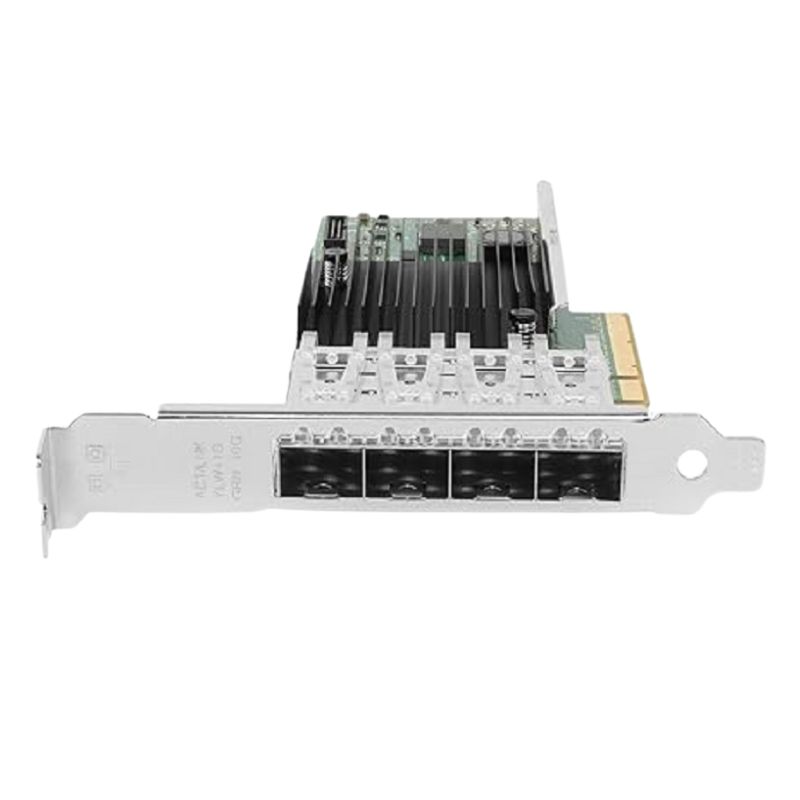


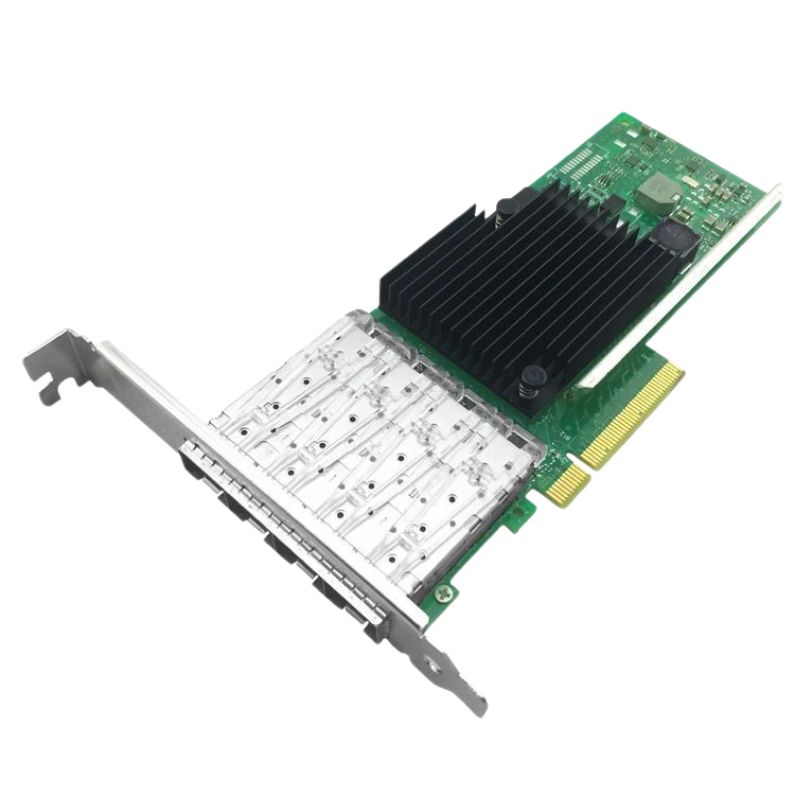
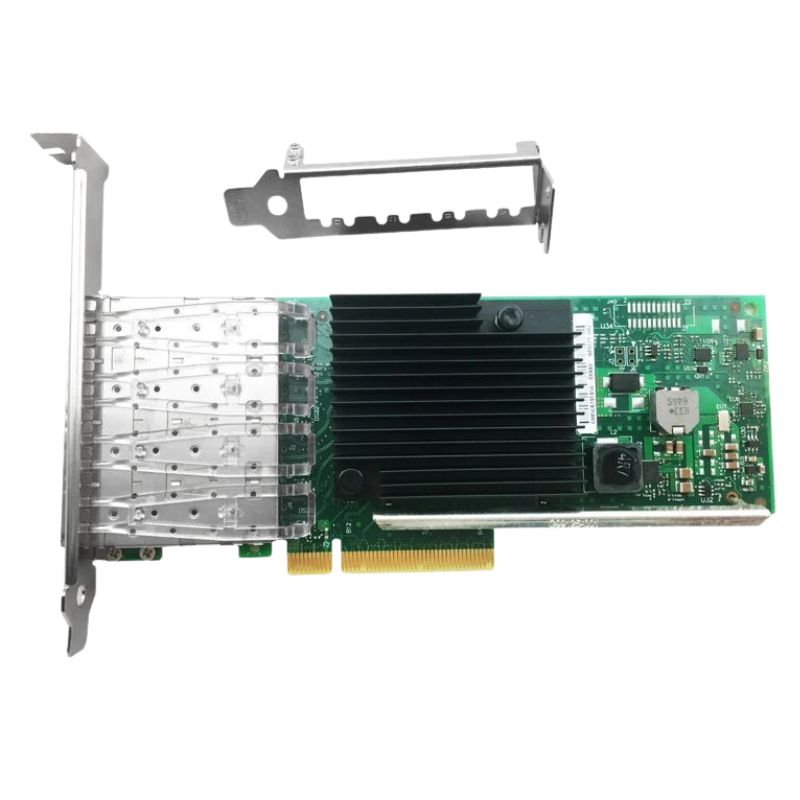
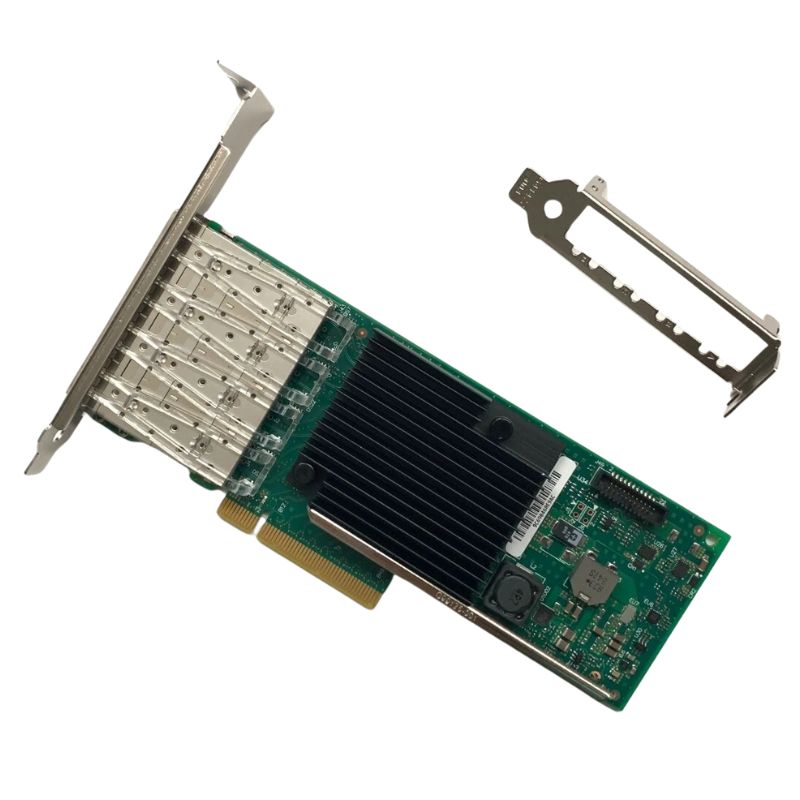
Intel X710-DA4FH Quad Port 10 Gigabit Ethernet SFP+ PCI-Express Converged Network Adapters. Excellent Refurbished with 1 year replacement warranty - Dell Version
| SKU/MPN | Warranty | Price | Condition | You save |
|---|---|---|---|---|
| X710-DA4FH | 1 Year Warranty | $123.00 | Excellent Refurbished | You save: $43.05 (26%) |
| X710-DA4FH | 1 Year Warranty | $255.00 | New Sealed in Box (NIB) | You save: $89.25 (26%) |
The Intel X710-DA4FH Quad Port 10 Gigabit Ethernet SFP+ PCI-Express Converged Network Adapter is a high-performance networking solution engineered to deliver ultra-fast, reliable, and scalable connectivity for modern data center environments. Designed to support demanding workloads, virtualization platforms, and enterprise-grade applications, this adapter integrates four independent 10GbE SFP+ ports through a PCI Express 3.0 x8 interface, ensuring optimized bandwidth utilization and efficient data handling. With advanced offloading capabilities, robust protocol support, and energy-efficient architecture, it enhances system performance while reducing CPU overhead, making it ideal for cloud computing, storage networking, and high-throughput server deployments.
The Intel X710-DA4FH Quad Port 10 Gigabit Ethernet SFP+ PCI-Express Converged Network Adapter represents a high-performance networking solution designed for modern data-intensive environments where throughput, reliability, and virtualization efficiency are critical. Built around a powerful Ethernet controller architecture, this adapter integrates four independent 10 Gigabit SFP+ interfaces into a single PCI Express form factor, enabling dense connectivity for enterprise servers, cloud infrastructure nodes, and high-performance computing systems. The convergence of networking, storage, and virtualization capabilities within a unified adapter design reduces system complexity while improving data path efficiency across multiple workloads.
At the core of this network adapter is its PCI Express interface, engineered to deliver consistent bandwidth to all four 10GbE ports without congestion under heavy traffic loads. The PCIe architecture ensures low-latency communication between the host CPU and network controller, supporting modern server platforms that demand high throughput for east-west and north-south traffic flows. This integration allows system architects to deploy fewer physical network cards while still achieving significant aggregate bandwidth, making it suitable for blade servers, rack-mounted systems, and dense virtualization clusters.
The adapter’s design aligns with multi-lane PCIe topologies commonly found in enterprise-grade motherboards, ensuring compatibility with scalable server environments. By distributing network processing across dedicated hardware engines, it reduces CPU overhead and enables applications to maintain predictable performance even under peak network utilization conditions.
The inclusion of four SFP+ ports provides flexibility for diverse network configurations, including redundant uplinks, link aggregation groups, and segmented traffic flows. Each port operates independently, allowing administrators to assign distinct roles such as storage traffic, virtual machine communication, management networks, or external uplinks. This separation enhances performance isolation and improves fault tolerance in mission-critical environments.
SFP+ interfaces support a wide range of optical transceivers and direct attach copper cables, enabling deployment across short-range intra-rack connections as well as longer-distance fiber links within data center fabrics. This adaptability makes the adapter suitable for hybrid infrastructures where different connectivity mediums are required.
The converged nature of this adapter allows it to handle multiple types of network traffic simultaneously, including traditional Ethernet data, storage communication protocols, and virtualization overlays. By consolidating these functions into a single hardware platform, organizations reduce the need for multiple specialized adapters, simplifying hardware management and reducing power consumption.
This convergence is particularly valuable in environments where storage traffic such as iSCSI or NFS must coexist with application traffic and virtual machine communication. The adapter’s architecture ensures consistent throughput across these workloads while maintaining low latency and high reliability.
In virtualized environments, the adapter supports high VM density by enabling efficient network partitioning. Each physical port can be segmented into multiple virtual interfaces, allowing hypervisors to assign dedicated network resources to individual virtual machines. This improves isolation between tenants and ensures predictable network performance in shared infrastructure environments.
The adapter offloads significant portions of virtual switching tasks from the host CPU to dedicated hardware engines. This reduces hypervisor overhead and allows more compute resources to be allocated to application workloads. In cloud data centers, this capability directly translates into improved consolidation ratios and more efficient infrastructure utilization.
Designed for modern data centers, the Intel X710-DA4FH supports environments where large-scale data movement is a constant requirement. Whether handling distributed databases, analytics platforms, or large-scale web services, the adapter maintains stable throughput across all four ports. This ensures that high-bandwidth applications can operate without network-induced bottlenecks.
The ability to aggregate multiple 10 Gigabit links also provides scalability for growing infrastructures. As demand increases, administrators can expand network capacity without redesigning the entire server architecture, leveraging link aggregation and multi-port balancing techniques.
A key strength of this network adapter lies in its hardware offload capabilities. By handling tasks such as checksum calculation, segmentation, and packet classification directly within the adapter, system CPUs are freed from repetitive network processing tasks. This leads to improved application performance and reduced latency across network-intensive workloads.
These offloads are particularly beneficial in environments running high-frequency trading systems, real-time analytics, and distributed computing frameworks, where microsecond-level latency improvements can significantly impact overall system efficiency.
The adapter supports storage networking protocols that enable unified fabric design within enterprise infrastructures. By carrying both storage and data traffic over the same physical network interfaces, organizations can reduce hardware complexity and streamline cabling within data centers. This unified approach enhances resource utilization and simplifies network administration.
In environments utilizing network-attached storage or software-defined storage platforms, the adapter ensures stable and predictable throughput, reducing the risk of storage latency spikes during peak network usage periods.
The quad port configuration provides inherent redundancy options that improve system resilience. Administrators can configure failover mechanisms so that traffic is automatically rerouted in the event of a link failure. This ensures uninterrupted service availability for critical applications.
In mission-critical infrastructures, redundancy is often combined with link aggregation technologies to create resilient network paths that distribute traffic across multiple physical interfaces while maintaining continuous operation even under partial failure conditions.
Cloud computing environments benefit significantly from the high-density connectivity offered by this adapter. Each server node equipped with the X710-DA4FH can serve as a high-throughput endpoint within a larger distributed system. This is particularly important in infrastructure-as-a-service platforms, where network performance directly influences tenant experience.
The adapter’s ability to support virtualization, storage, and application traffic simultaneously makes it well-suited for private clouds, hybrid deployments, and large-scale orchestration platforms. It allows cloud operators to standardize hardware while maintaining flexibility across different workload types.
Latency-sensitive applications such as real-time trading systems, high-frequency analytics, and large-scale simulation environments require consistent and minimal network delays. The architecture of this converged network adapter is optimized to reduce packet processing time, ensuring rapid data transmission between systems.
The integration of hardware acceleration mechanisms and efficient packet handling pipelines ensures that latency remains stable even under heavy traffic loads, which is essential for maintaining deterministic performance in enterprise-grade systems.
This adapter is designed for broad compatibility across a wide range of server platforms supporting PCI Express slots and SFP+ networking infrastructure. It integrates seamlessly with modern operating systems and hypervisors commonly used in enterprise environments. This compatibility ensures smooth deployment across heterogeneous infrastructure landscapes.
System administrators can deploy the adapter across multiple generations of servers, enabling consistent network performance across legacy and modern systems while maintaining unified management practices.
Enterprise-grade reliability is a defining characteristic of this network adapter. It is engineered to operate continuously under high load conditions typical of data center environments. The hardware design emphasizes durability and consistent performance over extended operational periods.
This reliability ensures that organizations can depend on stable network connectivity for mission-critical applications, reducing downtime risk and improving service-level consistency across distributed systems.
As enterprise workloads continue to evolve, network infrastructure must scale accordingly. The quad-port design provides a flexible foundation for incremental scaling without requiring major hardware redesigns. This adaptability ensures long-term value in dynamic IT environments.
Organizations can expand capacity through software-defined configurations and physical network expansion strategies, allowing the adapter to remain relevant across multiple infrastructure generations.


 Contact Us
 Information
 Catalog
 Solid State Drives (SSD)
 Network Switches
 Hard Disk Drives
 HBA & Controllers
 PC & Servers
 PC & Server Memory
 CPU & Processors
 Network Routers
 Power Supplies
 Tape Drives & Libraries
 Network Devices
 Computer & Network Cables