
(7% discount is applied at checkout)
Cart is empty
Your go-to destination for cutting-edge server products
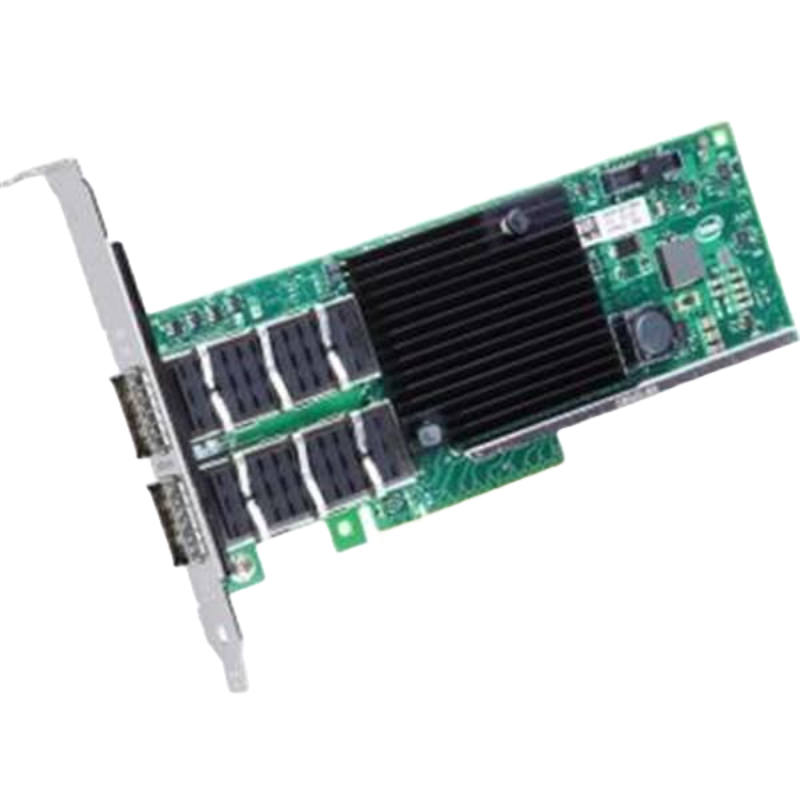
Intel XL710QDA2 2-Port 40 Gigabit Ethernet QSFP+ PCI-Express Converged Network Adapter Plug-in Card. New Sealed in Box (NIB) with 3 Years Warranty
| SKU/MPN | Warranty | Price | Condition | You save |
|---|---|---|---|---|
| XL710QDA2 | 1 Year Warranty | $270.00 | Excellent Refurbished | You save: $94.50 (26%) |
| XL710QDA2 | 1 Year Warranty | $290.00 | New Sealed in Box (NIB) | You save: $101.50 (26%) |
The Intel XL710QDA2 Dual Port Converged Network Adapter is a high-performance solution engineered for enterprise-grade networking. Featuring dual 40 Gigabit QSFP+ ports, this PCIe 3.0 x8 plug-in card delivers exceptional throughput, advanced virtualization support, and energy-efficient performance for modern data centers.
The XL710QDA2 Dual Port 40 Gigabit Ethernet QSFP+ PCI-E Converged Network Adapter represents a high-performance networking solution designed for enterprise-grade data centers, cloud infrastructures, virtualization environments, and high-throughput computing systems. Built on advanced Ethernet controller technology, this adapter delivers exceptional bandwidth efficiency, low latency communication, and robust scalability for modern IT workloads that demand consistent high-speed data transfer and optimized server connectivity.
As organizations continue to expand their digital infrastructure, the demand for ultra-fast networking components such as the Intel XL710QDA2 has significantly increased. This dual-port 40GbE adapter is engineered to handle intensive workloads such as large-scale virtualization, storage clustering, high-performance computing, and software-defined networking. It provides a converged architecture that allows both networking and storage traffic to be efficiently managed over a unified infrastructure.
At the core of the Intel XL710QDA2 is a powerful Ethernet controller architecture designed to offload processing tasks from the host CPU. This enables servers to maintain high efficiency by delegating packet processing, segmentation, and checksum operations directly to the network adapter. The result is reduced CPU utilization and improved system responsiveness in environments with heavy network traffic.
The controller architecture is optimized for virtualization environments, supporting multiple virtual machine instances without compromising performance. This makes it highly suitable for enterprise data centers that rely on dense virtual workloads and require predictable network performance across multiple tenants.
The PCI Express interface in the XL710QDA2 is engineered to support high-speed data transmission between the adapter and the host system. This ensures that the full potential of 40Gbps Ethernet connectivity is achieved without bottlenecks. The PCIe integration is designed to be compatible with modern server motherboards, providing flexibility in deployment across different hardware platforms.
By leveraging a high-bandwidth PCIe interface, the adapter ensures that data-intensive applications such as distributed storage systems, real-time analytics, and cloud computing platforms can operate without latency constraints introduced by the host bus system.
The Intel XL710QDA2 features dual QSFP+ ports that support 40 Gigabit Ethernet connections. This dual-port configuration enables redundancy, load balancing, and increased throughput across multiple network paths. Each port is capable of handling high-speed data streams independently, making it ideal for mission-critical applications requiring uninterrupted connectivity.
The QSFP+ interface also allows compatibility with various optical modules and direct attach copper (DAC) cables, offering flexibility in network topology design and deployment strategies.
The primary performance advantage of the Intel XL710QDA2 is its ability to deliver 40Gbps per port, enabling a total aggregated throughput suitable for large-scale enterprise workloads. This level of bandwidth is essential for environments where massive data transfers occur frequently, such as virtualization clusters, storage replication systems, and cloud-native applications.
The adapter ensures stable performance even under sustained heavy traffic conditions by utilizing advanced packet processing techniques and hardware-level optimization. This results in consistent throughput without degradation over time.
Latency reduction is a critical factor in high-performance networking, and the XL710QDA2 is designed with this principle in mind. By offloading processing tasks from the CPU and optimizing packet handling at the hardware level, the adapter minimizes delays in data transmission. This is particularly beneficial for financial trading systems, real-time analytics, and high-frequency transaction environments.
The architecture ensures that packets are processed and transmitted with minimal overhead, allowing applications to communicate more efficiently across the network infrastructure.
Virtualization environments benefit significantly from the Intel XL710QDA2 due to its support for advanced virtualization technologies. It enables efficient handling of multiple virtual machines with dedicated bandwidth allocation and isolated traffic management. This ensures that performance remains consistent across virtual workloads without interference or resource contention.
The adapter supports virtualization offloads that reduce CPU load and improve VM density per host server, making it a preferred choice for cloud service providers and enterprise virtualization platforms.
The converged nature of the Intel XL710QDA2 allows it to handle both network and storage traffic over a single adapter. This reduces the need for multiple network interface cards and simplifies infrastructure design. By consolidating traffic, organizations can reduce hardware costs while improving network efficiency.
This convergence is particularly useful in modern data centers where storage over Ethernet protocols is increasingly adopted. It ensures that storage workloads such as iSCSI and network file systems operate seamlessly alongside traditional network traffic.
Software-defined networking environments require flexible and programmable network interfaces. The XL710QDA2 supports these requirements by providing adaptable configuration options that integrate with modern SDN frameworks. This allows administrators to dynamically allocate bandwidth and optimize traffic flows based on application demands.
The adapter’s compatibility with orchestration tools enhances its usability in automated data center environments where network agility is critical.
In high-performance computing environments, the Intel XL710QDA2 plays a crucial role in ensuring fast inter-node communication. HPC clusters rely heavily on low-latency and high-bandwidth connectivity to process complex computations efficiently. The adapter’s 40GbE capability ensures that large datasets can be exchanged rapidly between compute nodes.
This improves processing speed for scientific simulations, machine learning workloads, and large-scale data modeling applications.
Cloud service providers benefit from the scalability and performance offered by the XL710QDA2. Its ability to handle multiple virtualized workloads and high traffic volumes makes it suitable for multi-tenant cloud environments. The adapter ensures consistent performance for end-users while maintaining efficient resource utilization at the infrastructure level.
It supports elastic scaling environments where network demand can fluctuate rapidly, ensuring stable service delivery across cloud platforms.
Modern storage systems require high-speed connectivity to ensure fast data access and replication. The XL710QDA2 supports these requirements by providing reliable 40GbE connectivity for storage area networks. This ensures that backup operations, data replication, and distributed storage systems function efficiently without bottlenecks.
Its ability to handle storage traffic alongside network traffic makes it ideal for unified storage architectures in enterprise environments.
The dual-port design of the Intel XL710QDA2 enhances system reliability by enabling failover configurations. In the event of a port failure, traffic can be rerouted through the secondary port, ensuring continuous network availability. This redundancy is essential for mission-critical applications where downtime is not acceptable.
The adapter is engineered for stable long-term operation in demanding data center environments, maintaining consistent performance under continuous load conditions.
Scalability is a key feature of modern network infrastructure, and the XL710QDA2 supports scalable deployment across large server farms. Its compatibility with high-density server configurations allows organizations to expand their infrastructure without compromising network performance.
This scalability makes it suitable for growing enterprises that require flexible expansion of their IT resources over time.
The adapter is designed to integrate seamlessly with a wide range of server platforms. Its standardized PCIe form factor ensures compatibility with enterprise-grade servers used in data centers worldwide. This simplifies deployment and reduces integration complexity for IT administrators.
It also supports advanced driver ecosystems that ensure compatibility with multiple operating systems and virtualization platforms.
Energy efficiency is a key consideration in modern data centers, and the Intel XL710QDA2 is designed to minimize power consumption while delivering high performance. The adapter intelligently manages power usage based on workload demands, ensuring efficient operation even under heavy traffic conditions.
This contributes to lower operational costs and improved energy efficiency in large-scale server environments.
Thermal management is critical for maintaining stable performance in high-speed networking hardware. The XL710QDA2 incorporates efficient heat dissipation mechanisms that ensure stable operation even under continuous high-load scenarios. This prevents thermal throttling and maintains consistent network throughput.
The design supports long-term reliability by maintaining optimal operating temperatures across extended usage periods.
The adapter supports hardware-based packet processing that significantly reduces CPU workload. Tasks such as segmentation, checksum calculation, and packet filtering are handled directly by the network adapter, improving overall system performance.
This offloading capability allows servers to allocate more resources to application-level processing, enhancing efficiency in compute-intensive environments.
Efficient traffic management is essential in high-density networks. The XL710QDA2 provides advanced load balancing capabilities that distribute network traffic evenly across available resources. This ensures optimal utilization of network bandwidth and prevents congestion.
It enhances overall network stability by dynamically managing traffic distribution based on real-time demand.
In virtualized data center environments, the Intel XL710QDA2 enables efficient communication between virtual machines and backend systems. Its high bandwidth and low latency ensure that virtual workloads perform consistently even under heavy utilization.
AI and machine learning workloads require rapid data transfer between compute nodes and storage systems. The XL710QDA2 provides the necessary bandwidth and reliability to support distributed training models and large dataset processing.
In financial systems where microseconds matter, the adapter’s low latency design ensures fast transaction processing and real-time data exchange. This makes it suitable for trading platforms and analytical systems requiring instant communication.
The Intel XL710QDA2 is compatible with a wide range of operating systems commonly used in enterprise environments. This ensures flexibility in deployment across diverse IT infrastructures.
The adapter integrates seamlessly with major virtualization platforms, enabling efficient network management for virtualized environments. This enhances its utility in cloud and enterprise deployments.
Designed for modern data center ecosystems, the XL710QDA2 works efficiently alongside storage systems, compute nodes, and network switches, forming a cohesive high-performance infrastructure.


 Contact Us
 Information
 Catalog
 Solid State Drives (SSD)
 Network Switches
 Hard Disk Drives
 HBA & Controllers
 PC & Servers
 PC & Server Memory
 CPU & Processors
 Network Routers
 Power Supplies
 Tape Drives & Libraries
 Network Devices
 Computer & Network Cables