(7% discount is applied at checkout)
Cart is empty
Your go-to destination for cutting-edge server products


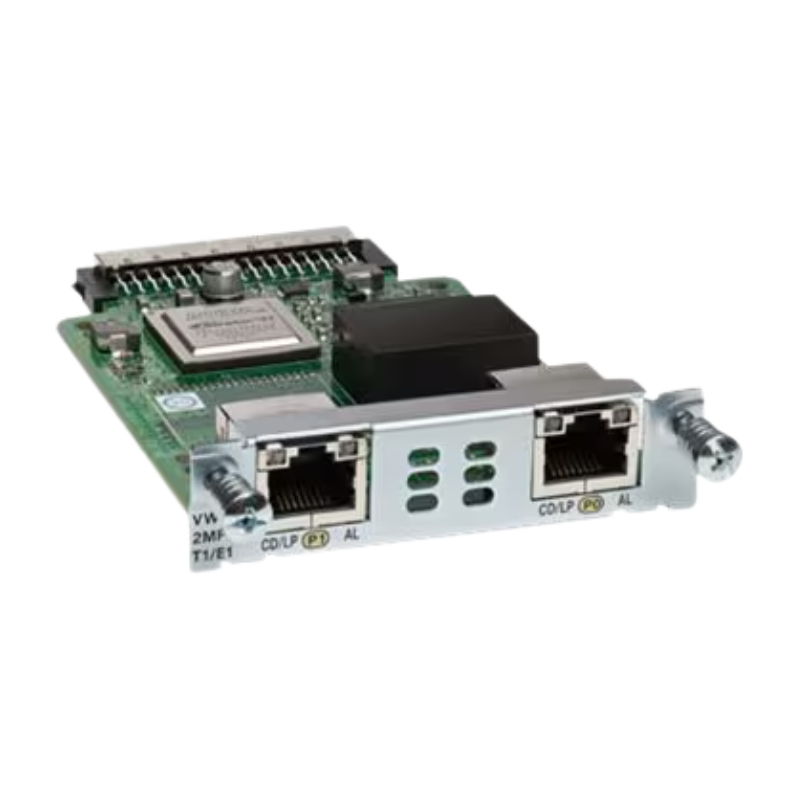
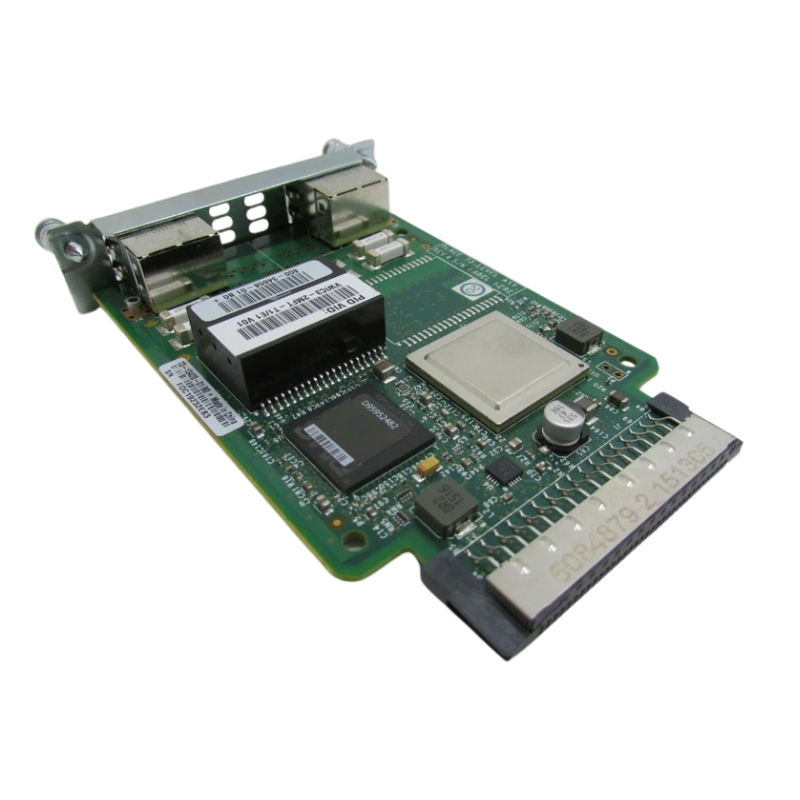
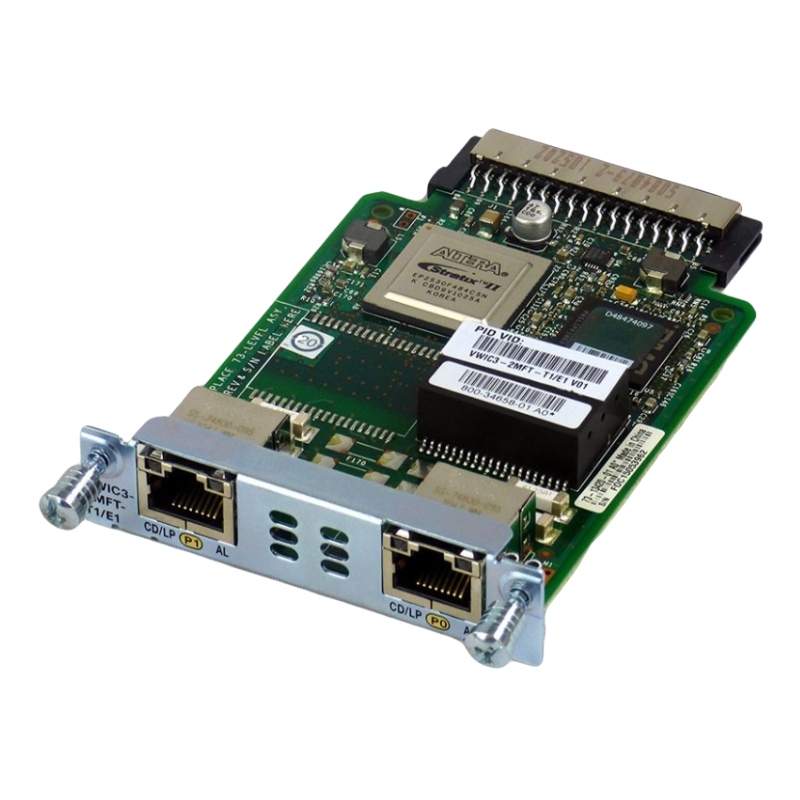
Cisco VWIC3-2MFT-T1E1 2-Port Voice/WAN Multiflex Trunk Interface Card. Excellent Refurbished with 1 year replacement warranty
The Cisco VWIC3-2MFT-T1E1 is a high-performance 2-port Voice/WAN Multiflex Trunk Interface Card engineered to expand the capabilities of Cisco Integrated Services Routers (ISR). Designed to support both voice and data applications, this interface card provides flexible T1 and E1 WAN connectivity for organizations requiring dependable communication, efficient branch connectivity, and scalable network infrastructure. It combines voice gateway functionality with WAN access, making it an ideal solution for enterprise environments, branch offices, and service providers.
The interface card is equipped with two configurable T1/E1 ports, providing reliable WAN connectivity and voice transport across business networks.
By combining voice gateway capabilities with WAN access, the module reduces hardware requirements while simplifying network architecture. Organizations benefit from centralized management and improved operational efficiency.
The VWIC3-2MFT-T1E1 delivers dependable T1/E1 connectivity, making it suitable for organizations that require stable branch communication, secure voice transmission, and uninterrupted network availability.
The Cisco VWIC3-2MFT-T1E1 2-Port Voice/WAN Multiflex Trunk Interface Card is a highly specialized networking hardware module designed to extend the capabilities of enterprise routers by enabling integrated voice and data transport over T1 and E1 circuits. Developed by Cisco Systems, this interface card plays a crucial role in legacy and hybrid telecommunications infrastructures where traditional PSTN connectivity and packet-based IP networks must coexist efficiently.
As part of the Cisco Multiflex Trunk (MFT) series, the VWIC3-2MFT-T1E1 provides dual-port support, allowing organizations to handle multiple voice or WAN trunk connections simultaneously. It is widely used in enterprise branch offices, service provider edge networks, call centers, and mission-critical communication environments where reliability, flexibility, and voice-data convergence are essential.
The Multiflex Trunk architecture is engineered to combine voice and WAN capabilities in a single interface card. This dual-functionality design eliminates the need for separate voice and data cards, thereby reducing hardware complexity and operational costs. The VWIC3-2MFT-T1E1 supports both channelized T1/E1 voice applications and fractional or full T1/E1 WAN data transport.
This interface card supports integrated voice services such as ISDN PRI (Primary Rate Interface), channelized voice, and digital signal transport, while also allowing packet-based WAN services. This makes it a versatile solution for enterprises transitioning from legacy telephony systems to VoIP-based infrastructures.
At the hardware level, the VWIC3-2MFT-T1E1 is designed to offload processing from the router CPU, enabling efficient handling of time-division multiplexing (TDM) streams. This ensures stable performance in environments with high concurrent voice and data traffic.
In North American and Japanese telecom environments, T1 circuits are commonly used for digital transmission at 1.544 Mbps. The VWIC3-2MFT-T1E1 supports channelized T1 operations, allowing the division of a single T1 line into 24 separate 64 Kbps channels. These channels can be used for voice calls, data transmission, or signaling purposes.
In Europe, Asia, and other international regions, E1 circuits operate at 2.048 Mbps and provide 32 time slots. The VWIC3-2MFT-T1E1 supports E1 configurations for both clear channel and channelized communication, making it globally adaptable for multinational enterprise deployments.
The interface card supports multiple framing formats such as ESF (Extended Super Frame), SF (Super Frame), and CRC4 for E1, ensuring compatibility with diverse carrier networks. Line coding options like AMI and B8ZS further enhance interoperability.
The 2-port configuration allows network administrators to terminate two separate T1 or E1 circuits on a single module. This enables redundancy, load balancing, or segmentation of voice and data traffic across different physical links.
By leveraging both ports, organizations can implement failover strategies where one circuit serves as a backup for the other. This enhances network resilience and minimizes downtime in mission-critical communications systems.
Branch offices often require scalable communication infrastructure without excessive hardware investment. The dual-port design supports incremental expansion, allowing enterprises to scale voice and WAN services efficiently.
One of the primary use cases of the VWIC3-2MFT-T1E1 is ISDN PRI connectivity. This enables enterprises to connect PBX systems to the PSTN using digital trunk lines, ensuring high-quality voice transmission with minimal latency and jitter.
The card supports channelized voice applications where each time slot on a T1 or E1 line can be assigned to individual voice calls. This is particularly useful in traditional telephony environments where analog-to-digital conversion and multiplexing are required.
The VWIC3-2MFT-T1E1 is frequently deployed in Cisco router-based voice gateways, enabling seamless integration between legacy PBX systems and modern VoIP networks. This hybrid capability is essential for phased migration strategies.
The interface card supports fractional T1 and E1 configurations, allowing enterprises to utilize only a portion of available bandwidth. This is cost-effective for organizations that do not require full circuit capacity.
In clear channel mode, all available time slots are dedicated to data transmission, enabling high-speed WAN connectivity between remote sites. This is ideal for secure point-to-point communication.
When integrated with Cisco routers, the VWIC3-2MFT-T1E1 facilitates seamless packet switching between TDM circuits and IP networks. This ensures compatibility with modern MPLS and IP backbone infrastructures.
Large enterprises use the VWIC3-2MFT-T1E1 to connect branch offices to centralized data centers. This ensures reliable voice communication and secure WAN access across geographically distributed locations.
Call centers rely heavily on ISDN PRI trunks for handling large volumes of concurrent calls. The interface card ensures stable voice channel distribution and integration with unified communications platforms.
Telecom service providers deploy this card in edge routers to aggregate customer voice and data traffic. It plays a key role in delivering managed services to business customers.
Highly secure and reliable communication is essential in government and financial sectors. The VWIC3-2MFT-T1E1 provides deterministic performance suitable for regulated environments requiring strict uptime guarantees.
Configuration of the VWIC3-2MFT-T1E1 is performed through Cisco IOS commands. Administrators can define controller settings, assign time slots, configure framing, and manage clocking sources to align with carrier requirements.
Proper clocking configuration is critical in TDM networks. The interface card supports internal and network-sourced clocking to ensure synchronization with service provider equipment.
Administrators can assign specific time slots for voice or data channels, enabling granular control over bandwidth utilization and service segmentation.
The VWIC3-2MFT-T1E1 reduces router CPU load by handling TDM signal processing at the hardware level. This improves overall system performance and allows routers to focus on IP packet processing.
Built-in diagnostic capabilities allow continuous monitoring of line conditions, including CRC errors, framing issues, and signal degradation. This ensures proactive network maintenance and troubleshooting.
The interface card supports loopback testing modes for both local and remote diagnostics, enabling engineers to isolate and resolve connectivity issues efficiently.
The VWIC3-2MFT-T1E1 is compatible with a wide range of Cisco ISR platforms, including legacy and modular routers designed for branch and enterprise environments.
It is commonly used in Cisco voice gateways where PSTN connectivity is required. This ensures seamless integration between analog/digital telephony systems and IP-based communication networks.
Organizations maintaining legacy infrastructure can leverage this interface card to extend the lifespan of existing telephony systems while gradually transitioning to VoIP solutions.


 Contact Us
 Information
 Catalog
 Solid State Drives (SSD)
 Network Switches
 Hard Disk Drives
 HBA & Controllers
 PC & Servers
 PC & Server Memory
 CPU & Processors
 Network Routers
 Power Supplies
 Tape Drives & Libraries
 Network Devices
 Computer & Network Cables