(7% discount is applied at checkout)
Cart is empty
Your go-to destination for cutting-edge server products
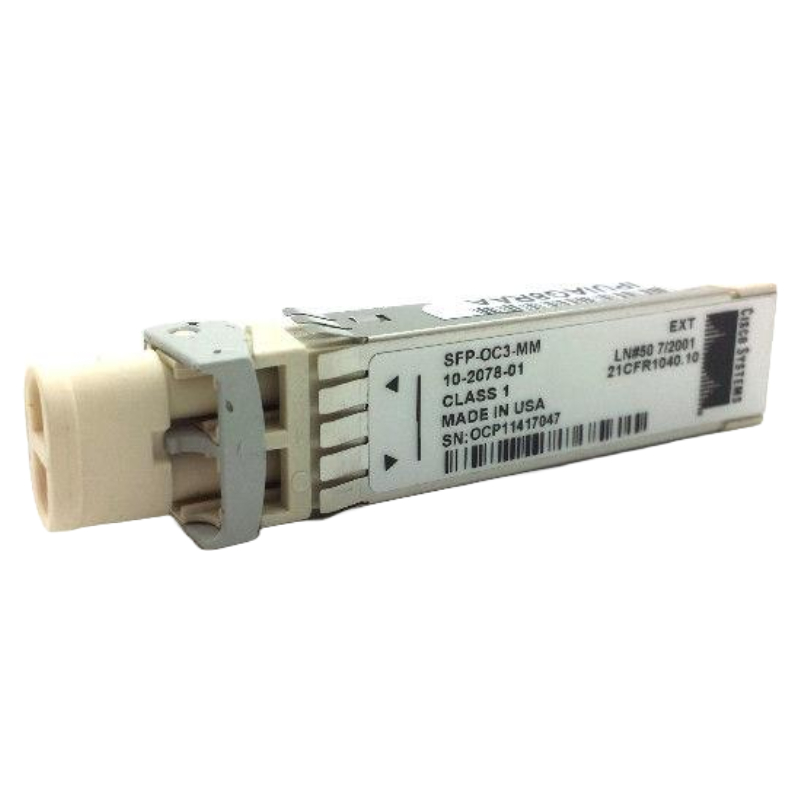


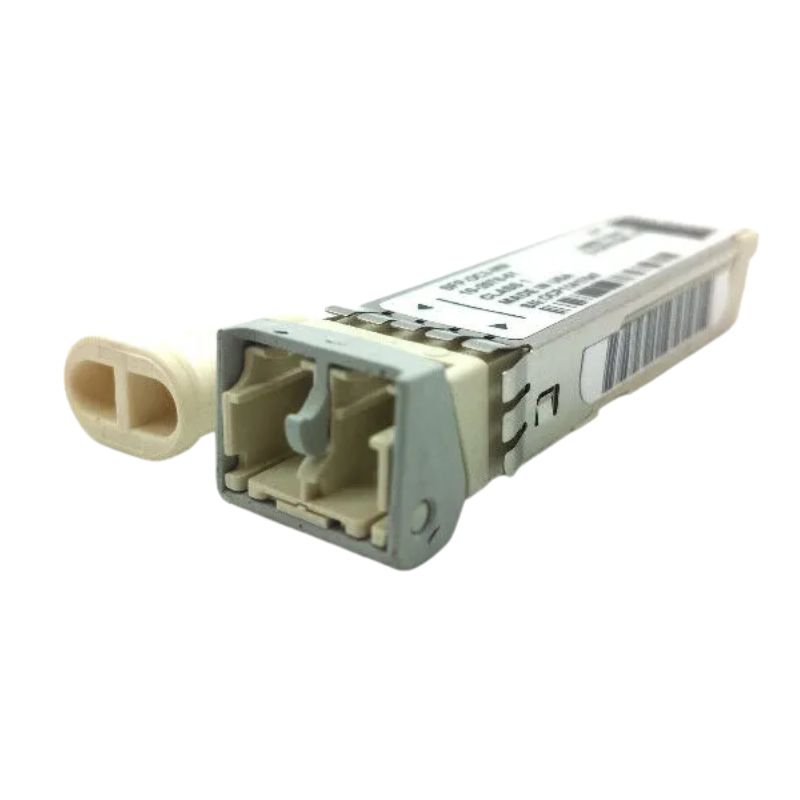
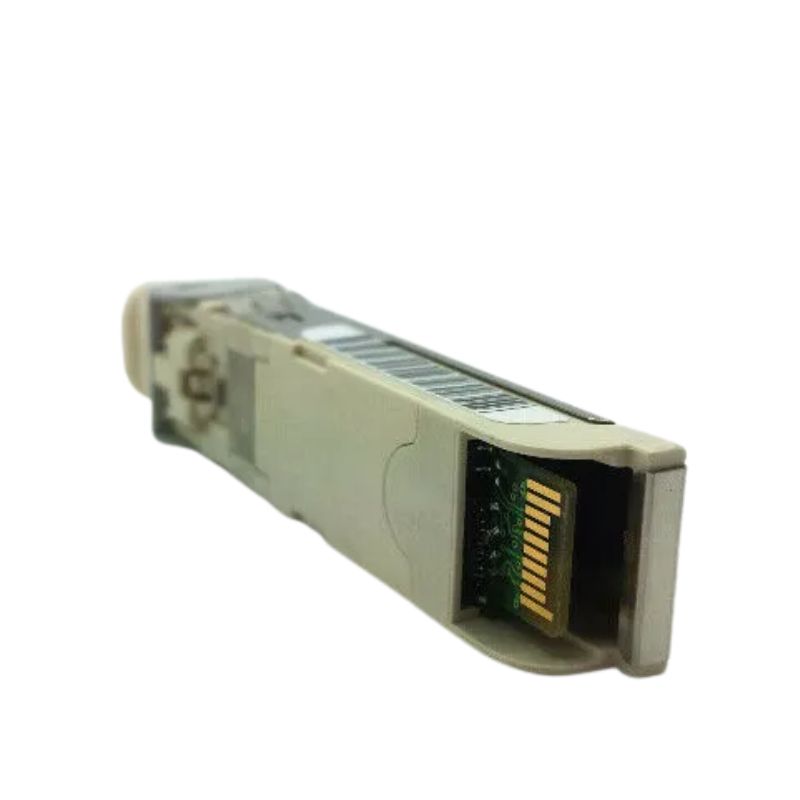
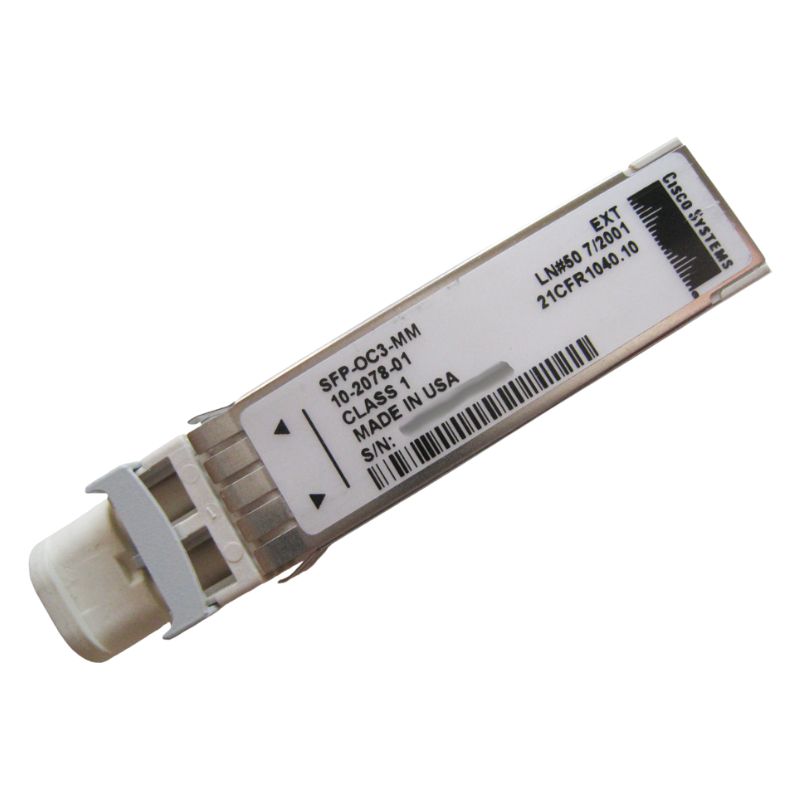
Cisco SFP-OC3-MM OC-3/STM-1 Pluggable Short-Reach Multimode 155Mbps Transceiver. Excellent Refurbished with 1 year replacement warranty
| SKU/MPN | Warranty | Price | Condition | You save |
|---|---|---|---|---|
| SFP-OC3-MM | 1 Year Warranty | $60.00 | Excellent Refurbished | You save: $21.00 (26%) |
| SFP-OC3-MM | 1 Year Warranty | $175.00 | Factory-Sealed New Retail in Original Box (FSB) | You save: $61.25 (26%) |
The SFP-OC3-MM Cisco OC-3/STM-1 Pluggable Short-Reach Multimode Transceiver is a high-performance optical networking module engineered for reliable SONET/SDH communication at OC-3/STM-1 speeds. Designed for short-reach multimode fiber environments, this transceiver plays a critical role in enabling efficient data transmission across enterprise backbone networks, metropolitan area networks (MANs), and service provider infrastructures requiring stable, low-latency optical connectivity.
The SFP-OC3-MM module is built to support OC-3 (Optical Carrier Level 3) and STM-1 (Synchronous Transport Module Level 1) standards, delivering a line rate of approximately 155 Mbps. It operates using multimode fiber (MMF), making it ideal for short-distance optical links within data centers, campus networks, and telecom switching facilities.
This transceiver converts electrical signals from networking equipment into optical signals transmitted over fiber optic cabling, ensuring minimal signal degradation and high transmission integrity. Its short-reach design allows it to efficiently serve intra-building and intra-campus connections where long-range single-mode solutions are not required.
The module is engineered with precision optical components and industry-standard compliance to ensure interoperability and consistent performance across Cisco networking environments.
The SFP-OC3-MM transceiver is commonly deployed in environments where stable short-distance optical communication is required. Its architecture supports point-to-point optical links and ring-based SONET/SDH topologies, which are widely used in telecommunications and enterprise backbone infrastructures.
In enterprise networks, it is frequently used to interconnect switches across different floors or buildings within a campus environment. In service provider networks, it supports aggregation layers where OC-3 circuits are still maintained for legacy transport systems or hybrid optical architectures.
Within corporate campuses, the transceiver is used to connect distribution switches across buildings using multimode fiber cabling. This enables high-speed, low-latency communication between departments, data centers, and network aggregation points.
Telecom operators deploy OC-3/STM-1 modules to maintain compatibility with legacy SONET/SDH infrastructure. The SFP-OC3-MM ensures smooth integration between modern packet-switched networks and traditional circuit-switched optical systems.
In data centers, the module is ideal for short-range optical links between top-of-rack switches, aggregation switches, and storage networking equipment where multimode fiber is already installed.
The SFP-OC3-MM Cisco module is designed with strict adherence to optical networking standards, ensuring predictable and stable performance across various deployment environments. These specifications ensure that the module delivers consistent optical performance with minimal bit error rates and optimized signal integrity.
The transceiver adheres to SONET (Synchronous Optical Network) and SDH (Synchronous Digital Hierarchy) standards, specifically OC-3 and STM-1. These standards define the framing, synchronization, and multiplexing methods used in optical transmission systems.
By maintaining compliance with these standards, the module ensures interoperability across multi-vendor environments and legacy telecom infrastructures, making it a versatile choice for hybrid network deployments.
Multimode fiber modules like the SFP-OC3-MM are optimized for cost-effective short-distance communication. They utilize a larger core fiber, allowing multiple light paths, which simplifies installation and reduces cabling complexity in confined network environments.
The SFP-OC3-MM module is designed for seamless integration with a wide range of Cisco networking devices, including routers, switches, and optical transport platforms. Its plug-and-play SFP architecture allows network administrators to deploy or replace modules without disrupting network operations.
This compatibility ensures that organizations using Cisco infrastructure can maintain consistent optical performance while leveraging existing network investments.
Despite advancements in high-speed Ethernet and DWDM technologies, OC-3/STM-1 modules continue to play an important role in maintaining legacy infrastructure and specialized network environments.
Many telecom operators still rely on SONET/SDH systems for stable and synchronized optical transport. The SFP-OC3-MM ensures continued operation of these systems without requiring full infrastructure replacement.
Banks and financial organizations use OC-3 links for secure and deterministic data transmission between branches and data centers, where predictable latency and reliability are critical.
Government agencies often maintain legacy optical systems for secure communications. The module supports these environments by providing stable multimode short-reach connectivity.
The module is designed with low power consumption in mind, reducing the thermal load on networking equipment. This contributes to improved overall system efficiency and helps maintain optimal operating conditions in high-density rack environments. Efficient heat dissipation ensures stable optical performance even in environments with limited airflow or high equipment concentration.
The optical budget of the SFP-OC3-MM is optimized for short-range multimode fiber transmission. It balances transmitter output power and receiver sensitivity to maintain high signal integrity across typical enterprise distances. Proper fiber installation and adherence to recommended distance limits ensure minimal signal attenuation and reduced bit error rates.
Modern network infrastructures often combine legacy SONET/SDH systems with Ethernet-based transport. The SFP-OC3-MM serves as a bridging component in such hybrid environments, enabling interoperability between different generations of optical technology. This makes it a valuable asset in network modernization strategies where full replacement of legacy systems is not immediately feasible.
As organizations grow, the need for scalable optical connectivity becomes essential. The modular nature of SFP transceivers allows network operators to expand capacity without redesigning the entire infrastructure. Additional SFP-OC3-MM modules can be deployed across switches and routers to extend OC-3 connectivity to new network segments efficiently.
The Cisco optical transceiver is engineered for mission-critical applications where network downtime is unacceptable. Its robust design ensures consistent operation in environments requiring continuous data flow and high availability. Redundant network configurations often incorporate multiple OC-3 links to ensure failover capabilities and uninterrupted service.
The SFP-OC3-MM Cisco OC-3/STM-1 Pluggable Short-Reach Multimode Transceiver remains a fundamental component in optical networking environments that require stable, standardized, and cost-effective short-range connectivity. Its integration capabilities, compliance with SONET/SDH standards, and compatibility with Cisco infrastructure make it a dependable solution for enterprise, telecom, and legacy system deployments.


 Contact Us
 Information
 Catalog
 Solid State Drives (SSD)
 Network Switches
 Hard Disk Drives
 HBA & Controllers
 PC & Servers
 PC & Server Memory
 CPU & Processors
 Network Routers
 Power Supplies
 Tape Drives & Libraries
 Network Devices
 Computer & Network Cables