
(7% discount is applied at checkout)
Cart is empty
Your go-to destination for cutting-edge server products
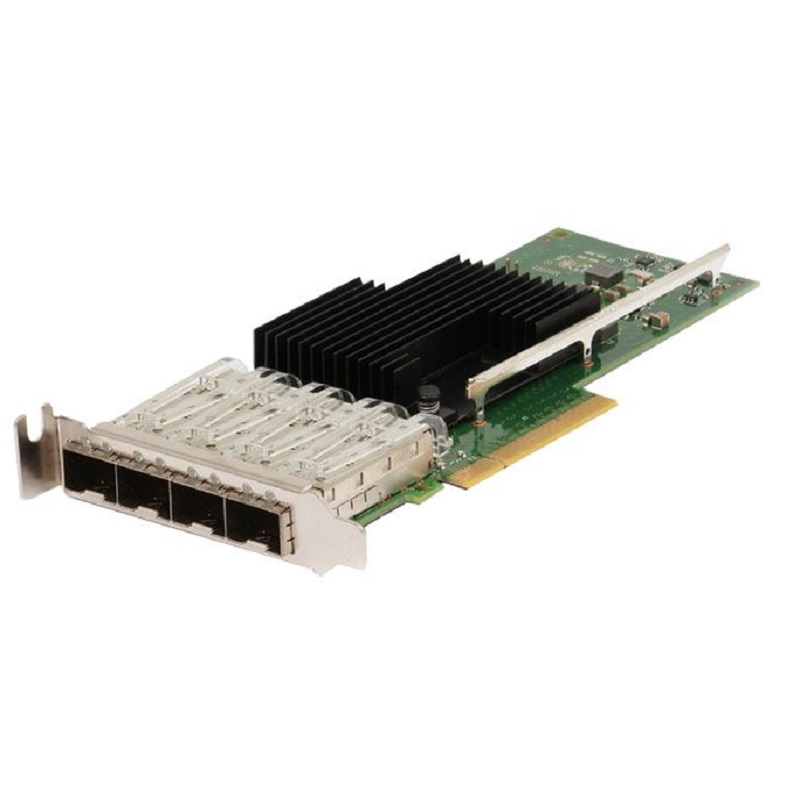
Intel X710DA4FH Quad Port 10 Gigabit Ethernet SFP+ PCI-Express Internal Converged Network Adapters. Excellent Refurbished with 1 year replacement warranty
| SKU/MPN | Warranty | Price | Condition | You save |
|---|---|---|---|---|
| X710DA4FH | 1 Year Warranty | $427.00 | New Sealed in Box (NIB) | You save: $149.45 (26%) |
| X710DA4FH | 1 Year Warranty | $228.00 | Excellent Refurbished | You save: $79.80 (26%) |
The Intel X710DA4FH is a high-performance quad-port 10 Gigabit Ethernet SFP+ network interface adapter designed for enterprise and data center environments requiring reliable, scalable, and high-throughput connectivity. Built on a PCI Express architecture, this internal converged network adapter delivers advanced networking acceleration, virtualization support, and efficient traffic management for demanding server workloads, cloud infrastructures, and storage networking applications.
The Intel X710DA4FH Quad Port 10 Gigabit Ethernet SFP+ PCI Express internal converged network adapter category represents a high performance networking class designed for enterprise servers, data centers, cloud infrastructures, virtualization environments, and high throughput storage networks. This category is built around advanced multi port 10 Gigabit Ethernet connectivity using SFP+ optical interfaces, enabling scalable bandwidth delivery, low latency packet processing, and reliable network convergence across compute and storage workloads. The architecture emphasizes hardware acceleration, efficient packet offloading, and optimized PCI Express integration to ensure stable performance under sustained heavy traffic conditions.
Within modern IT infrastructures, converged network adapters of this type are used to unify data, storage, and virtual machine traffic over a single high speed network interface. This reduces hardware complexity while improving overall throughput efficiency. The quad port design allows multiple independent network channels, enabling load balancing, redundancy configurations, and segmented traffic flows for mission critical workloads. Each port operates at 10 Gigabit per second capacity, supporting full duplex communication and ensuring consistent data transfer rates for demanding applications.
The PCI Express interface plays a central role in the performance characteristics of this adapter category. Designed for internal server installation, the card leverages high bandwidth PCI Express lanes to minimize bottlenecks between the network controller and system memory. This direct pathway allows rapid data exchange, reducing latency and improving overall packet processing efficiency. The adapter is engineered for compatibility with enterprise grade server motherboards that support modern PCI Express standards, ensuring stable integration across a wide range of hardware platforms.
System compatibility is a key consideration in this category, as these adapters are frequently deployed in rack mounted servers, blade systems, and virtualization hosts. The design supports multi operating system environments including enterprise Linux distributions, Windows Server platforms, and virtualization hypervisors. Driver optimization ensures that the network interface can be fully utilized under varying workloads, whether handling virtual machine migrations, distributed storage synchronization, or real time application traffic.
The SFP+ interface used in this category provides flexibility for network administrators by supporting a variety of optical transceivers and direct attach copper cables. This modular approach allows customization of network distance, speed optimization, and infrastructure design without replacing the entire adapter. Each of the four ports can be independently configured with compatible transceiver modules, enabling scalable network architecture that adapts to different deployment requirements.
In enterprise environments, SFP+ based connectivity is widely used for both short range and long range networking scenarios. Short range configurations typically utilize direct attach copper cables within data center racks, while long range configurations employ fiber optic transceivers for inter building or campus wide connectivity. This flexibility makes the adapter category suitable for distributed computing environments, cloud data centers, and high availability server clusters.
Converged networking is a fundamental concept in this adapter category, allowing multiple types of traffic to be processed through a unified network interface. This includes storage traffic, application data, virtual machine communication, and management traffic. By consolidating these workloads, organizations can reduce the number of physical network adapters required per server, thereby lowering operational complexity and improving infrastructure efficiency.
The Intel X710DA4FH class of adapters incorporates advanced offloading capabilities that shift processing tasks from the CPU to the network controller. This includes checksum offloading, segmentation offloading, and packet classification functions. These hardware assisted processes free up system resources, allowing server processors to focus on application workloads rather than network packet handling.
Virtualization environments benefit significantly from quad port 10 Gigabit Ethernet adapters due to their ability to handle multiple virtual network interfaces simultaneously. Each physical port can be partitioned into virtual functions, enabling dedicated bandwidth allocation for virtual machines. This improves network isolation, enhances security, and ensures predictable performance for each tenant in a virtualized infrastructure.
Support for advanced virtualization technologies allows the adapter category to integrate seamlessly with hypervisors, enabling efficient migration of virtual machines between hosts without network disruption. Live migration processes rely on stable high bandwidth connections, and the availability of multiple 10 Gigabit ports ensures that migration traffic does not interfere with production workloads.
This category of network adapters is frequently deployed in storage intensive environments where high throughput and low latency are critical. Applications such as network attached storage, storage area networks, and distributed storage clusters require consistent and reliable data transfer rates. The quad port design allows segmentation of storage traffic from application traffic, improving performance and reducing congestion.
In environments where data replication and backup operations are continuously running, the adapter ensures that large data sets can be transferred efficiently without affecting application responsiveness. The high bandwidth capacity of 10 Gigabit Ethernet per port supports rapid synchronization of storage nodes across geographically distributed data centers.
A defining characteristic of this adapter category is its reliance on hardware acceleration to improve packet processing efficiency. Instead of relying solely on the host CPU, the network controller manages critical networking functions internally. This includes interrupt moderation, traffic prioritization, and flow control mechanisms that enhance overall system performance.
By reducing CPU overhead, the adapter allows servers to handle higher workloads without requiring additional processing resources. This is particularly important in high density environments where multiple virtual machines or containerized applications operate simultaneously. Efficient packet handling ensures minimal latency even under peak network utilization.
The Intel X710DA4FH Quad Port 10 Gigabit Ethernet SFP+ adapter category is commonly deployed in enterprise data centers where scalability and reliability are essential. Typical deployment scenarios include cloud computing clusters, virtualization farms, database servers, high frequency trading systems, and large scale web hosting environments. Each scenario benefits from the adapter’s ability to deliver consistent high speed connectivity across multiple network paths.
Integration into existing infrastructure is streamlined through standardized PCI Express slots and widely supported driver ecosystems. Network administrators can deploy these adapters in both new and existing server environments without requiring major architectural changes. This makes them suitable for infrastructure upgrades where performance improvements are needed without complete system replacement.
Quad port configurations provide inherent advantages in redundancy and failover scenarios. If one network path experiences degradation or failure, traffic can be automatically rerouted through alternate ports. This ensures continuous network availability and minimizes downtime in critical systems. Load balancing across multiple ports allows traffic distribution based on application demand, improving overall throughput and reducing congestion.
In high availability environments, redundancy is a core requirement. This adapter category supports network teaming configurations where multiple ports function as a single logical interface. This enhances fault tolerance and ensures that network services remain operational even during hardware or link failures.
Certain enterprise applications require extremely low latency network communication. Financial trading systems, real time analytics platforms, and distributed computing workloads depend on rapid packet delivery with minimal delay. The architecture of this adapter category is optimized to reduce latency through efficient packet scheduling, direct memory access mechanisms, and streamlined interrupt handling.
By minimizing processing overhead and optimizing data flow paths, the adapter ensures that time sensitive applications can operate with high precision. This makes it suitable for environments where microsecond level performance differences can impact system outcomes.
Modern cloud and hybrid infrastructures demand highly scalable networking solutions capable of adapting to dynamic workloads. The quad port design of this adapter category supports horizontal scaling by allowing multiple network paths to be established between servers, switches, and storage systems. This facilitates efficient expansion of computing resources without network redesign.
Hybrid environments that combine on premise infrastructure with cloud services benefit from high speed interconnectivity provided by 10 Gigabit Ethernet interfaces. This enables seamless data synchronization and workload distribution across different environments.
Reliability is a core design principle in enterprise networking hardware. This adapter category is engineered to operate continuously under heavy workloads while maintaining stable performance. Components are selected for durability and long term operational stability, ensuring consistent performance over extended deployment cycles.
Extensive validation testing under real world conditions ensures that the adapter can withstand variable traffic patterns, environmental conditions, and system stress scenarios. This makes it suitable for deployment in critical infrastructure where downtime is not acceptable.


 Contact Us
 Information
 Catalog
 Solid State Drives (SSD)
 Network Switches
 Hard Disk Drives
 HBA & Controllers
 PC & Servers
 PC & Server Memory
 CPU & Processors
 Network Routers
 Power Supplies
 Tape Drives & Libraries
 Network Devices
 Computer & Network Cables