(7% discount is applied at checkout)
Cart is empty
Your go-to destination for cutting-edge server products
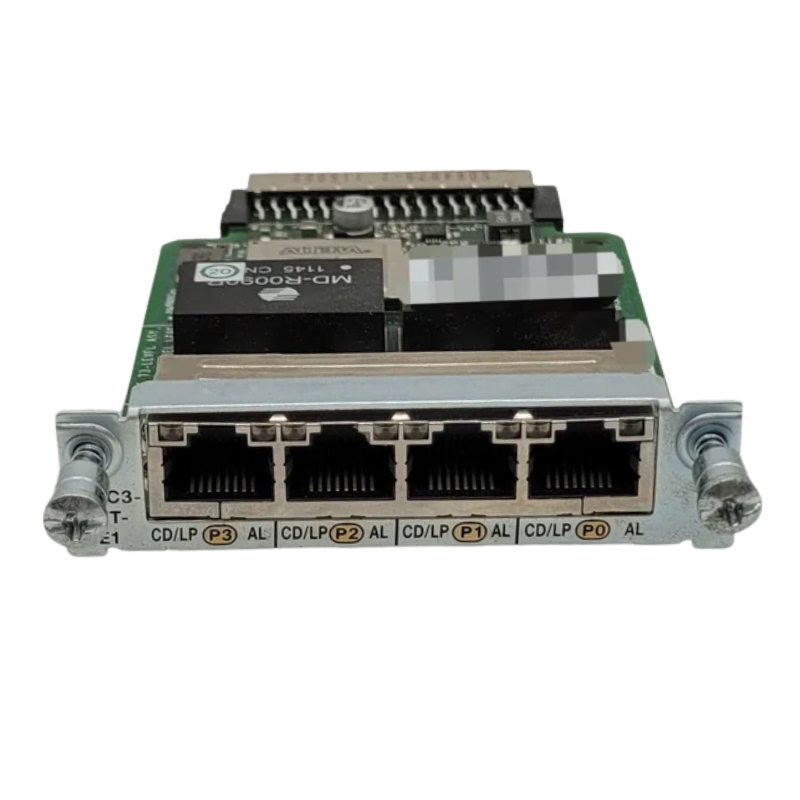


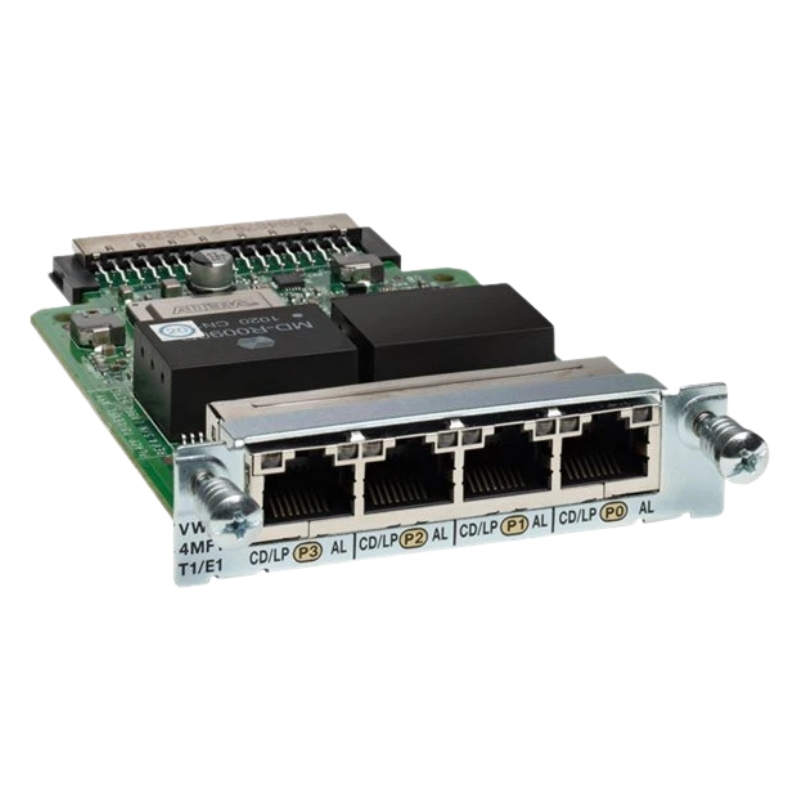
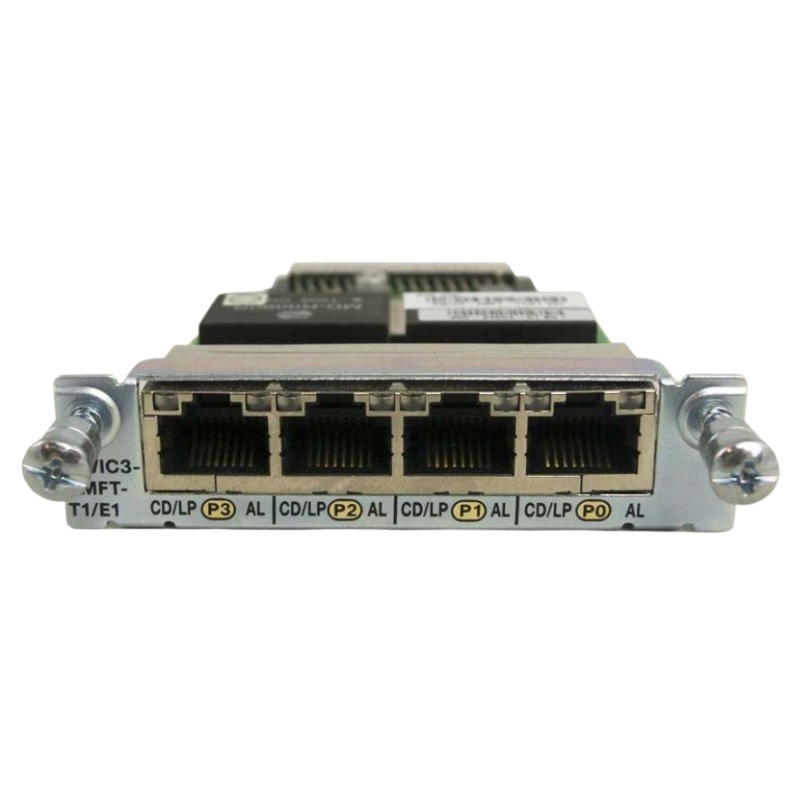
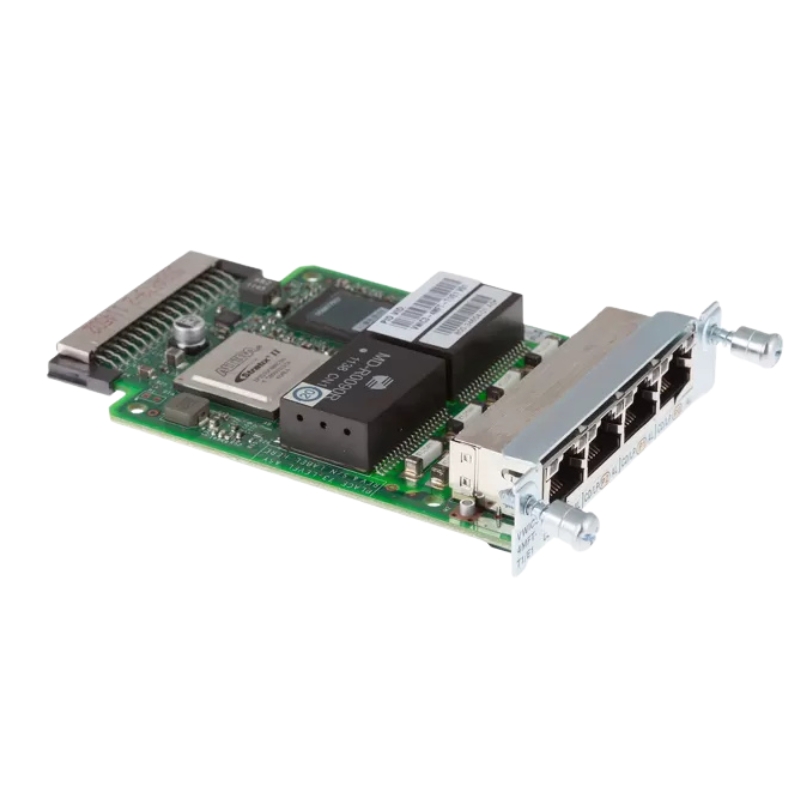
Cisco VWIC3-4MFT-T1/E1= 4 Ports Network Module WAN Interface Card 3rd Generation. Excellent Refurbished with 1 year replacement warranty
| SKU/MPN | Warranty | Price | Condition | You save |
|---|---|---|---|---|
| VWIC3-4MFT-T1/E1= | 1 Year Warranty | $50.00 | Excellent Refurbished | You save: $17.50 (26%) |
| VWIC3-4MFT-T1/E1= | 1 Year Warranty | $770.00 | Factory-Sealed New in Original Box (FSB) | You save: $269.50 (26%) |
The Cisco VWIC3-4MFT-T1/E1= is a third-generation 4-port Voice/WAN Interface Card engineered to expand the WAN connectivity capabilities of Cisco Integrated Services Routers (ISR). Designed for businesses that require dependable voice and data communications, this network module supports multiple T1 and E1 connections while delivering excellent flexibility for branch office and enterprise deployments.
The Cisco VWIC3-4MFT-T1/E1= is compatible with several Cisco Integrated Services Routers, making it a versatile upgrade option for enterprise environments.
This 4-port Voice/WAN Interface Card is well suited for organizations that require secure, stable, and high-performance WAN connectivity across distributed offices.
The Cisco VWIC3-4MFT-T1/E1= 4 Ports Network Module WAN Interface Card 3rd Generation is a high-performance WAN interface solution designed for enterprise-grade routers and integrated services environments. It is engineered to provide flexible connectivity for both T1 and E1 circuits, enabling organizations to scale voice, data, and integrated communications across distributed networks. As part of Cisco’s third-generation WAN interface card family, this module delivers enhanced density, improved performance, and better integration with modern converged network architectures.
The third-generation architecture of the VWIC3 series introduces optimized hardware acceleration, improved clocking mechanisms, and advanced signal processing capabilities. Unlike earlier WAN interface cards, the VWIC3-4MFT-T1/E1= is designed to support higher port density while maintaining low latency transmission. This enables enterprises to consolidate multiple WAN links into a single modular platform.
The card is designed to integrate seamlessly into Cisco ISR (Integrated Services Router) platforms. This modular approach allows network administrators to expand WAN connectivity without replacing entire router systems. The interface card fits into compatible network modules, enabling flexible deployment in branch offices, data centers, and enterprise edge environments.
The hardware design includes advanced line encoding support, jitter reduction mechanisms, and adaptive signal correction. These features ensure stable performance across long-distance T1 and E1 circuits, which are often prone to latency fluctuations and signal degradation.
T1 lines are primarily used in North America and Japan, offering 1.544 Mbps bandwidth divided into 24 channels. The VWIC3-4MFT-T1/E1= supports multiple T1 configurations, making it suitable for voice trunking, data transport, and hybrid deployments.
E1 lines, widely used in Europe, Asia, and other global regions, provide 2.048 Mbps bandwidth with 32 time slots. The module’s dual compatibility ensures global deployment flexibility, reducing the need for region-specific hardware.
The card supports multiple framing formats including SF, ESF for T1, and CRC4 for E1. It also supports AMI and B8ZS line coding schemes, ensuring compatibility with diverse telecom infrastructures.
This module provides four independent WAN ports, allowing simultaneous connection to multiple T1 or E1 circuits. This improves redundancy, load balancing, and network reliability in enterprise environments.
One of the key strengths of this WAN interface card is its ability to handle both voice and data traffic. It supports integrated voice trunking, making it ideal for legacy PBX integration and VoIP gateway configurations.
The module supports failover configurations, enabling automatic rerouting of traffic in case of link failure. This ensures uninterrupted business communication services.
Organizations can scale WAN capacity by adding additional VWIC3 modules to supported routers, eliminating the need for costly infrastructure overhauls.
The module is widely used in branch office deployments where reliable WAN connectivity is essential for accessing centralized applications, cloud services, and corporate data centers.
It plays a crucial role in VoIP deployments by providing stable digital trunking interfaces for IP-based voice systems. This ensures clear voice transmission and reduced jitter.
Many enterprises still rely on legacy PBX systems. The VWIC3-4MFT-T1/E1= allows seamless integration between traditional telephony systems and modern IP networks.
Service providers utilize this module to aggregate multiple customer circuits, enabling efficient bandwidth utilization and improved service delivery.
The VWIC3-4MFT-T1/E1= is designed for integration with Cisco ISR G2 and select ISR G3 routers. Compatibility varies depending on router model and installed network modules.
The module supports a wide range of WAN protocols including PPP, HDLC, Frame Relay, and ISDN PRI, ensuring integration with both modern and legacy networks.
Its compliance with global telecom standards ensures interoperability with most carrier-provided T1 and E1 circuits worldwide.
The module provides four RJ-48C interfaces for T1/E1 connectivity, supporting full-duplex digital transmission.
Each port supports up to 1.544 Mbps (T1) or 2.048 Mbps (E1), enabling aggregated bandwidth scaling across multiple circuits.
The card supports internal, line, and network timing modes to ensure accurate synchronization across WAN links.
Built-in error detection mechanisms such as CRC and parity checking improve transmission reliability and minimize packet loss.
The multi-port architecture reduces single points of failure and enhances network resilience through redundancy options.
Load balancing across multiple T1/E1 links improves bandwidth utilization and reduces congestion during peak traffic periods.
The hardware-based processing of the module ensures low latency transmission, which is essential for voice and real-time applications.
The VWIC3-4MFT-T1/E1= supports channel aggregation techniques that combine multiple physical links into logical high-bandwidth connections.
By optimizing packet flow and reducing overhead, the module enhances overall WAN efficiency and reduces operational costs.
Quality of Service policies can be applied to prioritize critical traffic such as voice and business applications over less time-sensitive data.
When used with Cisco IOS security features, the module supports encrypted tunneling and secure routing protocols.
Administrators can implement access control lists (ACLs) to regulate traffic flow and enhance network security.
The module provides real-time diagnostics to identify line faults, synchronization issues, and signal degradation.


 Contact Us
 Information
 Catalog
 Solid State Drives (SSD)
 Network Switches
 Hard Disk Drives
 HBA & Controllers
 PC & Servers
 PC & Server Memory
 CPU & Processors
 Network Routers
 Power Supplies
 Tape Drives & Libraries
 Network Devices
 Computer & Network Cables